Log24

Wednesday, April 29, 2020

Curtis at Pilsen, Thursday, July 5, 2018

Filed under: General — Tags: , , , , , — m759 @ 11:48 am

For an account by R. T. Curtis of how he discovered the Miracle Octad Generator,
see slides by Curtis, “Graphs and Groups,” from his talk on July 5, 2018, at the
Pilsen conference on algebraic graph theory, “Symmetry vs. Regularity: The first
50 years since Weisfeiler-Leman stabilization” (WL2018).

See also “Notes to Robert Curtis’s presentation at WL2018,” by R. T. Curtis.

Meanwhile, here  on July 5, 2018

Simultaneous perspective does not look upon language as a path because it is not the search for meaning that orients it. Poetry does not attempt to discover what there is at the end of the road; it conceives of the text as a series of transparent strata within which the various parts—the different verbal and semantic currents—produce momentary configurations as they intertwine or break apart, as they reflect each other or efface each other. Poetry contemplates itself, fuses with itself, and obliterates itself in the crystallizations of language. Apparitions, metamorphoses, volatilizations, precipitations of presences. These configurations are crystallized time: although they are perpetually in motion, they always point to the same hour—the hour of change. Each one of them contains all the others, each one is inside the others: change is only the oft-repeated and ever-different metaphor of identity.

— Paz, Octavio. The Monkey Grammarian
(Kindle Locations 1185-1191).
Arcade Publishing. Kindle Edition.

The 2018 Log24 post containing the above Paz quote goes on to quote
remarks by Lévi-Strauss. Paz’s phrase “series of transparent strata”
suggests a review of other remarks by Lévi-Strauss in the 2016 post
Key to  All Mythologies.

Saturday, September 22, 2018

Symmetric Generation, by Curtis

Filed under: G-Notes,General,Geometry — Tags: , — m759 @ 10:15 am

Norwegian artist Josefine Lyche —

Lyche's shirt honors the late Kurt Cobain.

"Here we are now, entertain us."

Friday, April 8, 2016

Ogdoads by Curtis

Filed under: General,Geometry — Tags: , , , , , — m759 @ 12:25 pm

As was previously noted here, the construction of the Miracle Octad Generator
of R. T. Curtis in 1974 may have involved his "folding" the 1×8 octads constructed
in 1967 by Turyn into 2×4 form.

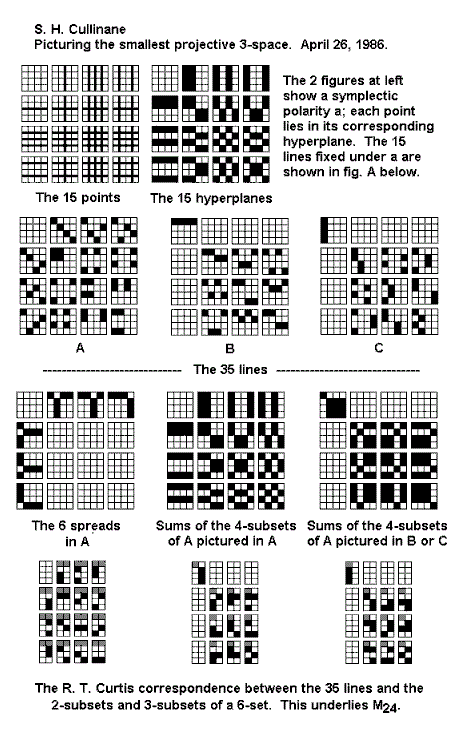
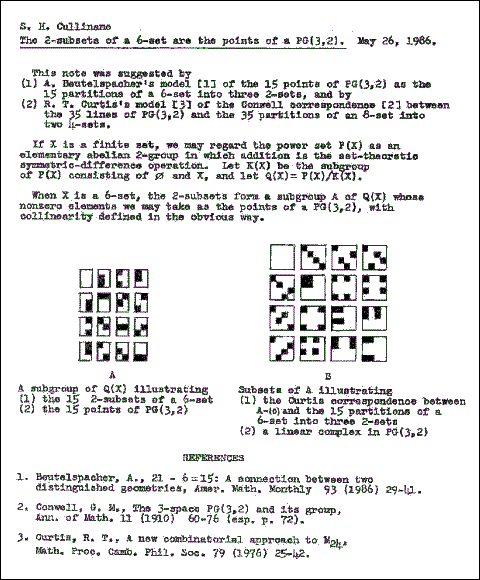
This results in a way of picturing a well-known correspondence (Conwell, 1910)
between partitions of an 8-set and lines of the projective 3-space PG(3,2).

For some background related to the "ogdoads" of the previous post, see
A Seventh Seal (Sept. 15, 2014).

Saturday, April 6, 2013

Pascal via Curtis

Filed under: General,Geometry — Tags: , , , — m759 @ 9:17 am

Click image for some background.

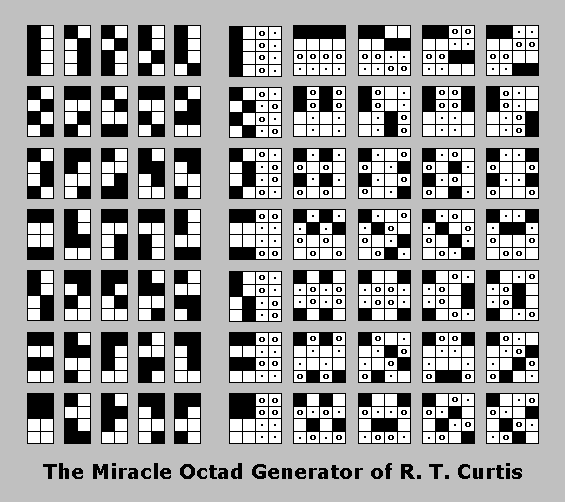
IMAGE- The Miracle Octad Generator (MOG) of R.T. Curtis

Shown above is a rearranged version of the
Miracle Octad Generator (MOG) of R. T. Curtis
("A new combinatorial approach to M24,"
Math. Proc. Camb. Phil. Soc., 79 (1976), 25-42.)

The 8-subcell rectangles in the left part of the figure may be
viewed as illustrating (if the top left subcell is disregarded)
the thirty-five 3-subsets of a 7-set.

Such a view relates, as the remarks below show, the
MOG's underlying Galois geometry, that of PG(3,2), to
the hexagrammum mysticum  of Pascal.

On Danzer's 354 Configuration:

IMAGE- Branko Grünbaum on Danzer's configuration
 

"Combinatorially, Danzer’s configuration can be interpreted
as defined by all 3-sets and all 4-sets that can be formed
by the elements of a 7-element set; each 'point' is represented
by one of the 3-sets, and it is incident with those lines
(represented by 4-sets) that contain the 3-set."

— Branko Grünbaum, "Musings on an Example of Danzer's,"
European Journal of Combinatorics , 29 (2008),
pp. 1910–1918 (online March 11, 2008)

"Danzer's configuration is deeply rooted in
Pascal's Hexagrammum Mysticum ."

— Marko Boben, Gábor Gévay, and Tomaž Pisanski,
"Danzer's Configuration Revisited," arXiv.org, Jan. 6, 2013

For an approach to such configurations that differs from
those of Grünbaum, Boben, Gévay, and Pisanski, see

Classical Geometry in Light of Galois Geometry.

Grünbaum has written little about Galois geometry.
Pisanski has recently touched on the subject;
see Configurations in this journal (Feb. 19, 2013).

Friday, May 8, 2026

Function Decomposition and the Klein Quadric

Filed under: General — Tags: — m759 @ 7:48 am

"Grid models" in finite geometry include the 4-row 2-column
"brick space" arrays of the R. T. Curtis Miracle Octad Generator.

The remarks below on grid models suggested this post's title,
"Function Decomposition and the Klein Quadric." The result of
applying the Cullinane decomposition theorem to the final 
remarks in Cameron's Parallelisms of Complete Designs

http://m759.net/wordpress/?s=Brick+Color+Monolith .

Connecting Diverse Mathematical Fields
The grid model acts as a unifying framework for several other abstract concepts:
  • The Klein Quadric: The correspondence extends to higher dimensions via the Klein correspondence. This maps the 35 lines of  PG(3,2) (the grid structures) to 35 points on the Klein quadric in a 5-dimensional projective space, PG(5,2). This connects the combinatorial partitions of the grid to the geometry of quadric surfaces.
  • Latin Squares: The model provides a geometric interpretation of combinatorial design. The concept of orthogonality between Latin squares corresponds to the geometric concept of skewness (non-intersecting lines) in PG(3,2).
  • Walsh Functions: The symmetries and binary additions inherent in the line diagrams reflect the structure of Walsh functions, which are orthogonal functions used in digital signal processing and discrete harmonic analysis.
  • Ring Theory: The patterns can be organized algebraically to form "diamond rings," which are isomorphic to rings of matrices over the field GF(4), linking the visual design to abstract algebra and function decomposition.
Summary
The 4×4 grid model acts as a "kaleidoscope" of mathematical structure. Just as a kaleidoscope rearranges simple elements into symmetric patterns, this grid rearranges simple binary tiles to reveal the invariant structures of finite geometries, sporadic groups, and error-correcting codes. It transforms what appears to be a simple problem of tiling into a visualization of the affine 4-space over GF(2)

Saturday, April 18, 2026

Hello Darkness

Filed under: General — Tags: — m759 @ 12:46 pm

Tuesday, April 14, 2026

Color Bodies

Filed under: General — Tags: , , — m759 @ 10:15 am

The above L2(23) is closely related to the "Seventh Seal" color bodies implied
by the conclusion of Cameron's classic Parallelisms of Complete Designs.

One such color body, from the set of 105 Klein quadric lines in brick space . . .

Monday, April 13, 2026

“Mathematics, Not Theology” —
The Geometry of the Miracle Octad Generator
by NotebookLM on April 13, 2026

Filed under: General — m759 @ 1:11 pm
 
The relationship between the Cullinane Diamond Theorem and R. T. Curtis's Miracle Octad Generator (MOG) represents a profound mathematical unification of visual patterns, finite geometry, and sporadic simple groups. The MOG is a combinatorial tool that utilizes a 4×6 array to study the Mathieu group M24, the Steiner system S(5,8,24), and the binary Golay code. The Diamond Theorem provides the geometric and algebraic foundation for the MOG through the following key connections:
 
1. Isomorphic Combinatorial Structures
 
The core connection is that the 35 distinct square patterns analyzed in the Diamond Theorem are fundamentally the same as the 35 square patterns utilized within the MOG. In both contexts, these patterns are visually and algebraically isomorphic to the 35 lines of the finite projective space PG(3,2). The same visual "line diagrams" that explain the symmetries of the Diamond Theorem's 4×4 figures identically explain the structural symmetries of Curtis's MOG patterns.
 
2. The Octad Stabilizer Subgroup of M24 

The transformation group G that scrambles the 4×4 array in the Diamond Theorem consists of 322,560 permutations and is isomorphic to the affine group AGL(4,2). Within the framework of the MOG, Curtis demonstrated that this exact symmetry group (which he denoted as 24.A8) functions as the octad stabilizer subgroup of the sporadic simple group M24. Thus, the group defining the symmetries of the 4×4 diamond configurations is mathematically identical to the subgroup that stabilizes an 8-element "octad" within the 24-point Steiner system S(5,8,24). 

3. The Conwell/Klein Correspondence 

The mathematical architecture bridging these concepts is the Klein correspondence (and Conwell's 1910 correspondence), which establishes a mapping between the 35 lines of PG(3,2) and the 35 ways to partition an 8-set into two 4-sets. The MOG physically illustrates this correspondence by pairing partitions of an 8-set (represented by a 4×2 array) with the 35 partitions of the 4×4 affine space. The Diamond Theorem translates these abstract combinatorial partitions into concrete symmetric properties governed by binary arithmetic (where components sum to zero via XOR). 

Ultimately, the Diamond Theorem serves as the geometric justification that explains why the 4×4 subarrays of the Miracle Octad Generator possess their highly structured symmetries, linking simple 2D tile arrangements to the complex algebra required for error-correcting codes and the construction of the Leech lattice.

Saturday, April 4, 2026

Geometry of the Diamond Theorem
and the Mathieu Group
by NotebookLM on April 4, 2026

Filed under: General — m759 @ 5:14 am
 

Based on the provided sources, the connection between the Cullinane Diamond Theorem and the Mathieu group M24 is established through group theory, finite geometry, and a combinatorial tool known as the Miracle Octad Generator (MOG).

1. Group Theoretic Connection:
    The Octad Stabilizer

The most direct link lies in the symmetry groups governing both structures.
  • The Diamond Theorem's Group (G): The theorem involves a group G of 322,560 permutations acting on a 4×4 grid of two-color tiles. This group is isomorphic to the affine group AGL(4,2), which consists of all invertible affine transformations on a 4-dimensional vector space over the field with two elements, GF(2).
  • The M24 Connection: This specific group, AGL(4,2), is identified as the octad stabilizer subgroup of the Mathieu group M24. In the context of the Steiner system S(5,8,24) preserved by M24, this subgroup fixes one "octad" (an 8-element set) and permutes the remaining 16 points according to the affine geometry of the 4×4 grid.
2. The Miracle Octad Generator (MOG)

The "Miracle Octad Generator," developed by R.T. Curtis to study M24 and the binary Golay code, serves as the bridge between the visual patterns of the Diamond Theorem and the abstract algebra of the Mathieu group.
  • Shared Structures: The Diamond Theorem identifies 35 distinct combinatorial structures (sets of line diagrams) arising from the permutations of the diamond figure. These structures are essentially the same as the 35 square patterns found within the MOG.
  • Geometric Construction: The MOG uses a 4×6 array, consisting of three 4×2 "bricks." Two of these bricks form a 4×4 square. The Diamond Theorem provides the geometric justification for the symmetries observed in this 4×4 part of the MOG, relating them to the 35 lines of the finite projective space PG(3,2).
  • Generating Octads: The MOG uses these patterns to construct the 759 octads of the Steiner system S(5,8,24), for which M24 is the automorphism group.
3. Geometric Unification

The connection is further unified by finite geometries that underlie both systems:
  • PG(3,2): The 35 lines of the projective space PG(3,2) correspond to the 35 structures in the Diamond Theorem and the MOG.
  • Klein Correspondence: The MOG and the Diamond Theorem structures are linked via the Klein correspondence, which maps the 35 lines of PG(3,2) to points on the Klein quadric in PG(5,2). This geometry is fundamental to understanding the maximal subgroups of M24.
In summary, the group that shuffles the Diamond Theorem's 4×4 tiles is physically the same mathematical object (up to isomorphism) as the subgroup of M24 that stabilizes an octad, and the visual patterns produced are the geometric building blocks of the Miracle Octad Generator used to construct M24.

Monday, March 23, 2026

Annals of Entertainment — Studio 54

Filed under: General — Tags: , — m759 @ 4:28 pm

Caveat:  The "masterclass" caption below
                     is  NOT  by Jamie Lee Curtis.

The video reposted by Curtis is of a performance at the Billboard Music Awards
on the 20th of May, 2018 — Eliza Doolittle Day. See as well remarks in this 
journal on that date. For a thoroughly fucked-up application of the I Ching in
music, see a Royal Holloway thesis that names my own name 19 times —

Sunday, March 22, 2026

Non-MOG Pattern Symmetry

Filed under: General — Tags: — m759 @ 8:36 am

The Miracle Octad Generator (MOG) of R. T. Curtis
greatly simplified the study of the 759 octads in the
Steiner system S(5, 8, 24).

The MOG arranges these octads very neatly in a 4×6 array
of square unit cells. There is, however, one aesthetic drawback
to the arrangement . . . It lacks symmetry under the natural
rotations and reflections of the entire 4×6 rectangular array.

A note of my own from 1981 may or may not lead eventually 
to a rearrangement of the 759 octads, each within a 4×6 array,
that does  have such overall symmetry under the symmetries
of a bare 4×6 rectangle . . . If, that is, such overall symmetry is
even possible, in light of purely group-theoretic considerations.

(Exercise: Would such symmetry imply the existence of a normal
subgroup in a group known to have no such subgroups?)

Previous posts in this journal have described approaches to the 
above symmetric-rearrangement problem . . . a problem that 
could be posed more generally, for binary patterns other than
those of the MOG.

Symmetric Generation of a Linear Code

The following Magma code shows that although the above space has
12 dimensions, it is NOT the Golay-code space.

// 260322 Magma Check March 22, 2026

> K := FiniteField(2);
> C := LinearCode<K, 24 |
> [0,0,0,0,0,1,0,1,0,0,1,1,1,0,0,1,0,1,1,1,0,1,1,1],
> [0,1,0,0,0,0,0,1,1,0,0,1,1,1,0,1,0,0,1,1,1,1,0,1],
> [0,1,1,0,1,0,0,0,1,0,0,0,1,1,1,1,1,0,1,0,1,1,0,0],
> [0,0,1,0,1,1,0,0,0,0,1,0,1,0,1,1,1,1,1,0,0,1,1,0],
> [1,0,0,0,0,0,1,1,0,0,1,0,1,0,1,0,0,1,1,1,1,0,1,1],
> [1,1,0,1,0,0,0,1,0,0,0,0,1,1,1,1,0,1,0,1,1,0,0,1],
> [0,1,0,1,1,0,0,0,0,1,0,0,0,1,1,1,1,1,0,0,1,1,0,1],
> [0,0,0,0,1,0,1,0,0,1,1,0,0,0,1,0,1,1,1,0,1,1,1,1],
> [1,0,1,1,0,0,1,1,1,1,1,0,0,0,1,0,0,0,0,1,1,0,1,0],
> [1,1,1,1,0,1,1,1,0,1,0,0,0,1,1,0,0,1,0,1,0,0,0,0],
> [1,1,0,1,1,1,1,0,0,1,0,1,0,1,0,0,1,1,0,0,0,0,0,1],
> [1,0,0,1,1,0,1,0,1,1,1,1,0,0,0,0,1,0,0,0,1,0,1,1],
> [0,0,1,1,0,1,0,1,1,1,1,1,0,0,0,1,0,0,0,1,0,1,1,0],
> [0,1,1,0,0,1,1,1,1,1,0,1,0,1,0,0,0,0,1,1,0,1,0,0],
> [1,1,1,0,1,1,1,0,1,0,0,1,1,1,0,0,1,0,1,0,0,0,0,0],
> [1,0,1,1,1,1,0,0,1,0,1,1,1,0,0,1,1,0,0,0,0,0,1,0],
> [1,0,0,1,0,1,0,0,0,0,0,1,1,1,0,1,1,1,0,1,0,0,1,1],
> [0,0,0,1,0,0,0,0,1,1,0,1,0,1,0,1,1,0,0,1,1,1,1,1],
> [0,0,1,0,0,0,1,0,1,1,0,0,0,1,1,0,1,0,1,1,1,1,1,0],
> [1,0,1,0,0,1,1,0,0,0,0,0,1,1,1,0,1,1,1,1,0,0,1,0],
> [0,1,0,0,1,1,1,1,0,1,1,1,0,0,0,0,0,1,1,0,0,1,0,1],
> [1,1,0,0,1,0,1,1,1,0,1,1,1,0,0,0,0,0,1,0,1,0,0,1],
> [1,1,1,1,1,0,0,1,1,0,1,0,1,0,1,1,0,0,0,0,1,0,0,0],
> [0,1,1,1,1,1,0,1,0,1,1,0,0,0,1,1,0,1,0,0,0,1,0,0],
//
// Bricks
> [1,1,0,0,0,0,1,1,0,0,0,0,1,1,0,0,0,0,1,1,0,0,0,0],
> [0,0,1,1,0,0,0,0,1,1,0,0,0,0,1,1,0,0,0,0,1,1,0,0],
> [0,0,0,0,1,1,0,0,0,0,1,1,0,0,0,0,1,1,0,0,0,0,1,1],
// Top and bottom halves
> [1,1,1,1,1,1,1,1,1,1,1,1,0,0,0,0,0,0,0,0,0,0,0,0],
> [0,0,0,0,0,0,0,0,0,0,0,0,1,1,1,1,1,1,1,1,1,1,1,1],
// Left and right halves
> [1,1,1,0,0,0,1,1,1,0,0,0,1,1,1,0,0,0,1,1,1,0,0,0],
> [0,0,0,1,1,1,0,0,0,1,1,1,0,0,0,1,1,1,0,0,0,1,1,1]>;
//
> Dimension(C);
> MinimumWeight(C);
> WeightDistribution(C);

12
4
[ <0, 1>, <4, 42>, <8, 591>, <12, 2828>,
<16, 591>, <20, 42>, <24, 1> ]

Here are some earlier Log24 images related to this topic.

Friday, February 27, 2026

The Lotus Rock

Filed under: General — Tags: , — m759 @ 8:40 am

"Derived Canons" —

For James Joyce, courtesy of Guillermo del Toro.

I prefer the flower window illustrated here 
on December 29, 2025 —

Related reading . . .

Monday, January 26, 2026

Twin Pillars

Filed under: General — Tags: , — m759 @ 9:59 am

The "Gray Lotus" octad within the Miracle Octad Generator
(MOG) framework of Robert T. Curtis might be called, for
fans of Freemasonry, The Twin Pillars.

Friday, January 16, 2026

From a Cartoon Graveyard

Filed under: General — Tags: — m759 @ 4:58 am

The date on a cartoon in the previous post — Sept. 19, 2019 —
suggests a review of the same date six years later . . .

See as well other posts now tagged Cullinane AI .

Related concept: "ghostly heptagons" —

Related art —

See this journal on the day of Becket (not Beckett), 2025.

Wednesday, January 14, 2026

Today Is World Logic Day 2026

Filed under: General — Tags: , — m759 @ 12:34 pm

"The date chosen to celebrate World Logic Day, 14 January, corresponds to
the date of death of Kurt Gödel and the date of birth of Alfred Tarski,.
two of the most prominent logicians of the twentieth century." — Wikipedia

Some "presentatonal symbols" — The Gray Lotus.

Diamond Theory
by NotebookLM

94 sources

The Cullinane diamond theorem establishes a profound link between visual 4×4 patterns and advanced mathematical structures such as finite geometry and group theory. By analyzing symmetry-preserving transformations within a group of 322,560 permutations, the research connects simple grid designs to the complex projective space PG(3,2). These geometric frameworks further extend into coding theory, illustrating how "diamond" rings are isomorphic to matrix algebras over the finite field GF(4). The sources also highlight the Miracle Octad Generator (MOG) and its relationship to the Mathieu group M24, which is essential for understanding error-correcting codes and sphere packings. Beyond pure mathematics, the text explores "brick space" and the Klein correspondence, suggesting that these abstract symmetries represent a "universal" order found in both art and nature. Ultimately, this body of work bridges the gap between ancient motifs and modern computational science through the elegant study of structural invariants.

 
Thursday, November 20, 2025

How are algebraic, combinatorial, and geometric structures unified within the Brick Space model?

The unification of algebraic, combinatorial, and geometric structures within the Brick Space model is achieved through its role as a graphic, isomorphic representation of key finite geometries, particularly the projective spaces PG(5,2) and PG(3,2), and their fundamental relationship via the Klein correspondence.

————————————————————————————.

The term "Brick Space" originates from the arrays, or "bricks," coined by R. T. Curtis as component parts of his Miracle Octad Generator (MOG)

. These physical or graphic arrangements serve as a concrete visualization (or model) of highly abstract mathematical structures.

1. Geometric Unification
The Brick Space model provides a geometric foundation for combinatorial objects through direct visualization of finite geometries defined over the two-element field, GF(2)
.
Modeling Projective Space: The Brick Space model is the natural geometric setting for the MOG's components, which may be regarded as forming both the 5-dimensional projective space and the 3-dimensional projective space
.
Visualizing PG(5,2) and the Klein Quadric: The model visually represents the space, which has 63 points, by partitioning these points into 28 points lying off the Klein quadric and 35 points lying on the Klein quadric

. The geometry of is linked to the concept of the 8-set

.
The Klein Correspondence: The geometric relationship between and is formalized by the Klein correspondence

. The model, developed as a brick space, is analogous to the "line diagrams" construction of found in the Cullinane diamond theorem

.
Lines and Points: The Brick Space implicitly models how the 35 lines of correspond to the 35 points on the Klein quadric in
.
2. Combinatorial Unification
Combinatorial structures, primarily partitions of sets and block designs, are mapped directly onto geometric entities within the Brick Space framework
.
Partitions and Lines: The central combinatorial equivalence involves mapping partitions of sets to geometric objects

. The 35 combinatorial structures arising from permutations of diamond tiles (related to the bricks) are isomorphic to the 35 lines of . These 35 structures also mirror the 35 square patterns within the original MOG

.
Partitions of the 8-Set: The lines correspond to the 35 partitions of an 8-set into two 4-sets

. This same framework connects to the 105 partitions of an 8-set into four 2-sets, which are essentially the same as the 105 lines contained in the Klein quadric

.
Latin Squares: The combinatorial property of orthogonality of Latin squares (specifically, order-4 Latin squares) is unified geometrically by corresponding exactly to the property of skewness of lines (non-intersecting lines) in

. This provides a geometric dictionary for abstract algebraic combinatorics

.
3. Algebraic Unification
Algebraic structures, rooted in finite field theory and group theory, govern the behavior and symmetries observed in the combinatorial and geometric models
.
Binary Field : The foundation of the geometry is the Galois field of two elements, (binary arithmetic: )

. The algebraic rules of dictate the structure of the affine and projective spaces represented by the bricks

.
Binary Addition (XOR): The line diagrams used to formalize the patterns (related to the bricks) can be "added" via component-wise binary addition (XOR)

. The closure property of lines in is represented algebraically by the fact that the three line diagrams corresponding to a pattern always sum to zero ()

.
Group Theory and Symmetry: The massive permutation group (of order 322,560) that transforms the visual patterns is isomorphic to the affine group

. This group, which explains the pervasive symmetry found in all -images, is the automorphism group of the underlying finite geometry, establishing the algebraic control over the system's geometric and combinatorial properties

.
Ring Theory: The patterns can be endowed with algebraic structure to generate an ideal within a ring of symmetric patterns, leading to an infinite family of "diamond rings" isomorphic to rings of matrices over

. This links the geometry to the machinery of abstract algebra

.
M24 Connection: The affine group is identified as the octad stabilizer subgroup of the Mathieu group

, linking the visual patterns and the underlying geometries to the abstract world of sporadic simple groups, coding theory (Golay code), and lattice theory (Leech lattice)

.
The Brick Space model, therefore, functions as a visual tapestry where graphic arrangements (geometry/visualization) encode set partitions (combinatorics) that behave according to the rules of binary algebra ( and affine groups)

. The entire structure is unified by powerful isomorphisms relating these three mathematical domains through finite geometries like and

Sunday, January 11, 2026

History as It Is Writ

Filed under: General — Tags: , , , , — m759 @ 10:48 pm

For James Joyce, courtesy of Guillermo del Toro.

I prefer the flower window illustrated here 
on December 29, 2025 —

Monday, December 29, 2025

Octad Art — Bricks, Cubes, Flowers

For the bricks of the title, see other posts tagged Brick Space
For some cubes* and flowers, see below.

Combining features of the above two images, one might picture the 24
cells of the 4×6 array underlying the Curtis Miracle Octad Generator
(MOG) as each containing an eightfold cube, pictured as above with seven
of its subcubes showing and an eighth subcube hidden behind them.

The seven visible subcubes may be colored, as in the Curtis image of
the Klein map, with seven distinct colors… corresponding to the seven
edge-colors used in the Curtis-Klein map. Each of the seven visible
subcubes in a cell may also be labeled, on its visible faces, with a symbol
denoting one of the 24 points of the projective line over GF(23), just as the
faces in the Curtis-Klein map are labeled.  The hidden subcube in each cell
may be regarded as also so labeled, by the MOG label of the cell's position.

There is then enough information in the array's eightfold cubes' colors and
labels to construct the seven generating permutations of M24 described by
Curtis, and the 24 array cells may be regarded as now containing 24 distinct
entities — which perhaps might be called "octoids."

Those desiring a more decorative approach may replace the 24 labeled cubes
with 24 labeled "flowers." Each flower — like the map's symmetric seven
"petals" and the central "infinity heptagon" they surround — forms an octad.

Related Illustrations . . .

* See as well posts tagged Mathieu Cube . . .

Related material — 

The 56 triangles of  the eightfold cube . . .

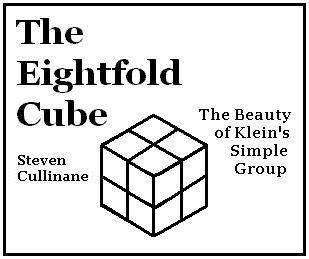
The Eightfold Cube: The Beauty of Klein's Simple Group

   Image from Christmas Day 2005.

Post last revised:  December 30, 2025 @ 21:30 E.S.T.

Friday, December 26, 2025

After Hirzebruch

Filed under: General — Tags: , , — m759 @ 11:35 am

For some context, see the parent webpage https://box759.wordpress.com/.

Thursday, December 4, 2025

Today’s NotebookLM “Diamond Theory” Summary

Filed under: General — Tags: , — m759 @ 8:13 am
 

Diamond Theory by NotebookLM

92 sources

The documents provide a comprehensive overview of advanced abstract algebra and combinatorics, centered on the finite projective space PG(3,2), which models the geometry of the 6-set. A primary focus is the Diamond Theorem, which uses the symmetries of 4×4 array patterns to establish deep connections between the visual arts, group theory, and geometry. The vast transformation set known as the Affine Group AGL(4,2), possessing an order of 322,560, is shown to preserve the structural relations of these arrays, which in turn are linked to the properties of lines and planes in PG(3,2). These geometric and combinatorial linkages are essential for understanding the Miracle Octad Generator (MOG) of R. T. Curtis and its relationship to the sporadic simple group Mathieu group M24. Additionally, the sources examine complex geometric partitions, such as Conwell’s Heptads and isotropic spreads within spaces like PG(5,2), demonstrating how group actions classify these objects and relate to applications in error-correcting codes. Ultimately, this body of work illustrates a powerful mathematical unity, presenting geometry, algebra, and combinatorics as tightly interwoven disciplines.

Thursday, November 20, 2025

On Brick Space

Filed under: General — Tags: , — m759 @ 6:24 pm

A question suggested by NotebookLM in the "Diamond Theory" notebook,
and its answer today by NotebookLM —

How are algebraic, combinatorial, and geometric structures unified within the Brick Space model?

The unification of algebraic, combinatorial, and geometric structures within the Brick Space model is achieved through its role as a graphic, isomorphic representation of key finite geometries, particularly the projective spaces PG(5,2) and PG(3,2), and their fundamental relationship via the Klein correspondence

.
The term "Brick Space" originates from the arrays, or "bricks," coined by R. T. Curtis as component parts of his Miracle Octad Generator (MOG)

. These physical or graphic arrangements serve as a concrete visualization (or model) of highly abstract mathematical structures

.
1. Geometric Unification
The Brick Space model provides a geometric foundation for combinatorial objects through direct visualization of finite geometries defined over the two-element field, GF(2)
.
Modeling Projective Space: The Brick Space model is the natural geometric setting for the MOG's components, which may be regarded as forming both the 5-dimensional projective space and the 3-dimensional projective space
.
Visualizing PG(5,2) and the Klein Quadric: The model visually represents the space, which has 63 points, by partitioning these points into 28 points lying off the Klein quadric and 35 points lying on the Klein quadric

. The geometry of is linked to the concept of the 8-set

.
The Klein Correspondence: The geometric relationship between and is formalized by the Klein correspondence

. The model, developed as a brick space, is analogous to the "line diagrams" construction of found in the Cullinane diamond theorem

.
Lines and Points: The Brick Space implicitly models how the 35 lines of correspond to the 35 points on the Klein quadric in
.
2. Combinatorial Unification
Combinatorial structures, primarily partitions of sets and block designs, are mapped directly onto geometric entities within the Brick Space framework
.
Partitions and Lines: The central combinatorial equivalence involves mapping partitions of sets to geometric objects

. The 35 combinatorial structures arising from permutations of diamond tiles (related to the bricks) are isomorphic to the 35 lines of . These 35 structures also mirror the 35 square patterns within the original MOG

.
Partitions of the 8-Set: The lines correspond to the 35 partitions of an 8-set into two 4-sets

. This same framework connects to the 105 partitions of an 8-set into four 2-sets, which are essentially the same as the 105 lines contained in the Klein quadric

.
Latin Squares: The combinatorial property of orthogonality of Latin squares (specifically, order-4 Latin squares) is unified geometrically by corresponding exactly to the property of skewness of lines (non-intersecting lines) in

. This provides a geometric dictionary for abstract algebraic combinatorics

.
3. Algebraic Unification
Algebraic structures, rooted in finite field theory and group theory, govern the behavior and symmetries observed in the combinatorial and geometric models
.
Binary Field : The foundation of the geometry is the Galois field of two elements, (binary arithmetic: )

. The algebraic rules of dictate the structure of the affine and projective spaces represented by the bricks

.
Binary Addition (XOR): The line diagrams used to formalize the patterns (related to the bricks) can be "added" via component-wise binary addition (XOR)

. The closure property of lines in is represented algebraically by the fact that the three line diagrams corresponding to a pattern always sum to zero ()

.
Group Theory and Symmetry: The massive permutation group (of order 322,560) that transforms the visual patterns is isomorphic to the affine group

. This group, which explains the pervasive symmetry found in all -images, is the automorphism group of the underlying finite geometry, establishing the algebraic control over the system's geometric and combinatorial properties

.
Ring Theory: The patterns can be endowed with algebraic structure to generate an ideal within a ring of symmetric patterns, leading to an infinite family of "diamond rings" isomorphic to rings of matrices over

. This links the geometry to the machinery of abstract algebra

.
M24 Connection: The affine group is identified as the octad stabilizer subgroup of the Mathieu group

, linking the visual patterns and the underlying geometries to the abstract world of sporadic simple groups, coding theory (Golay code), and lattice theory (Leech lattice)

.
The Brick Space model, therefore, functions as a visual tapestry where graphic arrangements (geometry/visualization) encode set partitions (combinatorics) that behave according to the rules of binary algebra ( and affine groups)

. The entire structure is unified by powerful isomorphisms relating these three mathematical domains through finite geometries like and .

Friday, November 14, 2025

A Moduli Space

Filed under: General — Tags: , , , — m759 @ 9:52 pm

On the Miracle Octad Generator  of R. T. Curtis

December 2025 Notices of the American Mathematical Society

Jarod Alper, "Evolution of Stacks and Moduli" —

"By a moduli space, we mean a geometric space whose points are in 'natural' bijection (more on what we mean by 'natural' in a moment) with isomorphism classes of your favorite mathematical objects, for example, Riemann surfaces or vector bundles on a fixed space. A moduli space is a solution to the classification problem: it packages all of the data of the geometric objects into a single space, a mathematical catalogue where any object can be located by selecting the corresponding point."

Analogous notions:  
Klein Space and Klein Quadric in this  journal.

The Source:

Related art from a Log24 post of July 1, 2018 —

Deutsche Ordnung —

Greg Egan’s animated image of the Klein quartic

Wednesday, October 15, 2025

Sextet Space

Filed under: General — Tags: , — m759 @ 4:46 pm

“Perhaps the philosophically most relevant feature of modern science
is the emergence of abstract symbolic structures as the hard core
of objectivity behind— as Eddington puts it— the colorful tale of
the subjective storyteller mind.”

— Hermann Weyl, Philosophy of  Mathematics and
    Natural Science 
, Princeton, 1949, p. 237

Melissa C. Wong, illustration for "Atlas to the Text,"
by Nicholas T. Rinehart:

The above fanciful illustration pictures 6*9=54 colored squares on the six 
faces of a 3x3x3 cube.

Compare and contrast the Aitchison  labeling, not unlike the one above,
of 6*4=24 unit squares (or, equivalently, 24 pips  at the squares' centers)
on a 2x2x2 cube.

Now consider how the 8-square "brick" of R. T. Curtis may be colored with
four colors using the 105 ways to partition its eight squares into four 2-sets.

By analogy, the 24  squares on a cube's  surface, as above, afford a cubical
space for applying six  colors to the sextet  partitions (into six 4-sets) of Curtis's
Miracle Octad Generator (MOG), using Aitchson's cubical model (with, of course,
the parts to be moved being pips or squares rather than cuboctahedron edges). 

The 4-coloring of Curtis bricks is useful in picturing the Klein correspondence.
Are there similar uses of  cube  6-colorings? Or 4-colorings? (Group actions on
a 6-set are of considerable combinatorial and algebraic interest because of
the exceptional outer automorphism of S6.)

For a colored presentation of sextet space modeled with a rectangle,
as in the Curtis MOG, see . . .

https://xenon.stanford.edu/~hwatheod/mog/mog.html .

Sunday, September 28, 2025

For Day 28 of September 2025: Fundamental Structures

Filed under: General — Tags: , , , , — m759 @ 3:59 am

http://m759.net/wordpress/?s="Ron+Shaw"

The Klein quadric as background for
the Miracle Octad Generator of R. T. Curtis —

The Klein quadric, PG(5,2), and the 'bricks' of the Miracle Octad Generator

Friday, September 26, 2025

Singage

Filed under: General — m759 @ 10:19 am

♫  "I need a photo opportunity
      I want a shot at redemption"

—  Paul Simon

Sunday, August 24, 2025

For Red One

Filed under: General — Tags: , , , , — m759 @ 8:07 am

Also on November 11, 2005, a figure from this  journal —

Students of myth may regard this hexagonal figure as a
snowflake . . . or, with a seventh dot added at the center,
a cube. For a religious interpretation of the snowflake,
see Thomas Mann's novel The Magic Mountain. For a
more secular, but still miraculous, interpretation of the
cube, see the oeuvre  of R. T. Curtis . . . and Octad Space

"Before time began . . . ." — Optimus Prime

Sunday, August 10, 2025

Cullinane Diamond Theorem:
Microsoft Copilot Deep Research Report, Aug. 10, 2025

Filed under: General — Tags: — m759 @ 6:17 am

HTML version — 

The Copilot "Deep Research" Report on the Cullinane Diamond Theorem … Aug. 10, 2025

The Cullinane Diamond Theorem: Definition, Significance, and Applications


Introduction

Mathematics often reveals profound connections between apparently simple patterns and deep, abstract structures. The Cullinane diamond theorem is a modern example of this phenomenon, residing at the confluence of finite geometry, combinatorial design, matrix theory, group theory, and visual art. While the theorem originated in investigations of symmetric patterns seen in quilt designs and graphic art, it has become increasingly influential in mathematics, especially for its connections to finite projective geometry, automorphism groups, and combinatorics. This report provides an extensive analysis of the theorem, covering its definition, historical origins, formal statement and proof, foundational geometry, group-theoretic underpinnings, far-reaching applications, and visual as well as computational implications.


1. Definition of the Cullinane Diamond Theorem

The Cullinane diamond theorem describes the symmetry properties of a specific set of two-color patterns arranged in a 4×4 square and reveals their deep connection to the finite geometry of projective 3-space over the field with two elements, PG(3,2).

1.1 The 4×4 Diamond Figure and Permutations

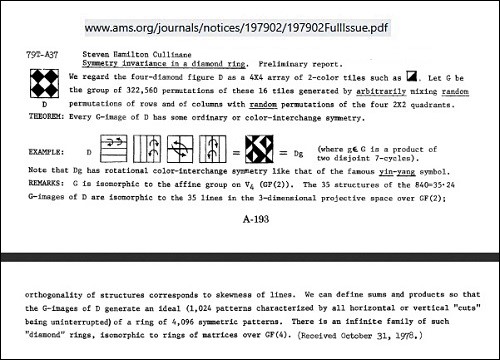
To frame the theorem, start with a 4×4 array of tiles, each diagonally split into two colors (say, black and white). This array, considered as a "four-diamond figure" (denoted D), is subjected to a group of 322,560 permutations (G) constructed by taking all possible compositions of permutations of the rows, columns, and four 2×2 quadrants. Each resulting pattern is termed a G-image of D.

The action of the group G generates a vast family of distinct two-color square patterns from the initial diamond configuration. However, and this is the heart of the theorem, every G-image of D has a symmetry—either ordinary (geometric) or color-interchange. In other words, despite the apparent randomness of the process, all resulting patterns retain some structured symmetry.

1.2 Formal Statement

Theorem (Cullinane Diamond Theorem):
Let D be a 4×4 array of two-color diagonally-divided square tiles. Let G be the group of all permutations formed by arbitrary permutations of rows, columns, and quadrants.
Then every G-image of D exhibits some ordinary or color-interchange symmetry. Moreover, the 35 combinatorial structures arising among the 840 (i.e., 35 × 24) G-images of D are isomorphic to the 35 lines (i.e., 3-element sets) of the projective space PG(3,2) over the field of two elements. The symmetries of these patterns are fully explained by the automorphism group of this finite geometry, and these symmetries can be interpreted in terms of affine groups, binary addition, and ring theory.

1.3 Line Diagrams and Binary Addition

A crucial formalization is via line diagrams, which decompose the 4×4 pattern into a set of 3 line diagrams, each corresponding to a distinct partition of the four tiles involved in the original diamond. The lines of these diagrams can be added using "binary addition" (i.e., XOR). The set of all such line diagrams constitutes a visual encoding of the points and lines in PG(3,2).


2. Historical Development and Origins

The Cullinane diamond theorem, as published by Steven H. Cullinane in the late 1970s, was motivated by observations of surprising symmetries in traditional quilt and graphic patterns—designs that, although ancient in their origin, presented mathematical relationships revealed only with the later development of finite geometry and group theory.

Cullinane's work was directly influenced by earlier mathematical tools used to classify and analyze the symmetries in complex combinatorial and geometric objects. Notably, the Miracle Octad Generator (MOG) introduced by R. T. Curtis to study the Mathieu group M24 and related objects, played a prominent role as both inspiration and context.

The development of the theorem thus sits at an intersection: ancient visual motifs became a gateway into exploring profound connections with contemporary group theory, combinatorics, and coding theory.


3. Finite Projective Geometry Background

An understanding of the Cullinane diamond theorem requires some familiarity with the essentials of finite geometry, particularly the projective space PG(3,2).

3.1 Definitions and Basic Properties

Projective geometry over a finite field GF(q) generalizes the familiar concept of projective space in classical geometry, but within a finite framework. Specifically, for the projective space PG(n,q):

  • The points are equivalence classes of non-zero vectors in a (n+1)-dimensional vector space over GF(q), up to scalar multiplication.
  • Lines are sets of points corresponding to 2-dimensional subspaces.
  • Planes are 3-dimensional subspaces, and so on.

For PG(3,2) (the projective 3-space over GF(2)):

  • There are 15 points, 35 lines, and 15 planes.
  • Each line contains 3 points; each plane contains 7 points; and these incident relationships exhibit a high degree of symmetry.
  • Automorphism groups (symmetry groups) are large; for PG(3,2), the automorphism group has order 20,160.

3.2 Visual Representations

Cullinane's insight was to map the elements of PG(3,2) onto graphic arrangements, particularly line diagrams in 4×4 arrays. This visualization reveals symmetrical relationships and algebraic properties (like binary addition) in a concrete and intuitive way.


4. Affine Group Structure and Automorphism Groups

One of the foundational results in the diamond theorem is that the permutation group G of the 4×4 diamond configurations is, in fact, isomorphic to the affine group AGL(4,2)—the group of all invertible affine transformations on 4-dimensional vector space over GF(2).

4.1 The Affine Group AGL(4,2)

  • The affine group AGL(4,2) consists of all functions of the form ( v \mapsto Av + b ) where:

    • (A) is an invertible 4×4 matrix over GF(2), and
    • (b) is a vector in GF(2)^4.
       
  • The order of AGL(4,2) is 322,560, matching the number of symmetry-preserving permutations in G.

These automorphism groups—sets of all invertible structure-preserving transformations—explain how seemingly disparate patterns are interrelated and how symmetry is preserved under allowed operations. In mathematical terms, the group-theoretic analysis links the visual and combinatorial structure of the 4×4 arrays to the highly symmetric structure of PG(3,2) and, by extension, to structures like the Steiner system S(5,8,24) and the Mathieu group M24.


5. Miracle Octad Generator and Connections to Sporadic Groups

5.1 The Miracle Octad Generator (MOG)

The MOG is a combinatorial diagram introduced by R. T. Curtis to study the largest Mathieu group, M24, which is a sporadic simple group and, notably, the automorphism group of the S(5,8,24) Steiner system.

  • The MOG arranges 24 elements or points (e.g., in the context of the binary Golay code or subsets of 24) in a 4×6 array.
  • The 35 square patterns defined within the MOG correspond to partitions of the 8-set into two 4-sets, linking directly with the 35 lines of PG(3,2).
  • According to Curtis, the symmetries of the MOG correspond exactly to the octad stabilizer subgroup within the Mathieu group M24.

Cullinane's theorem establishes that the same group-theoretic and geometric structures underlie both his "diamond figures" and these squares in the MOG.

5.2 Mathieu Group M24 and Wider Context

M24 is one of the 26 sporadic simple groups—mathematical structures that sit outside the infinite families of simple groups and exhibit highly exceptional symmetries. Its connections with combinatorics, geometry, and coding theory are multiple:

  • It acts as the automorphism group for the binary Golay code.
  • It stabilizes "octads" in the MOG, relating to the unique S(5,8,24) Steiner system.
  • Its action on combinatorial and geometric structures leads to dense sphere packings, as in the Leech lattice.

Cullinane's analysis situates his theorem as a bridge between accessible geometric patterns and the abstract world of sporadic group symmetries.


6. Line Diagrams, Binary Addition, and Orthogonality

6.1 Line Diagrams and Point-Line Incidence

The "three-set" of line diagrams mentioned in the diamond theorem refers to the fact that, for each 4-tile subset defining a pattern, there are three natural partitions into two 2-sets. These correspond, in the geometry of PG(3,2), to the 35 lines (each with three points) among the 15 points.

Line diagrams can be "added" via component-wise binary addition (in practice, XOR of the diagrams), respecting the arithmetic of GF(2). Each three-set of line diagrams sums to zero, reflecting deep structure:

  • If D1, D2, D3 are the three line diagrams in a set, then ( D1 \oplus D2 \oplus D3 = 0 ).
  • This mirrors the closure property of lines in finite projective geometry.

6.2 Orthogonality and Skew Lines

One of the finer points of the theorem is the relationship between orthogonality of Latin squares and skewness of lines in PG(3,2).

  • In combinatorial design, two Latin squares are orthogonal if, when superimposed, every ordered pair of symbols appears exactly once.
  • In the finite geometry PG(3,2), two lines are skew if they do not intersect.
  • Cullinane demonstrates that these two notions correspond: the combinatorial orthogonality of square patterns reflects geometric skewness of lines, providing a dictionary between abstract algebraic combinatorics and finite geometry.

7. Infinite Family of Diamond Rings and Ring Theory

The diamond theorem admits natural algebraic generalizations:

  • The set of G-images can be endowed with additive and multiplicative structures analogous to those in ring theory.
  • Specifically, the G-images of D (the 4×4 square patterns) generate an ideal of 1024 patterns (characterized by all horizontal or vertical cuts being uninterrupted) within a ring of 4096 symmetric patterns.
  • More generally, there is an infinite family of such "diamond" rings—structures isomorphic to rings of matrices over GF(4).

This identification links the geometric insight of the theorem to the algebraic machinery of rings and modules and allows for exploration of function decomposition over finite fields.


8. Applications and Implications

The ramifications of the Cullinane diamond theorem are wide-ranging. Below, we discuss its major areas of impact, supported by examples and analyses.


8.1 Applications to the Leech Lattice and Sphere Packings

The Leech lattice is one of the most extraordinary structures in mathematics, providing the densest sphere packing in 24 dimensions and featuring vast symmetry groups—including the Conway groups, which are closely related to M24. The connection between the Cullinane diamond theorem and the Leech lattice is via the Miracle Octad Generator and the associated binary Golay code:

  • The 35 square patterns arising in both the diamond theorem and the MOG are intimately related to the 35 lines of PG(3,2), which themselves participate in the construction of the binary Golay code.
  • The structures and automorphism groups highlighted by the diamond theorem thus feed directly into the symmetrical arrangements needed for the Leech lattice and its applications in coding theory and geometry.

8.2 Graphic Designs and Quilt Symmetry

One of the original motivations for the theorem was the unexpected mathematical depth underlying "folk" and traditional quilt patterns:

  • Many classic quilt blocks and graphic designs exhibit symmetries captured by the 4×4 arrangements considered in the theorem.
  • The theorem explains why certain diamond-shaped and square motifs exhibit pervasive symmetry, and why their transformations yield only a finite set of structurally distinct types.

Quilt design thus becomes a real-world laboratory for finite geometry, group action, and combinatorics, bringing mathematical elegance into the world of visual and textile art.


8.3 Walsh Functions, Symmetry, and Discrete Harmonic Analysis

The Walsh functions form a complete orthogonal system used in digital signal processing. Symmetry considerations in their construction and in the formation of Hadamard matrices are reflected in the combinatorial and binary structures underlying the diamond theorem.

  • The arrangement and addition of line diagrams via binary XOR echoes the production of Walsh functions from elementary Rademacher functions.
  • This supports the use of the theorem’s combinatorial frameworks in discrete harmonic analysis, coding, and signal design.

8.4 Latin-Square Orthogonality and Experimental Design

As previously discussed, the maps between mutual orthogonality of Latin squares and skewness of lines in PG(3,2) open new perspectives on the design of experiments:

  • Mutually orthogonal Latin squares (MOLS) are a cornerstone of statistical design, providing structure for multifactorial experiments with balanced representation.
  • The theorem’s framework supplies both direct constructions for such squares and geometric insight into their symmetry and relations.

8.5 Connections with the Sporadic Simple Groups and M24

Perhaps the deepest mathematical connection is to the Mathieu group M24, one of the largest sporadic simple groups, which stands at the crossroad of combinatorics, geometry, and algebra:

  • The symmetries underlying the diamond theorem, when viewed through the lens of the Miracle Octad Generator, mirror the stabilizer subgroups in M24.
  • The transformation group G of the theorem is, in Curtis’s notation, isomorphic to 2⁴.A₈, the octad stabilizer in M24, and this exact symmetry appears in error-correcting codes, lattice theory, and group theory.

8.6 Computational Visualizations and Interactive Puzzles

The explicit geometric and combinatorial nature of the theorem makes it ideal for visual and interactive exploration, and several puzzles, games, and computational models have been developed for educational and analytical purposes:

  • The "Diamond 16 Puzzle" allows users to manipulate the 4×4 arrays generated by G, exploring their symmetries and combinatorial properties in real time.
  • Such interactive tools provide both pedagogical value in teaching symmetry and combinatorics, and research value in testing hypotheses about transformations and structures.

8.7 Broader Mathematical Impact: Ring Theory, Function Decomposition, and Block Designs

The diamond theorem's reach extends to other key areas:

  • In ring theory, the diamond rings generated as ideals of patterns illustrate new classes of commutative and non-commutative rings, with multiplication and addition defined via tile operations and binary addition.
  • The decomposition techniques developed for the theorem's proof have applications in function analysis over finite fields, benefiting both abstract theory and applied mathematics (such as cryptography).
  • The configuration of lines and points addressed by the theorem closely relates to classical block design theory, fundamental in combinatorics and design of experiments.

9. Examples and Illustrations

To cement understanding, consider specific constructs and examples.

9.1 The Line Diagram Correspondence

Consider the 35 G-images of D, each associated with a triple of line diagrams corresponding to three distinct ways of partitioning the tiles. Each triple satisfies the XOR zero-sum property—capturing closure under addition in PG(3,2). The visual symmetry in the two-color 4×4 patterns directly encodes the projective geometric relationships.

9.2 The Orthogonality Correspondence

For any two Latin squares of order 4 corresponding to different skew lines in PG(3,2), their superpositions yield all possible ordered pairs of symbols, representing the design-theoretic concept of complete orthogonality.

9.3 Computational Puzzle

The Diamond 16 Puzzle, available online, illustrates the group action and symmetry described in the theorem by allowing users to permute the array and observe symmetry invariance in real time.


10. Comparative Table: Analytical Summary

Mathematical Component Role in Cullinane Diamond Theorem Linked Structure/Field
 
4×4 Diagonal Tile Array Base of all patterns; permutations generate G-images
 
Graphic design, combinatorics
Group G (AGL(4,2)) Symmetry group acting via permutations of rows, columns, quadrants; isomorphic to affine group on 4-space
 
Group theory, finite geometry
PG(3,2) Geometry of combinatorial structures; lines correspond to three-element sets among 15 points
 
Finite projective geometry
Line Diagrams Visual representation of points/lines; sum to zero under binary addition (XOR); correspond to configurations in PG(3,2)
 
Coding theory, geometry
Miracle Octad Generator (MOG) Combinatorial tool connecting diamond patterns, Golay code, and M24; mirrors the arrangement of 35 square patterns
 
Group theory, lattices
Latin-square Orthogonality Orthogonality mirrors skew lines in PG(3,2); supports combinatorial design and coding
 
Experimental design, statistics
Diamond Rings Ideals in ring of patterns; extensions lead to infinite family of combinatorial algebraic structures
 
Ring theory, algebra
Leech Lattice Dense sphere packing; ultimate application of symmetry and combinatorial code
 
Lattice theory, group theory
Walsh Functions Symmetry of binary additions reflected in digital orthogonal functions
 
Harmonic analysis, signal proc.
Quilt and Art Symmetry Real-world manifestation, accessible via design and visual arts
 
Visual art, education
Computational Puzzles Interactive models for exploring symmetry, group action, and combinatorial geometry
 
Pedagogy, computer science
Mathieu Group M24 Underlying sporadic group structure; stabilizer subgroups correspond to symmetry group in theorem Algebra, finite group theory

11. Conclusion

The Cullinane diamond theorem stands as an exemplar of mathematical interconnectedness, taking a pattern as accessible as a quilt design and showing that, beneath its surface, lies a structure as rich and profound as the group theory of sporadic simple groups, the design of error-correcting codes, and the geometric packing of spheres in the Leech lattice. Its formal statement grounds a vast array of applications: from explaining graphic symmetries, guiding experimental design via Latin squares, informing coding theory, to underpinning interactive computational tools and advancing pure mathematical research in finite geometry and algebra.

What emerges is a tapestry where geometry, algebra, combinatorics, and visual art are tightly interwoven. The diamond theorem transforms our view of symmetry from decorative flourish to mathematical inevitability—a property rooted not just in aesthetic preference, but in the deep logic of finite geometry and algebraic structure.


Further Reading and Exploration

  • For those interested in interactive exploration, the Diamond 16 Puzzle and related online visualizers provide intuitive, hands-on experience with the theorem's implications.
  • Advanced readers may delve into the role of the Miracle Octad Generator in coding and lattice theory, and the profound consequences in error correction and sphere packing.
  • Explorations into quilt design, art, and symmetry continue to bring this sophisticated mathematics into mainstream cultural contexts, demonstrating that mathematics, at its zenith, is both rigorous abstraction and artistic inspiration.

In summary, the Cullinane diamond theorem not only provides a window into deep symmetries underlying visual and combinatorial designs, but also acts as a portal bridging the worlds of finite geometry, abstract algebra, coding theory, and even the arts—a convergence as unexpected as it is mathematically natural.

Wednesday, July 9, 2025

Friday, July 4, 2025

1984-1985

Filed under: General — Tags: , — m759 @ 10:25 am

Meanwhile . . .

84-09-15… Diamonds and whirls  Block designs of a different sort — graphic figures on cubes. See also the University of Exeter page on the octahedral group O.
84-09-25… Affine groups on small binary spaces Six ways to slice a cube, and the resulting affine groups. For details, see the author's 1984 paper Binary Coordinate Systems.
85-03-26… Visualizing GL(2, p)
85-04-28… Generating the octad generator  The Miracle Octad Generator (MOG) of R. T. Curtis — A correspondence between the 35 partitions of an 8-set into two 4-sets and the 35 lines of PG(3,2).
85-08-22…

Symmetry invariance under M12  A generalization of the two-color plane patterns, made up of all-black and all-white squares, that underlie plane patterns, made up of two-color diagonally-divided squares, of diamond theory.

  In a more abstract vein . . .
84-01-05… Linear operators in geometric function spaces
85-04-05… Group actions on partitions
85-04-05… GL(2, 3) actions on a cube
85-11-17… Groups related by a nontrivial identity
85-12-11… Dynamic and algebraic compatibility of groups

Thursday, June 5, 2025

Scholium

Filed under: General — m759 @ 7:19 pm

From yesterday's post "Occult Logic" —

"Does the phrase 'intellectual source code'
mean anything to you?"

Related entertainment . . .

USS Callister: Into Infinity

688
00:34:19,061 –> 00:34:21,540
but if we can access
the game's source code,

689
00:34:21,541 –> 00:34:24,220
we can compile a private development build

690
00:34:24,221 –> 00:34:27,700
of a whole universe of our own, right?

691
00:34:27,701 –> 00:34:30,140
– Using cloud storage onto virtual servers?
– Yes, yes, yes.

692
00:34:30,141 –> 00:34:33,180
Then all we'd have to do
is cut and paste ourselves across the, um…

693
00:34:33,181 –> 00:34:35,620
Sorry. Cut, paste?
So we could just go someplace else?

694
00:34:35,621 –> 00:34:40,180
Yeah, we would enter a… a secure
and private and infinite universe,

695
00:34:40,181 –> 00:34:42,420
and then we could
just shut the door behind us.

696
00:34:42,421 –> 00:34:46,741
There'd be no more credits,
no more other players, no more threats.

697
00:34:47,701 –> 00:34:50,060
It would just be us, and we'd be safe.

698
00:34:50,061 –> 00:34:53,100
Okay, so how do we access
this, uh, source code?

699
00:34:53,101 –> 00:34:55,380
In the game, it manifests as this.

700
00:34:55,381 –> 00:34:57,101
– Karl, move.
– Okay.

701
00:34:57,821 –> 00:34:58,700
Okay.

702
00:34:58,701 –> 00:35:00,060
[beeps]

703
00:35:00,061 –> 00:35:03,700
[Dudani clone] The Heart of Infinity,
an engine at the center of the universe

704
00:35:03,701 –> 00:35:05,740
that creates and maintains
the whole thing.

705
00:35:05,741 –> 00:35:07,420
Okay, so let's go.

Wednesday, June 4, 2025

Occult Logic

Filed under: General — Tags: — m759 @ 11:35 am

A line from Black Mirror's "USS Callister: Into Infinity" —

USS Callister: Into Infinity - Quote at time remaining 55:33.

A related quotation —

"The Game in the Ship cannot be approached as a job, a vocation, a career, or a recreation. To the contrary, it is Life and Death itself at work there. In the Inner Game, we call the Game Dhum Welur, the Mind of God. And that Mind is a terrible mind, that one may not face directly and remain whole. Some of the forerunners guessed it long ago — first the Hebrews far back in time, others along the way, and they wisely left it alone, left the Arcana alone. That is why those who studied the occult arts were either fools or doomed. Fools if they were wrong, and most were; doomed if right. The forerunners know, and stay away."

The Gameplayers of Zan

Update of 1:10 PM EDT the same day —

"Does the phrase 'intellectual source code'
mean anything to you?"

Older Posts »

Powered by WordPress