Related material: This journal on the birthday of Kate Jackson ("Satan’s School for Girls") this year and in 2005.
For more literary depth, see Spider Girl references on March 1, 2005 and August 2, 2009, as well as Raiders of the Lost Well (Feb. 18, 2009). Related religious symbolism: Follow the Harvard links of October 28 ("serious" and then "de facto university motto. [1]").
Comments Off
In memory of Elmer Winter,
who died on October 22:

Poem from the firm of
Pemberton, Winter & Stevens:
"After the final no there comes a yes
And on that yes the future world depends.
No was the night. Yes is this present sun.
If the rejected things, the things denied,
Slid over the western cataract, yet one,
One only, one thing that was firm, even
No greater than a cricket's horn, no more
Than a thought to be rehearsed all day, a speech
Of the self that must sustain itself on speech,
One thing remaining, infallible, would be
Enough. Ah! douce campagna of that thing!
Ah! douce campagna, honey in the heart,
Green in the body, out of a petty phrase,
Out of a thing believed, a thing affirmed:
The form on the pillow humming while one sleeps,
The aureole above the humming house...
It can never be satisfied, the mind, never."
-- Wallace Stevens,
"The Well Dressed Man with a Beard"
Comments Off
This evening’s previous post, “Canonical Cubes,” 7:20 PM, post no. 4281, was in error and has been deleted.
Comments Off
“There has never since been any serious question that the event from which to date the founding of Harvard College is this vote on October 28, 1636.”
– Samuel Eliot Morison, The Founding of Harvard College
Related material: Columbus Day 2007.
Comments Off
The sequel to Being and Time,
a post of April 29, 2003:
Learning and Memory

Click to enlarge.
See also Picower in today’s news.
Comments Off
“We have named this journal in celebration of that moment in our century when revolutionary practice, theoretical inquiry and artistic innovation were joined in a manner exemplary and unique.”
– Rosalind Krauss and Annette Michelson, “About October,” October (Spring, 1976, MIT Press) 1: pp. 3–5
Comments Off
Noetic Symbology
Midrash:
“The Game in the Ship cannot be approached as a job, a vocation, a career, or a recreation. To the contrary, it is Life and Death itself at work there. In the Inner Game, we call the Game Dhum Welur, the Mind of God. And that Mind is a terrible mind, that one may not face directly and remain whole. Some of the forerunners guessed it long ago — first the Hebrews far back in time, others along the way, and they wisely left it alone, left the Arcana alone. That is why those who studied the occult arts were either fools or doomed. Fools if they were wrong, and most were; doomed if right. The forerunners know, and stay away.”
– The Gameplayers of Zan
Comments Off
A search for “Chinese Cube” (based on the the previous entry’s title) reveals the existence of a most interesting character, who…
“… has attempted in his books to produce a Science and Art of Reasoning using the simplest of the Platonic solids, the Cube. [His] model also parallels, in some ways, the Cube of Space constructed from the Sepher Yetzirah’s attributions for the Hebrew letters and their direction. [He] elucidated his theories at great length….”
– More…
For related remarks, see the link to Solomon’s Cube from the previous entry.
Then of course there is…

Click on figure for details.
Comments Off
From the Bulletin of the American Mathematical Society, Jan. 26, 2005:
What is known about unit cubes
by Chuanming Zong, Peking University
Abstract: Unit cubes, from any point of view, are among the simplest and the most important objects in n-dimensional Euclidean space. In fact, as one will see from this survey, they are not simple at all….
From Log24, now:
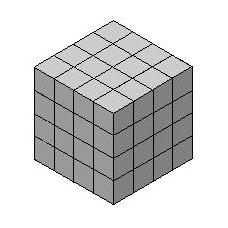
What is known about the 4×4×4 cube
by Steven H. Cullinane, unaffiliated
Abstract: The 4×4×4 cube, from one point of view, is among the simplest and the most important objects in n-dimensional binary space. In fact, as one will see from the links below, it is not simple at all.
Solomon’s Cube
The Klein Correspondence, Penrose Space-Time, and a Finite Model
Non-Euclidean Blocks
Geometry of the I Ching
Related material:
Monday’s entry Just Say NO and a poem by Stevens,
“The Well Dressed Man with a Beard.”
Comments Off
Joseph Wiseman, the actor who portrayed Dr. No, died Monday (Oct. 19). He appeared here in Chinese Theatre, Parts I and II, Nov. 20-21, 2003:
Just Say NO

Comments Off
Harvard’s motto is Veritas, i.e., Truth.
Today’s Crimson says a new philosophy professor has joined the Harvard faculty.
The professor, Mark E. Richard, is the author of a 2008 book, When Truth Gives Out.
For related material, see this journal on Oct. 19, 2002: “What Is Truth?.” The conclusion of that entry quotes Jack Nicholson’s classic remark, “You can’t handle the truth.”
For one way to handle the truth, see Pilate Goes to Kindergarten.
Comments Off
Modernity: A Film by
Alfred Hitchcock:
“… the most thoroughgoing modernist design element in Hitchcock’s films arises out of geometry, as Francois Regnault has argued, identifying ‘a global movement for each one, or a “principal geometric or dynamic form,” which can appear in the pure state in the credits….’” –Peter J. Hutchings (my italics)
John Lithgow
is 64 today.
Happy birthday.

Comments Off
A page with this title has been added to my finite-geometry site.
(For the first version of that site, see a web page cached on August 15, 2000; compare with Ivars Peterson’s August 28, 2000, column “Scrambled Grids.” These pieces are clearly intended for two different audiences, but there is a certain similarity in the subject matter.)
Comments Off
This weblog was built on Oct. 16, 2009, with posts imported from a different internet host. The imported posts have, for now, titles that are simply the date of the post.
– Steven H. Cullinane (m759)
Comments Off
Singer 7-Cycles


Click on images for details.
The 1985 Cullinane version
gives some algebraic background
for the 1987 Curtis version.
Comments Off
Wakes
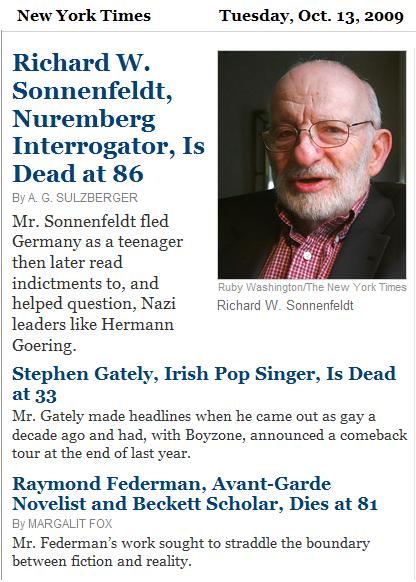
This morning’s New York Times reports the deaths of Nuremberg interrogator Richard W. Sonnenfeldt and of avant-garde novelist and Beckett scholar Raymond Federman.
Symbols from this journal on the dates of their deaths:
A quotation that appeared here on
Wednesday, Oct. 7, seems relevant to
Federman:
But I am a worker, a tombstone mason, anxious to pleace averyburies and jully glad when Christmas comes his once ayear. You are a poorjoist, unctuous to polise nopebobbies….
– James Joyce, Finnegans Wake
Comments Off
Knight Moves
Deborah Solomon, New York Times Magazine, Sunday, June 27, 1999:
“While modern art began as an assault on the academy, post-modern art might be described as a return to the academy. Instead of the old academy of rules, now we have the Academy of Cool, schools that treat avant-garde rebellion as a learned occupation.”
Christopher Knight, LA Times art critic, on Solomon:
“Back in the day, Solomon interviewed Knight for a
Times Magazine story on Los Angeles art schools. ‘Having been a journalist (at that time) for almost two decades, I also did my homework,’ Knight writes [in
a letter to the New York Press]. ‘I prepared a couple of quotable quotes on the subject, which might encapsulate larger ideas.’ One of Knight’s pearls of wisdom, ‘Modern art began as an assault on the academy, but post-modern art might be described as a return to the academy,’ excited Solomon so much that, according to Knight, she printed it as her own observation in
her final piece, which bore no mention of the Knight interview. In the final story, a seriously bitter Knight writes, ‘It was not a quote; my words had become her words.’” –
Gawker,
Oct. 11, 2007
A reference to Solomon’s piece appeared in this journal in 2003.
See also yesterday’s entry, today’s 9 AM entry, and (for the Academy) an example of knight’s move thinking.
Comments Off
Finucane’s Wake
Terence McKenna,
“Surfing on Finnegans Wake“–
“Shall I try and find a passage?….
But I am a worker, a tombstone mason, anxious to pleace averyburies and jully glad when Christmas comes his once a year. You are a poorjoist, unctuous to polise nopebobbies….”
Comments Off
– Sondheim in translation
Comments Off