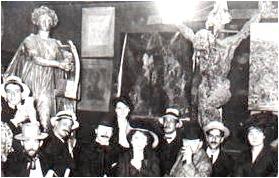
The "Facets" tag in this morning's previous post,
"The Portable Divinity Box," suggests a look at
Box759.

The "Facets" tag in this morning's previous post,
"The Portable Divinity Box," suggests a look at
Box759.
In 1978, Harvard moved a structure known as the Morton Prince House
from Divinity Avenue to Prescott Street, where it occupies the former Hurlbut
Parking Lot, which was the vista from my 1960-61 freshman room.
From the Log24 post "Very Stable Kool-Aid" —
|
A Letter from Timothy Leary, Ph.D., July 17, 1961
Harvard University July 17, 1961
Dr. Thomas S. Szasz Dear Dr. Szasz: Your book arrived several days ago. I've spent eight hours on it and realize the task (and joy) of reading it has just begun. The Myth of Mental Illness is the most important book in the history of psychiatry. I know it is rash and premature to make this earlier judgment. I reserve the right later to revise and perhaps suggest it is the most important book published in the twentieth century. It is great in so many ways–scholarship, clinical insight, political savvy, common sense, historical sweep, human concern– and most of all for its compassionate, shattering honesty. . . . . |
|
Morton Prince, a Boston neurologist, founded the Journal of Abnormal Psychology in 1906 as an outlet especially for those who took a psychogenic view of neurotic disorders. Through experiments with hypnotism, he added appreciably to knowledge of subconscious and coconscious mental processes; The Dissociation of a Personality (Prince, 1905) still ranks as a classic. He early saw that studying normal people in the depth and detail with which one studied patients could make significant contributions to our whole understanding of human nature. Before his death he established and briefly directed the Harvard Psychological Clinic, devising the research environment out of which presently sprang major contributions to the study of personality.
— "Who Was Morton Prince?," by R. W. White, |
See as well Who Was R. W. White?
“The book by Hesse has many facets ….” (Link added.)
— V. V. Nalimov, In the Labyrinths of Language ,
Ch. 1, “What Language Is,” p. 22.
Related philosophical speculation —

Two of the thumbnail previews
from yesterday's 1 AM post …


Further down in the "6 Prescott St." post, the link 5 Divinity Avenue
leads to …
|
A Letter from Timothy Leary, Ph.D., July 17, 1961
Harvard University July 17, 1961
Dr. Thomas S. Szasz Dear Dr. Szasz: Your book arrived several days ago. I've spent eight hours on it and realize the task (and joy) of reading it has just begun. The Myth of Mental Illness is the most important book in the history of psychiatry. I know it is rash and premature to make this earlier judgment. I reserve the right later to revise and perhaps suggest it is the most important book published in the twentieth century. It is great in so many ways–scholarship, clinical insight, political savvy, common sense, historical sweep, human concern– and most of all for its compassionate, shattering honesty. . . . . |
The small Morton Prince House in the above letter might, according to
the above-quoted remarks by Corinna S. Rohse, be called a "jewel box."
Harvard moved it in 1978 from Divinity Avenue to its current location at
6 Prescott Street.
Related "jewel box" material for those who
prefer narrative to mathematics —
"In The Electric Kool-Aid Acid Test , Tom Wolfe writes about encountering
'a young psychologist,' 'Clifton Fadiman’s nephew, it turned out,' in the
waiting room of the San Mateo County jail. Fadiman and his wife were
'happily stuffing three I-Ching coins into some interminable dense volume*
of Oriental mysticism' that they planned to give Ken Kesey, the Prankster-
in-Chief whom the FBI had just nabbed after eight months on the lam.
Wolfe had been granted an interview with Kesey, and they wanted him to
tell their friend about the hidden coins. During this difficult time, they
explained, Kesey needed oracular advice."
— Tim Doody in The Morning News web 'zine on July 26, 2012**
Oracular advice related to yesterday evening's
"jewel box" post …
A 4-dimensional hypercube H (a tesseract ) has 24 square
2-dimensional faces. In its incarnation as a Galois tesseract
(a 4×4 square array of points for which the appropriate transformations
are those of the affine 4-space over the finite (i.e., Galois) two-element
field GF(2)), the 24 faces transform into 140 4-point "facets." The Galois
version of H has a group of 322,560 automorphisms. Therefore, by the
orbit-stabilizer theorem, each of the 140 facets of the Galois version has
a stabilizer group of 2,304 affine transformations.
Similar remarks apply to the I Ching In its incarnation as
a Galois hexaract , for which the symmetry group — the group of
affine transformations of the 6-dimensional affine space over GF(2) —
has not 322,560 elements, but rather 1,290,157,424,640.
* The volume Wolfe mentions was, according to Fadiman, the I Ching.
** See also this journal on that date — July 26, 2012.
On the word Gestaltung —
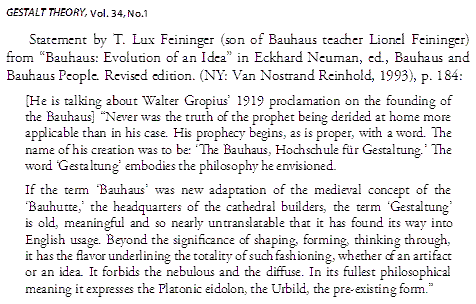
(Here “eidolon” should instead be “eidos .”)
A search for a translation of the book "Facettenreiche Mathematik " —

A paper found in the above search —

A related translation —

See also octad.design.
". . . the most magnificent 'object' in all of mathematics . . . .
is like a diamond with thousands of facets . . . ."
— MIT professor emeritus quoted here on Aug. 19, 2008
Also on that date —

"The stars and galaxies seem static, eternal, or moving slowly
in deterministic patterns, becoming the background stage
on which we move. But if we could speed up the sequence,
we would see how dramatic and unpredictable this background
really is — an actor, director, script and stage all at once.
Moreover, it is a unified universe, a single unfolding event
of which we are an embedded part, a narrative of highly
dangerous and fine-tuned events, something more like
a detective thriller with many crimes and last-minute escapes
than the impersonal account of astronomy textbooks.
We are only just beginning to decipher the plot and figure out
the Cosmic Code, as Heinz Pagels puts it."
— Charles Jencks, The Architecture of the Jumping Universe :
A Polemic (How Complexity Science is Changing Architecture
and Culture), Academy Editions, 1995, rev. ed. 1997
"A Grand Unified Theory (GUT) is a model in particle physics…."
— Wikipedia
"Under the GUT symmetry operation these field components
transform into one another. The reason quantum particles
appear to have different properties in nature is that the unifying
symmetry is broken. The various gluons, quarks and leptons
are analogous to the facets of a cut diamond, which appear
differently according to the way the diamond is held but in
fact are all manifestations of the same underlying object."
— Heinz Pagels, Perfect Symmetry , Bantam paperback, 1986, p. 284
See also the recent post Multifaceted Narrative.

"Here, modernism is defined as an autonomous body
of ideas, having little or no outward reference, placing
considerable emphasis on formal aspects of the work
and maintaining a complicated—indeed, anxious—
rather than a naïve relationship with the day-to-day
world, which is the de facto view of a coherent group
of people, such as a professional or discipline-based
group that has a high sense of the seriousness and
value of what it is trying to achieve. This brisk definition…."
— Jeremy Gray, Plato's Ghost: The Modernist
Transformation of Mathematics , Princeton, 2008
"Even as the dominant modernist narrative was being written,
there were art historians who recognized that it was inaccurate.
The narrative was too focused on France . . . . Nor was it
correct to build the narrative so exclusively around formalism;
modernism was far messier, far more multifaceted than that."
— Jane Kallir, https://www.tabletmag.com/
jewish-arts-and-culture/visual-art-and-design/
269564/the-end-of-middle-class-art,
quoted here on the above date — Sept. 11, 2018.
From some related Log24 posts —

" What this research implies is that we are not just hearing different 'stories'
about the electron, one of which may be true. Rather, there is one true story,
but it has many facets, seemingly in contradiction, just like in 'Rashomon.' "
— Edward Frenkel on "the Rashomon effect"

"Program or be programmed." — The Rushkoff Maxim

Earlier in Frenkel's above opinion piece —
"What this research implies is that we are not just hearing
different 'stories' about the electron, one of which may be
true. Rather, there is one true story, but it has many facets,
seemingly in contradiction, just like in 'Rashomon.'
There is really no escape from the mysterious — some
might say, mystical — nature of the quantum world."
See also a recent New Yorker version of the fashionable cocktail-party
phrase "the Rashomon effect."
For a different approach to the dictum "there is one true story, but
it has many facets," see . . .

"Read something that means something."
— New Yorker motto


See also, in this journal, 23-cycle.
Update of Sept. 6, 2018, 9:05 AM ET: "The Cubist Method" —
Multifaceted narrative by James Joyce —

Multifaceted structures in pure mathematics, from Plato and R. T. Curtis —

In memory of a French film publicist who worked with Clint Eastwood
in 1971 on the release of "The Beguiled" —
From a New York Times graphic review dated Sept. 16, 2016 —
It's Chapter 1 of George Eliot's "Middlemarch."
Dorothea Brooke, young and brilliant, filled with passion
no one needs, is beguiled by some gemstones . . . .
The characters, moving through the book,
glitter as they turn their different facets toward us . . . .
Cf. a glitter-ball-like image in today's New York Times philosophy column
"The Stone" — a column named for the legendary philosophers' stone.
The publicist, Pierre Rissient, reportedly died early Sunday.
See as well Duelle in this journal.
(Continued from yesterday's Sunday School Lesson Plan for Peculiar Children)
Novelist George Eliot and programming pioneer Ada Lovelace —


For an image that suggests a resurrected multifaceted
(specifically, 759-faceted) Osterman Omega (as in Sunday's afternoon
Log24 post), behold a photo from today's NY Times philosophy
column "The Stone" that was reproduced here in today's previous post —

For a New York Times view of George Eliot data, see a Log24 post
of September 20, 2016, on the diamond theorem as the Middlemarch
"key to all mythologies."
. . . Con Figuras de Espantar
"He Who Searches is multifaceted in structure …"
— Publisher's description of a Helen Lane translation
of "Como en la Guerra ," by Luisa Valenzuela.
Also by Valenzuela —

Related material — An obituary from The Boston Globe today
on the April 5 death of Borinsky's translator, and . . .

"He Who Searches" may consult also posts tagged Date.
See also the Feb. 17, 2017, post on Bertram Kostant
as well as "Mathieu Moonshine and Symmetry Surfing."
Two Students of Structure
A comment on Sean Kelly's Christmas Morning column on "aliveness"
in the New York Times philosophy series The Stone —

Diana Senechal's 1999 doctoral thesis at Yale was titled
"Diabolical Structures in the Poetics of Nikolai Gogol."
Her mother, Marjorie Senechal, has written extensively on symmetry
and served as editor-in-chief of The Mathematical Intelligencer .
From a 2013 memoir by Marjorie Senechal —
|
"While I was in Holland my enterprising student assistant at Smith had found, in Soviet Physics – Crystallography, an article by N. N. Sheftal' on tetrahedral penetration twins. She gave it to me on my return. It was just what I was looking for. The twins Sheftal' described had evidently begun as (111) contact twins, with the two crystallites rotated 60o with respect to one another. As they grew, he suggested, each crystal overgrew the edges of the other and proceeded to spread across the adjacent facet. When all was said and done, they looked like they'd grown through each other, but the reality was over-and-around. Brilliant! I thought. Could I apply this to cubes? No, evidently not. Cube facets are all (100) planes. But . . . these crystals might not have been cubes in their earliest stages, when twinning occurred! I wrote a paper on "The mechanism of certain growth twins of the penetration type" and sent it to Martin Buerger, editor of Neues Jarbuch für Mineralogie. This was before the Wrinch symposium; I had never met him. Buerger rejected it by return mail, mostly on the grounds that I hadn't quoted any of Buerger's many papers on twinning. And so I learned about turf wars in twin domains. In fact I hadn't read his papers but I quickly did. I added a reference to one of them, the paper was published, and we became friends.[5]
After reading Professor Sheftal's paper I wrote to him in Moscow; a warm and encouraging correspondence ensued, and we wrote a paper together long distance.[6] Then I heard about the scientific exchanges between the Academies of Science of the USSR and USA. I applied to spend a year at the Shubnikov Institute for Crystallography, where Sheftal' worked. I would, I proposed, study crystal growth with him, and color symmetry with Koptsik. To my delight, I was accepted for an 11-month stay. Of course the children, now 11 and 14, would come too and attend Russian schools and learn Russian; they'd managed in Holland, hadn't they? Diana, my older daughter, was as delighted as I was. We had gone to Holland on a Russian boat, and she had fallen in love with the language. (Today she holds a Ph.D. in Slavic Languages and Literature from Yale.) . . . . |
Philosophy professors and those whose only interest in mathematics
is as a path to the occult may consult the Log24 posts tagged Tsimtsum.
"Bertram Kostant, professor emeritus of mathematics at MIT,
died at the Hebrew Senior Rehabilitation Center in Roslindale,
Massachusetts, on Thursday, Feb. 2, at the age of 88."
— MIT News, story dated Feb. 16, 2017
See also a search for Kostant in this journal.
Regarding the discussions of symmetries and "facets" found in
that search —
Kostant:
“A word about E(8). In my opinion, and shared by others,
E(8) is the most magnificent ‘object’ in all of mathematics.
It is like a diamond with thousands of facets. Each facet
offering a different view of its unbelievable intricate internal
structure.”
Cullinane:
In the Steiner system S(5, 8, 24) each octad might be
regarded as a "facet," with the order of the system's
automorphism group, the Mathieu group M24 , obtained
by multiplying the number of such facets, 759, by the
order of the octad stabilizer group, 322,560.
Analogously …

The authors Taormina and Wendland in the previous post
discussed some mathematics they apparently did not know was
related to a classic 1905 book by R. W. H. T. Hudson, Kummer's
Quartic Surface .
"This famous book is a prototype for the possibility
of explaining and exploring a many-faceted topic of
research, without focussing on general definitions,
formal techniques, or even fancy machinery. In this
regard, the book still stands as a highly recommendable,
unparalleled introduction to Kummer surfaces, as a
permanent source of inspiration and, last but not least,
as an everlasting symbol of mathematical culture."
— Werner Kleinert, Mathematical Reviews ,
as quoted at Amazon.com
Some 4×4 diagrams from that book are highly relevant to the
discussion by Taormina and Wendland of the 4×4 squares within
the 1974 Miracle Octad Generator of R. T. Curtis that were later,
in 1987, described by Curtis as pictures of the vector 4-space over
the two-element Galois field GF(2).
Hudson did not think of his 4×4 diagrams as illustrating a vector space,
but he did use them to picture certain subsets of the 16 cells in each
diagram that he called Rosenhain and Göpel tetrads .
Some related work of my own (click images for related posts)—
Rosenhain tetrads as 20 of the 35 projective lines in PG(3,2)

Göpel tetrads as 15 of the 35 projective lines in PG(3,2)

Related terminology describing the Göpel tetrads above

Multifaceted Music Critic Andrew Porter Dies At 86
APRIL 03, 2015 4:38 PM ET
From the article:

Over the Rainbow
In memory of an actor “who as a boy was one of the few Jewish children
in his mostly Italian-American neighborhood in Brooklyn” —
See the link nocciolo from The Book of Abraham (Oct. 7, 2013).
Continued from December 25—

A link from Sunday afternoon to Nov. 26, 2012,
suggests a review of one of the above structures.

The Dreaming Jewels cover at left is taken from a review
by Jo Walton at Tor.com—
"This is a book that it’s clearly been difficult
for publishers to market. The covers have been
generally pretty awful, and also very different.
I own a 1975 Corgi SF Collectors Library
paperback that I bought new for 40p in the later
seventies. It’s purple, and it has a slightly grainy
cover, and it matches my editions of The Menace
From Earth and A Canticle for Leibowitz .
(Dear old Corgi SF Collectors Editions with their
very seventies fonts! How I imprinted on them at
an early age!) I mention this, however, because
the (uncredited) illustration actually represents and
illustrates the book much better than any of the other
cover pictures I’ve seen. It shows a hexagon with an
attempt at facets, a man, a woman, hands, a snake,
and stars, all in shades of green. It isn’t attractive,
but it wouldn’t put off people who’d enjoy what’s inside
either."
The "hexagon with an attempt at facets" is actually
an icosahedron, as the above diagram shows.
(The geometric part of the diagram is from a Euclid webpage.)
For Plato's dream about these jewels, see his Timaeus.
“… her mind rotated the facts….”
Related material— hypercube rotation,* in the context
of rotational symmetries of the Platonic solids:
“I’ve heard of affairs that are strictly Platonic”
* Footnote added on Dec. 26, 2013 —
See Arnold Emch, “Triple and Multiple Systems, Their Geometric
Configurations and Groups,” Trans. Amer. Math. Soc. 31 (1929),
No. 1, 25–42.
On page 42, Emch describes the above method of rotating a
hypercube’s 8 facets (i.e., three-dimensional cubes) to count
rotational symmetries —
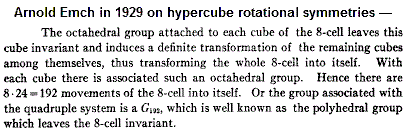
See also Diamond Theory in 1937.
Also on p. 42, Emch mentions work of Carmichael on a
Steiner system with the Mathieu group M11 as automorphism
group, and poses the problem of finding such systems and
groups that are larger. This may have inspired the 1931
discovery by Carmichael of the Steiner system S(5, 8, 24),
which has as automorphisms the Mathieu group M24 .
Alan Cowell in the The New York Times ,
October 21, 2006—
"Mr. Pinter played the role of Krapp,
a 69-year-old man revisiting
a tape recording he had made at 39…."
See also a weblog post by a 69-year-old man
revisiting a drawing he had made at 39.
The revisiting:
On Guy Fawkes Day 2011,
a return to Guy Fawkes day 2005—
Contrapuntal Themes in a Shadowland.
The drawing:
A clearer version, from 1981, of the central object below —

For commentary on the original 1981 drawing, see
Diamond-Faceted: Transformations of the Rock.
(A link in that page to "an earlier note from 1981"
leads to remarks from exactly thirty years before
the 2011 post, made on another Guy Fawkes Day.)
Occurrences of the phrase "magic square" in Lowe-Porter's translation of the Thomas Mann novel Doctor Faustus—
"On the wall above the piano was an arithmetical diagram fastened with drawing-pins, something he had found in a second-hand shop: a so-called magic square, such as appears also in Dürer's Melancolia , along with the hour-glass, the circle, the scale, the polyhedron, and other symbols. Here as there, the figure was divided into sixteen Arabic-numbered fields, in such a way that number one was in the right-hand lower corner, sixteen in the upper left; and the magic, or the oddity, simply consisted in the fact that the sum of these numerals, however you added them, straight down, crosswise, or diagonally, always came to thirty-four. What the principle was upon which this magic uniformity rested I never made out, but by virtue of the prominent place Adrian had given it over the piano, it always attracted the eye, and I believe I never visited his room without giving a quick glance, slanting up or straight down and testing once more the invariable, incredible result."
….
"Adrian kept without changing during the whole four and a half years he spent in Leipzig his two-room quarters in Peterstrasse near the Collegium Beatae Virginis, where he had again pinned the magic square above his cottage piano."
….
" 'The decisive factor is that every note, without exception, has significance and function according to its place in the basic series or its derivatives. That would guarantee what I call the indifference to harmony and melody.'
'A magic square,' I said. 'But do you hope to have people hear all that?' "
….
" 'Extraordinarily Dürerish. You love it. First "how will I shiver after the sun"; and then the houre-glasse of the Melancolia . Is the magic square coming too?' "
….
"Here I will remind the reader of a conversation I had with Adrian on a long-ago day, the day of his sister's wedding at Buchel, as we walked round the Cow Trough. He developed for me— under pressure of a headache— his idea of the 'strict style,' derived from the way in which, as in the lied 'O lieb Madel, wie schlecht bist du ' melody and harmony are determined by the permutation of a fundamental five-note motif, the symbolic letters h, e, a, e, e-flat. He showed me the 'magic square' of a style of technique which yet developed the extreme of variety out of identical material and in which there is no longer anything unthematic, anything that could not prove itself to be a variation of an ever constant element. This style, this technique, he said, admitted no note, not one, which did not fulfil its thematic function in the whole structure— there was no longer any free note."
Review of related material—
Last night's midnight post (disambiguation), the followup 1 AM post (ambiguation), today's noon post (ambiguity), and Dürer in this journal.
The tesseracts of the noon post are related to the Dürer magic square by a well-known adjacency property.
"… the once stable 'father's depression' has been transmuted into a shifting reality that shimmered in a multiplicity of facets."
— Haim Omer, Tel-Aviv University, on Milanese ambiguation therapy,
p. 321 in "Three Styles of Constructive Therapy,"
Constructive Therapies, Vol. 2 , pp. 319-333,
ed. by Michael F. Hoyt (Guilford Press paperback, 1998)
Wikipedia disambiguation page—

"When you come to a fork in the road…"

For another "shifting reality that shimmered
in a multiplicity of facets," see The Diamond Theorem.
In the catacomb of my mind
Where the dead endure—a kingdom
I conjure by love to rise
— Samuel Menashe, as quoted by
Stephen Spender in a review of four
different poets, "The Last Ditch,"
The New York Review of Books , July 22, 1971
"…the ghost reveals that the beggar
is in fact a sorcerer, a necromancer
who is preparing the mandala in order
to achieve an evil end. The ascetic
intends to bind the ghost to the corpse,
place it in the center of the circle,
and worship it as a deity."
— The King and the Corpse (from synopsis in
"How Many Facets Can a Non-Existent Jewel Have?")
Menashe died on Monday, August 22, 2011.
Related material by and for two other poets
who also died on Monday:
See also an excerpt from Kerouac I cached on Monday, and
Men ask the way to Cold Mountain
Cold Mountain: there's no through trail .
An Amazon.com reader review of Algis Budrys's Writing to the Point: A Complete Guide to Selling Fiction—
"Mr. Budrys claims to have the secret to writing fiction that will sell. His secret is very useful but short enough to include here:
Beginning: Must consist of introducing a character, in a particular context, with a problem. And if there are important yet unique/unusual aspects of the character that will be revealed later in the story they must be foreshadowed in the beginning.
Middle: Must involve the character attempting to solve the problem and encountering unexpected failure. During this attempt he begins to learn more about the problem and himself. The character must undergo stress which causes hitherto concealed facets of him to be revealed-that must fit in. The character must try to overcome the problem a total of 3 times on a rising scale of effort, commitment, and depth of knowledge of the problem and one's self. At the last possible moment, with maximum effort and staking everything, he achieves victory. This must be done by wagering everything in a do-or-die situation. Conversely the villain, coming closer to his goal experiences defeat snatched from the jaws of victory-because of some flaw in character.
End: Validation and foreclosure by someone who has no other vested interest in the story. They step forward and say 'He's dead, Jim' or 'Who was that masked man?' This serves to close the story in the reader's mind."
Here are two parallel stories suggested by yesterday's New York Lottery numbers:
|
Evening: 003 and 8997— From an author born on 8/9/97: For the 003, see
7/11. |
Midday: 004 and 1931— From an author born on 1/9/31:
For the 004, see the ideogram
See also the day of the author's |
Happy Feast of St. Ignatius of Loyola.
For St. Peter's Day
"For Stevens, the poem 'makes meanings of the rock.'
In the mind, 'its barrenness becomes a thousand things/
And so exists no more.' In fact, in a peculiar irony
that only a poet with Stevens's particular notion
of the imagination's function could develop,
the rock becomes the mind itself, shattered
into such diamond-faceted brilliance
that it encompasses all possibilities for human thought…."
—A discussion of Stevens's late poem "The Rock" (1954)
in Wallace Stevens: A World of Transforming Shapes,
by Alan D. Perlis, Bucknell University Press, 1976, p. 120
Related material on transforming shapes:

Perfect Symmetry (Oct. 2008) and Perfect Symmetry single (Dec. 2008)—


Related science…
Heinz Pagels in Perfect Symmetry (paperback, 1985), p. xvii—
The penultimate chapter of this third part of the book—
as far as speculation is concerned— describes some
recent mathematical models for the very origin of the
universe—how the fabric of space, time and matter can
be created out of absolutely nothing. What could have more
perfect symmetry than absolute nothingness? For the first
time in history, scientists have constructed mathematical
models that account for the very creation of the universe
out of nothing.
On Grand Unified Theories (GUT's) of physics (ibid., 284)—
In spite of the fact that GUTs leave deep puzzles unsolved,
they have gone a long way toward unifying the various
quantum particles. For example, many people are disturbed
by the large numbers of gluons, quarks and leptons. Part of
the appeal of the GUT idea is that this proliferation of
quantum particles is really superficial and that all the gluons
as well at the quarks and leptons may be simply viewed as
components of a few fundamental unifying fields. Under the
GUT symmetry operation these field components transform
into one another. The reason quantum particles appear to
have different properties in nature is that the unifying
symmetry is broken. The various gluons, quarks and leptons
are analogous to the facets of a cut diamond, which appear
differently according to the way the diamond is held but in
fact are all manifestations of the same underlying object.
Related art— Puzzle and Particles…
The Diamond 16 Puzzle (compare with Keane art above)—

—and The Standard Model of particle theory—

The fact that both the puzzle and the particles appear
within a 4×4 array is of course completely coincidental.
See also a more literary approach— "The Still Point and the Wheel"—
"Anomalies must be expected along the conceptual frontier between the temporal and the eternal."
— The Death of Adam , by Marilynne Robinson, Houghton Mifflin, 1998, essay on Marguerite de Navarre
One approach to the storied philosophers' stone, that of Jim Dodge in Stone Junction , was sketched in yesterday's Easter post. Dodge described a mystical "spherical diamond." The symmetries of the sphere form what is called in mathematics a Lie group . The "spherical" of Dodge therefore suggests a review of the Lie group E8 in Garrett Lisi's poetic theory of everything.
A check of the Wikipedia article on Lisi's theory yields…

Diamond and E8 at Wikipedia
Related material — E8 as "a diamond with thousands of facets"—

Also from the New Yorker article—
“There’s a dream that underlying the physical universe is some beautiful mathematical structure, and that the job of physics is to discover that,” Smolin told me later. “The dream is in bad shape,” he added. “And it’s a dream that most of us are like recovering alcoholics from.” Lisi’s talk, he said, “was like being offered a drink.”
A simpler theory of everything was offered by Plato. See, in the Timaeus , the Platonic solids—
Figure from this journal on August 19th, 2008.
See also July 19th, 2008.
“It’s all in Plato, all in Plato:
bless me, what do they
teach them at these schools!”
— C. S. Lewis
Tina Fey to Steve Martin
at the Oscars:
"Oh, Steve, no one wants
to hear about our religion
… that we made up."

|
From Wallace Stevens: A World of Transforming Shapes, by Alan D. Perlis, Bucknell University Press, 1976, p. 117:
… in 'The Pediment of Appearance,' a slight narrative poem in Transport to Summer… A group of young men enter some woods 'Hunting for the great ornament, The pediment of appearance.' Though moving through the natural world, the young men seek the artificial, or pure form, believing that in discovering this pediment, this distillation of the real, they will also discover the 'savage transparence,' the rude source of human life. In Stevens's world, such a search is futile, since it is only through observing nature that one reaches beyond it to pure form. As if to demonstrate the degree to which the young men's search is misaligned, Stevens says of them that 'they go crying/The world is myself, life is myself,' believing that what surrounds them is immaterial. Such a proclamation is a cardinal violation of Stevens's principles of the imagination. |
Superficially the young men's philosophy seems to resemble what Wikipedia calls "pantheistic solipsism"– noting, however, that "This article has multiple issues."
As, indeed, does pantheistic solipsism– a philosophy (properly called "eschatological pantheistic multiple-ego solipsism") devised, with tongue in cheek, by science-fiction writer Robert A. Heinlein.
Despite their preoccupation with solipsism, Heinlein and Stevens point, each in his own poetic way, to a highly non-solipsistic topic from pure mathematics that is, unlike the religion of Martin and Fey, not made up– namely, the properties of space.
"Sharpie, we have condensed six dimensions into four, then we either work by analogy into six, or we have to use math that apparently nobody but Jake and my cousin Ed understands. Unless you can think of some way to project six dimensions into three– you seem to be smart at such projections."
I closed my eyes and thought hard. "Zebbie, I don't think it can be done. Maybe Escher could have done it."
|
A discussion of Stevens's late poem "The Rock" (1954) in Wallace Stevens: A World of Transforming Shapes, by Alan D. Perlis, Bucknell University Press, 1976, p. 120:
For Stevens, the poem "makes meanings of the rock." In the mind, "its barrenness becomes a thousand things/And so exists no more." In fact, in a peculiar irony that only a poet with Stevens's particular notion of the imagination's function could develop, the rock becomes the mind itself, shattered into such diamond-faceted brilliance that it encompasses all possibilities for human thought:
The rock is the gray particular of man's life,
The stone from which he rises, up—and—ho,
The step to the bleaker depths of his descents ...

The rock is the stern particular of the air,
The mirror of the planets, one by one,
But through man's eye, their silent rhapsodist,

Turquoise the rock, at odious evening bright
With redness that sticks fast to evil dreams;
The difficult rightness of half-risen day.

The rock is the habitation of the whole,
Its strength and measure, that which is near,
     point A
In a perspective that begins again

At B: the origin of the mango's rind.

                    (Collected Poems, 528)
|
Stevens's rock is associated with empty space, a concept that suggests "nothingness" to one literary critic:
B. J. Leggett, "Stevens's Late Poetry" in The Cambridge Companion to Wallace Stevens— On the poem "The Rock":
"… the barren rock of the title is Stevens's symbol for the nothingness that underlies all existence, 'That in which space itself is contained'…. Its subject is its speaker's sense of nothingness and his need to be cured of it."
More positively…
Space is, of course, also a topic
in pure mathematics…
For instance, the 6-dimensional
affine space (or the corresponding
5-dimensional projective space)

over the two-element Galois field
can be viewed as an illustration of
Stevens's metaphor in "The Rock."
Cara:

Here the 6-dimensional affine
space contains the 63 points
of PG(5, 2), plus the origin, and
the 3-dimensional affine
space contains as its 8 points
Conwell's eight "heptads," as in
Generating the Octad Generator.
Diamond-Faceted:
Transformations
of the Rock
|
A discussion of Stevens's late poem "The Rock" (1954) in Wallace Stevens: A World of Transforming Shapes, by Alan D. Perlis, Bucknell University Press, 1976, p. 120:
For Stevens, the poem "makes meanings of the rock." In the mind, "its barrenness becomes a thousand things/And so exists no more." In fact, in a peculiar irony that only a poet with Stevens's particular notion of the imagination's function could develop, the rock becomes the mind itself, shattered into such diamond-faceted brilliance that it encompasses all possibilities for human thought:
The rock is the gray particular of man's life,
The stone from which he rises, up—and—ho,
The step to the bleaker depths of his descents ...

The rock is the stern particular of the air,
The mirror of the planets, one by one,
But through man's eye, their silent rhapsodist,

Turquoise the rock, at odious evening bright
With redness that sticks fast to evil dreams;
The difficult rightness of half-risen day.

The rock is the habitation of the whole,
Its strength and measure, that which is near,
     point A
In a perspective that begins again

At B: the origin of the mango's rind.

                    (Collected Poems, 528)
|

For some explanation of the
groups of 8 and 24
motions referred to in the note,
see an earlier note from 1981.
For the Perlis "diamond facets,"
see the Diamond 16 Puzzle.
For a much larger group
of motions, see
Solomon's Cube.
As for "the mind itself"
and "possibilities for
human thought," see
Geometry of the I Ching.
|
From April 28, 2008:
Religious Art
The black monolith of
One artistic shortcoming
The following
One approach to
"Transformations play
See 4/28/08 for examples |
|
From Wallace Stevens: A World of Transforming Shapes, by Alan D. Perlis, Bucknell University Press, 1976, pp. 117-118:
"… his point of origin is external nature, the fount to which we come seeking inspiration for our fictions. We come, many of Stevens's poems suggest, as initiates, ritualistically celebrating the place through which we will travel to achieve fictive shape. Stevens's 'real' is a bountiful place, continually giving forth life, continually changing. It is fertile enough to meet any imagination, as florid and as multifaceted as the tropical flora about which the poet often writes. It therefore naturally lends itself to rituals of spring rebirth, summer fruition, and fall harvest. But in Stevens's fictive world, these rituals are symbols: they acknowledge the real and thereby enable the initiate to pass beyond it into the realms of his fictions. Two counter rituals help to explain the function of celebration as Stevens envisions it. The first occurs in 'The Pediment of Appearance,' a slight narrative poem in Transport to Summer. A group of young men enter some woods 'Hunting for the great ornament, The pediment of appearance.' Though moving through the natural world, the young men seek the artificial, or pure form, believing that in discovering this pediment, this distillation of the real, they will also discover the 'savage transparence,' the rude source of human life. In Stevens's world, such a search is futile, since it is only through observing nature that one reaches beyond it to pure form. As if to demonstrate the degree to which the young men's search is misaligned, Stevens says of them that 'they go crying/The world is myself, life is myself,' believing that what surrounds them is immaterial. Such a proclamation is a cardinal violation of Stevens's principles of the imagination. For in 'Notes Toward a Supreme Fiction' he tells us that ... the first idea was not to shape the clouds In imitation. The clouds preceded us. There was a muddy centre before we breathed. There was a myth before the myth began, Venerable and articulate and complete. From this the poem springs: that we live in a place That is not our own and, much more, not ourselves And hard it is in spite of blazoned days. We are the mimics. (Collected Poems, 383-84) Believing that they are the life and not the mimics thereof, the world and not its fiction-forming imitators, these young men cannot find the savage transparence for which they are looking. In its place they find the pediment, a scowling rock that, far from being life's source, is symbol of the human delusion that there exists a 'form alone,' apart from 'chains of circumstance.' A far more productive ritual occurs in 'Sunday Morning.'…." |
For transformations of a more
specifically religious nature,
see the remarks on
Richard Strauss,
"Death and Transfiguration,"
(Tod und Verklärung, Opus 24)
in Mathematics and Metaphor
on July 31, 2008, and the entries
of August 3, 2008, related to the
death of Alexander Solzhenitsyn.
|
"Credences of Summer," VII,
by Wallace Stevens, from
"Three times the concentred |
One possibility —
Bertram Kostant, Professor Emeritus of Mathematics at MIT, on an object discussed in a recent New Yorker:
"A word about E(8). In my opinion, and shared by others, E(8) is the most magnificent 'object' in all of mathematics. It is like a diamond with thousands of facets. Each facet offering a different view of its unbelievable intricate internal structure."
Another possibility —

A more modest object —
the 4×4 square.
Update of Aug. 20-21 —
Kostant's poetic comparison might be applied also to this object.
More precisely, there are 322,560 natural rearrangements– which a poet might call facets*— of the array, each offering a different view of the array's internal structure– encoded as a unique ordered pair of symmetric graphic designs. The symmetry of the array's internal structure is reflected in the symmetry of the graphic designs. For examples, see the Diamond 16 Puzzle.
For an instance of Stevens's "three times" process, see the three parts of the 2004 web page Ideas and Art.
* For the metaphor of rearrangements as facets, note that each symmetry (rearrangement) of a Platonic solid corresponds to a rotated facet: the number of symmetries equals the number of facets times the number of rotations (edges) of each facet–
If Greek geometers had started with a finite space (as in The Eightfold Cube), the history of mathematics might have dramatically illustrated Halmos's saying (Aug. 16) that
"The problem is– the genius is– given an infinite question, to think of the right finite question to ask. Once you thought of the finite answer, then you would know the right answer to the infinite question."
The Greeks, of course, answered the infinite questions first– at least for Euclidean space. Halmos was concerned with more general modern infinite spaces (such as Hilbert space) where the intuition to be gained from finite questions is still of value.
Bertram Kostant, Professor Emeritus of Mathematics at MIT, on an object discussed in this week's New Yorker:
Hermann Weyl on the hard core of objectivity:
Steven H. Cullinane on the symmetries of a 4×4 array of points:
|
A Structure-Endowed Entity
"A guiding principle in modern mathematics is this lesson: Whenever you have to do with a structure-endowed entity S, try to determine its group of automorphisms, the group of those element-wise transformations which leave all structural relations undisturbed. You can expect to gain a deep insight into the constitution of S in this way." — Hermann Weyl in Symmetry Let us apply Weyl's lesson to the following "structure-endowed entity."
What is the order of the resulting group of automorphisms? |
The above group of
automorphisms plays
a role in what Weyl,
following Eddington,
called a "colorful tale"–

This puzzle shows
that the 4×4 array can
also be viewed in
thousands of ways.
"You can make 322,560
pairs of patterns. Each
pair pictures a different
symmetry of the underlying
16-point space."
— Steven H. Cullinane,
July 17, 2008
For other parts of the tale,
see Ashay Dharwadker,
the Four-Color Theorem,
and Usenet Postings.
Part I: Matisse

The Wisdom of the Ego,
by George E. Vaillant,
Harvard University Press (1993)
Cover illustration:
“Icarus,” from Jazz, by Henri Matisse
Publisher’s description of author:
George E. Vaillant is Professor of Psychiatry;
Director of the Study of Adult Development,
Harvard University Health Services;
and Director of Research in
the Division of Psychiatry,
Brigham and Women’s Hospital.
“This is a remarkable synthesis of the best current thinking on ego psychology as well as a many-faceted picture of what Robert White would call ‘lives in progress.’ It makes on its own not only a highly innovative contribution to ego psychology but an equally original and impressive contribution to longitudinal research. A remarkable and many-faceted work.”
— The late George W. Goethals
of Harvard University
Part II:
The Hospital
Cached from http://bostonist.com/2007/12/01/boston_blotter_164.php
December 1, 2007Boston Blotter: More on Harvard Student Found Dead
A Facebook group named “In Memory of John Edwards” has already been established. * Other reports say the body was found at about 11 PM on Thursday, Nov. 29– the presumed date of Edwards’s death. Edwards was said to have conducted stem cell research at Brigham and Women’s Hospital, a teaching affiliate of Harvard Medical School. |
Part III:
Down to Earth
The reviewer in Icarus, Part I, above,
Dr. Goethals, was my teacher in a
1960-61 freshman seminar at Harvard.
He admired the work of
Harry Stack Sullivan.
The cover of the Sullivan book below
may serve to illustrate yesterday’s
“Plato’s Horses” remarks.

The ego defenses of today’s
Harvard students seem to need some
strengthening. Perhaps Vaillant, Sullivan,
and the philosophies of Pirsig and of Plato
discussed in yesterday’s entry
may be of use in this regard.
Related material:
| Le Républicain Lorrain du 14 janvier 2001
Le Lapin Agile veille sur la Butte (par Michel Genson) 24 décembre 1900. Dans son atelier glacial du Bateau Lavoir, à flanc de la colline de Montmartre, Picasso se frotte les yeux. C’est bien Wasley, son ami Wasley, qu’il aperçoit traversant la place Ravignan, courbé sous le poids d’un grand Christ en croix. Le sculpteur titube et s’en va gravissant un à un les escaliers qui mènent au sommet de la Butte, direction la rue des Saules. Car l’œuvre est destinée aux murs du petit estaminet où la bande a trouvé asile, pour y échanger chaque soir des refrains, bocks et vaticinations les plus folles. La bande, c’est à dire Utrillo, Max Jacob, Modigliani et les autres… Un siècle et un souffle de légende plus tard, le même Christ blanc occupe toujours la même place, sous les lumières tamisées du Lapin Agile. À l’abri sous son aisselle droite, l’autoportrait de Picasso en Arlequin a été authentique en son temps. Jusqu’au jour où le grand Frédé, tenancier mythique du lieu, s’est gratté la barbe avant de le céder à un amateur suédois de passage. Depuis l’original a fait le voyage du MAM (Modern Art Museum) de New-York, et la Butte se contente d’une copie. Pour le reste, rien a changé ou presque pour le doyen des cabarets parisiens. Ni le décor, ni l’esprit. L’incroyable patine noire des murs, posée là par des lustres de tabagies rigolardes ou inspirées, rappelle au générique les voix des habituées de jadis, Apollinaire, Carco, Dullin, Couté, puis Pierre Brasseur, et plus proches de nous encore d’autres débutants, Caussimon, Brassens, François Billetdoux… La liste exhaustive serait impossible à dresser de tous ceux qui ont émargé au livre d’or du Lapin Agile. Malgré les tempêtes et les modes, le Lapin Agile dure et perdure donc. Et sa silhouette pour carte postale inspire toujours les peintres venus de partout. Comme si la halte faisait partie d’un parcours initiatique immuable. Deux pièces pour un minuscule rez-de-chaussée, dans la première, mi-loge, mi-vestiaire, une guitare attend son tour de projecteur. En l’occurrence un faisceau unique clouant le chanteur (l’humoriste ou le diseur) au rideau rouge de la seconde salle. Là où le spectacle se déroule depuis toujours, là où l’on s’accoude sans vergogne à la table d’Apollinaire, sous les lampes toujours drapées de rouge, pour écouter Ferré, Aragon, Mac Orlan ou les rengaines du Folklore populaire montmartrois. Yves Mathieu reste ferme, « ici, pas de sonorisation, pas de haut-parleur. Les gens découvrent la voix humaine. » Un refrain de Piaf glisse jusqu’au « laboratoire », le réduit où les autres artistes du programme dissertent sur l’état du monde. Les meubles de Bruant sont encore là, au hasard d’un coffre breton, un autre de marine, la façade d’un lit clos… « Des trucs d’origine » pour Yves Mathieu, qui malgré les vicissitudes du temps – il s’ingénie toute l’année durant à entretenir un établissement qui ne bénéficie d’aucun classement officiel, ni d’aucun subside – prêche haut et fort sa confiance, « parce qu’on aura plus que jamais besoin de racines, de repères, et qu’ici, c’est tout un pan de patrimoine qu’on défend à travers la chanson française, celle qu’on chante tous ensemble… » Le même secoue sa longue carcasse et se fend d’un sourire entendu : « Quand je descends à Paris, c’est pas pareil. Ici, le jour, c’est comme dans une église. Il y a le silence, et l’impression de ressentir les ondes laissées pare les cerveaux de ces types, là… » Aux murs, dessins ou tableaux laissés par Mac Orlan, Maclet ou Suzanne Valadon jouent avec l’ombre amicale. Le Lapin Agile, 22 rue des Saules, 75018 Paris. Tel : 01 46 06 85 87 |
Note the above description
of Christmas Eve 1900,
and the remark that
“Ici, le jour, c’est comme
dans une église.”
A search for more material on
the Wasley Christ leads to
Princeton’s Nassau Church:
|
The fullness of time. I don’t have to call on the physicists among us to conclude that this fullness was not meant to be the end of the time line. That Paul must not have been talking about time in a linear way. Fullness. Complete. Almost perfect. Overflowing with grace. Just right. Fullness. As in “the earth is the Lord’s and the fullness thereof.” Fullness. As in “I pray that you may have the power to comprehend with all of the saints, what is the breadth, and length, and height and depth, and to know the love of Christ that surpasses all knowledge, so that you may be filled with all the fullness of God.” Fullness. As in “For in Christ, all the fullness of God was pleased to dwell.” “When the fullness of time had come, God sent his Son, born of a woman.” I can remember Christmas Eve as a child….
— Christmas Eve, 2004, |
Religious Symbolism at Princeton,
on the Nassau Church,
Counting Crows on
the Feast of St. Luke
(“Fullness… Multitude”),
The Quality of Diamond,
in memory of
Saint Hans-Georg Gadamer,
who died at 102
four years ago on this date,
and
Christendom Today
From PP Nunca Mas! —

From today’s Washington Post:
Security Officials Try to Forge
‘Europe-Wide Response’ After Attacks
By John Burgess
Washington Post Foreign Service
Saturday, March 20, 2004
European Union officials acknowledged Friday that mistrust between intelligence agencies posed a serious challenge.
“We have to build trust.”
— Michael McDowell, Ireland’s justice minister
_______________________
Reasons for distrust, from a page on Ángel Acebes, Spain’s Interior Minister, at PP Nunca Mas! —

Acebes
(today’s Washington Post)
En cuanto a su faceta espiritual, Acebes es miembro de la inquietante organización religiosa Legionarios de Cristo (de su brazo seglar, Regnum Christi).
Los Legionarios de Cristo… es una organización fundada en 1941 en Méjico por el padre Marcel [Marcial] Maciel (rehabilitado por el Vaticano en 1958 tras ser acusado de ayudarse en sus visiones con ampollas de morfina; también fue acusado de pederastia, le gustaba masturbar a jovencitos y que ellos le masturbaran a él).
Those who distrust members of Opus Dei (so memorably described in the recent bestseller The Da Vinci Code) may also distrust members, like Acebes, of the secular arm of the Legion of Christ.
If, on the other hand, one applies the “by their fruits ye shall know them” test to the Legion of Christ, one finds, for example,
The Royal Palm Academy in Naples, Florida.
This school seems to excel both academically and spiritually.

Royal Palm Student
| Starflight Theme
On Graham Greene’s novel “Greene, always the master of economy, never wrote a tighter or more beautifully focused novel.” |
|
“The main character is Maurice Castle, the head of the Africa station for a branch of British intelligence…. [the] writing is sparse and neat rather than languid or flowery….”
— Kevin Holtsberry
From Chapter I:
“Castle could see that telling the truth this time had been an error of judgement, yet, except on really important occasions, he always preferred the truth. The truth can be double-checked.”
On fiction and truth:
Here is a short story that is
tight, focused, sparse, and neat.
The story is also true.
 |
This problem embodies the “starflight” theme;
for details, see Tim Krabbé’s
Open Chess Diary, entry 9.
As the example of Nabokov shows, a taste for truth (as in chess or geometry) may accompany a taste for fiction. This applies also to Krabbé, as shown by the following reviews of his novel The Cave:
New York Times
“Krabbe’s carefully constructed narrative has a geometry so precise that the patterns buried under the surface emerge only in the final pages.”
Library Journal
“A diamond of a book- perfectly proportioned, multifaceted, and containing not one wasted word”
Powered by WordPress





 –John Edwards, the Harvard sophomore whose body was