





Synchronology check:
From a motion picture filmed in Bucharest —

Meanwhile, in this journal . . .

* See the previous post.
Art Blocks in the previous post —
"… making accessibility and IRL viewership a core component" . . .

From this journal on the above art date — April 6, 2021 —
Tuesday, April 6, 2021
|
The date — January 9, 2010 — of the Guardian book review
in the previous post was noted here by a top 40 music list
from that same date in an earlier year.
Update of 4:07 AM ET the same morning:
Fans of Cormac McCarthy's recent adventures in unreality
might enjoy interpreting the time — 3:25 AM ET — of this post
as the date 3/25, and comparing the logos, both revisited
and new, in a Log24 post from 3/25 . . .

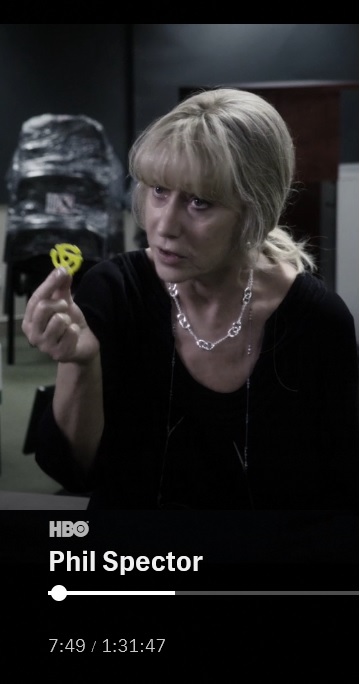
Helen Mirren with plastic Gankyil .
. . . with the logo of a venue whose motto is
"Reality is not enough."


See also this journal on the above Cambridge U. Press date.
"There are many places one can read about twistors
and the mathematics that underlies them. One that
I can especially recommend is the book Twistor Geometry
and Field Theory, by Ward and Wells."
— Peter Woit, "Not Even Wrong" weblog post, March 6, 2020.
* A fictional entity. See Synchronology in this journal.
From the previous post . . .
"This review was filed from the 2020 Sundance Film Festival
on January 30th."
Meanwhile . . .

Click the above image for posts on "Expanding the Spielraum."
See as well . . .

From this journal on September 16, 2013 —
|
"La modernité, c’est le transitoire, le fugitif, le contingent, la moitié de l’art, dont l’autre moitié est l’éternel et l’immuable." — Baudelaire, "Le Peintre de la Vie Moderne," IV (1863) "By 'modernity' I mean the ephemeral, the fugitive, the contingent, the half of art whose other half is the eternal and the immutable." — Baudelaire, "The Painter of Modern Life," IV (1863), translated by Jonathan Mayne (in 1964 Phaidon Press book of same title) |
Also on September 16, 2013 —

* See that term in this journal.

* See Synchronology and the previous post.
Dates from math forums mentioned in the previous post —
Dec. 7, 2016 and Aug. 2, 2010.
Connoisseurs of synchonology may like to click on those dates.

See also this journal on the above date — July 13, 2016.

The above image includes a July 9, 2014, file photo.
From this journal on that date —
“Be serious, because
The stone may have contempt
For too-familiar hands”
A book cover from Amazon.com —

See also this journal on the above date, September 27, 2016 —
Chomsky and Levi-Strauss in China,
Or: Philosophy for Jews.
Some other remarks related to the figure on the book cover —
Field Theology and Galois Window.
* See Synchronology in this journal.
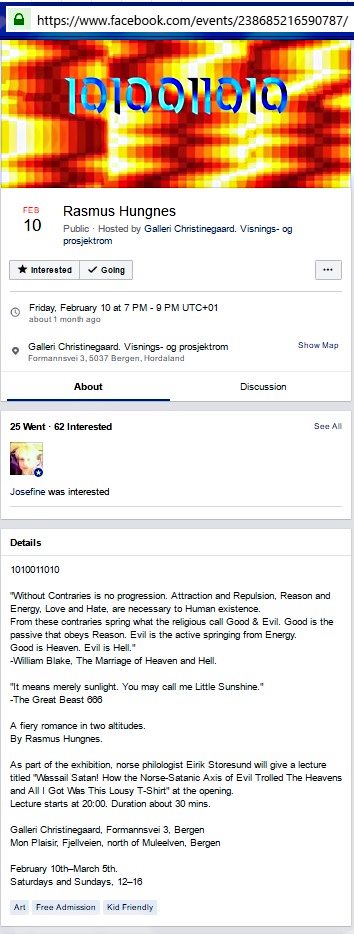
"… and all I got was this lousy sweatshirt" —

Some posts related to the above Rasmus Hungnes exhibition
opening date — Feb. 10, 2017 — are now tagged Bewitchment.
* See Synchronology in this journal.
From the Wikipedia article Bauhaus (band) —
"On 31 October 2013 (Halloween), David J and Jill Tracy released
'Bela Lugosi's Dead (Undead Is Forever),' a cinematic piano-led
rework of 'Bela Lugosi's Dead.'"
Halloween 2013 here (click to enlarge) —

* See "synchronolog…" in this journal.
"Everything clear so far?"
— Review by Anthony Burgess of the 1989 translation
by William Weaver** of Umberto Eco's 1988 novel
Il Pendolo di Foucault
* A fictional institution in a just-published novel
** Weaver reportedly died on Nov. 12, 2013.
Synchronologists may consult that date
in this journal.

NPRC.org is not, as far as I know, affiliated with NPR.org.
Also not affiliated with the Church of Synchronology.

A scene I prefer . . .


Click the album above for a video uploaded on June 17, 2021.
For the Church of Synchronology: This journal on that date.
Metadata —

The New York Times this afternoon —
" William Beecher, who as a reporter for The New York Times
revealed President Richard M. Nixon’s secret bombing campaign
over Cambodia during the Vietnam War, and who later won a
Pulitzer Prize at The Boston Globe, died on Feb. 9 at his home
in Wilmington, N.C. He was 90." — Clay Risen, 2:28 PM
Also on Feb. 9 —

Another Beecher narrative —

Religious meditation from the Church of Synchronology . . .

In memory of a Broadway star who reportedly died on Jan. 30 . . .

A Jan. 29 New Yorker story, "Life with Spider," suggests
a look at the author's earlier novel The Variations and,
after a synchronology check, a Log24 flashback —

Thursday, September 7, 2023
|
See also Fritz Leiber's rather different Spider Woman in this journal.
Hat tip to Instagram's @slightlystable for some colorful background
today on Venice Beach Kundalini. Related reading —

A synchronology check on the above WWD date,
Aug. 4, 2021, yields some related art —

"Here's to efficient packing."
The previous post suggests a synchronology check of
the release date for the film "The 355." That in turn suggests …


See also a synchronology check of "Jul 8, 2023."
The previous post displayed a use of the phrase "quantum kernel"
by Prof. Dr. Koen Thas of Ghent University. Here is an example of
a rather different, and more widely known, meaning of the phrase —

Synchronology check (approximate) — Also from May 2023 —
From Prof. Dr. Koen Thas at the University of Ghent on 13 Dec. 2017 —

From this journal on that same date — 13 Dec. 2017 —

Related material for fans of synchronology — both from Nov. 3, 2009 —
Nightlight and Summa Mythologica .

Lewis Carroll's chess Red Queen, from Through the Looking Glass,
is "often confused with" the playing cards Queen of Hearts,
from Alice in Wonderland —
" The King turned pale, and shut his notebook hastily.
'Consider your verdict,' he said to the jury in a low, trembling voice….
. . . . 'No, no!' said the Queen. 'Sentence first—verdict afterward.' "
— Lewis Carroll, Alice in Wonderland
|
The figure at right in the video of today's previous post,
"In Alice in Wonderland , the Red Queen
— College of Natural Resources commencement address,
Berck's address was titled "The Red Queen." |
Berck's dies natalis — "birth into heaven," in Catholic parlance —
was reportedly August 10, 2018. A Log24 synchronology check
yields a different chess-related figure … Actor/director John Huston:


"Scarecrow Press, June 21, 2000" — The above publication date.
That date suggests a synchronology check —


From a December 2021 obituary —


"I'm just sittin' on the dock of the bay
Wastin' time"
From Peter Woit's weblog today —

A background check yields . . .

For the Church of Synchronology . . . Posts now tagged


Members of the Church of Synchronology may investigate
in this journal the above Harold Budd dates —
Sept. 27, 2020 and April 18, 2018.
The Mathematical Intelligencer Vol. 10, Issue 1, page 3 (Dec. 1988) . . .
http://www.log24.com/noindex-pdf/
Cullinane-letter-Artes_Liberales-Intelligencer.pdf —

Not a snowflake . . .

Related material . . . "Omnibus ex Nihilo."
And, for the Church of Synchronology —
Log24 on the above Instagram date:
September 8, 2022 — Chevron Variations.

"Hey now, you're an all star
Get your game on, go play
Hey now, you're a rock star
Get the show on, get paid"
— Lyrics from . . .


And for the Church of Synchronology … Log24 on
the above YouTube date — Dec. 25, 2009.
A check of today's New Yorker penbots yields
an entertaining piece on pop culture by Sarah Larson:

Perhaps, in death's dream kingdom, there is some guidance from
the illustrator who reportedly did the book cover in the previous post —
one Hector Garrido.
"Operation Childlike Innocence, Phase One."
— Sarah Larson, quoted here on Sept. 5, 2015.
Garrido's dies natalis was reportedly 19 April, 2020.
Synchronology check — Log24 search: "Wittgenstein Easter."

Related dramatic dialogue from FUBAR —
Hero — I guess I'll take the pill, and get it over with. (Dramatic music playing.)
Villain — This will be fun. (Music intensifies.) Cheers … Nothing's happening.
Hero — Come to think of it, I might have taken the antidote.
Read more at: https://tvshowtranscripts.ourboard.org/… .
Related synchronology check —

The previous post suggests a review of
a Log24 post from August 22, 2020 —
From a web page —

From YouTube, for the Church of Synchronology —

For some context, see Holocron in this journal.

Cable was born in Akeley, Pennsylvania, in 1932 and graduated
from Warren High School in nearby Warren PA in 1950.
The "online remembrance" is at the Meadville Tribune.
Members of the Church of Synchronology may consult this journal's
posts on the date of Cable's reported death.
The date of the Rubber Ducky article in the previous post was . . .
November 11, 2019.
Synchronology check:

* A phrase by Woody Allen (NY Times , May 5, 2011).


Newlove grew up in Jamestown, NY, a city which
appeared in his fiction. He reportedly died on Aug. 17.
Synchronology check: "Little Museum of Horrors."
A Bon Jovi "Stripped" video released May 1, 2007 —

Synchronology check —
This journal in the early morning of the above release date —
"Nine is a very |
||||||||||||||

Synchronology check — See LA Scenes tag.
Here is the source of an image from the "tour a book"
link target in the previous post —

Note the time and date: Midnight on the morning of Oct. 26, 2015.
Synchronology check: From that date, posts now tagged Critical Space Theory.
"… Denis fashioned a minimalist chamber
that derives eroticism from its sparseness."
That remark describes a film, "High Life,"
that stars Juliette Binoche.
Binoche, along with other minimalist art, appeared here
in the post "The Triangle Induction" on May 11, 2021 —
|
The logo of a news site that yesterday
|
Related material:
From a 2014 review, remarks by a noted minimalist sculptor
who reportedly died at 85 on the above date … May 11, 2021.
I personally prefer remarks by Munari —

For the Church of Synchronology:
This journal on the above HuffPost date — April 11, 2019.
The "bricks" in posts tagged Octad Group suggest some remarks
from last year's HBO "Watchmen" series —

Related material — The two bricks constituting a 4×4 array, and . . .

"(this is the famous Kummer abstract configuration )"
— Igor Dolgachev, ArXiv, 16 October 2019.
As is this —
 .
.
The phrase "octad group" does not, as one might reasonably
suppose, refer to symmetries of an octad (a "brick"), but
instead to symmetries of the above 4×4 array.
A related Broomsday event for the Church of Synchronology —


Note for the Church of Synchronology —
See also this journal on the “Songs for the Deaf” release date:
August 27, 2002.
The following image was suggested by today’s
New York Times obituary of Joanna Harcourt-Smith
and by earlier Log24 posts now also tagged Grossinger.

For some background, see a book that reportedly
was published on Devil’s Night (October 30) 1997 —

The interview date above suggests some related material
for students of bullshit and for the Church of Synchronology —


For the Church of Synchronology —
This journal on the above YouTube date — June 21, 2018 —
had posts now tagged Mnemonic Model.

Synchronology check —
This journal on the above dates —
8 January 2019 (“For the Church of Synchronology“)
and 24 April 2019 (“Critical Visibility“).
Related mathematics: Klein Correspondence posts.
Related entertainment: “The Bulk Beings.”
The above Physical Review remarks were found in a search
for a purely mathematical concept —
“35 points” + projective space . . .

"After years in hiding, latex fashion re-emerged in the late 1950s,
thanks to the British designer John Sutcliffe, who created the world’s
first catsuit – the prototype rubber-fetish garment. …
The 1960s British spy series The Avengers was monumental
in bringing rubberwear to the masses. The show’s feminist heroine,
Emma Peel (played by Diana Rigg), was styled in a latex, Sutcliffe-
inspired catsuit. With Peel as a media archetype, latex’s second-skin
look wasn’t just sexy, it was superhuman.
Sutcliffe capitalised on the obsession with his products, and founded
AtomAge Magazine in 1972. The periodical, filled with artful and erotic
bondage imagery, gained a huge following among fetishists, and made
quite the splash on London’s progressive fashion scene. "
— By Cassidy George, bbc.com, 8th January 2020
See also an image from a Log24 post on that date a year earlier—
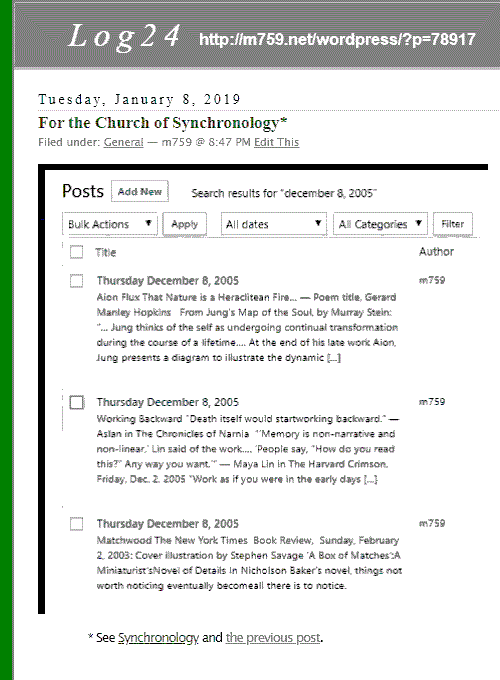
From a web page —
From YouTube, for the Church of Synchronology —
Meanwhile, elsewhere . . .
* See that book title in this journal.
The title refers to a Paris Review article dated August 18, 2020.
Detail of poet Donald Hall’s home in a photo accompanying the article —

A synchronology check of Hall’s date of death — Midsummer Eve
in 2018 — yields, in this journal —

Related images I prefer to Hall’s —


The above novel uses extensively the term “inscape.”
The term’s originator, a 19th-century Jesuit poet,
is credited . . . sort of. For other uses of the term,
search for Inscape in this journal. From that search —

A quote from a 1962 novel —
“There’s something phoney
in the whole setup, Meg thought.
There is definitely something rotten
in the state of Camazotz.”
Addendum for the Church of Synchronology —
The Joe Hill novel above was published (in hardcover)
on Walpurgisnacht —April 30, 2013. See also this journal
on that date.

For the conference, see
https://www.birs.ca/events/2009/5-day-workshops/09w5030 .
For the Church of Synchronology:
“Time for you to see the field.” (Posts now tagged “For Banff 2009”)
“… the Jesuit religious order, whose intensive, extensive ordination process
typically takes about 10 years”
— The above link in The New York Times today leads to . . .

For the Church of Synchronology —
A post in this journal on the above Jesuit date — Aug. 11, 2013 —
leads to a John Hurley at Wolfram Demonstrations . . .

This may or may not be the John Hurley described in the
LinkedIn page below (click for further details):

In memory of Stephen Schwartz, a member of
the Harvard College class of 1963 —

Synchronology check —

In memory of a composer who reportedly died on Wednesday,
March 11, 2020 —

From a synchronology check —

Today's 4:02 AM ET post, "Steinfeld as Rose the Hat,"
suggests a review —

A more impressive woman in white —

Update of 8 PM ET —
Beckinsale gives Oct. 5, 2001, as the date of the New York
premiere of the film "Serendipity." Synchronology check:

Beckinsale's premiere date — Oct. 5, 2001 — is incorrect.
The film was released on that date, but its New York premiere
was actually on Oct. 3, 2001. See Getty Images.

* A weblog motto. See …
http://enowning.blogspot.com/
2007/07/alfred-denkers-dictionary-on-ereignis.html.
That Ereignis post is dated July 3, 2007.
Related material for the Church of Synchronology —
"The deepest strain in a religion is the particular
and particularistic doctrine it asserts at its heart,
in the company of such pronouncements as
‘Thou shalt have no other Gods before me.’
Take the deepest strain of religion away…
and what remains are the surface pieties —
abstractions without substantive bite —
to which everyone will assent
because they are empty, insipid, and safe."
— Stanley Fish, quoted here on July 3, 2007…
The opening date of the film "Transformers."

The opening pronouncement of "Transformers" —
Gravatar at the weblog of Peter J. Cameron —

Same Gravatar in blue —

Synchronology check —

Click Lukasiewicz for further remarks.
For the Church of Synchronology —

See as well this journal on the above lecture date: April 4, 2018,
in other posts now also tagged D8.
Update of 11:22 PM ET Jan. 13, 2020 —

Note the Christmas Eve date, and compare and contrast with the previous post.
For Hollywood —


For Emily Yahr (see second item above) —

Buck Henry reportedly died yesterday, January 8, 2020.
This journal on that date a year earlier —

Art notes —
See also the "Night of the Iguana" logo by Saul Bass,
a student of Gyorgy Kepes.

Postscript for synchronologists —
See this journal on that date: Nov. 6, 2011.
From some autobiographical remarks by Simon During,
who was featured in the previous post —

For more on the phrase “god professor,” see
“The Ownership of Knowledge in Higher Education
in Australia 1939-1996,” Hannah Forsyth, Ph.D. thesis,
University of Sydney, 2012
Simon During at Utrecht earlier this year —

For the Church of Synchronology, other April 11, 2019, remarks —

See in particular the phrase “Eritis sicut dei ” in the Log24 remarks.
From a Log24 search for Deep Beauty —

From a related search —

For the Church of Synchronology —
An image from this journal on the above Dick date, Feb. 9, 2011 —

An article in Men's Journal on August 1, 2013 —

For the Church of Synchronology — This journal on August 1, 2013.
The title was suggested by the previous post and by
the title illustration in the weblog of the director,
Leigh Whannell, of the 2018 film “Upgrade.”
Related visual details —

For the Church of Synchronology —

Related remarks: “The Thing and I.”
The production-company logos for Carpenter B and Bad Robot
in end credits for a 2016 TV mini-series based on the Stephen King
novel 11/22/63 suggest a look at . . .

For the Church of Synchronology —
This weblog on Aug. 11, 2017:
From my reading Monday morning —

From the online New York Times this afternoon —

Related literature —

For the Church of Synchronology —
The Gigantomachia page above is dated September 20, 2003.
See as well my own webpage from that date: "The Form, the Pattern."
For the title, see Zero: Both Real and Imaginary (a Log24 search).
The title was suggested by the previous post, by Zorro Ranch,
by the classic 1967 film The Producers , and by . . .

Related material —

Vanity Fair on Sept. 8, 2017, celebrated the young actress
who played Beverly Marsh in the 2017 film version of
Stephen King's IT . See a post from her 12th birthday —
"Winter's Game" — that touches upon Maori themes.
More generally, see Bester + Deceivers in this journal.
And for the Church of Synchronology . . .
See posts related to the above Vanity Fair date.
" … this beautiful love story . . . ."

An image from the previous post:

The above line "From the producer of Transformers " suggests
a story from March 18, 2019 . . .

Misreading the words of di Bonaventura
yields a phrase that might be applied to
the Church of Rome . . .
"A franchise based on release dates."
See dies natalis in this journal.
For the Church of Synchronology, see
the above di Bonaventura date, March 18.
Then there is the Church of Cubism . . .
"Before time began, there was the Cube."
— Optimus Prime, Transformers , 2007

This flashback was suggested by the following date —
February 26, 2014 —

Related material — The Church of Synchronology.
"Elmore Rual 'Rip' Torn Jr. (February 6, 1931 – July 9, 2019)
was an American actor, voice artist … Torn was born in
Temple, Texas,
on February 6, 1931, the son of Elmore Rual "Tiger" Torn Sr. and
Thelma Mary Torn (née Spacek)."

For the Church of Synchronology —
The above photo was reportedly taken on March 10, 2011.
An image from this journal on that date —

Found in translation — See "Ex Fano " in this journal
and the Fano post "In Nomine Patris."
is a TCM special at 8 PM ET this evening.

A snow-globe phrase from April 28 —

Bauble, Babel . . . Bubble —

The "bubble" cited above —

For more metaphysical accounting, see
The Church of Synchronology.


See too "Desperately Seeking Resonance"
and, for the Church of Synchronology, posts
on the above date — April 3, 2017.
(Continued from the previous post.)
|
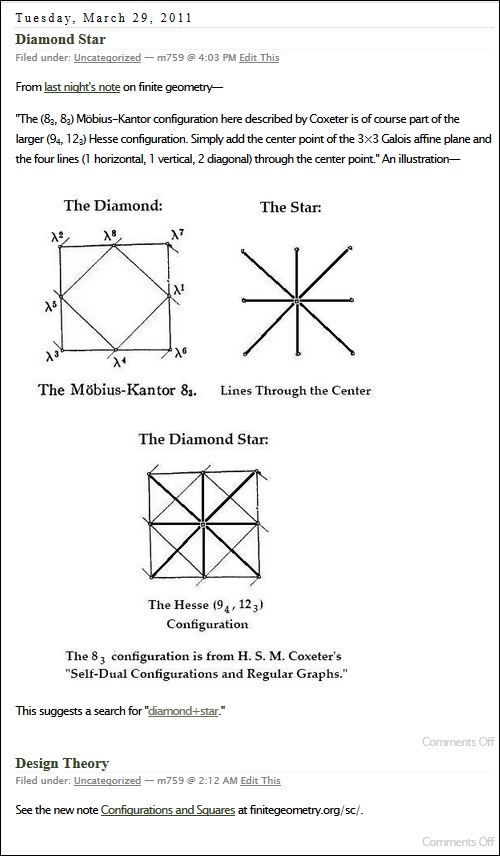
In-Between "Spacing" and the "Chôra " (Ch. 2 in Henk Oosterling & Ewa Plonowska Ziarek (Eds.), Intermedialities: Philosophy, Arts, Politics , Lexington Books, October 14, 2010) "The term 'spacing' ('espacement ') is absolutely central to Derrida's entire corpus, where it is indissociable from those of différance (characterized, in the text from 1968 bearing this name, as '[at once] spacing [and] temporizing' 1), writing (of which 'spacing' is said to be 'the fundamental property' 2) and deconstruction (with one of Derrida's last major texts, Le Toucher: Jean-Luc Nancy , specifying 'spacing ' to be 'the first word of any deconstruction' 3)." 1 Jacques Derrida, “La Différance,” in Marges – de la philosophie (Paris: Minuit, 1972), p. 14. Henceforth cited as D . 2 Jacques Derrida, “Freud and the Scene of Writing,” trans. A. Bass, in Writing and Difference (Chicago: University of Chicago Press, 1978), p. 217. Henceforth cited as FSW . 3 Jacques Derrida, Le Toucher, Jean-Luc Nancy (Paris: Galilée, 2000), p. 207. . . . . "… a particularly interesting point is made in this respect by the French philosopher, Michel Haar. After remarking that the force Derrida attributes to différance consists simply of the series of its effects, and is, for this reason, 'an indefinite process of substitutions or permutations,' Haar specifies that, for this process to be something other than a simple 'actualisation' lacking any real power of effectivity, it would need “a soubassement porteur ' – let’s say a 'conducting underlay' or 'conducting medium' which would not, however, be an absolute base, nor an 'origin' or 'cause.' If then, as Haar concludes, différance and spacing show themselves to belong to 'a pure Apollonism' 'haunted by the groundless ground,' which they lack and deprive themselves of,16 we can better understand both the threat posed by the 'figures' of space and the mother in the Timaeus and, as a result, Derrida’s insistent attempts to disqualify them. So great, it would seem, is the menace to différance that Derrida must, in a 'properly' apotropaic gesture, ward off these 'figures' of an archaic, chthonic, spatial matrix in any and all ways possible…." 16 Michel Haar, “Le jeu de Nietzsche dans Derrida,” Revue philosophique de la France et de l’Etranger 2 (1990): 207-227. . . . . … "The conclusion to be drawn from Democritus' conception of rhuthmos , as well as from Plato's conception of the chôra , is not, therefore, as Derrida would have it, that a differential field understood as an originary site of inscription would 'produce' the spatiality of space but, on the contrary, that 'differentiation in general' depends upon a certain 'spatial milieu' – what Haar would name a 'groundless ground' – revealed as such to be an 'in-between' more 'originary' than the play of differences it in-forms. As such, this conclusion obviously extends beyond Derrida's conception of 'spacing,' encompassing contemporary philosophy's continual privileging of temporization in its elaboration of a pre-ontological 'opening' – or, shall we say, 'in-between.' |
For permutations and a possible "groundless ground," see
the eightfold cube and group actions both on a set of eight
building blocks arranged in a cube (a "conducting base") and
on the set of seven natural interstices (espacements ) between
the blocks. Such group actions provide an elementary picture of
the isomorphism between the groups PSL(2,7) (acting on the
eight blocks) and GL(3,2) (acting on the seven interstices).

Espacements
For the Church of Synchronology —
See also, from the reported publication date of the above book
Intermedialities , the Log24 post Synchronicity.
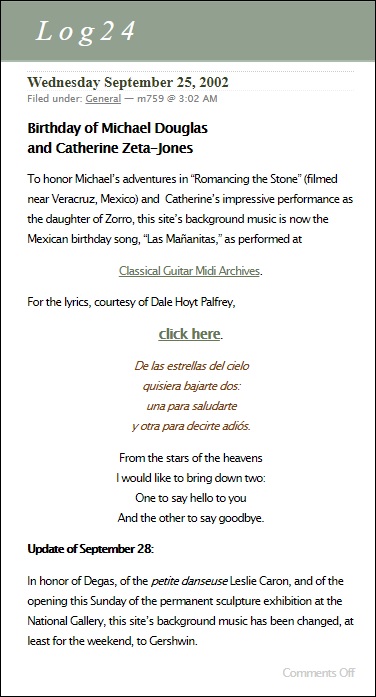

(The date "September 25, 2002" in the opening of the Alferov video above
may or may not be correct. It will suffice for the Church of Synchronology.)

"ACTUALLY HAPPENED!"
Wolff reportedly did on Sunday, Feb. 17.
For the Church of Synchronology —
Log24 posts on the reported date of Wolff's death.
Related Log24 post — Good News and Bad News.
Wolff himself, in a weblog post of Oct. 16, 2017,*
had some trenchant comments on religion . . .
See "How Odd of God." (See as well today's midnight
post in this journal, "Ghost in the Shell.")
* "Broomsday." See also Log24 posts on that date.
and the Church of Synchronology
The date of the Urban Dictionary "Joy of Six"
article in this afternoon's previous post was Oct. 15, 2016.
A check of that date in this journal yielded a post titled "Word and Object"
that featured an image of a sailor in Times Square.
Related material encountered later this afternoon —

From the "Word and Object" post —

A novel by Harry Albers featuring his fictional Pacific Science Institute:

See the real Pacific Science Institute (PSI) in the previous post.
Synchronology check —
Related literary remarks —

— Cloud Atlas , by David Mitchell (2004).
"Particularly if a person thinks of himself as clever,
he will often have a hard time admitting his own ignorance."
— John Ganz in the online New York Times today.
"One model for what I’m trying to accomplish is the writings of
Martin Gardner. Some other models are … well, actually, I’m not
going [to] tell you; I’d much rather imitate these writers in hope that
you’ll notice the resemblance and figure it out. That’s a game
I’ll be playing with you over the next few years."
— James Propp, Mathematical Enchantments, June 17, 2015.
A check of my own ignorance of synchronology . . .
http://m759.net/wordpress/?p=50955,
a post of June 17, 2015.
"How do you get young people excited about space?"
— Megan Garber in The Atlantic , Aug. 16, 2012
The above quote is from this journal on 9/11, 2014.
Related material —

Synchronology for the above date — 9/11, 2014 —
A BuzzFeed article with that date, and in reply
"A Personal Statement from Michael Shermer" with that date.
From this evening's online New York Times :
"Eric Salzman, a composer and music critic who
championed a new art form, music theater,
that was neither opera nor stage musical, died
on Nov. 12 at his home in Brooklyn. He was 84."
. . . .
"The first American Music Theater Festival
took place in the summer of 1984.
Among that first festival’s featured works was
'Strike Up the Band!,' Mr. Salzman’s 'reconstructed
and adapted' version of a satirical musical
with a score by George and Ira Gershwin
that had not been staged in 50 years. The director
of that production, Frank Corsaro, died
the day before Mr. Salzman did."
Synchronology check :
"The day before" above was November 11, 2017.
Links from this journal on November 11 —
A Log24 search for Michael Sudduth and an
October 28, 2017, Facebook post by Sudduth.
Detail of Sudduth's Nov. 11 Facebook home page —

Click the above for an enlarged view of the Sudduth profile picture.
Related material :

Aooo.
Washington Post dateline . . .
November 20 at 6:34 PM
Address . . .
https://www.washingtonpost.com/investigations/
eight-women-say-charlie-rose-sexually-harassed-them–
with-nudity-groping-and-lewd-calls/2017/11/20/ . . .
See also Charlie Rose in this journal.
The only post found in a Log24 search for "Charlie Rose" is about
his May 7, 2008, interview with a Museum of Modern Art figure,
Paola Antonelli. A more recent appearance by Antonelli —


Synchronolgy check — Log24 on the date 5 June 2012.
* Title and wording of post revised the following day.


See also Norbert Wiener in this journal and …

Related material for the Church of Synchronology —
The Log24 post on the above New York Times death date.
From today's online Wall Street Journal —

A synchronology check of the above 2015 Taylor Swift date —


The above remarks suggest Swift as a possible presidential candidate:
From The Harvard Crimson on Halloween —
 .
.
The previous post suggests an example of
extreme aesthetic distance.
The word "mosaic" in Max Black —

The same word in a very different author —

Related historical remarks, for the Church of Synchronology —

The above death reportedly occurred on Sunday, Sept. 13, 2015.
This journal at 11 AM on that date —

Some background —


The Decepticons date above, June 21, 2017, suggests an instance of
that date in this journal —

For the Church of Synchronology, a New York Times item from
the above death date, June 21, 2017 —

See as well Kurt Russell in Guardians of the Galaxy, Vol. 2 —

Some relevant context: Expanding the Spielraum .


Exercise:
Discuss whether Knudson's phrase "essentially says" is correct.
For the Church of Synchronology —
The above Forbes article is dated July 29, the date of death for
Landon T. Clay, founder of Clay Mathematics Institute.
For remarks related to that date, see posts tagged Prize Problem
in this journal.
Or: Emma Watson at the Church of Synchronology .
Amir Aczel was the author of, among other books,
The Mystery of the Aleph :
Mathematics, the Kabbalah,
and the Search for Infinity , and
The Riddle of the Compass :
The Invention That Changed the World .
He reportedly died on November 26, 2015.
The "bubble" passage in the previous post suggests a review of
a post from December 21, 2006, with the following images —


Update of 11:01 PM ET the same day, June 12, 2017 —

Related material for the Church of Synchronology —
From a tech-article series that began on Halloween 2006 and
ended on the date of the above Geometry's Tombstones post —


Compare and contrast (from a post of Feb. 27, 2017) —
“Lord Arglay had a suspicion that the Stone would be
purely logical. Yes, he thought, but what, in that sense,
were the rules of its pure logic?”
—Many Dimensions (1931), by Charles Williams

See also "The Geometry of Logic:
Finite Geometry and the 16 Boolean Connectives"
by Steven H. Cullinane in 2007.
" In 1965, Mr. Simmons, an incisive, erudite reviewer and essayist,
won a William Faulkner Foundation Award for Powdered Eggs [ 1964 ],
recognized as a notable first novel. (He wryly called it his
'64th first novel.') The Boston Globe said it was 'certainly among
the outstanding fictions of the ′60s.' [ Later, in 1971,* ] The novelist
Harry Crews heralded him as 'one of the finest comic voices to appear
anywhere in years.' "
— Sam Roberts in a New York Times obituary this evening
See also Harry Crews in this journal.
Roberts says Simmons also wrote "a savage sendup of The New York Times
Book Review , where he had worked as an editor for three decades."
Some not-so-savage related material —

* "Anywhere in years" — From http://www.nytimes.com/1971/11/21/archives/
an-oldfashioned-darling-by-charles-simmons- 202-pp-new-york-coward.html
"I guess I found my future through Billy Name’s eye.
I saw his pictures of the Warhol Factory when I was
in college and thought, 'Oh that’s the place to get to.
Everyone is so beautiful and it looks brilliant and
complicated – art, music, film, but most of all a kind
of wild life.' It looked like the future as I imagined it."
— The late Glenn O'Brien in The Guardian
on November 8, 2014. O'Brien reportedly
died at 70 yesterday, Friday (April 7) morning,
in Manhattan.
"… through Billy Name's eye …."
Then there is Kurt Seligmann's eye …
The above-mentioned Billy Name appeared in this journal
in July 2016 in the post "Coterie (for Philip Rieff)." Also
featured in that post was artist Kurt Seligmann.
A Google Search sidebar on Seligmann today:

Synchronology check of this journal on the above Guardian date:
|
Saturday, November 8, 2014
At 11:59*
|
See also an 11:59 PM ET post on Thursday, April 6, titled
"Where Entertainment Is God (continues)."
Some related entertainment:


I do not recommend any of the above entertainments,
but they do supply some background for the article
"Fantasy and the Buffered Self" (which is recommended.)
A Ghost Ship —

Related tales for the Church of Synchronology —
See excerpts from an RSS feed this evening.
Earlier related material — Peregrine in this journal.
"Transformations , Anne Sexton’s 1971 collection of poems, is a portal."
— "A Poisonous Antidote," by Nick Ripatrazone, at themillions.com
at noon on October 22, 2015
"You see, opening dimensional portals is a tricky business."
— The librarian in "Buffy the Vampire Slayer," season 1, episode 2
See also Transformers in this journal.
Synchronology —
"Objective Quality" in this journal on the date of the above review,
October 22, 2015, at 2:26 AM ET.
… Also known as quaternion —

"Diagram of an 8 leaf gathering: Quaternion (8 folio or leaf gathering).
A quaternion is composed of 4 bifolios. Conjugate folios form a bifolio
at either end of a gathering or quire. So in the diagram above folios
1 and 8 which form a bifolio are conjugate folios."
— http://employees.oneonta.edu/farberas/arth/arth214_folder/workshop.htm
The source:
SUNY Oneonta
ARTH 214
History of Northern Renaissance Art
Spring, 2013
Dr. Allen Farber, Associate Professor
Tuesday, February 26: From Workshop to Chamber:
The Paris Book Industry of the Early Fifteenth Century
"Images for class" folder
Synchronology:
An image from Publication, a Log24 post on the above date,


* A reference to a line in a poem in a novel
by Katherine Neville, The Eight (1988)
For the Church of Synchronology, a correction of
a recent New York Times obituary by Daniel Lewis —
Actor Gene Wilder died early Monday, Aug. 29, not, as
earlier reported, late Sunday, Aug. 28.


See also the last Log24 post of Sunday night, Aug. 28 (Angles of Vision)
and the first post of Monday morning, Aug. 29, 2016 (Roll Credits).
* For some reading related to the title, see an Evil Genius page
by the late David Lavery mentioning Colin Wilson's novel
The Mind Parasites . Great entertainment for the tinfoil-hat crowd —
"More and more I feel like the narrator of Colin Wilson's
The Mind Parasites , a phenomenologist who, along with
a dedicated group of compatriots, struggles clandestinely
to overthrow alien invaders that have secretly
taken captive the 'deep structure' of the human mind."
From an earlier Log24 post —
Friday, July 11, 2014
|
From a post of the next day, July 12, 2014 —

"So there are several different genres and tones
jostling for prominence within Lexicon :
a conspiracy thriller, an almost abstract debate
about what language can do, and an ironic
questioning of some of the things it’s currently used for."
— Graham Sleight in The Washington Post
a year earlier, on July 15, 2013
For the Church of Synchronology, from Log24 on the next day —

From a post titled Circles on the date of Marc Simont's death —

See as well Verhexung in this journal.

For the Church of Synchronology, some Log24 posts from
the date of King's tweet, on a not-so-dark tower —

Erica Goode in the online New York Times tonight —
"Irving Gottesman, a pioneer in the field of behavioral genetics
whose work on the role of heredity in schizophrenia helped
transform the way people thought about the origins of serious
mental illness, died on June 29 at his home in Edina, Minn., a
suburb of Minneapolis. He was 85.
His wife, Carol, said he died while taking an afternoon nap.
Although Dr. Gottesman had some health problems, she said,
his death was unexpected, and several of his colleagues said
they received emails from him earlier that day."
A note from noon (EDT) on that day, June 29, for the Church of Synchronology —

A detail from the page mentioned in the June 29 post above —

A passage related to the word "soul" discussed by Sullivan —

See as well a related biblical passage, better known at the time of Royce (ca. 1892)
than today, that would probably mean nothing to the late Dr. Gottesman.
For the Church of Synchronology
From the literary journal ELH , Winter 1973 —

See as well …
"The explosion panicked parkgoers and could be heard nearby
at the Orthodox Fifth Avenue Synagogue, where the funeral for
Nobel laureate and Holocaust survivor Elie Wiesel was underway.
Police said they do not think the blast was targeting the funeral."
— Justin Jouvenal in The Washington Post , 7:01 PM ET
on July 3, 2016
Also, from Mark Helprin's In Sunlight and in Shadow ,
a passage linked to here on August 30, 2013 —

Previous references in this journal to the "Church of Synchronology"
suggest a review of that phrase's source —
"The fine line between hokum and rational thinking
is precisely the point of The Lost Time Accidents ;
a brick of a book not just because of its length but
because of the density of both the prose and the
ideas it contains.
It is, in a nutshell, a sweeping historical novel that's
also a love story but is rooted in time-travel
science fiction and takes on as its subject
the meaning of time itself. This is no small endeavor."
— Janelle Brown in The Los Angeles Times
on February 4, 2016

See also …

"The editors are also grateful to
T. Kibble and Imperial College Press
for permission to reprint B. Zumino's paper
'Supersymmetry: A Personal View' . . . ."
— Preface to Symmetry in Mathematics and Physics
(AMS, 2009), a book based on talks at
a UCLA conference of Jan. 18-20, 2008
(For the book's title page, see yesterday morning's post Symmetry.)
This suggests a search in this journal for the term "supersymmetry."
That search yields some links that may be of further interest to
devotees of the Church of Synchronology.
For a physicist who reportedly died at 83 yesterday
(Thursday, June 2, 2016) —
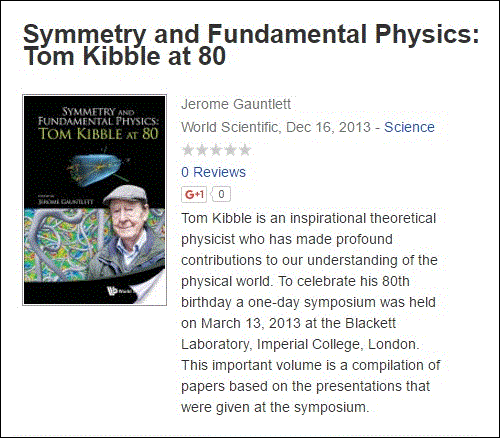
Also on March 13, 2013 —

A note for the Church of Synchronology —
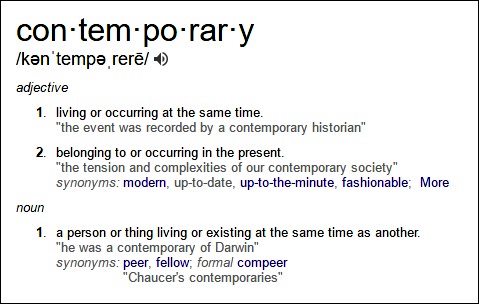
See as well the word "contemporary" in the previous post.
Principles before Personalities — AA Saying .
Principles —
See Schoolgirl Problem in Wikipedia.
Personalities —
See Alexandra Alter in the May 26 online New York Times :
"With the proliferation of 'girl' titles,
there are signs that the trend may have peaked;
it already seems ripe for parody."

Update of 12:40 PM ET on Wednesday, June 1, 2016 —
A note for the Church of Synchronology …
See a post from this journal on the date of the Alter piece, May 26:
(Click image for the rest of the post .)

Images suggested by the previous post —

Note the name "Dorje" in the first image above.
Remarks related to the name "Dorje," as well as to
"Projective Geometry and PT-Symmetric Dirac Hamiltonian,"
a 2009 paper by Y. Jack Ng and the late Hendrik van Dam —
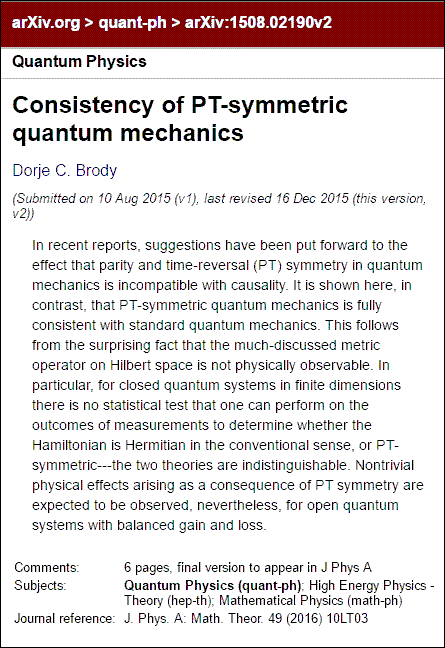
Remarks for the Church of Synchronology from December 16, 2015,
the date of the above Dorje arXiv upload —

For the Church of Synchronology
Marissa Mayer, as illustrated on the cover
of the current issue of Variety , and
Mira Sorvino, as discussed in posts of
Feb. 20, 2009 (a date suggested by the
arXiv upload date in the previous post).
The previous post suggests two images …

The date of the above Promoted Tweet is October 19, 2015.
For the Church of Synchronology, an image from Log24 on that date:

"So we beat on, boats against the current …" — F. Scott Fitzgerald

A college girl's remarks in the previous post suggested
a search in this journal for "vulgar and stupid."
That search yielded a date — March 2, 2014.
In the spirit of the Church of Synchronology, a further search —
for that date — yielded, in a March 2, 2014, post, the following —
Square Dance
|
And no fact of Alain Resnais’s life seemed to strike a stranger note than his assertion that the films which first inspired his ambition to become a film director were those in which Fred Astaire and Ginger Rogers danced. Or was it Dick Powell and Ruby Keeler? He could never be sure. “I wondered if I could find the equivalent of that exhilaration,” he recalled. If he never did it was perhaps because of his highly cultivated attitude to serious cinema. His character and temperament were more attuned to the theory of film and a kind of intellectual square dance* which was far harder to bring to the screen with “exhilaration” than the art of Astaire and Rogers. *See today's 11 AM ET Sermon. |
The college girl, who reportedly died at 70 on May 11, was
Katherine Dunn, author of the book One Ring Circus quoted
above. She apparently improved with age.
Powered by WordPress


