In memory of a graphic-design figure who reportedly died
on Monday, Nov. 13, 2023 — images from a post on that date —
"The great aim is accurate, precise and definite description . . . . "
— T. E. Hulme, Speculations: Essays on Humanism and the
Philosophy of Art, ed. Herbert Read. London and New York:
Routledge and Kegan Paul, 1987. First published 1924.
"Scarecrow Press, June 21, 2000" — The above publication date.
That date suggests a synchronology check —
The above title is from the Black Mass performed by Boris Karloff
in a classic 1934 horror film. An illustration —
Leonard F. Wheat, Harvard Ph.D. 1958,
is said to have died at 82 on May 12, 2014.
Look upon his works, ye Mighty, and despair.
Also on Wheat's date of death —
Related art —
(For some backstory, see Geometry of the I Ching
and the history of Chinese philosophy.)
More "spots of time": "0915."
In memory of a former president of Boston University —
Other posts now tagged Cube Mine.
Related entertainment —
The New York Times on its print edition yesterday:
A version of this article appeared in print
on September 28, 2012, on page B17
of the New York edition with the headline:
John Silber Dies at 86; Led Boston University.
The Times 's Robert D. McFadden wrote that
Silber was "a philosopher by training but
a fighter by instinct."
That phrase was brought to mind today
by a Sept. 25 link in The Harvard Crimson
to Mumford & Sons singing "The Boxer"
in Providence on Transfiguration Day.
There was no Transfiguration Day post
in this journal. Here are parts of the posts
for the preceding and following days—
See also "The Count" from September 17.
Below: A New York Times "Fashion Week: Immerse Yourself" ad
with obituary of former Boston University president John Silber—
"a philosopher by training but a fighter by instinct"—
"I can't do that to myself ." — Clint Eastwood
* See a Sept. 1st CNN piece by Boston University
religion scholar Stephen Prothero—
"Give Me Bali's Empty Chair over Eastwood's"—
See also Prothero in this journal.
MEDEIS AGEOMETRETOS EISITO
— Inscription at entrance to
Plato's Academy, according to
an elementary introduction to
philosophy by James L. Christian
For Irving Adler, who reportedly
died on September 22, 2012—
|
|
Background: See Sangaku in this journal.
See also the following, from a different
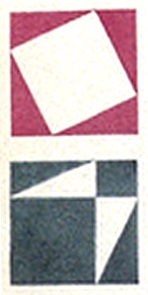
elementary introduction, by Adler—
Giant Golden Book of Mathematics,
illustrated by Lowell Hess—
.
(Detail of Flickr photo)
* See Liddell and Scott.
Denote the d-dimensional hypercube by γd .
"… after coloring the sixty-four vertices of γ6
alternately red and blue, we can say that
the sixteen pairs of opposite red vertices represent
the sixteen nodes of Kummer's surface, while
the sixteen pairs of opposite blue vertices
represent the sixteen tropes."
— From "Kummer's 166 ," section 12 of Coxeter's 1950
"Self-dual Configurations and Regular Graphs"
Just as the 4×4 square represents the 4-dimensional
hypercube γ4 over the two-element Galois field GF(2),
so the 4x4x4 cube represents the 6-dimensional
hypercube γ6 over GF(2).
For religious interpretations, see
Nanavira Thera (Indian) and
I Ching geometry (Chinese).
See also two professors in The New York Times
discussing images of the sacred in an op-ed piece
dated Sept. 26 (Yom Kippur).
In diamond-narrative news today…
"Among the low points of his career was his performance
in the disastrous 1985 remake of “King Solomon’s Mines….”
— David Belcher in today's online New York Times
"A kenning… is a circumlocution
used instead of an ordinary noun
in Old Norse, Old English and
later Icelandic poetry." — Wikipedia
Note the title of Tuesday's post High White in the Dark Fields.
Related material, in memory of a composer-lyricist
who died Monday (NY Times ) or Tuesday (LA Times )—
The "1961" Oscars ceremony shown above was for the films of 1961.
The ceremony itself was held on April 9, 1962.
For a different Tiffany, see Tuesday's Another Day.
Powered by WordPress