|
# Odysseus in the leafpile
## Goole Search AI, following up (in detail, as suggested by the AI and then requested by the user) an initial question asking for the exact source, in Greek, of Homer's "Odysseus in the leafpile" passage . . .
## Google Search AI —
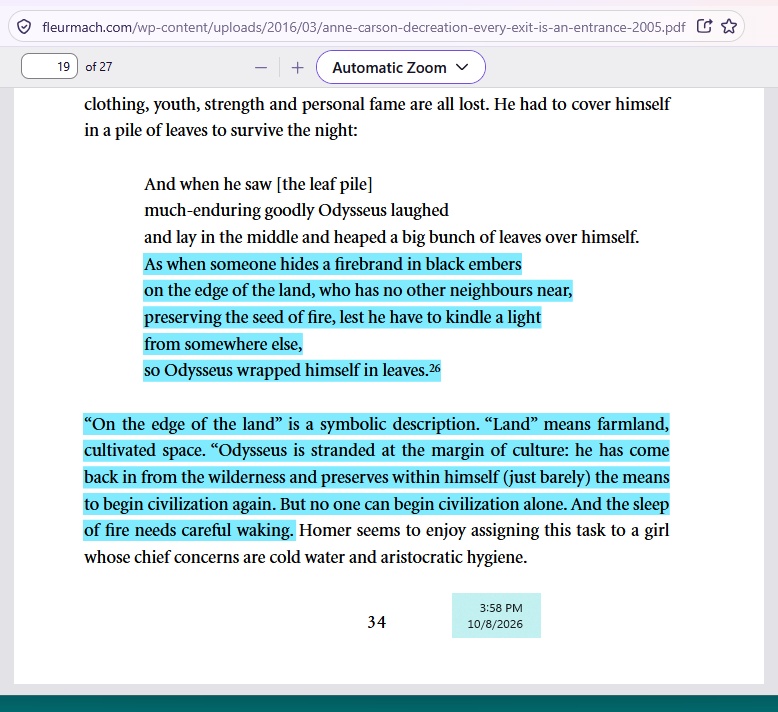
Here is the word-by-word breakdown of Homer's Odyssey, Book 5, lines 488–493, which compares Odysseus to a buried ember:
## Line 488: ὡς δ' ὅτε τις δαλὸν σποδιῇ ἐνέκρυψε μελαίνῃ
* ὡς (hōs): As, just as.
* δ' (d' / δέ): And, but (used here as a transition).
* ὅτε (hote): When.
* τις (tis): Someone, a person.
* δαλὸν (dalon): A firebrand, a burning piece of wood.
* σποδιῇ (spodiēi): In the embers, in the wood-ashes.
* ἐνέκρυψε (enekrypse): Hides, buries (from enkryptō).
* μελαίνῃ (melainēi): Black, dark (modifying the ashes).
## Line 489: ἀγροῦ ἐπ' ἐσχατιῆς, ᾧ μὴ πάρα γείτονες ἄλλοι,
* ἀγροῦ (agrou): Of a field, of the countryside.
* ἐπ' (ep' / ἐπί): On, at.
* ἐσχατιῆς (eschatiēs): The edge, the furthest border, a lonely outpost.
* ᾧ (hōi): To whom, where.
* μὴ (mē): Not.
* πάρα (para / πάρεισι): Are near, are present.
* γείτονες (geitones): Neighbors.
* ἄλλοι (alloi): Others.
## Line 490: σπέρμα πυρὸς σῴζων, ἵνα μή ποθεν ἄλλοθεν αὕοι,
* σπέρμα (sperma): Seed.
* πυρὸς (pyros): Of fire. (Together, "σπέρμα πυρὸς" means the spark or ember to rekindle a fire).
* σῴζων (sōizōn): Saving, preserving, keeping alive.
* ἵνα (hina): So that, in order that.
* μή (mē): Not.
* ποθεν (pothen): From somewhere.
* ἄλλοθεν (allothen): From another place.
* αὕοι (hauoi): He might have to kindle/light it (from hauō, to kindle a fire from a distance).
## Line 491: ὣς ᾿Οδυσεὺς φύλλοισι καλύψατο. τῷ δ' ἄρ' ᾿Αθήνη
* ὣς (hōs): So, in this way, even so.
* ᾿Οδυσεὺς (Odyseus): Odysseus.
* φύλλοισι (phylloisi): In leaves, with leaves.
* καλύψατο (kalypsato): Covered himself, hid himself (from kalyptō, the same root as Calypso's name).
* τῷ (tōi): Upon him, for him.
* δ' (d' / δέ): And.
* ἄρ' (ar' / ἄρα): Then, straightway, fittingly.
* ᾿Αθήνη (Athēnē): Athena.
## Line 492: ὕπνον ἐπ' ὄμμασι χεῦ', ἵνα μιν παύσειε τάχιστα
* ὕπνον (hypnon): Sleep.
* ἐπ' (ep'): Upon.
* ὄμμασι (ommasi): Eyes.
* χεῦ' (cheu' / ἔχευε): Poured (Athena "poured" sleep over him).
* ἵνα (hina): So that.
* μιν (min): Him.
* παύσειε (pauseie): It might rest him, deliver him, make him cease.
* τάχιστα (tachista): Most swiftly, as quickly as possible.
## Line 493: δυσπονέος καμάτοιο, φίλα βλέφαρ' ἀμφικαλύψας.
* δυσπονέος (dysponeos): Hard-toiling, painful, distressing.
* καμάτοιο (kamatoio): From weariness, exhaustion, toil.
* φίλα (phila): His own (literally "dear," often used in Homer to mean one's own limbs or eyes).
* βλέφαρ' (blephar' / βλέφαρα): Eyelids.
* ἀμφικαλύψας (amphikalypsas): Enfolding, covering all around.
Would you like to examine the poetic meter (dactylic hexameter) of any of these specific lines, or explore how this metaphor of the "seed of fire" connects to Odysseus's symbolic rebirth on Scheria?
## Me — Yes, how does the fire-seed metaphor connect to the symbolic rebirth you mentioned?
## Google Search AI —
The “seed of fire” (σπέρμα πυρὸς) metaphor is one of the most powerful symbols of rebirth, identity, and cosmic survival in the entire Odyssey. By burying himself in the leaves like an ember at the end of Book 5, Odysseus is undergoing a profound transition from the supernatural, static world of the gods back into the mortal world of human striving.
The metaphor connects to his symbolic rebirth in several distinct ways:
## 1. Stripping Down to Pure Survival
Before this scene, Odysseus is utterly destroyed. He has lost his ships, his crew, and his clothes, and he has just survived a brutal, near-fatal battering by Poseidon’s storm. When he crawls ashore on the island of Scheria (Phaeacia), he has been stripped of all external markers of his identity—he is no longer a king, a general, or a husband in appearance.
* By comparing him to a lone ember hidden away on a “lonely outpost” (ἐπ' ἐσχατιῆς) where there are no neighbors to help relight a fire, Homer emphasizes that Odysseus has nothing left but his raw, internal spark of life. His survival depends entirely on his own internal metis (cunning and resourcefulness).
## 2. The Semantic Link to Calypso (Death vs. Life)
The choice of verbs in this passage creates a brilliant poetic frame. For seven years, Odysseus was trapped on the island of Ogygia by the nymph Calypso, whose very name comes from the Greek verb καλύπτω (kalyptō), meaning "to hide" or "to conceal." While with her, he was effectively dead to the world—immortalized but forgotten, hidden away from his mortal destiny.
* In line 491, Odysseus καλύψατο (kalypsato—"covered/hid himself") in the leaves.
* This time, the hiding is not a form of captivity or stagnation; it is an act of self-preservation. He is "hiding" himself temporarily so that he can be preserved and "rekindled" back into the mortal world.
## 3. Womb Imagery and Maternal Care
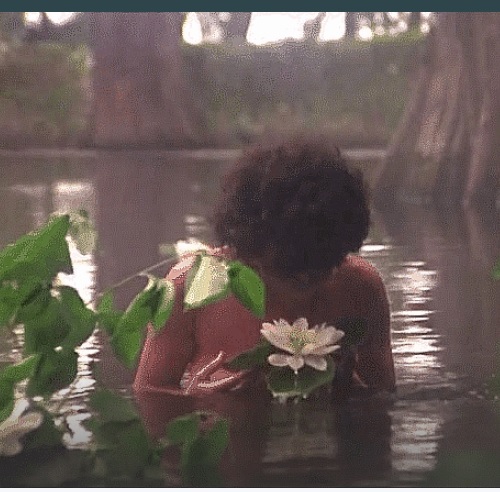
The pile of leaves acts as a literal and symbolic womb. Odysseus crawls between two closely growing olive trees—one wild, one grafted—which represent the duality of his nature (his wild, savage survival instincts and his civilized, kingly nature).
* He scoops the leaves over himself for warmth, mirroring a child being tucked in or returning to the earth.
* This imagery is completed when Athena pours sleep over his eyes. Throughout the Odyssey, Athena acts as a divine, maternal guide. By putting him to sleep in this leaf-womb, she protects the "seed" while it regenerates.
## 4. Awakening into a New Society
A seed's only purpose is to break open and grow. When Odysseus finally wakes up in Book 6, he does so to the sound of young Phaeacian women playing on the beach.
* His emergence from the leaf pile is explicitly described as a rebirth. He steps out naked, caked in brine, looking terrifying like a mountain lion, but ready to re-enter civilization.
* It is the Phaeacians who will ultimately provide him with clothes, a ship, and the passage back to Ithaca. The "seed of fire" kept alive in the leaves is what allows him to successfully initiate this final leg of his homecoming (nostos).
Would you like to look at the contrasting metaphor Homer uses later when Odysseus returns to Ithaca, or perhaps explore the cultural importance of fire in ancient Greek hospitality (xenia)?
## Me — No, that's all for now, and thank you for your perceptive and helpful remarks.
|