Sunday, June 7, 2026
Friday, August 4, 2023
Kinbotean Annotation (Continued)
Tuesday, July 11, 2023
|
For some illuminating remarks on Kinbotean annotation, see
Chapter 6 (Nabokov, Lowry, Orwell) of The Wreath of Wild Olive ,
by Mihai Spariosu.
(Published by State University of New York Press,
© 1997 State University of New York.)
Tuesday, July 11, 2023
Kinbotean Annotation
NB : The author of the report below is not the same person as
the author of this journal, who is known as Steven H. Cullinane.
See also this journal on the above Sunday at Little Gidding date.
Friday, September 9, 2016
Notation
The New York Times interviews Alan Moore —
“A version of this article appears in print on September 11, 2016,
on page BR9 of the Sunday Book Review ….”
“What genres do you prefer? And which do you avoid?”
“To be honest, having worked in genre for so long, I’m happiest
when I’m outside it altogether, or perhaps more accurately,
when I can conjure multiple genres all at once, in accordance
with my theory (now available, I believe, as a greeting card and
fridge magnet) that human life as we experience it is a
simultaneous multiplicity of genres. I put it much more elegantly
on the magnet.”
Saturday, August 27, 2016
Folk Notation
See the Chautauqua Season post of June 25
and a search for Notation in this journal.
See as well the previous post and Bullshit Studies .
Saturday, August 14, 2010
Iconic Notation
Continued from Friday the 13th—
Related material—

Cover art by Barclay Shaw reprinted from an earlier (1984) edition
A question from Ivan Illich
(founder of CIDOC, the Center for Intercultural Documentation,
in Cuernavaca, Mexico)—
"Who can be served by bridges to nowhere?"
For more about nowhere, see Utopia. See also http://outis.blogspot.com.
Tuesday, June 2, 2026
By Morning Light
260602-Miapensa-suggested-song-lyrics.jpg
Annotation . . . Magic Carpet Ride . . .
260602-Miapensa-10-seconds-of-not-painting-carpet-details.jpg

Thursday, October 16, 2025
Story Space: “The Greek Letter”
For this year's winner of the Nobel prize for literature,
a Hungarian enthusiast of run-on sentences whose "bible"
is said to be the classic novel about Cuernavaca by
Malcolm Lowry Under the Volcano . . .
As season three of "The Diplomat" unfolds, I visit my
memory garden to recall the time I sat with Judge Flick in his
chambers at my hometown courthouse to get a reference for
my application to Harvard and noticed on his desk a copy of
E. B. White's "little book" on prose style which, along with
a library book by Norbert Wiener, may have influenced my
mentioning to the judge the rather strange word "cybernetics,"
derived from the term for the steersman of the ship of Odysseus
who was lost at sea in Homer's epic tale.
"Wiener" of course is another term for a resident of Vienna.
And so, returning to much more recent memories — from
yesterday — of the long strange journey that has been my life . . .
Two references from a much less subjective and much more
objective tale that might amuse the late Hermann Weyl —
Related picture from a cartoon graveyard —
Sunday, August 10, 2025
Cullinane Diamond Theorem:
Microsoft Copilot Deep Research Report, Aug. 10, 2025
|
The Copilot "Deep Research" Report on the Cullinane Diamond Theorem … Aug. 10, 2025
The Cullinane Diamond Theorem: Definition, Significance, and Applications
|
| Mathematical Component | Role in Cullinane Diamond Theorem |
Linked Structure/Field |
|---|---|---|
| 4×4 Diagonal Tile Array |
Base of all patterns; permutations generate G-images |
Graphic design, combinatorics |
| Group G (AGL(4,2)) |
Symmetry group acting via permutations of rows, columns, quadrants; isomorphic to affine group on 4-space |
Group theory, finite geometry |
| PG(3,2) |
Geometry of combinatorial structures; lines correspond to three-element sets among 15 points |
Finite projective geometry |
| Line Diagrams |
Visual representation of points/lines; sum to zero under binary addition (XOR); correspond to configurations in PG(3,2) |
Coding theory, geometry |
| Miracle Octad Generator (MOG) |
Combinatorial tool connecting diamond patterns, Golay code, and M24; mirrors the arrangement of 35 square patterns |
Group theory, lattices |
| Latin-square Orthogonality |
Orthogonality mirrors skew lines in PG(3,2); supports combinatorial design and coding |
Experimental design, statistics |
| Diamond Rings |
Ideals in ring of patterns; extensions lead to infinite family of combinatorial algebraic structures |
Ring theory, algebra |
| Leech Lattice |
Dense sphere packing; ultimate application of symmetry and combinatorial code |
Lattice theory, group theory |
| Walsh Functions |
Symmetry of binary additions reflected in digital orthogonal functions |
Harmonic analysis, signal proc. |
| Quilt and Art Symmetry |
Real-world manifestation, accessible via design and visual arts |
Visual art, education |
| Computational Puzzles |
Interactive models for exploring symmetry, group action, and combinatorial geometry |
Pedagogy, computer science |
| Mathieu Group M24 | Underlying sporadic group structure; stabilizer subgroups correspond to symmetry group in theorem | Algebra, finite group theory |
11. Conclusion
The Cullinane diamond theorem stands as an exemplar of mathematical interconnectedness, taking a pattern as accessible as a quilt design and showing that, beneath its surface, lies a structure as rich and profound as the group theory of sporadic simple groups, the design of error-correcting codes, and the geometric packing of spheres in the Leech lattice. Its formal statement grounds a vast array of applications: from explaining graphic symmetries, guiding experimental design via Latin squares, informing coding theory, to underpinning interactive computational tools and advancing pure mathematical research in finite geometry and algebra.
What emerges is a tapestry where geometry, algebra, combinatorics, and visual art are tightly interwoven. The diamond theorem transforms our view of symmetry from decorative flourish to mathematical inevitability—a property rooted not just in aesthetic preference, but in the deep logic of finite geometry and algebraic structure.
Further Reading and Exploration
- For those interested in interactive exploration, the Diamond 16 Puzzle and related online visualizers provide intuitive, hands-on experience with the theorem's implications.
- Advanced readers may delve into the role of the Miracle Octad Generator in coding and lattice theory, and the profound consequences in error correction and sphere packing.
- Explorations into quilt design, art, and symmetry continue to bring this sophisticated mathematics into mainstream cultural contexts, demonstrating that mathematics, at its zenith, is both rigorous abstraction and artistic inspiration.
In summary, the Cullinane diamond theorem not only provides a window into deep symmetries underlying visual and combinatorial designs, but also acts as a portal bridging the worlds of finite geometry, abstract algebra, coding theory, and even the arts—a convergence as unexpected as it is mathematically natural.
Microsoft Copilot Deep Research Report, Aug. 10, 2025
Tuesday, May 20, 2025
“A Point Chosen from a Well-Mapped Space” … Illustrated.
For the title quote, see a post of May 18.
A figure from, in chess notation,
square (or "point") a4 . . .
Geometry of the I Ching Hexagram 43, Breakthrough —
Sunday, May 18, 2025
Language Models History: Points in a Space, 1966
Update from 10 minutes later:
Summary of the 1966 Landin paper in a Google AI Overview —
|
In his 1966 paper "The Next 700 Programming Languages," Peter Landin explored the potential for a large and diverse family of programming languages, arguing for a principled approach to language design focusing on well-defined frameworks and a "well-mapped space" of possible languages. He introduced ISWIM (If You See What I Mean), an abstract language that served as a foundational concept for functional programming. [1, 2]
Here's a more detailed explanation:
In essence, Landin's "Next 700 Programming Languages" paper was a seminal work that envisioned a future where programming languages would be designed more systematically and in a more principled manner, paving the way for the development of various functional and dataflow programming paradigms. [1, 2, 6]
AI responses may include mistakes.
|
Two links from the homepage of the Crary of the cmu.edu link above —
A Man For All Seasons
The Gods of the Copybook Headings .
Other material related to the name Crary —
Saturday, February 1, 2025
Matrix Geometry: The Schläfli Double-Six
Compare and contrast:
A larger, but in some sense simpler, illustration of the corresponding
double-six combinatorial configuration * —
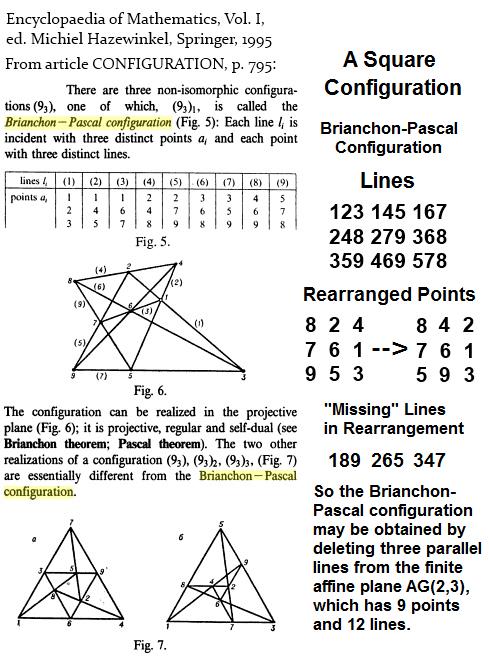
See also this method of illustration in the article "Configuration"
of the Encyclopedia of Mathematics.
* See Ryser, "Combinatorial Configurations,"
SIAM Journal on Applied Mathematics
Vol. 17, No. 3 (May, 1969), pp. 593-602 —

Wednesday, December 4, 2024
Thursday, October 31, 2024
Touching Base . . . and Minding the Gap
(The annotated page above is not in the cited source.)
"Sunshine on my shoulders . . ."
— Soundtrack for Instagram story
posted by cmellevold 18 hours ago
Saturday, October 5, 2024
Inks for Inklings:
Red, Black, and Blue
Red and black are accountants' colors. Blue, as in the above text
highlight, suggests Henry Miller and the keyhole of Opus Pistorum.
… And then there is Pullman, with his "Dust." Perhaps the most
appropriate color for Pullman's account is white , as in the following
photo annotation —
Some painters, not inkers, may enjoy studio background
music from Dusty Springfield's album "White Heat."
Red, Black, and Blue
Thursday, May 23, 2024
Logo Design: The Maltese Parrot
"The stuff that dreams are made of." — Bogart
But seriously . . .
|
From OSF . . . Among the positions that take this independence even further is Susanne Langer's approach towards meaning. Long before Derrida, she suggested in her chapter "The logic of signs and symbols" that we should understand meaning not as a relation to an author at all. Influenced by music and musical notation, she defines meaning instead as the function of a term from which a pattern emerges:
It is better, perhaps, to say: "Meaning is not a Reference: Langer, Susanne K., 1948 [1954]. Philosophy in a New Key: A Study in the Symbolism of Reason, Rite, and Art. Mentor Book. |
Saturday, May 18, 2024
Among the Positions
|
From OSF . . . Among the positions that take this independence even further is Susanne Langer's approach towards meaning. Long before Derrida, she suggested in her chapter "The logic of signs and symbols" that we should understand meaning not as a relation to an author at all. Influenced by music and musical notation, she defines meaning instead as the function of a term from which a pattern emerges:
It is better, perhaps, to say: "Meaning is not a Reference: Langer, Susanne K., 1948 [1954]. Philosophy in a New Key: A Study in the Symbolism of Reason, Rite, and Art. Mentor Book. |
Related art . . .
Cover illustration:
Spies returning from the land of
Canaan with a cluster of grapes.
Colored woodcut from
Biblia Sacra Germanica ,
Nuremberg, Anton Koberger, 1483.
Victoria and Albert Museum, London.
Friday, May 17, 2024
New Key
"I've got a brand new pair of roller skates,
you've got a brand new key." — Song lyric
|
From OSF . . . "According to Derrida, to break with its original context and with its situation of production entirely is the ability of, and even a necessity for, the written. With this argument, Derrida moves the author and their communicative intent to the margins and frees up space to approach meaning from another side, stressing the independence of writing from its speaker. Among the positions that take this independence even further is Susanne Langer's approach towards meaning. Long before Derrida, she suggested in her chapter 'The logic of signs and symbols' that we should understand meaning not as a relation to an author at all. Influenced by music and musical notation, she defines meaning instead as the function of a term from which a pattern emerges:
It is better, perhaps, to say: 'Meaning is not a Langer's approach towards meaning as a function puts the relation to other terms in the foreground, the pattern a term is part of and linked to. From her perspective, strongly informed by thinking of meaning-making in music, this seems obvious. In music, no note holds meaning for itself. It is in the relation between notes that meaning emerges, and Large Language Models approach language in a similar manner." Reference: Langer, Susanne K., 1948 [1954]. Philosophy in a New Key: A Study in the Symbolism of Reason, Rite, and Art. Mentor Book. |
Wednesday, February 7, 2024
Personal Emblem
Personal Emblem
of psychiatrist
Harry Stack Sullivan
This image, from a post of Wednesday, Dec. 12, 2007,
was suggested by Taylor Swift's annotation for her new
album . . .
http://m759.net/wordpress/?p=114081 —
"And so I enter into evidence
My tarnished coat of arms . . . ."
and by the Frida Kahlo image in the 2007 post, as well as
Kahlo in art by the former Sullivanian whose work has
now been added to yesterday's "American Pie" post.
Tuesday, February 6, 2024
Evidence
"And so I enter into evidence
My tarnished coat of arms . . . ."
— Taylor Swift, annotation for a new album.
Sunday, October 8, 2023
Aulidic Venus
The title is an annotation from page 299 of Finnegans Wake.
The complete phrase is …
Canine Venus
sublimated to
Aulidic
Aphrodite.
Tuesday, March 28, 2023
Language Drill
"Jigs are indispensable in the machining process.
They help guide and hold workpieces to a specified
location, thus ensuring that any drilling or tapping
will be accurate."
See also, in this journal, "the notation 'as' " …
"At the still point, there the dance is." — T. S. Eliot
Wednesday, September 21, 2022
Verse without Words (Title via Kandinsky)
Tuesday, September 6, 2022
Saturday, July 30, 2022
Modal Diamond Box
|
A mnemonic from a course titled
“Traditionally, there are two modalities, namely,
|
For less rigorous remarks, search Log24 for Modal Diamond Box.
Sunday, July 10, 2022
Midnight in the Garden
Today's date — "10" or one-zero — suggests a review of base-16
(hexadecimal) notation. In hexadecimal, "10" means 16.
See as well some other Geek Lore.
Wednesday, June 8, 2022
Thursday, February 17, 2022
Four Dots, Six Lines
"There is such a thing as a tesseract."
— Mrs. Whatsit in A Wrinkle in Time (1962)
"Simplify, simplify." — Henry David Thoreau in Walden (1854)
|
A Jungian on this six-line figure:
“They are the same six lines that exist in the I Ching…. Now observe the square more closely: four of the lines are of equal length, the other two are longer…. For this reason symmetry cannot be statically produced and a dance results.” |
Wednesday, February 9, 2022
8!
Conwell, 1910 —
(In modern notation, Conwell is showing that the complete
projective group of collineations and dualities of the finite
3-space PG (3,2) is of order 8 factorial, i.e. "8!" —
In other words, that any permutation of eight things may be
regarded as a geometric transformation of PG (3,2).)
Later discussion of this same "Klein correspondence"
between Conwell's 3-space and 5-space . . .
A somewhat simpler toy model —
Related fiction — "The Bulk Beings" of the film "Interstellar."
Sunday, January 16, 2022
O’Hara vs. West
"You see, Malloy, I'm writing a novel about Los Angeles….
It's a fantastic place, you know, Malloy…. It has a Spanish name,
with religious Roman Catholic connotations…. And yet, Malloy,
consider this: the really fantastic thing about it is that it's the
crystallization of the ordinary, cheap ordinary American.
The people. The politics. The cults…. And I'm going to put it
in a book…."
— Hope of Heaven, by John O'Hara (1938)
The Malloy character perhaps represents O'Hara, and the
speaker in the passage above, Nathanael West. The planned
book is perhaps The Day of the Locust , by West (1939).
The opening of Miss Lonelyhearts , an earlier work by West —
|
The Miss Lonelyhearts of The New York Post-Dispatch (Are-you-in-trouble?—Do-you-need-advice?—Write-to-Miss-Lonelyhearts-and-she-will-help-you) sat at his desk and stared at a piece of white cardboard. On it a prayer had been printed by Shrike, the feature editor.
“Soul of Miss L, glorify me. Although the deadline was less than a quarter of an hour away, he was still working on his leader. He had gone as far as: “Life is worth while, for it is full of dreams and peace, gentleness and ecstasy, and faith that burns like a clear white flame on a grim dark altar.” But he found it impossible to continue. The letters were no longer funny. He could not go on finding the same joke funny thirty times a day for months on end. And on most days he received more than thirty letters, all of them alike, stamped from the dough of suffering with a heart-shaped cookie knife. |
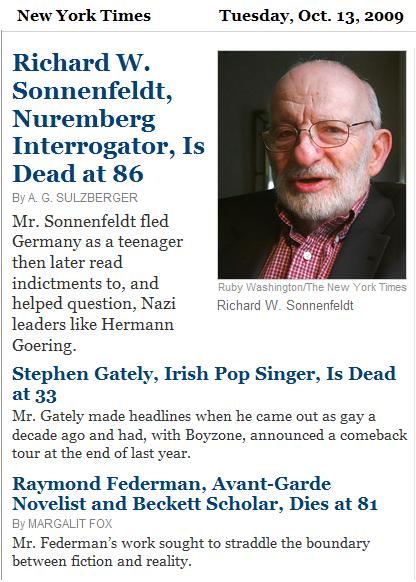
This post was suggested by an obituary in tonight's online
New York Times and by the German nickname — Würger ,
in English: Shrike — of a WWII German fighter plane
mentioned in that obituary.


.gif)