
Related material:
Lead obituary in today’s online New York Times and Los Angeles Times —

Maazel reportedly died on Sunday, July 13, 2014.
From a search in this journal for Iconic Notation,
a related image from August 14, 2010—

See also…
Epiphany

Related material:
Lead obituary in today’s online New York Times and Los Angeles Times —
Maazel reportedly died on Sunday, July 13, 2014.
From a search in this journal for Iconic Notation,
a related image from August 14, 2010—
See also…
Epiphany
Roman answer: X
Whanganui answer: Also X
Graphic answer: Hexagram 14
Art History answer: The Ten O'Clock
Architectural theorist Jeffrey Kipnis in 1991, recalled here in 2015 —

For the source of the illustration, see Hexagram 14.

Click the above image for details.

There was, however, a challenge by Cozzens himself:

The apparent source:

Box-style I Ching, January 6, 1989 —
(Click on images for background.)
Detail:
See also yesterday's illustration of
the 1965 paperback edition
of Whittaker and Watson …

Detail:
 .
.

— Jeffrey Kipnis, "Twisting the Separatrix"
Assemblage No. 14 (Apr., 1991), pp. 30-61
Published by: The MIT Press
Article Stable URL: http://www.jstor.org/stable/3171098
This morning's New York Times obituaries—

These suggest a look at Solving Nabokov's Lolita Riddle ,
by Joanne Morgan (Sydney: Cosynch Press, 2005).
That book discusses Lolita as a character like Lewis Carroll's Alice.
(The Red Queen and Alice of course correspond to figures in
the first two thumbnails above.)
From the obituary associated with the third thumbnail above:
"Front-page headlines combined concision and dark humor."
The title of this post, Bend Sinister , is not unlike such a headline.
It is the title of a novel by Nabokov (often compared with Orwell's 1984 )
that is discussed in the Lolita Riddle book.
Related material— The bend sinister found in Log24 searches
for Hexagram 14 and for the phrase Hands-On—
 |
 |
The New York Times today—
"Reality and our perception of it are incommensurate…."

The above New York Times Wire item from 3:35 PM ET today
mentions two topics touched on in today's earlier Log24 post
Bowling in Diagon Alley— magic (implied by the title) and
incommensurability. The connection in that post
between the two topics is the diagonal of a square.
The wire item shows one detail from a Times illustration
of the linked article— a blindfolded woman.
Another detail from the same illustration—
Hands-on Wand Work
See also remarks on Magic in this journal and on Harry Potter.
I dislike both topics.
From post 4017 in this journal (do not click links)—
"Thanks to University Diaries for an entry on Clancy Martin,
a philosophy professor in the 'show me' state, and his experiences with AA."
Neither link in this quote works anymore.
See instead Martin in the London Review of Books .
Lottery hermeneutics, however, still seems usable.

Today's midday NY lottery "163" may be taken as a sequel
to both the page number "162" in today's noon post—

— Humboldt's Gift , page 163 (Penguin Classics, 1996)
— and a sequel to University Diaries ' meditation today on the Nobel literature prize,
which includes a quote from the winner:
"At last my life returns. My name appears like an angel.
Outside the walls a trumpet signal blows…. It is I! It is I!"
— Tomas Tranströmer, "The Name"
As for the evening NY numbers 014 and 5785, see Hexagram 14,
Not Even Wrong , and 5/7/85.
Continued from Friday the 13th—
Related material—

Cover art by Barclay Shaw reprinted from an earlier (1984) edition

A question from Ivan Illich
(founder of CIDOC, the Center for Intercultural Documentation,
in Cuernavaca, Mexico)—
"Who can be served by bridges to nowhere?"
For more about nowhere, see Utopia. See also http://outis.blogspot.com.
Symbol from the
box-style I Ching
Related material:
The five Log24 entries
ending on August 1
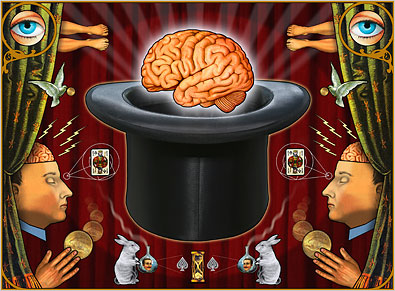
Illustration by Lou Beach
in today's New York Times
article on science and magic
Related material:
A Wrinkle in Time
From the front page of this
morning's online New York Times:


Stephen B. King,
a Hallmark creative director,
with some of the new
greeting cards based
on topical themes and humor.

When you care enough
to send the very best…
From a llnk to Aug. 1
in yesterday's entry:
Epiphany
Box-style I Ching, January 6, 1989
(Click on image for background.)
Detail:
Related material:
Logos and Logic
and Diagon Alley.

Logo design by Anton Stankowski
"… at the beginning of the thirties… Stankowski began to work as a typographer and graphic designer in a Zurich advertising agency. Together with a group of friends– they were later to be known as the 'Zurich Concretists'– he explored the possibilities of symmetry and mirroring in the graphic arts. Stankowski experimented with squares and diagonals, making them the hallmarks of his art. Of his now world-famous logo for the Deutsche Bank— the soaring diagonal in the stable square– he proudly said in 1974: 'The company logo is a trade-mark that sends out a signal.'"
New York firefighters
killed at Deutsche Bank

"Two New York fire fighters were killed while trying to douse a blaze in the former Deutsche Bank building in the city.
The fire broke out on 14th and 15th floors yesterday afternoon and spread to several floors before it was brought under control about five hours later.
The building had been heavily damaged during the 11 September, 2001 terrorist attacks.
The building, which was damaged by falling debris of the twin towers that had collapsed in 2001 when terrorists flew hijacked planes into them, was being 'deconstructed' to make way for construction of a new Freedom Tower."
Related material
|
SPORTS OF THE TIMES
Restoring the Faith
By SELENA ROBERTS
What good is a nadir if it's denied or ignored? What's the value of reaching the lowest of the low if it can't buy a cheap epiphany? |
When you care enough
to send the very best…

"Summer Reading,"
by Joost Swarte
Cover art by Barclay Shaw reprinted
from an earlier (1984) edition
Philip K. Dick as a
window wraith (see below)
"… the kind of guy who can't drink one cup of coffee without drinking six, and then stays up all night to tell you what Schopenhauer really said and how it affects your understanding of Hitchcock and what that had to do with Christopher Marlowe."
— as well as by the illustrations of Gopnik's characterization in Kernel of Eternity, and by the following passage from Gopnik's 2005 novel The King in the Window:
"What's a window wraith?"
"It's someone who once lived in the ordinary world who lives now in a window, and makes reflections of the people who pass by and look in."
"You mean you are a ghost?!" Oliver asked, suddenly feeling a little terrified.
"Just the opposite, actually. You see, ghosts come from another world and haunt you, but window wraiths are the world. We're the memory of the world. We're here for good. You're the ones who come and go like ghosts. You haunt us."
Related material: As noted, Kernel of Eternity, and also John Tierney's piece on simulated reality in last night's online New York Times. Whether our everyday reality is merely a simulation has long been a theme (as in Dick's novel above) of speculative fiction. Interest in this theme is widespread, perhaps partly because we do exist as simulations– in the minds of other people. These simulations may be accurate or may be– as is perhaps Gopnik's characterization of Philip K. Dick– inaccurate. The accuracy of the simulations is seldom of interest to the simulator, but often of considerable interest to the simulatee.
The cover of the Aug. 20 New Yorker in which the Adam Gopnik essay appears may also be of interest, in view of the material on diagonals in the Log24 entries of Aug. 1 linked to in yesterday's entry:
"Summer Reading,"
by Joost Swarte
This symbol from the
box-style I Ching is
echoed by a French ad for
the 2006 film "Scoop"–

This film may be taken as
foreshadowing the afterlife
of the late Fleet Street
figure Richard Stott.
Stott, along with film
directors Ingmar Berman
and Michelangelo Antonioni,
died on Monday (July 30).
He is, we may suppose,
the mysterious third man
in Tuesday's remark by
the mayor of Rome:
"With Antonioni dies not only
one of the greatest directors

but also
a master of modernity."

Dogs and Lampposts,
by Richard Stott
The title of Stott's book
is from H. L. Mencken,
who is said to have felt
that the proper relationship
of a journalist to a politician
is that of a dog to a lamppost.
Cheap Epiphany
|
SPORTS OF THE TIMES
Restoring the Faith
By SELENA ROBERTS What good is a nadir if it's denied or ignored? What's the value of reaching the lowest of the low if it can't buy a cheap epiphany? |
|
Pennsylvania Lottery on the Feast of St. Ignatius Loyola: |
|

|

|
Restoring the Booze:
A Look at the 50's-

Another Epiphany:
Box-style I Ching, January 6, 1989
(Click on image for background.)
Detail:
Related material:
Logos and Logic
and Diagon Alley.
"What a swell
party this is."
— adapted from
Cole Porter
Powered by WordPress
