From a Jan. 27 post —

The Hustvedt title "Dance Around the Self" suggests
a review of other posts now tagged Jung Diamonds.
From a Jan. 27 post —
The Hustvedt title "Dance Around the Self" suggests
a review of other posts now tagged Jung Diamonds.

Tuesday, June 15, 2010
|
|
Google search result: Saint Anselm College https://www.anselm.edu › Documents › Brown by M Brown · 2014 · Cited by 14 — Thomas insists that the image of God exists most perfectly in the acts of the soul, for the soul is that which is most perfect in us and so best images God, and … 11 pages |
For a Douglas Hofstadter version of the Imago Dei , see the
"Gödel, Escher, Bach" illustration in the Jan. 15 screenshot below —

Tuesday, June 15, 2010
|
"The novelist Cormac McCarthy has been a fixture around
the Santa Fe Institute since its embryonic stages in the
early 1980s. Cormac received a MacArthur Award in 1981
and met one of the members of the board of the MacArthur
Foundation, Murray Gell-Mann, who had won the Nobel Prize
in physics in 1969. Cormac and Murray discovered that they
shared a keen interest in just about everything under the sun
and became fast friends. When Murray helped to found the
Santa Fe Institute in 1984, he brought Cormac along, knowing
that everyone would benefit from this cross-disciplinary
collaboration." — https://www.santafe.edu/news-center/news/
cormac-and-sfi-abiding-friendship
Joy Williams, review of two recent Cormac McCarthy novels —
"McCarthy has pocketed his own liturgical, ecstatic style
as one would a coin, a ring, a key, in the service of a more
demanding and heartless inquiry through mathematics and
physics into the immateriality, the indeterminacy, of reality."
A Demanding and Heartless Coin, Ring, and Key:
COIN

RING
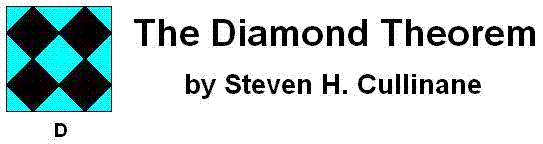
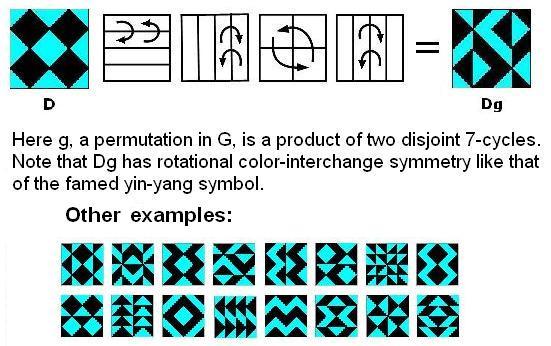
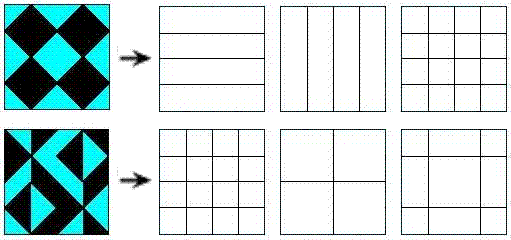
"We can define sums and products so that the G-images of D generate
an ideal (1024 patterns characterized by all horizontal or vertical "cuts"
being uninterrupted) of a ring of 4096 symmetric patterns. There is an
infinite family of such 'diamond' rings, isomorphic to rings of matrices
over GF(4)."
KEY
"It must be remarked that these 8 heptads are the key to an elegant proof…."
— Philippe Cara, "RWPRI Geometries for the Alternating Group A8," in
Finite Geometries: Proceedings of the Fourth Isle of Thorns Conference
(July 16-21, 2000), Kluwer Academic Publishers, 2001, ed. Aart Blokhuis,
James W. P. Hirschfeld, Dieter Jungnickel, and Joseph A. Thas, pp. 61-97.
For those who prefer a "liturgical, ecstatic style" —


Jung’s four-diamond figure from
Aion — a symbol of the self –

For those who prefer the Ed Wood approach —
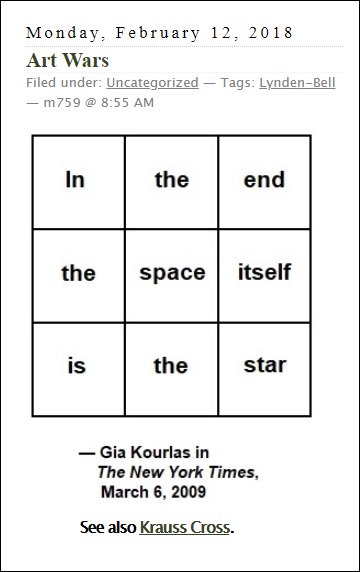


" How small is the evil that may be safely ignored…? "
— "QBass" at Wikipedia, April 1, 2020
Good question.
Remarks by Rosalind Krauss in the previous post suggest a look at …

Then there is the universal beauty of oneself :
Jung's Four-Diamond Figure from Aion—

This figure was devised by Jung
to represent the Self.
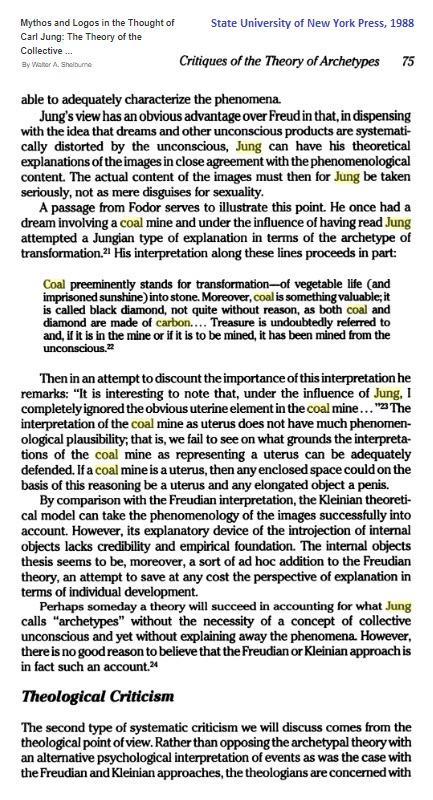
Mythos
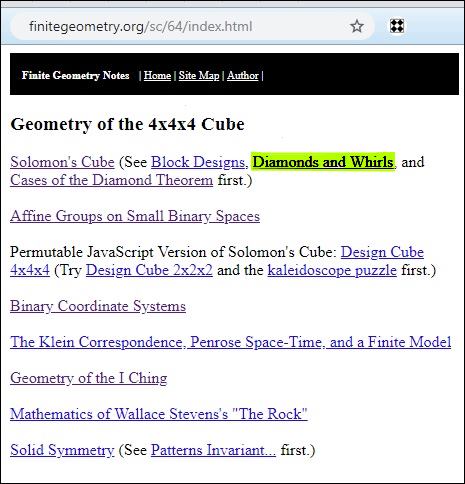
Logos
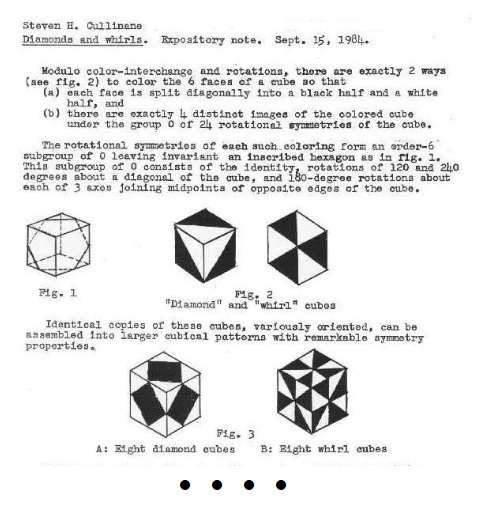
The six square patterns which, applied as above to the faces of a cube,
form "diamond" and "whirl" patterns, appear also in the logo of a coal-
mining company —
 .
.
Related material —
Metaphysical conceit | literature | Britannica.com
|
This post's title refers to a metaphysical conceit
in the previous post, Desperately Seeking Clarity.
Related material —


The source of the above mystical octahedron —

See also Jung's Imago Dei in this journal.
The title was suggested by the "Crystal Cult" installations
of Oslo artist Josefine Lyche and by a post of May 30 —
|
Thursday, May 30, 2019 Filed under: General — m759 @ 8:02 PM Edit This Jeff Nichols, director of Midnight Special (2016) —
"When asked about the film's similarities to See also Jung's four-diamond figure and the previous post. |
Writers of fiction are, of course, also dabblers in the collective unconscious.
For instance . . .
A 1971 British paperback edition of The Dreaming Jewels,
a story by Theodore Sturgeon (first version published in 1950):

The above book cover, together with the Death Valley location
Zabriskie Point, suggests . . .

Those less enchanted by the collective unconscious may prefer a
different weblog's remarks on the same date as the above Borax post . . .

Jeff Nichols, director of Midnight Special (2016) —
"When asked about the film's similarities to the 2015 Disney
movie Tomorrowland , which also posits a futuristic world
that exists in an alternative dimension, Nichols sighed.
'I was a little bummed, I guess,' he said of when he first
learned about the project. . . . 'Our die was cast.
Sometimes this kind of collective unconscious that
we're all dabbling in, sometimes you're not the first one
out of the gate.' "
See also Jung's four-diamond figure and the previous post.
1955 ("Blackboard Jungle") —

1976 —

2009 —

2016 —

Continued from the previous post and from posts
now tagged Dueling Formulas —
The four-diamond formula of Jung and
the four-dot "as" of Claude Lévi-Strauss:


Simplified versions of the diamonds and the dots —
 ::
::
I prefer Jung. For those who prefer Lévi-Strauss —

First edition, Cornell University Press, 1970.
A related tale — "A Meaning, Like."
At MASS MoCA, the installation "Chalkroom" quotes a lyric —
Oh beauty in all its forms funny how hatred can also be a beautiful thing When it's as sharp as a knife as hard as a diamond Perfect |
— From "One Beautiful Evening," by Laurie Anderson.
See also the previous post and "Smallest Perfect" in this journal.

The above cycle may have influenced the design
of Carl Jung's symbol of the self —

Related art by
Steven H. Cullinane
See also Levi-Strauss Formula in this journal.
The "unity" of the title was suggested by this morning's update
at the end of yesterday's post Paz.
For the Plato of the title, see the Sept. 27, 2016, post
For glyphs representing the "unity of opposites" of the title,
see a webpage linked to here on Groundhog Day 2014 —

The above image is related to Jung's remarks on Coincidentia
Oppositorum . (See also coincidentia in this journal.)
A different Jung, in a new video with analogues of the rapidly
flashing images in Ajna's webpage "Diamond Theory Roullete" —

The above video promotes Google's new open-source "Noto" font —

From a web page —
Breaking the Code of the Archetypal Self:
An Introductory Overview of the Research Discoveries
Leading to Neo-Jungian Structural Psychoanalysis
Dr. Moore will introduce his research and discoveries
with regard to the deep structures of the Self.
Tracing the foundations in the tradition of Jung’s
affirmation of the collective unconscious, Moore
will present his “decoding of the Diamond Body,”
a mapping of the deep structures of the Great Code
of the psyche. . . .
From the same web site —

Googling "Jung" + "Diamond Body" shows that
Moore's terminology differs from Jung's.
The octahedron that Moore apparently associates
with his "diamond body" was discussed by Jung
in a different context. See selections from Ch. 14
of Jung's Aion : "The Structure and Dynamics of the Self."
Dr. Moore appears as well in the murder-suicide story
of last night's 11:18 PM ET post.
For the relevance of Aion to "deep structures,"
see Jung + Diamond + Structure in this journal
and, more specifically, "Deep Structure."
According to McLuhan
Marshall McLuhan writing to Ezra Pound on Dec. 21, 1948—
"The American mind is not even close to being amenable
to the ideogram principle as yet. The reason is simply this.
America is 100% 18th Century. The 18th century had
chucked out the principle of metaphor and analogy—
the basic fact that as A is to B so is C to D. AB:CD.
It can see AB relations. But relations in four terms are still
verboten. This amounts to deep occultation of nearly all
human thought for the U.S.A.
I am trying to devise a way of stating this difficulty as it exists.
Until stated and publicly recognized for what it is, poetry and
the arts can’t exist in America."
For context, see Cameron McEwen,
"Marshall McLuhan, John Pick, and Gerard Manley Hopkins."
(Renascence , Fall 2011, Vol. 64 Issue 1, 55-76)
A relation in four terms —
A : B :: C : D as Model : Crutch :: Metaphor : Ornament —

See also Dueling Formulas and Symmetry.
From a check tonight of The New York Review of Books —

These NYRB stories from May 15 and May 13 suggest a
review of images on Ratner's Star and on the Eye of God.

Above image reposted from Jan. 10, 2014
|
I. The structures in the Diamond Puzzle…
Click on image for Jungian background. II: The structure on a recent cover of Semiotica…
|
Above images reposted from May 5, 2016
Related material: The previous post, Dueling Formulas.

Note the echo of Jung's formula in the diamond theorem.
An attempt by Lévi-Strauss to defend his formula —

"… reducing the life of the mind to an abstract game . . . ." —
For a fictional version of such a game, see Das Glasperlenspiel .
Excerpt from a post of November 4, 2009 —
|
I. The structures in the Diamond Puzzle…
Click on image for Jungian background. II: The structure on a recent cover of Semiotica…
|
For some related material, see a search
for Solomon Marcus in this journal.
The saying of poet Mary Karr that
"there is a body on the cross in my church,"
together with the crosses of the previous post,
suggests a synchronicity check of the
date discussed in that post —

“Be serious, because
The stone may have contempt
For too-familiar hands”
— Adrienne Rich in “The Diamond Cutters” (1955)
Blackboard Jungle , 1955 —

"Remember, Genesis IS Skynet."
Bloomberg News today:
Why 2015 Was a Breakthrough Year in Artificial Intelligence
"Computers are 'starting to open their eyes,' said a senior fellow at Google."
For Jack and Jill.

The above motivational video is from the web page of a middle school
math teacher who was shot to death yesterday morning.
Related journalism —

See also "S in a Diamond" (here, October 2013)
and "Superman Comes to the Supermarket,"
by Norman Mailer (Esquire , November 1960).
In a recent film, Amy Adams asked Superman,
"What's the S stand for?"
One possible answer, in light of Stephen King's
recent sequel to The Shining and of
the motivational video above—
Steam.
Memories, Dreams, Reflections
by C. G. Jung
Recorded and edited By Aniela Jaffé, translated from the German
by Richard and Clara Winston, Vintage Books edition of April 1989
From pages 195-196:
"Only gradually did I discover what the mandala really is:
'Formation, Transformation, Eternal Mind's eternal recreation.'*
And that is the self, the wholeness of the personality, which if all
goes well is harmonious, but which cannot tolerate self-deceptions."
* Faust , Part Two, trans. by Philip Wayne (Harmondsworth,
England, Penguin Books Ltd., 1959), p. 79. The original:
… Gestaltung, Umgestaltung,
Des ewigen Sinnes ewige Unterhaltung….
Jung's "Formation, Transformation" quote is from the realm of
the Mothers (Faust , Part Two, Act 1, Scene 5: A Dark Gallery).
The speaker is Mephistopheles.
See also Prof. Bruce J. MacLennan on this realm
in a Web page from his Spring 2005 seminar on Faust:
"In alchemical terms, F is descending into the dark, formless
primary matter from which all things are born. Psychologically
he is descending into the deepest regions of the
collective unconscious, to the source of life and all creation.
Mater (mother), matrix (womb, generative substance), and matter
all come from the same root. This is Faust's next encounter with
the feminine, but it's obviously of a very different kind than his
relationship with Gretchen."
The phrase "Gestaltung, Umgestaltung " suggests a more mathematical
approach to the Unterhaltung . Hence…
Part I: Mothers
"The ultimate, deep symbol of motherhood raised to
the universal and the cosmic, of the birth, sending forth,
death, and return of all things in an eternal cycle,
is expressed in the Mothers, the matrices of all forms,
at the timeless, placeless originating womb or hearth
where chaos is transmuted into cosmos and whence
the forms of creation issue forth into the world of
place and time."
— Harold Stein Jantz, The Mothers in Faust:
The Myth of Time and Creativity ,
Johns Hopkins Press, 1969, page 37
Part II: Matrices


Part III: Spaces and Hypercubes

Click image for some background.
Part IV: Forms
Forms from the I Ching :

Click image for some background.
Forms from Diamond Theory :

Click image for some background.
(Continued from In Memoriam (Aug. 22), Chapman's Homer (Aug. 23),
and this morning's Colorful Tale)
An informative, but undated, critique of the late Marvin W. Meyer
by April D. DeConick at the website of the Society of Biblical Literature
appeared in more popular form in an earlier New York Times
op-ed piece, "Gospel Truth," dated Dec. 1, 2007.
A check, in accord with Jungian synchronicity, of this journal
on that date yields a quotation from Plato's Phaedrus —
"The soul or animate being has the care of the inanimate."
Related verses from T. S. Eliot's Four Quartets —
"The detail of the pattern is movement."
"So we moved, and they, in a formal pattern."
Some background from pure mathematics (what the late
William P. Thurston called "the theory of formal patterns")—

Related art—
Midnight's Icons,

and…

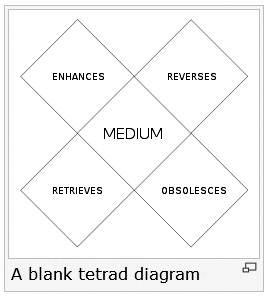
(Wikipedia figure)
"Visually, a tetrad can be depicted as
four diamonds forming an X…."
Background: Jung's Aion in this journal discusses this
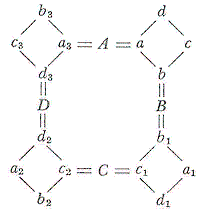
figure from finite geometry's diamond theorem—
Fig. A
This resembles a figure that served Jung
as a schema of the Self—
Fig. B
Fig. A, with color variations, serves as the core
of many automatically generated Identicons —
a different sort of self-symbol.
Examples from Sept. 6 at MathOverflow—


A user wanting to custom-tailor his self-symbol should consider
the following from the identicon service Gravatar—
1. User Submissions. "… you hereby do and shall grant to Automattic a worldwide, perpetual, irrevocable, royalty-free and fully-paid, transferable (including rights to sublicense) right to perform the Services (e.g., to use, modify, reproduce, distribute, prepare derivative works of, display, perform, and otherwise fully exercise and exploit all intellectual property, publicity, and moral rights with respect to any User Submissions, and to allow others to do so)."
Sounds rather Faustian.
… and Arthur Koestler
|
The theme of the January 2010 issue of the
Notices of the American Mathematical Society was “Mathematics and the Arts.”
Related material:
|
See also two posts from the day Peter Jennings died—
"Plato acknowledges how khora challenges our normal categories
of rational understanding. He suggests that we might best approach it
through a kind of dream consciousness."
—Richard Kearney, quoted here yesterday afternoon
"You make me feel like I'm living a teenage dream."
— Song at last night's Grammy awards

Richard Kiley in "Blackboard Jungle" (1955)
Note the directive on the blackboard.
Quoted here last year on this date—
Alexandre Borovik's Mathematics Under the Microscope (American Mathematical Society, 2010)—
"Once I mentioned to Gelfand that I read his Functions and Graphs ; in response, he rather sceptically asked me what I had learned from the book. He was delighted to hear my answer: 'The general principle of always looking at the simplest possible example.'….
So, let us look at the principle in more detail:
Always test a mathematical theory on the simplest possible example…
This is a banality, of course. Everyone knows it; therefore, almost no one follows it."
Related material— Geometry Simplified and A Simple Reflection Group of Order 168.
"Great indeed is the riddle of the universe.
Beautiful indeed is the source of truth."
– Shing-Tung Yau, Chairman,
Department of Mathematics, Harvard University
"Always keep a diamond in your mind."
– King Solomon at the Paradiso

Image from stoneship.org
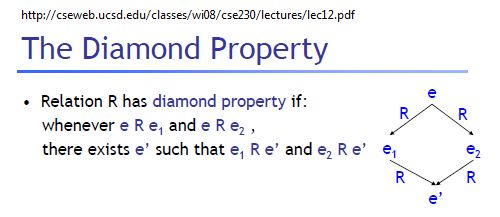
Also known, roughly speaking, as confluence or the Church-Rosser property.
From “NYU Lambda Seminar, Week 2” —
[See also the parent page Seminar in Semantics / Philosophy of Language or:
What Philosophers and Linguists Can Learn From Theoretical Computer Science But Didn’t Know To Ask)]
A computational system is said to be confluent, or to have the Church-Rosser or diamond property, if, whenever there are multiple possible evaluation paths, those that terminate always terminate in the same value. In such a system, the choice of which sub-expressions to evaluate first will only matter if some of them but not others might lead down a non-terminating path.
The untyped lambda calculus is confluent. So long as a computation terminates, it always terminates in the same way. It doesn’t matter which order the sub-expressions are evaluated in.
A computational system is said to be strongly normalizing if every permitted evaluation path is guaranteed to terminate. The untyped lambda calculus is not strongly normalizing: ω ω doesn’t terminate by any evaluation path; and (\x. y) (ω ω) terminates only by some evaluation paths but not by others.
But the untyped lambda calculus enjoys some compensation for this weakness. It’s Turing complete! It can represent any computation we know how to describe. (That’s the cash value of being Turing complete, not the rigorous definition. There is a rigorous definition. However, we don’t know how to rigorously define “any computation we know how to describe.”) And in fact, it’s been proven that you can’t have both. If a computational system is Turing complete, it cannot be strongly normalizing.
There is no connection, apart from the common reference to an elementary geometric shape, between the use of “diamond” in the above Church-Rosser sense and the use of “diamond” in the mathematics of (Cullinane’s) Diamond Theory.
Any attempt to establish such a connection would, it seems, lead quickly into logically dubious territory.
Nevertheless, in the synchronistic spirit of Carl Jung and Arthur Koestler, here are some links to such a territory —
Link One — “Insane Symmetry” (Click image for further details)—

See also the quilt symmetry in this journal on Christmas Day.
Link Two — Divine Symmetry
(George Steiner on the Name in this journal on Dec. 31 last year (“All about Eve“)) —
“The links are direct between the tautology out of the Burning Bush, that ‘I am’ which accords to language the privilege of phrasing the identity of God, on the one hand, and the presumptions of concordance, of equivalence, of translatability, which, though imperfect, empower our dictionaries, our syntax, our rhetoric, on the other. That ‘I am’ has, as it were, at an overwhelming distance, informed all predication. It has spanned the arc between noun and verb, a leap primary to creation and the exercise of creative consciousness in metaphor. Where that fire in the branches has gone out or has been exposed as an optical illusion, the textuality of the world, the agency of the Logos in logic—be it Mosaic, Heraclitean, or Johannine—becomes ‘a dead letter.'”
– George Steiner, Grammars of Creation
(See also, from Hanukkah this year, A Geometric Merkabah and The Dreidel is Cast.)
Link Three – Spanning the Arc —
Part A — Architect Louis Sullivan on “span” (see also Kindergarten at Stonehenge)
Part B — “Span” in category theory at nLab —

Also from nLab — Completing Spans to Diamonds
“It is often interesting whether a given span in some partial ordered set can be completed into a diamond. The property of a collection of spans to consist of spans which are expandable into diamonds is very useful in the theory of rewriting systems and producing normal forms in algebra. There are classical results e.g. Newman’s diamond lemma, Širšov-Bergman’s diamond lemma (Širšov is also sometimes spelled as Shirshov), and Church-Rosser theorem (and the corresponding Church-Rosser confluence property).”
The concepts in this last paragraph may or may not have influenced the diamond theory of Rudolf Kaehr (apparently dating from 2007).
They certainly have nothing to do with the Diamond Theory of Steven H. Cullinane (dating from 1976).
For more on what the above San Francisco art curator is pleased to call “insane symmetry,” see this journal on Christmas Day.
For related philosophical lucubrations (more in the spirit of Kaehr than of Steiner), see the New York Times “The Stone” essay “Span: A Remembrance,” from December 22—
“To understand ourselves well,” [architect Louis] Sullivan writes, “we must arrive first at a simple basis: then build up from it.”
Around 300 BC, Euclid arrived at this: “A point is that which has no part. A line is breadthless length.”
See also the link from Christmas Day to remarks on Euclid and “architectonic” in Mere Geometry.

In the above view, four of the tesseract's 16
vertices are overlaid by other vertices.
For views that are more complete and
moveable, see Smith's tesseract page.
Four-Part Tesseract Divisions—

The above figure shows how four-part partitions
of the 16 vertices of a tesseract in an infinite
Euclidean space are related to four-part partitions
of the 16 points in a finite Galois space
|
Euclidean spaces versus Galois spaces in a larger context— Infinite versus Finite The central aim of Western religion —
"Each of us has something to offer the Creator...
the bridging of
                 masculine and feminine,
                      life and death.
It's redemption.... nothing else matters."
-- Martha Cooley in The Archivist  (1998)
The central aim of Western philosophy —
              Dualities of Pythagoras
              as reconstructed by Aristotle:
                 Limited     Unlimited
                     Odd     Even
                    Male     Female
                   Light      Dark
                Straight    Curved
                  ... and so on ....
"Of these dualities, the first is the most important; all the others may be seen as different aspects of this fundamental dichotomy. To establish a rational and consistent relationship between the limited [man, etc.] and the unlimited [the cosmos, etc.] is… the central aim of all Western philosophy." |
Another picture related to philosophy and religion—
Jung's Four-Diamond Figure from Aion—
This figure was devised by Jung
to represent the Self. Compare the
remarks of Paul Valéry on the Self—
|
Flight from Eden: The Origins of Modern Literary Criticism and Theory, by Steven Cassedy, U. of California Press, 1990, pages 156-157—
Valéry saw the mind as essentially a relational system whose operation he attempted to describe in the language of group mathematics. "Every act of understanding is based on a group," he says (C, 1:331). "My specialty— reducing everything to the study of a system closed on itself and finite" (C, 19: 645). The transformation model came into play, too. At each moment of mental life the mind is like a group, or relational system, but since mental life is continuous over time, one "group" undergoes a "transformation" and becomes a different group in the next moment. If the mind is constantly being transformed, how do we account for the continuity of the self? Simple; by invoking the notion of the invariant. And so we find passages like this one: "The S[elf] is invariant, origin, locus or field, it's a functional property of consciousness" (C, 15:170 [2:315]). Just as in transformational geometry, something remains fixed in all the projective transformations of the mind's momentary systems, and that something is the Self (le Moi, or just M, as Valéry notates it so that it will look like an algebraic variable). Transformation theory is all over the place. "Mathematical science… reduced to algebra, that is, to the analysis of the transformations of a purely differential being made up of homogeneous elements, is the most faithful document of the properties of grouping, disjunction, and variation in the mind" (O, 1:36). "Psychology is a theory of transformations, we just need to isolate the invariants and the groups" (C, 1:915). "Man is a system that transforms itself" (C, 2:896). O Paul Valéry, Oeuvres (Paris: Pléiade, 1957-60) C Valéry, Cahiers, 29 vols. (Paris: Centre National de le Recherche Scientifique, 1957-61) |
Note also the remarks of George David Birkhoff at Rice University
in 1940 (pdf) on Galois's theory of groups and the related
"theory of ambiguity" in Galois's testamentary letter—
|
… metaphysical reasoning always relies on the Principle of Sufficient Reason, and… the true meaning of this Principle is to be found in the “Theory of Ambiguity” and in the associated mathematical “Theory of Groups.” If I were a Leibnizian mystic, believing in his “preestablished harmony,” and the “best possible world” so satirized by Voltaire in “Candide,” I would say that the metaphysical importance of the Principle of Sufficient Reason and the cognate Theory of Groups arises from the fact that God thinks multi-dimensionally* whereas men can only think in linear syllogistic series, and the Theory of Groups is the appropriate instrument of thought to remedy our deficiency in this respect. * That is, uses multi-dimensional symbols beyond our grasp. |
Related material:
A medal designed by Leibniz to show how
binary arithmetic mirrors the creation by God
of something (1) from nothing (0).

Another array of 16 strings of 0's and 1's, this time
regarded as coordinates rather than binary numbers—


Some context by a British mathematician —

|
Imago by Wallace Stevens Who can pick up the weight of Britain, Who can move the German load Or say to the French here is France again? Imago. Imago. Imago. It is nothing, no great thing, nor man Of ten brilliancies of battered gold And fortunate stone. It moves its parade Of motions in the mind and heart, A gorgeous fortitude. Medium man In February hears the imagination's hymns And sees its images, its motions And multitudes of motions And feels the imagination's mercies, In a season more than sun and south wind, Something returning from a deeper quarter, A glacier running through delirium, Making this heavy rock a place, Which is not of our lives composed . . . Lightly and lightly, O my land, Move lightly through the air again. |
Recommended— an online book—
Flight from Eden: The Origins of Modern Literary Criticism and Theory,
by Steven Cassedy, U. of California Press, 1990.
See in particular
Pages 156-157—
Valéry saw the mind as essentially a relational system whose operation he attempted to describe in the language of group mathematics. "Every act of understanding is based on a group," he says (C, 1:331). "My specialty—reducing everything to the study of a system closed on itself and finite" (C, 19: 645). The transformation model came into play, too. At each moment of mental life the mind is like a group, or relational system, but since mental life is continuous over time, one "group" undergoes a "transformation" and becomes a different group in the next moment. If the mind is constantly being transformed, how do we account for the continuity of the self? Simple; by invoking the notion of the invariant. And so we find passages like this one: "The S[elf] is invariant, origin, locus or field, it's a functional property of consciousness" (C, 15:170 [2: 315]). Just as in transformational geometry, something remains fixed in all the projective transformations of the mind's momentary systems, and that something is the Self (le Moi, or just M, as Valéry notates it so that it will look like an algebraic variable). Transformation theory is all over the place. "Mathematical science . . . reduced to algebra, that is, to the analysis of the transformations of a purely differential being made up of homogeneous elements, is the most faithful document of the properties of grouping, disjunction, and variation in the mind" (O, 1:36). "Psychology is a theory of transformations, we just need to isolate the invariants and the groups" (C, 1:915). "Man is a system that transforms itself" (C, 2:896).
O Paul Valéry, Oeuvres (Paris: Pléiade, 1957-60)
C Valéry, Cahiers, 29 vols. (Paris: Centre National de le Recherche Scientifique, 1957-61)
Compare Jung's image in Aion of the Self as a four-diamond figure:
and Cullinane's purely geometric four-diamond figure:

For a natural group of 322,560 transformations acting on the latter figure, see the diamond theorem.
What remains fixed (globally, not pointwise) under these transformations is the system of points and hyperplanes from the diamond theorem. This system was depicted by artist Josefine Lyche in her installation "Theme and Variations" in Oslo in 2009. Lyche titled this part of her installation "The Smallest Perfect Universe," a phrase used earlier by Burkard Polster to describe the projective 3-space PG(3,2) that contains these points (at right below) and hyperplanes (at left below).

Although the system of points (at right above) and hyperplanes (at left above) exemplifies Valéry's notion of invariant, it seems unlikely to be the sort of thing he had in mind as an image of the Self.
Photo caption in NY Times today— a pianist "preforming" in 1967. (See today's previous post.)
The pianist's life story seems in part to echo that of Juliette Binoche in the film "Bleu." Binoche appeared in this journal yesterday, before I had seen the pianist in today's Times obituaries. The Binoche appearance was related to the blue diamond in the film "Duelle " (Tuesday morning's post) and the saying of Heraclitus "immortals mortal, mortals immortal" (Tuesday afternoon's post).
This somewhat uncanny echo brings to mind Nabokov—
Life Everlasting—based on a misprint!
I mused as I drove homeward: take the hint,
And stop investigating my abyss?
But all at once it dawned on me that this
Was the real point, the contrapuntal theme;
Just this: not text, but texture; not the dream
But topsy-turvical coincidence,
Not flimsy nonsense, but a web of sense.
Whether sense or nonsense, the following quotation seems relevant—
"Archetypes function as living dispositions, ideas in the Platonic sense, that preform and continually influence our thoughts and feelings and actions." –C.G. Jung in Four Archetypes: Mother, Rebirth, Spirit, Trickster, the section titled "On the Concept of the Archetype."
That section is notable for its likening of Jungian archetypes to Platonic ideas and to axial systems of crystals. See also "Cubist Tune," March 18 —

The Medium is the Message

Marshall McLuhan
From the Wikipedia article
on Marshall McLuhan–
(Click images for some background.)

Related material:
a web page on McLuhan's
student Walter J. Ong, S. J.,

Arthur Koestler by David Levine,
New York Review of Books,
December 17, 1964
| A Jesuit at the Gerard Manley Hopkins Archive: ‘Bisociation’: The Act of Creation Koestler’s concept of ‘bisociation’… enters into the very ‘act of creation.’ In every such act, writes Koestler, the creator ‘bisociates,’ that is, combines, two ‘matrices’– two diverse patterns of knowing or perceiving– in a new way. As each matrix carries its own images, concepts, values, and ‘codes,’ the creative person brings together– ‘bisociates’– two diverse matrices not normally connected. — Joseph J. Feeney, S.J. |
See also December 9, 2009:
The theme of the January 2010 issue of the
Notices of the American Mathematical Society
is “Mathematics and the Arts.”
Related material:
The theme of the January 2010 issue of the
Notices of the American Mathematical Society
is "Mathematics and the Arts."
Related material:
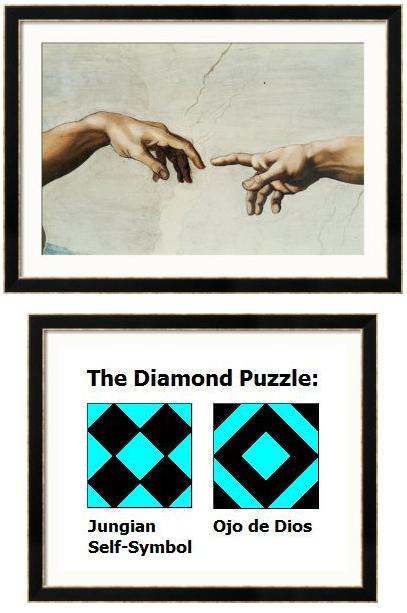
The Diamond Puzzle
may be downloaded by
viewing it in Internet Explorer
and saving it in the
"web archive" (*.mht) format.
Time and Chance, continued…
NY Lottery numbers today–
Midday 401, Evening 717
_________________________________________________
From this journal on 4/01, 2009:
The Cruelest Month

"Langdon sensed she was
toying with him…."
___________________________________________
From this journal on 7/17, 2008:
Jung’s four-diamond figure from
Aion — a symbol of the self –
Jung’s Map of the Soul,
by Murray Stein:
“… Jung thinks of the self as undergoing continual transformation during the course of a lifetime…. At the end of his late work Aion, Jung presents a diagram to illustrate the dynamic movements of the self….”
For related dynamic movements,
see the Diamond 16 Puzzle
and the diamond theorem.
As noted here yesterday, Claude Levi-Strauss may have died on Devil's Night, on Halloween, or on All Saints' Day. He was apparently a myth-transformer to the end.
The Independent says today he died on Sunday, All Saints' Day. Its eulogy, by Adam Kuper, is well-written, noting that linguist Roman Jakobson was a source of Levi-Strauss's theory of oppositions in myth, and observing that
"… binary oppositions tend to accumulate to form structures…."
Yes, they do. Examples:
I. The structures in the Diamond Puzzle…
Click on image for Jungian background.
II: The structure on a recent cover of Semiotica…

The Semiotica article by mathematical linguist Solomon Marcus is a defense of the Levi-Strauss canonic formula mentioned here yesterday.
It is available online for $40.
A less expensive, and possibly more informative, look at oppositions in linguistics is available for free online in a 1984 master's thesis (pdf, 8+ mb)–
"Language, Linguistics, and Philosophy: A Comparison of the Work of Roman Jakobson and the Later Wittgenstein, with Some Attention to the Philosophy of Charles Saunders Peirce," by Miles Spencer Kimball.

Steven Miessner, keeper
of the Academy’s Oscars,
died of a heart attack at 48
on Wednesday, July 29, 2009:

Click the above to enlarge.

Steve Miessner, the keeper of the Oscars,
packages the statues for transport
to Kodak Theatre in Los Angeles
in preparation for the 81st
Academy Awards ceremony held
on Sunday, Feb. 22, 2009
(Chris Carlson/AP).
From the date of
Miessner’s death:
Log24 on Thursday, July 30, 2009Annals of Aesthetics, continued: Academy Awards “First of all, I’d like “A poem cannot exhaust reality, — At War with the Word: |
— Quoted here July 29, 2009
(the day the keeper of
the Oscars died)
Possible clues:
From Google News at about
7 AM ET Mon., Aug. 3, 2009:
Henry Louis Gates Jr. mulls moving over death threatsBoston Herald – – 6 hours ago
CHILMARK – Black scholar Henry Louis Gates Jr. has received numerous death threats since he accused a white officer of …
Death threats may make Gates moveThe Daily Inquirer – 4 hours ago
Henry Louis Gates Jr. said yesterday that Harvard University suggested he move after receiving numerous death threats since he accused a white officer of …
Gates: I’ve received death threatsNECN – 9 hours ago
… Gates spoke at a book signing on Martha’s Vineyard. He also said that he has received death and bomb threats after the incident at his Cambridge home. …
Black scholar says he’s able to joke about arrestThe Associated Press – – 17 hours ago
Gates said he received numerous threats after the incident, including an e-mail that read, “You should die, you’re a racist.” Gates has changed his e-mail …
Gates grateful for island havenCape Cod Times – – 4 hours ago
As a result of death threats and bomb threats, he hasn’t returned to his Cambridge home, leased from Harvard University. The university has encouraged him …
Gates makes public appearance after race debateWorcester Telegram – – 20 hours ago
Gates, who spoke at a book signing on Martha’s Vineyard Sunday, says there also have been some serious moments. He says he received death and bomb threats …
|
Related material:
Dialogue from Forbidden Planet —
Dialogue from another story —
“Sizewise?”
“Brainwise, but what they did was multiply me by myself into a quadratic.”
— Psychoshop, by Bester and Zelazny, 1998 paperback, p. 7
“… which would produce a special being– by means of that ‘cloned quadratic crap.’ [P. 75] The proper term sounds something like ‘Kaleideion‘….”
“So Adam is a Kaleideion?”
She shook her head.
“Not a Kaleideion. The Kaleideion….”
— Psychoshop, 1998 paperback, p. 85
|
“Kaleidoscope turning…
Shifting pattern within
|
“When life itself seems lunatic,
who knows where madness lies?”
— For the source, see
Joyce’s Nightmare Continues.
The Rest
of the Story
Today's previous entry discussed the hermeneutics of the midday NY and PA lottery numbers.
| Lotteries on Reba's birthday, 2009 |
Pennsylvania (No revelation) |
New York (Revelation) |
| Mid-day (No belief) |
No belief, no revelation 726 |
Revelation without belief 378 |
| Evening (Belief) |
Belief without revelation 006 |
Belief and revelation 091 |
Interpretations of the evening numbers–
The PA evening number, 006, may be viewed as a followup to the PA midday 726 (or 7/26, the birthday of Kate Beckinsale and Carl Jung). Here 006 is the prestigious "00" number assigned to Beckinsale.

The NY evening number, 091, may be viewed as a followup to the NY midday 378 (the number of pages in The Innermost Kernel by Suzanne Gieser, published by Springer, 2005)–
Page 91: The entire page is devoted to the title of the book's Part 3– "The Copenhagen School and Psychology"–

The next page begins: "With the crisis of physics, interest in epistemological and psychological questions grew among many theoretical physicists. This interest was particularly marked in the circle around Niels Bohr."
The circle above is
marked with a version of
the classic Chinese symbol
adopted as a personal emblem
by Danish physicist Niels Bohr,
leader of the Copenhagen School.

"Two things of opposite natures seem to depend
On one another, as a man depends
On a woman, day on night, the imagined

On the real. This is the origin of change.
Winter and spring, cold copulars, embrace
And forth the particulars of rapture come."

-- Wallace Stevens,
  "Notes Toward a Supreme Fiction,"
   Canto IV of "It Must Change"

The square above is marked
with a graphic design
related to the four-diamond
figure of Jung's Aion.
Immortal Diamond
continued:
"That flower unseen, that gem of purest ray,
Bright thoughts uncut by men:
Strange that you need but speak them, Thomas Gray,
And the mind skips and dives beyond its ken,
Finding at once the wild supposed bloom,
Or in the imagined cave
Some pulse of crystal staving off the gloom
As covertly as phosphorus in a grave."
— From "In a Churchyard," by Richard Wilbur
"A metaphysical assertion of this kind is the idea of the 'diamond body,' the indestructible breath-body which develops in the Golden Flower, or in the square inch space."
— The Secret of the Golden Flower, by Richard Wilhelm, Carl Gustav Jung, and Hua-Yang Liu, second rev. ed., publ. by Routledge, 1999, pp. 130-131
For more about these concepts, see the work cited.
Humorism

"Always with a
little humor."
— Dr. Yen Lo

From Temperament: A Brief Survey
For other interpretations
of the above shape, see
The Illuminati Diamond.
from Jung's Aion:
As for rotation, see the ambigrams in Dan Brown's Angels & Demons (to appear as a film May 15) and the following figures:

A related note on
"Angels & Demons"
director Ron Howard:

Click image for details.
TV listing for this evening —
Family Channel, 7:30 PM:
"Harry Potter and
the Sorcerer's Stone"
In other entertainment news —
Scheduled to open May 15:

"Only gradually did I discover
what the mandala really is:
'Formation, Transformation,
Eternal Mind's eternal recreation'"
(Faust, Part Two)
Related material:
| "For just about half a century, E.J. Holmyard's concisely-titled Alchemy has served as a literate, well-informed, and charming introduction to the history and literature of Western alchemy." —Ian Myles Slater |

For more about this
"prime matter" (prima materia)
see The Diamond Archetype

and Holy the Firm.
Background:
Holmyard —

— and Aristotle's
On Generation and Corruption.
The British Academy Awards last night showed two Paul Newman clips:
"Sometimes nothin' can be a real cool hand."
"Boy, I got vision and the rest of the world wears bifocals."
Related material: This journal, September 2008.
 Pennsylvania Lottery 
|
|
A PBS broadcast of Cyrano de Bergerac was shown yesterday nationally and this evening, a day late, by WNED TV, Buffalo.
From the translation by Anthony Burgess:
Cyrano speaks of falling leaves–
They fall well. With a sort of panache.
They plume down in their last
Loveliness, disguising their fear
Of being dried and pounded to ash
To mix with the common dust.
They go in grace, making their fall appear
Like flying.
ROXANE You’re melancholy today.
CYRANO Never. I’m not the melancholy sort.
ROXANE Very well, then. We’ll let
The leaves of the fall fall while you
Turn the leaves of my gazette.
What’s new at court?
CYRANO … There have been some scandals
To do with witches. A bishop went to heaven,
Or so it’s believed: there’s been as yet no report
Of his arrival….”
Later….
CYRANO … See it there, a white plume
Over the battle– A diamond in the ash
Of the ultimate combustion–
My panache.”
Related material:
Today’s previous entry
and the Epiphany
link to the
four-diamond symbol
in Jung’s Aion
with an epigraph by
Gerard Manley Hopkins:
The current (Feb. 2009) Notices of the American Mathematical Society has a written version of Freeman Dyson's 2008 Einstein Lecture, which was to have been given in October but had to be canceled. Dyson paraphrases a mathematician on Carl Jung's theory of archetypes:
"… we do not need to accept Jung’s theory as true in order to find it illuminating."
The same is true of Jung's remarks on synchronicity.
For example —
Yesterday's entry, "A Wealth of Algebraic Structure," lists two articles– each, as it happens, related to Jung's four-diamond figure from Aion as well as to my own Notes on Finite Geometry. The articles were placed online recently by Cambridge University Press on the following dates:
R. T. Curtis's 1974 article defining his Miracle Octad Generator (MOG) was published online on Oct. 24, 2008.
Curtis's 1987 article on geometry and algebraic structure in the MOG was published online on Dec. 19, 2008.
On these dates, the entries in this journal discussed…
Oct. 24:
Cube Space, 1984-2003
Material related to that entry:
Dec. 19:
Art and Religion: Inside the White Cube
That entry discusses a book by Mark C. Taylor:
The Picture in Question: Mark Tansey and the Ends of Representation (U. of Chicago Press, 1999).
"What, then, is a frame, and what is frame work?"
One possible answer —
Hermann Weyl on the relativity problem in the context of the 4×4 "frame of reference" found in the above Cambridge University Press articles.
|
CHANGE FEW CAN BELIEVE IN |
Continued from June 18.
Jungian Symbols
of the Self —

Compare and contrast:
Jung's four-diamond figure from
Aion — a symbol of the self —
Jung's Map of the Soul,
by Murray Stein:
John Baez, Week 266
(June 20, 2008):
"The Renaissance thinkers liked to
organize the four elements using
a chain of analogies running
from light to heavy:
fire : air :: air : water :: water : earth
They also organized them
in a diamond, like this:"

This figure of Baez
is related to a saying
attributed to Heraclitus:
For related thoughts by Jung,
see Aion, which contains the
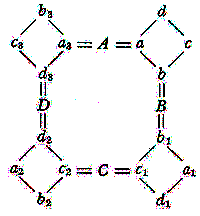
following diagram:
"The formula reproduces exactly the essential features of the symbolic process of transformation. It shows the rotation of the mandala, the antithetical play of complementary (or compensatory) processes, then the apocatastasis, i.e., the restoration of an original state of wholeness, which the alchemists expressed through the symbol of the uroboros, and finally the formula repeats the ancient alchemical tetrameria, which is implicit in the fourfold structure of unity."
— Carl Gustav Jung
That the words Maximus of Tyre (second century A.D.) attributed to Heraclitus imply a cycle of the elements (analogous to the rotation in Jung's diagram) is not a new concept. For further details, see "The Rotation of the Elements," a 1995 webpage by one "John Opsopaus."
Related material:
Log24 entries of June 9, 2008, and
"Quintessence: A Glass Bead Game,"
by Charles Cameron.

|
"Logos and logic, crystal hypothesis,
— Wallace Stevens, |
Yesterday's meditation ("Simon's Shema") on the interpenetration of opposites continues:
"The fundamental conception of Tantric Buddhist metaphysics, namely, yuganaddha, signifies the coincidence of opposites. It is symbolized by the conjugal embrace (maithuna or kama-kala) of a god and goddess or a Buddha and his consort (signifying karuna and sunyata or upaya and prajna, respectively), also commonly depicted in Tantric Buddhist iconography as the union of vajra (diamond sceptre) and padme (lotus flower). Thus, yuganaddha essentially means the interpenetration of opposites or dipolar fusion, and is a fundamental restatement of Hua-yen theoretic structures."
— p. 148 in "Part II: A Whiteheadian Process Critique of Hua-yen Buddhism," in Process Metaphysics and Hua-Yen Buddhism: A Critical Study of Cumulative Penetration vs. Interpenetration (SUNY Series in Systematic Philosophy), by Steve Odin, State University of New York Press, 1982
And on p. 163 of Odin, op. cit., in "Part III: Theology of the Deep Unconscious: A Reconstruction of Process Theology," in the section titled "Whitehead's Dipolar God as the Collective Unconscious"–
"An effort is made to transpose Whitehead's theory of the dipolar God into the terms of the collective unconscious, so that now the dipolar God is to be comprehended not as a transcendent deity, but the deepest dimension and highest potentiality of one's own psyche."
Odin obtained his Ph.D. degree from the Department of Philosophy at the State University of New York (SUNY) at Stony Brook in 1980. (See curriculum vitae (pdf).)
For an academic review of Odin's book, see David Applebaum, Philosophy East and West, Vol. 34 (1984), pp. 107-108.
It is perhaps worth noting, in light of the final footnote of Mark D. Brimblecombe's Ph.D. thesis "Dipolarity and God" quoted yesterday, that "tantra" is said to mean "loom." For some less-academic background on the Tantric iconography Odin describes, see the webpage "Love and Passion in Tantric Buddhist Art." For a fiction combining love and passion with the word "loom" in a religious context, see Clive Barker's Weaveworld. This fiction– which is, if not "supreme" in the Wallace Stevens sense, at least entertaining– may correspond to some aspects of the deep Jungian psychological reality discussed by Odin.
Click on image for details.
The previous entry dealt with Plato’s myth of the ring of Gyges that conferred invisibility. Another legendary ring, from Hermann Hesse, with some background from Carl Jung:
From C. G. Jung, Collected Works (Princeton U. Press), Volume 12– Psychology and Alchemy (1944)– Part II– “Individual Dream Symbolism in Relation to Alchemy”– Chapter 3, “The Symbolism of the Mandala”– as quoted in Jung, Dreams, published by Routledge, 2001– Page 265–
“… the dreamer is wandering about in a dark cave, where a battle is going on between good and evil. But there is also a prince who knows everything. He gives the dreamer a ring set with a diamond….
Visual impression (waking dream):
The dreamer is falling into the abyss. At the bottom there is a bear whose eyes gleam alternately in four colours: red, yellow, green, and blue. Actually it has four eyes that change into four lights. The bear disappears and the dreamer goes through a long dark tunnel. Light is shimmering at the far end. A treasure is there, and on top of it the ring with the diamond. It is said that this ring will lead him on a long journey to the east.”
Hermann Hesse, The Journey to the East (1932):
“‘… Despair is the result of each earnest attempt to go through life with virtue, justice, and understanding and to fulfil their requirements. Children live on one side of despair, the awakened on the other side. Defendant H. is no longer a child and is not yet fully awakened. He is still in the midst of despair. He will overcome it and thereby go through his second novitiate. We welcome him anew into the League, the meaning of which he no longer claims to understand. We give back to him his lost ring, which the servant Leo has kept for him.’
The Speaker then brought the ring, kissed me on the cheek and placed the ring on my finger. Hardly had I looked at the ring, hardly had I felt its metallic coolness on my fingers, when a thousand things occurred to me, a thousand inconceivable acts of neglect. Above all, it occurred to me that the ring had four stones at equal distances apart, and that it was a rule of the League and part of the vow to turn the ring slowly on the finger at least once a day, and at each of the four stones to bring to mind one of the four basic precepts of the vow. I had not only lost the ring and had not once missed it, but during all those dreadful years I had also no longer repeated the four basic precepts or thought of them. Immediately, I tried to say them again inwardly. I had an idea what they were, they were still within me, they belonged to me as does a name which one will remember in a moment but at that particular moment cannot be recalled. No, it remained silent within me, I could not repeat the rules, I had forgotten the wording. I had forgotten the rules; for many years I had not repeated them, for many years I had not observed them and held them sacred– and yet I had considered myself a loyal League brother.
The Speaker patted my arm kindly when he observed my dismay and deep shame.”
The Ring of Gyges
10:31:32 AM ET
Commentary by Richard Wilhelm
on I Ching Hexagram 32:
“Duration is… not a state of rest, for mere standstill is regression.
Duration is rather the self-contained and therefore self-renewing
movement of an organized, firmly integrated whole, taking place in
accordance with immutable laws and beginning anew at every ending.”
Related material
Jung and the Imago Dei
| Log24 on June 10, 2007:
WHAT MAKES IAGO EVIL? some people ask. I never ask. —Joan Didion Iago states that he is not who he is. —Mark F. Frisch |
“Not Being There,”
by Christopher Caldwell,
from next Sunday’s
New York Times Magazine:
| “The chance to try on fresh identities was the great boon that life online was supposed to afford us. Multiuser role-playing games and discussion groups would be venues for living out fantasies. Shielded by anonymity, everyone could now pass a ‘second life’ online as Thor the Motorcycle Sex God or the Sage of Wherever. Some warned, though, that there were other possibilities. The Stanford Internet expert Lawrence Lessig likened online anonymity to the ring of invisibility that surrounds the shepherd Gyges in one of Plato’s dialogues. Under such circumstances, Plato feared, no one is ‘of such an iron nature that he would stand fast in justice.’Time, along with a string of sock-puppet scandals, has proved Lessig and Plato right.” |
“The Boy Who Lived,”
by Christopher Hitchens,
from next Sunday’s
New York Times Book Review:
| On the conclusion of the Harry Potter series:”The toys have been put firmly back in the box, the wand has been folded up, and the conjuror is discreetly accepting payment while the children clamor for fresh entertainments. (I recommend that they graduate to Philip Pullman, whose daemon scheme is finer than any patronus.)” |
I, on the other hand,
recommend Tolkien…
or, for those who are
already familiar with
Tolkien, Plato– to whom
“The Ring of Gyges” may
serve as an introduction.
“It’s all in Plato, all in Plato:
bless me, what do they
teach them at these schools!”
— C. S. Lewis
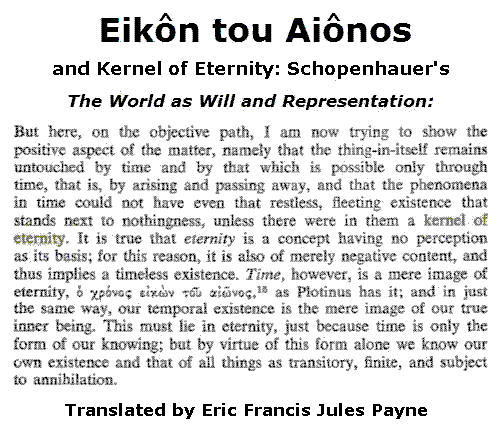
"Ich aber, hier auf dem objektiven Wege, bin jetzt bemüht, das Positive der Sache nachzuweisen, daß nämlich das Ding an sich von der Zeit und Dem, was nur durch sie möglich ist, dem Entstehen und Vergehen, unberührt bleibt, und daß die Erscheinungen in der Zeit sogar jenes rastlos flüchtige, dem Nichts zunächst stehende Dasein nicht haben könnten, wenn nicht in ihnen ein Kern aus der Ewigkeit* wäre. Die Ewigkeit ist freilich ein Begriff, dem keine Anschauung zum Grunde liegt: er ist auch deshalb bloß negativen Inhalts, besagt nämlich ein zeitloses Dasein. Die Zeit ist demnach ein bloßes Bild der Ewigkeit, ho chronos eikôn tou aiônos,** wie es Plotinus*** hat: und ebenso ist unser zeitliches Dasein das bloße Bild unsers Wesens an sich. Dieses muß in der Ewigkeit liegen, eben weil die Zeit nur die Form unsers Erkennens ist: vermöge dieser allein aber erkennen wir unser und aller Dinge Wesen als vergänglich, endlich und der Vernichtung anheimgefallen."
* "a kernel of eternity"
** "Time is the image of eternity."
*** "wie es Plotinus hat"–
Actually, not Plotinus, but Plato,
according to Diogenes Laertius.
Related material:
J. N. Darby,
"On the Greek Words for
Eternity and Eternal
(aion and aionios),"
Carl Gustav Jung, Aion,
which contains the following
four-diamond figure,

Our Judeo-Christian
Heritage –
Lottery
Hermeneutics
Part I: Judeo
| The Lottery 12/9/06 | Mid-day | Evening |
| New York | 036
See |
331
See 3/31— “square crystal” and “the symbolism could not have been more perfect.” |
| Pennsylvania | 602
See 6/02— Walter Benjamin |
111
See 1/11— “Related material:
|
Part II: Christian
| The Lottery 4/3/07 | Mid-day | Evening |
| New York | 115
See 1/15— |
017
See
|
| Pennsylvania | 604
See |
714
See |
Related material:
It is perhaps relevant to
this Holy Week that the
date 6/04 (2006) above
refers to both the Christian
holy day of Pentecost and
to the day of the
facetious baccalaureate
of the Class of 2006 in
the University Chapel
at Princeton.
For further context for the
Log24 remarks of that same
date, see June 1-15, 2006.
Time and Chance
on the 90th Birthday
of Kirk Douglas,
star of
“The Garden of Allah“
| The Lottery 12/9/06 | Mid-day | Evening |
| New York | 036
See |
331
See 3/31— “square crystal” and “the symbolism could not have been more perfect.” |
| Pennsylvania | 602
See 6/02— Walter Benjamin |
111
See 1/11— “Related material: |

"Wherefore let it hardly… be… thought that the prisoner… was at his best a onestone parable…
for… pathetically few… cared… to doubt… the canonicity of his existence as a tesseract."
— Finnegans Wake, page 100, abridged
"… we have forgotten that we were angels and painted ourselves into a corner
of resource extraction and commodification of ourselves."
— A discussion, in a draft of a paper (rtf) attributed to Josh Schultz,
of the poem "Diamond" by Attila Jozsef
Commodification of
the name Cullinane:
See the logos at
cullinane.com,
a design firm with
the motto

To adapt a phrase from
Finnegans Wake, the
"fourstone parable" below
is an attempt to
decommodify my name.
Fourstone Parable:
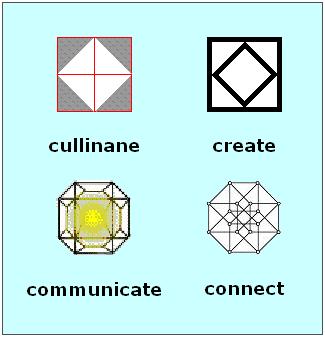
(See also yesterday's "Logos."
The "communicate" logo is taken from
an online library at Calvin College;
the "connect" logo is a commonly
available picture of a tesseract
(Coxeter, Regular Polytopes, p. 123),
and the other two logos
are more or less original.)
For a more elegant
four-diamond figure, see
Jung and the Imago Dei.
From Jung's Map of the Soul, by Murray Stein:
"… Jung thinks of the self as undergoing continual transformation during the course of a lifetime…. At the end of his late work Aion, Jung presents a diagram to illustrate the dynamic movements of the self…."
"The formula presents a symbol of the self, for the self is not just a stable quantity or constant form, but is also a dynamic process. In the same way, the ancients saw the imago Dei in man not as a mere imprint, as a sort of lifeless, stereotyped impression, but as an active force…. The four transformations represent a process of restoration or rejuvenation taking place, as it were, inside the self…."
"The formula reproduces exactly the essential features of the symbolic process of transformation. It shows the rotation of the mandala, the antithetical play of complementary (or compensatory) processes, then the apocatastasis, i.e., the restoration of an original state of wholeness, which the alchemists expressed through the symbol of the uroboros, and finally the formula repeats the ancient alchemical tetrameria, which is implicit in the fourfold structure of unity.
What the formula can only hint at, however, is the higher plane that is reached through the process of transformation and integration. The 'sublimation' or progress or qualitative change consists in an unfolding of totality into four parts four times, which means nothing less than its becoming conscious. When psychic contents are split up into four aspects, it means that they have been subjected to discrimination by the four orienting functions of consciousness. Only the production of these four aspects makes a total description possible. The process depicted by our formula changes the originally unconscious totality into a conscious one."
— Jung, Collected Works,
Vol. 9, Part 2, Aion: Researches into the Phenomenology of the Self (1951)
Related material:

"Although 'wholeness' seems at first sight to be nothing but an abstract idea (like anima and animus), it is nevertheless empirical in so far as it is anticipated by the psyche in the form of spontaneous or autonomous symbols. These are the quaternity or mandala symbols, which occur not only in the dreams of modern people who have never heard of them, but are widely disseminated in the historical recods of many peoples and many epochs. Their significance as symbols of unity and totality is amply confirmed by history as well as by empirical psychology. What at first looks like an abstract idea stands in reality for something that exists and can be experienced, that demonstrates its a priori presence spontaneously. Wholeness is thus an objective factor that confronts the subject independently of him… Unity and totality stand at the highest point on the scale of objective values because their symbols can no longer be distinguished from the imago Dei. Hence all statements about the God-image apply also to the empirical symbols of totality."
— Jung, Aion, as quoted in
Carl Jung and Thomas Merton
Part I: Mathematics and Narrative

Apostolos Doxiadis on last month's conference on "mathematics and narrative"–
Doxiadis is describing how talks by two noted mathematicians were related to
"… a sense of a 'general theory bubbling up' at the meeting… a general theory of the deeper relationship of mathematics to narrative…. "
Doxiadis says both talks had "a big hole in the middle."
"Both began by saying something like: 'I believe there is an important connection between story and mathematical thinking. So, my talk has two parts. [In one part] I’ll tell you a few things about proofs. [And in the other part] I’ll tell you about stories.' …. And in both talks it was in fact implied by a variation of the post hoc propter hoc, the principle of consecutiveness implying causality, that the two parts of the lectures were intimately related, the one somehow led directly to the other."
"And the hole?"
"This was exactly at the point of the link… [connecting math and narrative]… There is this very well-known Sidney Harris cartoon… where two huge arrays of formulas on a blackboard are connected by the sentence ‘THEN A MIRACLE OCCURS.’ And one of the two mathematicians standing before it points at this and tells the other: ‘I think you should be more explicit here at step two.’ Both… talks were one half fascinating expositions of lay narratology– in fact, I was exhilarated to hear the two most purely narratological talks at the meeting coming from number theorists!– and one half a discussion of a purely mathematical kind, the two parts separated by a conjunction roughly synonymous to ‘this is very similar to this.’ But the similarity was not clearly explained: the hole, you see, the ‘miracle.’ Of course, both [speakers]… are brilliant men, and honest too, and so they were very clear about the location of the hole, they did not try to fool us by saying that there was no hole where there was one."
"At times, bullshit can only be countered with superior bullshit."
— Norman Mailer
Many Worlds and Possible Worlds in Literature and Art, in Wikipedia:
"The concept of possible worlds dates back to a least Leibniz who in his Théodicée tries to justify the apparent imperfections of the world by claiming that it is optimal among all possible worlds. Voltaire satirized this view in his picaresque novel Candide….
Borges' seminal short story El jardín de senderos que se bifurcan ("The Garden of Forking Paths") is an early example of many worlds in fiction."
Background:
Modal Logic in Wikipedia
Possible Worlds in Wikipedia
Possible-Worlds Theory, by Marie-Laure Ryan
(entry for The Routledge Encyclopedia of Narrative Theory)
— Many Dimensions, by Charles Williams, 1931 (Eerdmans paperback, April 1979, pp. 43-44)
— Aion, by C. G. Jung, 1951 (Princeton paperback, 1979, p. 236)
"Its discoverer was of the opinion that he had produced the equivalent of the primordial protomatter which exploded into the Universe."
|
"We symbolize
logical necessity with the box  ) )and logical possibility with the diamond  ). ).
"The possibilia that exist,
— Michael Sudduth, |
"We symbolize logical necessity
with the box )
and logical possibility
with the diamond ).
— Keith Allen Korcz,
(Log24.net, 1/25/05)
And what do we
symbolize by  ?
?
On the Lapis Philosophorum,
the Philosophers' Stone –
"'What is this Stone?' Chloe asked….
'…It is told that, when the Merciful One
made the worlds, first of all He created
that Stone and gave it to the Divine One
whom the Jews call Shekinah,
and as she gazed upon it
the universes arose and had being.'"
– Many Dimensions,
by Charles Williams, 1931
(Eerdmans paperback,
April 1979, pp. 43-44)
"The lapis was thought of as a unity
and therefore often stands for
the prima materia in general."
– Aion, by C. G. Jung, 1951
(Princeton paperback,
1979, p. 236)
"Its discoverer was of the opinion that
he had produced the equivalent of
the primordial protomatter
which exploded into the Universe."
– The Stars My Destination,
by Alfred Bester, 1956
(Vintage hardcover,
July 1996, p. 216)
"The possibilia that exist,
and out of which
the Universe arose,
are located in
a necessary being…."
— Michael Sudduth,
Notes on
God, Chance, and Necessity
by Keith Ward,
Regius Professor of Divinity
at Christ Church College, Oxford
(the home of Lewis Carroll)
See also
The Diamond Archetype.
For more on modal theology, see
Kurt Gödel's Ontological Argument
and
The Ontological Argument
from Anselm to Gödel.
Quartet
An illustration from July 26,
Jung’s birthday and the date
of Alexander Hammid’s death:
of the Self:  Four Quartets: “… history is a pattern |
Alexander |
From today’s
|
“… legend has it, supported by Casals himself, that he was conceived when Brahms began his B-flat Major Quartet, of which Casals owned the original manuscript, and that he was born when Brahms completed its composition.”
Happy Birthday,
Carl Jung
|
Jung in Von Franz's Psyche and Matter, p. 85: "What the formula can only hint at is the higher plane that is reached through the process of transformation…. The change consists in an unfolding of totality into four parts four times, which means nothing less than its becoming conscious."
Jung's Model of the Self: Four Quartets:
"… history is a pattern Cold Mountain, the film:
Inman: You are all that keeps me from sliding into some dark place. |
The Da Vinci Code
and Symbology at Harvard
The protagonist of the recent bestseller The Da Vinci Code is Robert Langdon, "a professor of Religious Symbology at Harvard University." A prominent part in the novel is played by the well-known Catholic organization Opus Dei. Less well known (indeed, like Langdon, nonexistent) is the academic discipline of "symbology." (For related disciplines that do exist, click here.) What might a course in this subject at Harvard be like?
|
Harvard Crimson, April 10, 2003: While Opus Dei members said that they do not refer to their practices of recruitment as "fishing," the Work’s founder does describe the process of what he calls "winning new apostles" with an aquatic metaphor. Point #978 of The Way invokes a passage in the New Testament in which Jesus tells Peter that he will make him a "fisher of men." The point reads:
|
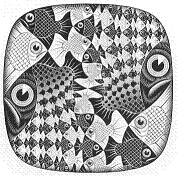

Exercise for Symbology 101:
Describe the symmetry
in each of the pictures above.
Show that the second picture
retains its underlying structural
symmetry under a group of
322,560 transformations.
Having reviewed yesterday's notes
on Gombrich, Gadamer, and Panofsky,
discuss the astrological meaning of
the above symbols in light of
today's date, February 20.
Extra credit:
Relate the above astrological
symbolism to the four-diamond
symbol in Jung's Aion.
Happy metaphors!
For Jung’s 7/26 Birthday:
A Logocentric Meditation
Leftist academics are trying to pull a fast one again. An essay in the most prominent American mathematical publication tries to disguise a leftist attack on Christian theology as harmless philosophical woolgathering.
In a review of Vladimir Tasic’s Mathematics and the Roots of Postmodern Thought, the reviewer, Michael Harris, is being less than candid when he discusses Derrida’s use of “logocentrism”:
“Derrida uses the term ‘logocentrism’… as ‘the metaphysics of phonetic writing’….”
— Notices of the American Mathematical Society, August 2003, page 792
We find a rather different version of logocentrism in Tasic’s own Sept. 24, 2001, lecture “Poststructuralism and Deconstruction: A Mathematical History,” which is “an abridged version of some arguments” in Tasic’s book on mathematics and postmodernism:
“Derrida apparently also employs certain ideas of formalist mathematics in his critique of idealist metaphysics: for example, he is on record saying that ‘the effective progress of mathematical notation goes along with the deconstruction of metaphysics.’
Derrida’s position is rather subtle. I think it can be interpreted as a valiant sublation of two completely opposed schools in mathematical philosophy. For this reason it is not possible to reduce it to a readily available philosophy of mathematics. One could perhaps say that Derrida continues and critically reworks Heidegger’s attempt to ‘deconstruct’ traditional metaphysics, and that his method is more ‘mathematical’ than Heidegger’s because he has at his disposal the entire pseudo-mathematical tradition of structuralist thought. He has himself implied in an interview given to Julia Kristeva that mathematics could be used to challenge ‘logocentric theology,’ and hence it does not seem unreasonable to try looking for the mathematical roots of his philosophy.”
The unsuspecting reader would not know from Harris’s review that Derrida’s main concern is not mathematics, but theology. His ‘deconstruction of metaphysics’ is actually an attack on Christian theology.
From “Derrida and Deconstruction,” by David Arneson, a University of Manitoba professor and writer on literary theory:
“Logocentrism: ‘In the beginning was the word.’ Logocentrism is the belief that knowledge is rooted in a primeval language (now lost) given by God to humans. God (or some other transcendental signifier: the Idea, the Great Spirit, the Self, etc.) acts a foundation for all our thought, language and action. He is the truth whose manifestation is the world.”
Some further background, putting my July 23 entry on Lévi-Strauss and structuralism in the proper context:
Part I. The Roots of Structuralism
“Literary science had to have a firm theoretical basis…”
Part II. Structuralism/Poststructuralism
“Most [structuralists] insist, as Levi-Strauss does, that structures are universal, therefore timeless.”
Part III. Structuralism and
Jung’s Archetypes
Jung’s “theories, like those of Cassirer and Lévi-Strauss, command for myth a central cultural position, unassailable by reductive intellectual methods or procedures.”
And so we are back to logocentrism, with the Logos — God in the form of story, myth, or archetype — in the “central cultural position.”
What does all this have to do with mathematics? See
“the Klein group (much beloved of Structuralists)”
Another Michael Harris Essay, Note 47 –
“From Krauss’s article I learned that the Klein group is also called the Piaget group.”
and Jung on Quaternity:
Beyond the Fringe –
“…there is no denying the fact that [analytical] psychology, like an illegitimate child of the spirit,
leads an esoteric, special existence beyond the fringe of what is generally acknowledged to be the academic world.”
What attitude should mathematicians have towards all this?
Towards postmodern French
atheist literary/art theorists –
Mathematicians should adopt the attitude toward “the demimonde of chic academic theorizing” expressed in Roger Kimball’s essay, Feeling Sorry for Rosalind Krauss.
Towards logocentric German
Christian literary/art theorists –
Mathematicians should, of course, adopt a posture of humble respect, tugging their forelocks and admitting their ignorance of Christian theology. They should then, if sincere in their desire to honestly learn something about logocentric philosophy, begin by consulting the website
The Quest for the Fiction of an Absolute.
For a better known, if similarly disrespected, “illegitimate child of the spirit,” see my July 22 entry.
Elementary,
My Dear Gropius
“What is space, how can it be understood and given a form?”
— Walter Gropius
    |
Stoicheia,” Elements, is the title of
Euclid’s treatise on geometry.
Stoicheia is apparently also related to a Greek verb meaning “march” or “walk.”
According to a website on St. Paul’s phrase “ta stoicheia tou kosmou,” which might be translated
“… the verbal form of the root stoicheo was used to mean, ‘to be in a line,’ ‘to march in rank and file.’ … The general meaning of the noun form (stoicheion) was ‘what belongs to a series.’ “
As noted in my previous entry, St. Paul used a form of stoicheo to say “let us also walk (stoichomen) by the Spirit.” (Galatians 5:25) The lunatic ravings* of Saul of Tarsus aside, the concepts of walking, of a spirit, and of elements may be combined if we imagine the ghost of Gropius strolling with the ghosts of Plato, Aristotle, and Euclid, and posing his question about space. Their reply might be along the following lines:
Combining stoicheia with a peripatetic peripateia (i.e., Aristotelian plot twist), we have the following diagram of Aristotle’s four stoicheia (elements),

which in turn is related, by the “Plato’s diamond” figure in the monograph Diamond Theory, to the Stoicheia, or Elements, of Euclid.
Quod erat demonstrandum.
* A phrase in memory of the Paulist Norman J. O’Connor, the “jazz priest” who died on St. Peter’s day, Sunday, June 29, 2003. Paulists are not, of course, entirely mad; the classic The Other Side of Silence: A Guide to Christian Meditation, by the Episcopal priest Morton Kelsey, was published by the Paulist Press.

Its cover (above), a different version of the four-elements theme, emphasizes the important Jungian concept of quaternity. Jung is perhaps the best guide to the bizarre world of Christian symbolism. It is perhaps ironic, although just, that the Paulist Fathers should distribute a picture of “ta stoicheia tou kosmou,” the concept that St. Paul himself railed against.
The above book by Kelsey should not be confused with another The Other Side of Silence, a work on gay history, although confusion would be understandable in light of recent ecclesiastical revelations.
Let us pray that if there is a heaven, Father O’Connor encounters there his fellow music enthusiast Cole Porter rather than the obnoxious Saul of Tarsus.
Mark
Today is the feast of Saint Mark. It seems an appropriate day to thank Dr. Gerald McDaniel for his online cultural calendar, which is invaluable for suggesting blog topics.
Yesterday's entry "Cross-Referenced" referred to a bizarre meditation of mine titled "The Matthias Defense," which combines some thoughts of Nabokov on lunacy with some of my own thoughts on the Judeo-Christian tradition (i.e., also on lunacy). In this connection, the following is of interest:
From a site titled Meaning of the Twentieth Century —
"Freeman Dyson has expressed some thoughts on craziness. In a Scientific American article called 'Innovation in Physics,' he began by quoting Niels Bohr. Bohr had been in attendance at a lecture in which Wolfgang Pauli proposed a new theory of elementary particles. Pauli came under heavy criticism, which Bohr summed up for him: 'We are all agreed that your theory is crazy. The question which divides us is whether it is crazy enough to have a chance of being correct. My own feeling is that is not crazy enough.' To that Freeman added: 'When a great innovation appears, it will almost certainly be in a muddled, incomplete and confusing form. To the discoverer, himself, it will be only half understood; to everyone else, it will be a mystery. For any speculation which does not at first glance look crazy, there is no hope!' "
— Kenneth Brower, The Starship and the Canoe, 1979, pp. 146, 147
It is my hope that the speculation, implied in The Matthias Defense, that the number 162 has astonishing mystical properties (as a page number, article number, etc.) is sufficiently crazy to satisfy Pauli and his friend Jung as well as the more conventional thinkers Bohr and Dyson. It is no less crazy than Christianity, and has a certain mad simplicity that perhaps improves on some of that religion's lunatic doctrines.
Some fruits of the "162 theory" —
Searching on Google for muses 162, we find the following Orphic Hymn to Apollo and a footnote of interest:
27 Tis thine all Nature's music to inspire,
28 With various-sounding, harmonising lyre;
29 Now the last string thou tun'ft to sweet accord,
30 Divinely warbling now the highest chord….
"Page 162 Verse 29…. Now the last string…. Gesner well observes, in his notes to this Hymn, that the comparison and conjunction of the musical and astronomical elements are most ancient; being derived from Orpheus and Pythagoras, to Plato. Now, according to the Orphic and Pythagoric doctrine, the lyre of Apollo is an image of the celestial harmony…."
For the "highest chord" in a metaphorical sense, see selection 162 of the 1919 edition of The Oxford Book of English Verse (whose editor apparently had a strong religious belief in the Muses (led by Apollo)). This selection contains the phrase "an ever-fixèd mark" — appropriately enough for this saint's day. The word "mark," in turn, suggests a Google search for the phrase "runes to grave" Hardy, after a poem quoted in G. H. Hardy's A Mathematician's Apology.
Such a search yields a website that quotes Housman as the source of the "runes" phrase, and a further search yields what is apparently the entire poem:
Smooth Between Sea and Land
by A. E. Housman
Smooth between sea and land
Is laid the yellow sand,
And here through summer days
The seed of Adam plays.Here the child comes to found
His unremaining mound,
And the grown lad to score
Two names upon the shore.Here, on the level sand,
Between the sea and land,
What shall I build or write
Against the fall of night?Tell me of runes to grave
That hold the bursting wave,
Or bastions to design
For longer date than mine.Shall it be Troy or Rome
I fence against the foam
Or my own name, to stay
When I depart for aye?Nothing: too near at hand
Planing the figured sand,
Effacing clean and fast
Cities not built to last
And charms devised in vain,
Pours the confounding main.(Said to be from More Poems (Knopf, 1936), p. 64)
Housman asks the reader to tell him of runes to grave or bastions to design. Here, as examples, are one rune and one bastion.
|
Represents |
 Dagaz: (Pronounced thaw-gauze, but with the "th" voiced as in "the," not unvoiced as in "thick") (Day or dawn.)
From Rune Meanings:
Dagaz means "breakthrough, awakening, awareness. Daylight clarity as opposed to nighttime uncertainty. A time to plan or embark upon an enterprise. The power of change directed by your own will, transformation. Hope/happiness, the ideal. Security and certainty. Growth and release. Balance point, the place where opposites meet."
Also known as "the rune of transformation."
For the Dagaz rune in another context, see Geometry of the I Ching. The geometry discussed there does, in a sense, "hold the bursting wave," through its connection with Walsh functions, hence with harmonic analysis.
 Temple of Athena Nike on the Nike Bastion, the Acropolis, Athens. Here is a relevant passage from Paul Valéry's Eupalinos ou L'Architecte about another temple of four columns:
Et puis… Écoute, Phèdre (me disait-il encore), ce petit temple que j'ai bâti pour Hermès, à quelques pas d'ici, si tu savais ce qu'il est pour moi ! — Où le passant ne voit qu'une élégante chapelle, — c'est peu de chose: quatre colonnes, un style très simple, — j'ai mis le souvenir d'un clair jour de ma vie. Ô douce métamorphose ! Ce temple délicat, nul ne le sait, est l'image mathématique d'une fille de Corinthe que j'ai heureusement aimée. Il en reproduit fidèlement les proportions particulières. Il vit pour moi !
Four columns, in a sense more suited to Hardy's interests, are also a recurrent theme in The Diamond 16 Puzzle and Diamond Theory.
Apart from the word "mark" in The Oxford Book of English Verse, as noted above, neither the rune nor the bastion discussed has any apparent connection with the number 162… but seek and ye shall find.
Time and Eternity
|
 Kali figure
|
|
 Windmill
|
Yesterday's meditation on St. Bridget suggests the above graphic summary of two rather important philosophical concepts. Representing Kali, or Time, is Judy Davis in "The New Age." Representing Shiva, or Eternity, is sword-saint Michioka Yoshinori-sensei. The relationship between these two concepts is summarized very neatly by Heinrich Zimmer in his section on the Kalika Purana in The King and the Corpse.
The relationship is also represented graphically by the "whirl" of Time and the "diamond" of Eternity.
On this day in 1944, Mondrian died. Echoes of the graphic whirl and diamond may be found (as shown above) in his "Red Mill" and "Victory Boogie-Woogie."
Irish Fourplay
"…something I once heard Charles M. Schulz say, 'Don't worry about the world coming to an end today. It's already tomorrow in Australia.'"
"Forewarned is four-armed."
— Folk saying
|
|
The painting at left is by Mary B. Kelly, a 1958 graduate of Saint Mary-of-the-Woods College. Kelly is an expert on portrayals of Goddess figures in art. |
Today in Australia is February First, the feast of St. Bridget. As several websites note, St. Bridget is a combination of Christian saint and Goddess figure… rather like St. Sara (patron saint of Gypsies, also known as Kali) or like Sara Pezzini in the classic TV series "Witchblade."
"Aww… Irish foreplay."
— Sara Pezzini in Witchblade, Episode 6
"Mighty in the gift of purity
She was pleasing unto the Bridegroom on high."
"Brace yourself, Bridget."
— Definition of Irish foreplay

|
Four people can form this cross by joining hands as shown. Of course, a Goddess like Kali (shown above) or Sara Pezzini could do it all by herself. |
For futher details, see The Swastika Goddess, the history of Jews and the Roman Catholic Church, and the history of Irish neutrality in World War II.
Postscript of 11 PM —
The Goddess Bridget in Literature
The Goddess Bridget (or Brigid) is incarnated in two classic works of American literature —
"In Jungian terms, Brigid becomes a projection of Spade's anima, a contrasexual replica of his own face as expressed in someone of the opposite sex.
Spade wears a variety of masks in his work. Masking allows him to get underneath the scam most clients lay on him. He is closer to the darker side of his unconscious than any of the other characters in the book, and he is so, because of his role as shamus. His function in his society is to expose all of the underlying darkness of the human psyche."
One way of looking at animus and anima is through the following archetypes:


A diamond and its dual "whirl" figure —
or a "jewel-box and its mate"
"D'ye mane to soy that Bridget O'Shaughnessy bought the mate to that joo-ul box to ship that dhrunken divil to Purgatory in?"
"Yes, madam."
"Then Pat shall go to heaven in the twin to it, if it takes the last rap the O'Flaherties can raise!"
Waiting for Logos
Searching for background on the phrase "logos and logic" in yesterday's "Notes toward a Supreme Fact," I found this passage:
"…a theory of psychology based on the idea of the soul as the dialectical, self-contradictory syzygy of a) soul as anima and b) soul as animus. Jungian and archetypal psychology appear to have taken heed more or less of only one half of the whole syzygy, predominantly serving an anima cut loose from her own Other, the animus as logos and logic (whose first and most extreme phenomenological image is the killer of the anima, Bluebeard). Thus psychology tends to defend the virginal innocence of the anima and her imagination…"
— Wolfgang Giegerich, "Once More the Reality/Irreality Issue: A Reply to Hillman's Reply," website
The anima and other Jungian concepts are used to analyze Wallace Stevens in an excellent essay by Michael Bryson, "The Quest for the Fiction of an Absolute." Part of Bryson's motivation in this essay is the conflict between the trendy leftist nominalism of postmodern critics and the conservative realism of more traditional critics:
"David Jarraway, in his Stevens and the Question of Belief, writes about a Stevens figured as a proto-deconstructionist, insisting on 'Steven's insistence on dismantling the logocentric models of belief' (311) in 'An Ordinary Evening in New Haven.' In opposition to these readings comes a work like Janet McCann's Wallace Stevens Revisited: 'The Celestial Possible', in which the claim is made (speaking of the post-1940 period of Stevens' life) that 'God preoccupied him for the rest of his career.'"
Here "logocentric" is a buzz word for "Christian." Stevens, unlike the postmodernists, was not anti-Christian. He did, however, see that the old structures of belief could not be maintained indefinitely, and pondered what could be found to replace them. "Notes toward a Supreme Fiction" deals with this problem. In his essay on Stevens' "Notes," Bryson emphasizes the "negative capability" of Keats as a contemplative technique:
"The willingness to exist in a state of negative capability, to accept that sometimes what we are seeking is not that which reason can impose…."
For some related material, see Simone Weil's remarks on Electra waiting for her brother Orestes. Simone Weil's brother was one of the greatest mathematicians of the past century, André Weil.
"Electra did not seek Orestes, she waited for him…"
— Simone Weil
"…at the end, she pulls it all together brilliantly in the story of Electra and Orestes, where the importance of waiting on God rather than seeking is brought home forcefully."
— Tom Hinkle, review of Waiting for God
Compare her remarks on waiting for Orestes with the following passage from Waiting for God:
"We do not obtain the most precious gifts by going in search of them but by waiting for them. Man cannot discover them by his own powers, and if he sets out to seek for them he will find in their place counterfeits of which he will be unable to discern falsity.
The solution of a geometry problem does not in itself constitute a precious gift, but the same law applies to it because it is the image of something precious. Being a little fragment of particular truth, it is a pure image of the unique, eternal, and living Truth, the very Truth that once in a human voice declared: "I am the Truth."
Every school exercise, thought of in this way, is like a sacrament.
In every school exercise there is a special way of waiting upon truth, setting our hearts upon it, yet not allowing ourselves to go out in search of it. There is a way of giving our attention to the data of a problem in geometry without trying to find the solution…."
— Simone Weil, "Reflections on the Right Use of School Studies with a View to the Love of God"
Weil concludes the preceding essay with the following passage:
"Academic work is one of those fields containing a pearl so precious that it is worth while to sell all of our possessions, keeping nothing for ourselves, in order to be able to acquire it."
This biblical metaphor is also echoed in the work of Pascal, who combined in one person the theological talent of Simone Weil and the mathematical talent of her brother. After discussing how proofs should be written, Pascal says
"The method of not erring is sought by all the world. The logicians profess to guide to it, the geometricians alone attain it, and apart from their science, and the imitations of it, there are no true demonstrations. The whole art is included in the simple precepts that we have given; they alone are sufficient, they alone afford proofs; all other rules are useless or injurious. This I know by long experience of all kinds of books and persons.
And on this point I pass the same judgment as those who say that geometricians give them nothing new by these rules, because they possessed them in reality, but confounded with a multitude of others, either useless or false, from which they could not discriminate them, as those who, seeking a diamond of great price amidst a number of false ones, but from which they know not how to distinguish it, should boast, in holding them all together, of possessing the true one equally with him who without pausing at this mass of rubbish lays his hand upon the costly stone which they are seeking and for which they do not throw away the rest."
— Blaise Pascal, The Art of Persuasion
|
|
||||
|
Example:
|
||||
|
|
||||
|
|
Initial Xanga entry. Updated Nov. 18, 2006.
Powered by WordPress



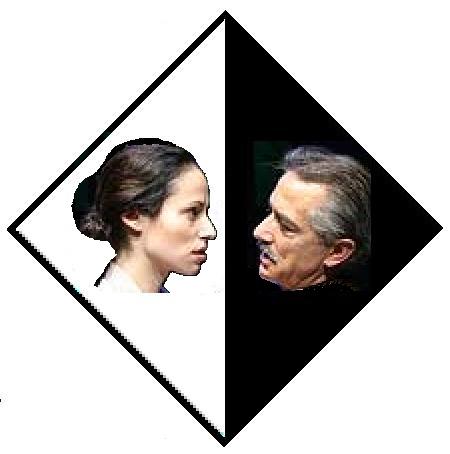


 lexander Hammid, a filmmaker whose