Log24

Thursday, November 23, 2017

Lévi-Strauss vs. Propp

Filed under: General,Geometry — Tags: , , , — m759 @ 12:25 pm
​Claude Lévi-Strauss

From his Structure and Form:
Reflections on a Work by Vladimir Propp
” *

To maintain. as I have done. that the permutability of contents is not arbitrary amounts to saying that, if the analysis is carried to a sufficiently deep level, behind diversity we will discover constancy. And, of course. the avowed constancy of form must not hide from us that functions are also permutable.

The structure of the folktale as it is illustrated by Propp presents a chronological succession of qualitatively distinct functions. each constituting an independent genre. One can wonder whether—as with dramatis personae and their attributes— Propp does not stop too soon, seeking the form too close to the level of empirical observation. Among the thirty-one functions that he distinguishes, several are reducible to the same  function reappearing at different  moments of the narrative but after undergoing one or a number of transformations . I have already suggested that this could be true of the false hero (a transformation of the villain), of assigning a difficult task (a transformation of the test), etc. (see p. 181 above), and that in this case the two parties  constituting the fundamental tale would themselves be transformations of each other.

Nothing prevents pushing this reduction even further and analyzing each separate partie  into a small number of recurrent functions, so that several of Propp’s functions would constitute groups of transformations of one and the same function. We could treat the “violation” as the reverse of the “prohibition” and the latter as a negative transformation of the “injunction.” The “departure” of the hero and his “return” would appear as the negative and positive expressions of the same disjunctive function. The “quest” of the hero (hero pursues someone or something) would become the opposite of “pursuit” (hero is pursued by something or someone), etc.

In Vol. I of Structural Anthropology , p. 209, I have shown that this analysis alone can account for the double aspect of time representation in all mythical systems: the narrative is both “in time” (it consists of a succession of events) and “beyond” (its value is permanent). With regard to Propp’s theories my analysis offers another advantage: I can reconcile much better than Propp himself  his principle of a permanent order of wondertale elements with the fact that certain functions or groups of functions are shifted from one tale to the next (pp. 97-98. p. 108) If my view is accepted, the chronological succession will come to be absorbed into an atemporal matrix structure whose form is indeed constant. The shifting of functions is then no more than a mode of permutation (by vertical columns or fractions of columns).

These critical remarks are certainly valid for the method used by Propp and for his conclusions. However. it cannot be stressed enough that Propp envisioned them and in several places formulated with perfect clarity the solutions I have just suggested. Let us take up again from this viewpoint the two essential themes of our discussion: constancy of the content (in spite of its permutability) and permutability of functions (in spite of their constancy).

* Translated from a 1960 work in French.  It appeared in English as Chapter VIII
of Structural Anthropology, Volume 2  (U. of Chicago Press, 1976).  Chapter VIII
was originally published in Cahiers de l’Institut de Science 
Économique Appliquée , 
No. 9 (Series M, No. 7) (Paris: ISEA, March 1960).

See also “Lévi-Strauss” + Formula  in this journal.

Some background related to the previous post

Tuesday, September 27, 2016

Chomsky and Lévi-Strauss in China

Filed under: General,Geometry — Tags: , , , — m759 @ 7:31 am

Or:  Philosophy for Jews

From a New Yorker  weblog post dated Dec. 6, 2012 —

"Happy Birthday, Noam Chomsky" by Gary Marcus—

"… two titans facing off, with Chomsky, as ever,
defining the contest"

"Chomsky sees himself, correctly, as continuing
a conversation that goes back to Plato, especially
the Meno dialogue, in which a slave boy is
revealed by Socrates to know truths about
geometry that he hadn’t realized he knew."

Socrates and the slave boy discussed a rather elementary "truth
about geometry" — A diamond inscribed in a square has area 2
(and side the square root of 2) if the square itself has area 4
(and side 2).

Consider that not-particularly-deep structure from the Meno dialogue
in the light of the following…

The following analysis of the Meno diagram from yesterday's
post "The Embedding" contradicts the Lévi-Strauss dictum on
the impossibility of going beyond a simple binary opposition.
(The Chinese word taiji  denotes the fundamental concept in
Chinese philosophy that such a going-beyond is both useful
and possible.)

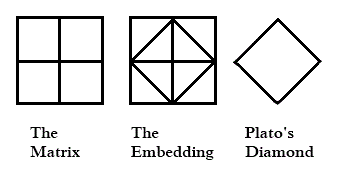
The matrix at left below represents the feminine yin  principle
and the diamond at right represents the masculine yang .

      From a post of Sept. 22,
"Binary Opposition Illustrated" —

A symbol of the unity of yin and yang —

Related material:

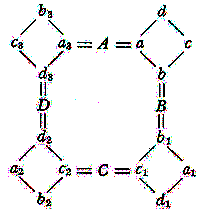
A much more sophisticated approach to the "deep structure" of the
Meno diagram —

The larger cases —

The diamond theorem

Tuesday, November 3, 2009

Levi-Strauss Died…

Filed under: General — Tags: , — m759 @ 3:09 pm

… on Friday, October 30, 2009 ………
(known to some as “Devil’s Night”)………
according to The New York Timeshttp://www.log24.com/images/asterisk8.gif

http://www.log24.com/log/pix09A/091103-NYT-LeviStrauss.jpg

A search in this journal for “Levi-Strauss” yields various entries, the most recent being “Autistic Enchantment” (Sept. 3, 2009).

Related material:

Today’s New York Times on autism
(A Powerful Identity, a Vanishing Diagnosis)
and Log24 on enchantment.

An instance of the latter (from Feb. 15, 2008):

Door

Black monolith, 1x4x9

Step:

“Many dreams have been
brought to your doorstep.
They just lie there
and they die there.”

Lyricist Ray Evans,
who died at 92
one year ago today

Associated Press –
Feb. 15, 2008
Today in History
Thought for Today:

“Like all dreamers I confuse
disenchantment with truth.”
— Jean-Paul Sartre

http://www.log24.com/log/pix09A/091103-Cartoon.jpg

Postscript of Nov. 3, 2009:
For more confusion, see
the works of Claude Levi-Strauss.

http://www.log24.com/images/asterisk8.gif But according to The Telegraph, Levi-Strauss
died on Saturday, Oct. 31, All Hallows’ Eve.
According to Le Monde, he may have died
even later, on Sunday, Nov. 1, All Saints’ Day.

Wednesday, February 18, 2026

Definitions

Filed under: General — Tags: , — m759 @ 1:11 pm

George Steiner in 1969  defined man as "a language animal."

Here is Steiner in 1974  on another definition—

IMAGE- George Steiner on Levi-Strauss viewing man as 'a mythopoetic primate'

Saturday, November 22, 2025

Myth Space Flashbacks

Filed under: General — Tags: — m759 @ 2:29 pm

IMAGE- Stella Octangula and Claude Levi-Strauss

Thursday, November 6, 2025

On Middlemarch: “The Patterns Are Out There!”

Filed under: General — Tags: , — m759 @ 11:10 am
 

The Hunt for the World’s Oldest Story

From thunder gods to serpent slayers, scholars are reconstructing myths that vanished millennia ago. How much further can we go—and what might we find?

By Manvir Singh in The New Yorker

October 13, 2025
. . . .

The Reverend Edward Casaubon is Eliot’s grand study in futility: an aging, self-important, faintly ridiculous clergyman who has dedicated his life to an audacious quest. Casaubon is convinced that every mythic system is a decayed remnant of a single original revelation—a claim he plans to substantiate in his magnum opus, “The Key to All Mythologies.” He means to chart the world’s myths, trace their similarities, and produce a codex that, as Eliot puts it, would make “the vast field of mythical constructions . . . intelligible, nay, luminous with the reflected light of correspondences.”

The ill-fated project founders between the unruly diversity of cultural traditions and the fantasy of a single source, between the expanse of his material and the impossibility of ever mastering it, between the need for theory and the distortions it introduces. These failures are deepened by Casaubon’s limitations—his pedantic love of minutiae (he “dreams footnotes”) and his refusal to engage with scholarship in languages he doesn’t know (if only he’d learned German).

Casaubon’s quest stands as both an indictment of overreach and a warning about the senselessness of such sweeping comparisons. But is this entirely fair? The patterns are out there. Floods, tricksters, battles with monsters, creation and apocalypse—sometimes the resemblances are uncanny. 
. . . .

    "Before time began . . ." — Optimus Prime

The magic square of Doktor Faustus: its structure

Thursday, July 10, 2025

Structures in Myth Space

Filed under: General — Tags: , , — m759 @ 6:20 pm

Some background:

The Matrix of Lévi-Strauss

Friday, May 31, 2024

Hex Ad: The Six-Pointed Star

Filed under: General — Tags: , — m759 @ 6:33 am

For the star of the title, see "Levi-Strauss + Stella."

For a related hex, see an academic's weblog post from yesterday.

For an antidote to that hex, see a Wikipedia article . . .
Contrast the academic's phrase below with Wikipedia's "Pantocrator."

I prefer Yeats's (and Pantocrator's) Byzantium as a "soulful country."

Monday, February 19, 2024

Mythspace: Its Logic, Poetry, and Geometry

Filed under: General — Tags: — m759 @ 12:42 pm

For logicians

http://www.log24.com/log/pix09A/090815-Grid8x8.gif

For poets

The 1955 Levi-Strauss 'canonic formula' in its original context of permutation groups

For geometers

Affine groups on small binary spaces

Saturday, September 16, 2023

A Cube for Casaubon

Filed under: General — Tags: , , — m759 @ 1:25 pm

The 1955 Levi-Strauss 'canonic formula' in its original context of permutation groups

Later . . .

Affine groups on small binary spaces

Sunday, August 27, 2023

Shadow Work* for Alcoholics

Filed under: General — Tags: , , — m759 @ 3:23 pm

"Please wait as your operating system is initiated."

* See that phrase in this  journal.

Sunday, January 22, 2023

Preform

Filed under: General — Tags: , , — m759 @ 11:33 pm

Sometimes  the word "preform"  is not  a misspelling.

"there are present in every psyche forms which are unconscious
but nonetheless active — living dispositions, ideas in the Platonic sense,
that preform and continually influence our thoughts and feelings and actions."

The Source:  Jung on a facultas praeformandi  . . .

Illustration —

"A primordial image . . . .
the axial system of a crystal"

For those who prefer a  Jewish  approach to these matters —

(Post last updated at about 2:10 PM ET on Jan. 23, 2023.)

Monday, October 31, 2022

Folklore vs. Mathematics

Filed under: General — Tags: , , , — m759 @ 5:59 pm


Folklore —
 

Earlier in that same journal . . .

The 1955 Levi-Strauss 'canonic formula' in its original context of permutation groups


Mathematics —
 

Webpage demonstrating symmetries of 'Solomon's Cube'

Tuesday, June 28, 2022

A Data Cube for Casaubon

Filed under: General — Tags: , — m759 @ 10:26 am

Cartoon version of George Eliot, author of Middlemarch 
and Ada Lovelace, programming pioneer —

See as well an earlier vision of a data cube for mythologies
by Claude Lévi-Strauss

The 1955 Levi-Strauss 'canonic formula' in its original context of permutation groups

Wednesday, June 8, 2022

Meta Four

Filed under: General — Tags: , — m759 @ 12:42 pm

Tonight is Replacement Eve —

"The metaphor for metamorphosis no keys unlock" — Cullinane, 1986

Related remarks —

From a Log24 search for "Notation+Levi-Strauss" —

"There is  such a thing as a four-set."

— Motto adapted from a 1962 young-adult novel.

Sunday, April 24, 2022

Structuralism: Three Betweens

Filed under: General — Tags: , , , — m759 @ 10:44 am
 

Tuesday, November 3, 2009

Summa Mythologica

Filed under: General,Geometry — Tags:  — m759 @ 10:10 PM 

Book review by Jadran Mimica in Oceania, Vol. 74, 2003:

"In his classic essay of 1955 'The Structural Study of Myth' Levi-Strauss came up with a universal formula of mythopoeic dynamics

[fx(a) : fy(b) :: fx(b) : fa-1(y)]

that he called canonical 'for it can represent any mythic transformation'. This formulation received its consummation in the four massive Mythologiques volumes, the last of which crystallises the fundamental dialectics of mythopoeic thought: that there is 'one myth only' and the primal ground of this 'one' is 'nothing'. The elucidation of the generative matrix of the myth-work is thus completed as is the self-totalisation of both the thinker and his object."

So there.

At least one mathematician has claimed that the Levi-Strauss formula makes sense. (Jack Morava, arXiv pdf, 2003.)

I prefer the earlier (1943) remarks of Hermann Hesse on transformations of myth:

"…in the spirit of the Glass Bead Game, everything actually was all-meaningful, that every symbol and combination of symbols led not hither and yon, not to single examples, experiments, and proofs, but into the center, the mystery and innermost heart of the world, into primal knowledge. Every transition from major to minor in a sonata, every transformation of a myth or a religious cult, every classical or artistic formulation was, I realized in that flashing moment, if seen with a truly meditative mind, nothing but a direct route into the interior of the cosmic mystery, where in the alternation between inhaling and exhaling, between heaven and earth, between Yin and Yang, holiness is forever being created."

Tuesday, August 31, 2021

Matrix Reloaded

Filed under: General — Tags: , — m759 @ 6:01 pm

In today's online New York Times , Kathryn Harrison reviews a new novel:

MATRIX
By Lauren Groff

From the online New York Times Book Review  on May 24, 2018 —

From this  journal on May 24, 2018 —

Further remarks by Lauren Groff on May 24, 2018 —

"Something invisible and pernicious seems to be preventing
even good literary men from either reaching for books with
women’s names on the spines, or from summoning women’s
books to mind when asked to list their influences. I wonder
what such a thing could possibly be."

Quentin Tarantino?

   — 

"It seems no coincidence that all of these titles
are written by women, for a primary angle of 
Gunpowder Milkshake  is one that tries its best
to promote 'feminism' in a Quentin Tarantino
sort of way." 

Or Lévi-Strauss?

See Log24 posts on The Matrix of Lévi-Strauss

Tuesday, August 17, 2021

Mythical Figure

Filed under: General — Tags: , , — m759 @ 12:55 pm

A phrase from the previous post : "modern society's mythical figures."

A mythical figure from Claude Lévi-Strauss

The above image is from a study of Lévi-Strauss's "Canonical Formula" …

Thursday, August 6, 2020

Structure and Mutability . . .

Filed under: General — Tags: , , — m759 @ 8:33 pm

Continues.

See a Log24 search for Beadgame Space.

This  post might be regarded as a sort of “checked cell”
for the above concepts listed as tags . . .

Related material from a Log24 search for Structuralism

IMAGE- Stella Octangula and Claude Levi-Strauss

Friday, May 1, 2020

Bullshit Studies

Filed under: General — Tags: , , , , , , — m759 @ 2:55 pm

The following passage is from Amanda Gefter’s  Trespassing
on Einstein’s Lawn  (Bantam Books, 2014).

“You know the story of Plato’s cave?” my father asked. “All the prisoners are chained up in the cave and they can’t see the real world outside, only the shadows on the wall? That’s supposed to be a negative thing, like they’ll never know reality. But the truth is, you have to be stuck inside a limited reference frame for there to be any reality at all! If you weren’t chained to your light cone, you’d see nothing. The H-state.”

I nodded. “You’d have no information. You need the broken symmetry, the shadow, to have information and information gives rise to the world. It from bit.”

I couldn’t help but grin with excitement. The message was clear: having a finite frame of reference creates the illusion of a world, but even the reference frame itself is an illusion. Observers create reality, but observers aren’t real. There is nothing ontologically distinct about an observer, because you can always find a frame in which that observer disappears: the frame of the frame itself, the boundary of the boundary.

“If physicists discover an invariant someday, the game will be up,” my father mused. “That would rule out the hypothesis that the universe is really nothing.”

That was true. But so far, at least, every last invariant had gone the way of space and time, rendered relative and observer-dependent. Spacetime, gravity, electromagnetism, the nuclear forces, mass, energy, momentum, angular momentum, charge, dimensions, particles, fields, the vacuum, strings, the universe, the multiverse, the speed of light— one by one they had been downgraded to illusion. As the surface appearance of reality fell away, only one thing remained. Nothing.

My path to Gefter’s father’s musing led from a quotation attributed,
probably falsely, to John Archibald Wheeler on page 52 of Octavio
Paz’s  Claude Lévi-Strauss: An Introduction  (Cornell, 1970)

“There is a point at which

‘something is nothing and nothing is something.’

The quote may actually be by AP writer John Barbour reporting
on a 1967 American Physical Society talk by Wheeler, “The End
of Time.”

Gefter mentions Wheeler 369 times:

See as well Introduction to Quantum Woo.

Wednesday, April 29, 2020

Curtis at Pilsen, Thursday, July 5, 2018

Filed under: General — Tags: , , , , , — m759 @ 11:48 am

For an account by R. T. Curtis of how he discovered the Miracle Octad Generator,
see slides by Curtis, “Graphs and Groups,” from his talk on July 5, 2018, at the
Pilsen conference on algebraic graph theory, “Symmetry vs. Regularity: The first
50 years since Weisfeiler-Leman stabilization” (WL2018).

See also “Notes to Robert Curtis’s presentation at WL2018,” by R. T. Curtis.

Meanwhile, here  on July 5, 2018

Simultaneous perspective does not look upon language as a path because it is not the search for meaning that orients it. Poetry does not attempt to discover what there is at the end of the road; it conceives of the text as a series of transparent strata within which the various parts—the different verbal and semantic currents—produce momentary configurations as they intertwine or break apart, as they reflect each other or efface each other. Poetry contemplates itself, fuses with itself, and obliterates itself in the crystallizations of language. Apparitions, metamorphoses, volatilizations, precipitations of presences. These configurations are crystallized time: although they are perpetually in motion, they always point to the same hour—the hour of change. Each one of them contains all the others, each one is inside the others: change is only the oft-repeated and ever-different metaphor of identity.

— Paz, Octavio. The Monkey Grammarian
(Kindle Locations 1185-1191).
Arcade Publishing. Kindle Edition.

The 2018 Log24 post containing the above Paz quote goes on to quote
remarks by Lévi-Strauss. Paz’s phrase “series of transparent strata”
suggests a review of other remarks by Lévi-Strauss in the 2016 post
Key to  All Mythologies.

Wednesday, October 2, 2019

Algebra for Jews

Filed under: General — Tags: — m759 @ 1:28 pm

(A sequel to Geometry for Jews.)

The Lévi-Strauss formula —

Related posts: Dueling.

Wednesday, August 14, 2019

The Mask of Zero

Filed under: General — Tags: , , , — m759 @ 12:55 pm

For the title, see Zero: Both Real and Imaginary (a Log24 search).

The title was suggested by the previous post, by Zorro Ranch,
by the classic 1967 film The Producers , and by . . .

Related material —

Vanity Fair  on Sept. 8, 2017, celebrated the young actress
who played Beverly Marsh in the 2017 film version of
Stephen King's IT . See a post from her 12th birthday —
"Winter's Game" — that touches upon Maori themes.

More generally, see Bester + Deceivers in this  journal.

And for the Church of Synchronology . . .
See posts related to the above Vanity Fair  date.

Tuesday, August 13, 2019

Putting the Structure  in Structuralism

Filed under: General — Tags: , , , — m759 @ 8:34 pm

The Matrix of Lévi-Strauss —

(From his “Structure and Form: Reflections on a Work by Vladimir Propp.”
Translated from a 1960 work in French. It appeared in English as
Chapter VIII of Structural Anthropology, Volume 2  (U. of Chicago Press, 1976).
Chapter VIII was originally published in Cahiers de l’Institut de Science
Économique Appliquée 
, No. 9 (Series M, No. 7) (Paris: ISEA, March 1960).)

The structure  of the matrix of Lévi-Strauss —

Illustration from Diamond Theory , by Steven H. Cullinane (1976).

The relevant field of mathematics is not Boolean algebra, but rather
Galois geometry.

The Central Myth

Filed under: General — Tags: , , — m759 @ 12:12 pm

Wikipedia on film producer Lorenzo di Bonaventura
(Harvard AB (1980) in Intellectual History*) —

“His tenure at Warner Bros. included discovering and
shepherding The Matrix  into production, and the
purchase of the rights to the Harry Potter  books by
J. K. Rowling.”

From the previous post

“But he enters into the central myth of
this book at another, higher level as well;
for he is an artist, a potter . . . .

— Wendy Doniger O’Flaherty on
Claude Lévi-Strauss, author of
The Jealous Potter

* See as well “What is Intellectual History?” and
Magic for Liars .

Friday, May 3, 2019

The Structure of Story Space

Filed under: General — Tags: , , , — m759 @ 11:11 am

T. S. Eliot

Four Quartets

. . . Only by the form, the pattern,
Can words or music reach
The stillness, as a Chinese jar still
Moves perpetually in its stillness.

Lévi-Strauss

A Permanent Order of Wondertale Elements

In Vol. I of Structural Anthropology , p. 209, I have shown that this analysis alone can account for the double aspect of time representation in all mythical systems: the narrative is both “in time” (it consists of a succession of events) and “beyond” (its value is permanent). With regard to Propp’s theories my analysis offers another advantage: I can reconcile much better than Propp himself  his principle of a permanent order of wondertale elements with the fact that certain functions or groups of functions are shifted from one tale to the next (pp. 97-98. p. 108). If my view is accepted, the chronological succession will come to be absorbed into an atemporal matrix structure whose form is indeed constant. The shifting of functions is then no more than a mode of permutation (by vertical columns or fractions of columns).

Or by congruent quarter-sections.

Thursday, July 5, 2018

Paz:

Filed under: General,Geometry — Tags: , , — m759 @ 1:44 pm

Some context for what Heidegger called
das Spiegel-Spiel des Gevierts

From Helen Lane's translation of El Mono Gramático ,
a book by Nobel winner Octavio Paz first published
in Barcelona by Seix Barral in 1974 —

Simultaneous perspective does not look upon language as a path because it is not the search for meaning that orients it. Poetry does not attempt to discover what there is at the end of the road; it conceives of the text as a series of transparent strata within which the various parts—the different verbal and semantic currents—produce momentary configurations as they intertwine or break apart, as they reflect each other or efface each other. Poetry contemplates itself, fuses with itself, and obliterates itself in the crystallizations of language. Apparitions, metamorphoses, volatilizations, precipitations of presences. These configurations are crystallized time: although they are perpetually in motion, they always point to the same hour—the hour of change. Each one of them contains all the others, each one is inside the others: change is only the oft-repeated and ever-different metaphor of identity.

— Paz, Octavio. The Monkey Grammarian 
(Kindle Locations 1185-1191). 
Arcade Publishing. Kindle Edition. 

A related 1960 meditation from Claude Lévi-Strauss taken from a 
Log24 post of St. Andrew's Day 2017,  "The Matrix for Quantum Mystics":

The Matrix of Lévi-Strauss —

"In Vol. I of Structural Anthropology , p. 209, I have shown that
this analysis alone can account for the double aspect of time
representation in all mythical systems: the narrative is both
'in time' (it consists of a succession of events) and 'beyond'
(its value is permanent)." — Claude Lévi-Strauss

I prefer the earlier, better-known, remarks on time by T. S. Eliot
in Four Quartets , and the following four quartets
(from The Matrix Meets the Grid) —

.

Thursday, November 30, 2017

The Matrix for Quantum Mystics

Scholia on the title — See Quantum + Mystic in this journal.

The Matrix of Lévi-Strauss

"In Vol. I of Structural Anthropology , p. 209, I have shown that
this analysis alone can account for the double aspect of time
representation in all mythical systems: the narrative is both
'in time' (it consists of a succession of events) and 'beyond'
(its value is permanent)." — Claude Lévi-Strauss, 1976

I prefer the earlier, better-known, remarks on time by T. S. Eliot
in Four Quartets , and the following four quartets (from
The Matrix Meets the Grid) —

.

From a Log24 post of June 26-27, 2017:

A work of Eddington cited in 1974 by von Franz

See also Dirac and Geometry and Kummer in this journal.

Ron Shaw on Eddington's triads "associated in conjugate pairs" —

For more about hyperbolic  and isotropic  lines in PG(3,2),
see posts tagged Diamond Theorem Correlation.

For Shaw, in memoriam — See Contrapuntal Interweaving and The Fugue.

Thursday, November 23, 2017

The Matrix

Filed under: General — Tags: , — m759 @ 10:00 pm

David Brooks in The New York Times  today

"We once had a unifying national story, celebrated each Thanksgiving.
It was an Exodus story. Americans are the people who escaped oppression,
crossed a wilderness and are building a promised land. The Puritans brought
this story with them. Each wave of immigrants saw themselves in this story.
The civil rights movement embraced this story.

But we have to admit that many today do not resonate with this story. . . .

Today, we have no common national narrative, no shared way
of interpreting the flow of events. Without a common story,
we don’t know what our national purpose is. We have no
common set of goals or ideals.

We need a new national narrative."

From a post of August 15, 2010

http://www.log24.com/log/pix10B/100815-NeoAndOracle.jpg

For some background, see Java Jive and Today's Theology.

Related readings —

From 1928:

From the previous post:

"Thus, instead of Propp's chronological scheme,
in which the order of succession of events
is a feature of the structure . . .
another scheme should be adopted, which would present
a structural model defined as the group of transformations
of a small number of elements. This scheme would appear
as a matrix . . . ."

Claude Lévi-Strauss, 1960 

Tuesday, October 10, 2017

Another 35-Year Wait

Filed under: G-Notes,General,Geometry — Tags: , , — m759 @ 9:00 pm

The title refers to today's earlier post "The 35-Year Wait."

A check of my activities 35 years ago this fall, in the autumn
of 1982, yields a formula I prefer to the nonsensical, but famous,
"canonical formula" of Claude Lévi-Strauss.

The Lévi-Strauss formula

My "inscape" formula, from a note of Sept. 22, 1982 —

S = f ( f ( X ) ) .

Some mathematics from last year related to the 1982 formula —

Koen Thas, 'Unextendible Mututally Unbiased Bases' (2016)

See also Inscape in this  journal and posts tagged Dirac and Geometry.

Older Posts »

Powered by WordPress