
Sunday, October 27, 2024
For the “David Brooks” of “Canary Black” —
Grandiose Eschatological Visions!
Comments Off on For the “David Brooks” of “Canary Black” —
Grandiose Eschatological Visions!
Grandiose Eschatological Visions!
Sunday, September 22, 2024
Annals of Substance Abuse:
Timothy Leary* as Sparkle Plenty

"You probably couldn't come up with a more stinging metaphor for how
fame, for all its sensation and glitter, ultimately becomes a tombstone."
The black rectangle below is
known as the "end-of-proof symbol,"
"Halmos," or "tombstone."

* See the previous post, "Raiders of the Lost Box."
Comments Off on Annals of Substance Abuse:
Timothy Leary* as Sparkle Plenty
Timothy Leary* as Sparkle Plenty
Raiders of the Lost Box
The "Facets" tag in this morning's previous post,
"The Portable Divinity Box," suggests a look at
Box759.

Comments Off on Raiders of the Lost Box
The Portable Divinity Box
In 1978, Harvard moved a structure known as the Morton Prince House
from Divinity Avenue to Prescott Street, where it occupies the former Hurlbut
Parking Lot, which was the vista from my 1960-61 freshman room.
From the Log24 post "Very Stable Kool-Aid" —
|
A Letter from Timothy Leary, Ph.D., July 17, 1961
Harvard University July 17, 1961
Dr. Thomas S. Szasz Dear Dr. Szasz: Your book arrived several days ago. I've spent eight hours on it and realize the task (and joy) of reading it has just begun. The Myth of Mental Illness is the most important book in the history of psychiatry. I know it is rash and premature to make this earlier judgment. I reserve the right later to revise and perhaps suggest it is the most important book published in the twentieth century. It is great in so many ways–scholarship, clinical insight, political savvy, common sense, historical sweep, human concern– and most of all for its compassionate, shattering honesty. . . . . |
|
Morton Prince, a Boston neurologist, founded the Journal of Abnormal Psychology in 1906 as an outlet especially for those who took a psychogenic view of neurotic disorders. Through experiments with hypnotism, he added appreciably to knowledge of subconscious and coconscious mental processes; The Dissociation of a Personality (Prince, 1905) still ranks as a classic. He early saw that studying normal people in the depth and detail with which one studied patients could make significant contributions to our whole understanding of human nature. Before his death he established and briefly directed the Harvard Psychological Clinic, devising the research environment out of which presently sprang major contributions to the study of personality.
— "Who Was Morton Prince?," by R. W. White, |
See as well Who Was R. W. White?
Comments Off on The Portable Divinity Box
Monday, July 15, 2024


Sunday, June 16, 2024
Naturalized Epistemology: Knowing Brooklyn

Comments Off on Naturalized Epistemology: Knowing Brooklyn
Saturday, February 24, 2024
The adverb Li ly
An AI image created today by https://neural.love —
"Lily Collins Playing Chess" —

Perhaps some Dreaming Jewels have mated.
|
From The Dreaming Jewels , by Theodore Sturgeon: "Oh. And the crystals make things — even complete things — like Tin Pan Alley makes songs." "Something like it." Zena smiled. It was the first smile in a long while. "Sit down, honey; I'll bring the toast. Now — this is my guess — when two crystals mate, something different happens. They make a whole thing. But they don't make it from just anything the way the single crystals do. First they seem to die together. For weeks they lie like that. After that they begin a together-dream. They find something near them that's alive, and they make it over. They replace it, cell by cell. You can't see the change going on in the thing they're replacing. It might be a dog; the dog will keep on eating and running around; it will howl at the moon and chase cats. But one day — I don't know how long it takes — it will be completely replaced, every bit of it." "Then what?" "Then it can change itself — if it ever thinks of changing itself. It can be almost anything if it wants to be." Bunny stopped chewing, thought, swallowed, and asked, "Change how?" "Oh, it could get bigger or smaller. Grow more limbs. Go into a funny shape — thin and flat, or round like a ball. If it's hurt it can grow new limbs. And it could do things with thought that we can't even imagine. Bunny, did you ever read about werewolves?" "Those nasty things that change from wolves to men and back again?" Zena sipped coffee. "Mmm. Well, those are mostly legends, but they could have started when someone saw a change like that." |
Comments Off on The adverb Li ly
Thursday, February 8, 2024
Psychobilly Requiem* — Nixon Mojo!

* nytimes.com/2024/02/08/arts/music/mojo-nixon-dead.html and
latimes.com/entertainment-arts/music/story/2024-02-08/mojo-nixon-obit
Comments Off on Psychobilly Requiem* — Nixon Mojo!
Wednesday, December 6, 2023
Sicilians at Annenberg Hall, or “Look Homeward, Marshall”
" One of many miniature rotund Sicilians in blue work uniforms,
employed by Harvard to sit on steps and smoke cheap cigars,
or lean for hours against the handles of rakes, was opening
the great door. Sunlight washed through the hall as if a dam
had broken, and was met from the other end, where another
maintenance man, rake in hand, opened the facing doors.
They met in the middle and disappeared through some
swinging panels which led to a staircase going down.
Marshall heard one of them say: 'Just anothah weahdo . . .' ”
— Helprin, Mark. Refiner's Fire (pp. 238-239).
Houghton Mifflin Harcourt. Kindle Edition.
(The first edition was from New York: Alfred A. Knopf, 1977.)

Comments Off on Sicilians at Annenberg Hall, or “Look Homeward, Marshall”
Wednesday, October 4, 2023
Quantum Dots: “The Thing and I” Continues.

See as well "The Thing and I."
Comments Off on Quantum Dots: “The Thing and I” Continues.
Monday, September 11, 2023
Cool Kids’ Vocabulary… Edgelord!
Jill Lepore of Harvard in The New Yorker today —
|
"In 2021, Elon Musk became the world’s richest man (no woman came close), and Time named him Person of the Year: 'This is the man who aspires to save our planet and get us a new one to inhabit: clown, genius, edgelord, visionary, industrialist, showman, cad; a madcap hybrid of Thomas Edison, P. T. Barnum, Andrew Carnegie and Watchmen’s Doctor Manhattan, the brooding, blue-skinned man-god who invents electric cars and moves to Mars.' Right about when Time was preparing that giddy announcement, three women whose ovaries and uteruses were involved in passing down the madcap man-god’s genes were in the maternity ward of a hospital in Austin. Musk believes a declining birth rate is a threat to civilization and, with his trademark tirelessness, is doing his visionary edgelord best to ward off that threat." |
Some vocabulary background —

See also this journal on that date —
|
Monday, May 8, 2017
New Pinterest Board
|

The face at lower left above is that of an early Design edgelord.
Comments Off on Cool Kids’ Vocabulary… Edgelord!
Friday, June 23, 2023
Ashes to Ashes, Dustbin to Dustbin
In memory of Broadway lyricist Sheldon Harnick,
who reportedly died today at 99:


Related legal notice from Princeton —

The above copyright notice is from The Symbolic Quest,
by one Edward C. Whitmont (birth name: Weissberg).
Comments Off on Ashes to Ashes, Dustbin to Dustbin
Wednesday, April 12, 2023
Wednesday, March 29, 2023
For Pretty Mama*


Comments Off on For Pretty Mama*
Tuesday, March 28, 2023
The Painted Word: Booty Call


Comments Off on The Painted Word: Booty Call
Monday, March 6, 2023
Date with a Dark Lady

The name "Vrinda Madan" from the above book cover metadata
yields a webpage that may or may not have the same Madan as
an author — "… Howie Michels' Epic Dreamscapes."
The date of that webpage — Sept. 15, 2022 — seems of particular
interest. See as well this journal on that date for some other posts
that are also now tagged The Cavalier Date.
Wednesday may or may not want to play "Paint it Black" to honor
the cover of the above newly published book.

(Michels is reportedly married to Francine Prose,
author of Bigfoot Dreams and Mister Monkey .)
Comments Off on Date with a Dark Lady
Wednesday, February 1, 2023

Tuesday, January 24, 2023
Nuance
"Her attention to the nuances of language
is both intuitive and painstaking."
— Testimonials page at
https://www.lesliekendalldye.net/testimonials.html

The birth name of Leslie Kendall Dye was Leslie Engelberg.
Related remarks —
Tom Wolfe in The Painted Word (1975):
“It is important to repeat that Greenberg and Rosenberg
did not create their theories in a vacuum or simply turn up
with them one day like tablets brought down from atop
Green Mountain or Red Mountain (as B. H. Friedman once
called the two men). As tout le monde understood, they
were not only theories but … hot news,
straight from the studios, from the scene.”
Report from Angel Mountain —
"Turn to page three hundred and ninety-four."

Comments Off on Nuance
The Importance of Being Droll
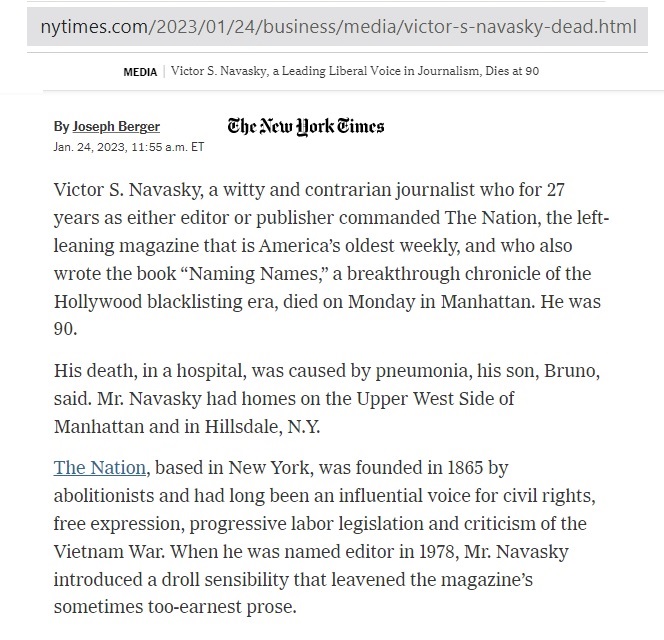
The Engelberg Variations —

"… the arrangement of one's books …."
. . . or of one's house committees . . . .

Comments Off on The Importance of Being Droll
Thursday, December 8, 2022
Old Art

A related problem:
"What powers the Velvet Buzzsaw?"
Perhaps the Santa Fe Institute . . .
Logo of the Santa Fe Institute —

Perhaps Morf Vandewalt …

… Perhaps, as the above Hockney date suggests,
Louis Menand —

Comments Off on Old Art
Monday, June 27, 2022
Dealing With Cubism
Continued from April 12, 2022.
"It’s important, as art historian Reinhard Spieler has noted,
that after a brief, unproductive stay in Paris, circa 1907,
Kandinsky chose to paint in Munich. That’s where he formed
the Expressionist art group Der Blaue Reiter (The Blue Rider) —
and where he avoided having to deal with cubism."
— David Carrier,
Remarks by Louis Menand in The New Yorker today —
"The art world isn’t a fixed entity.
It’s continually being reconstituted
as new artistic styles emerge."

(Adapted from Encyclopaedia Britannica,
Eleventh Edition (1911), Crystallography .)
"Before time began, there was the Cube."
— Optimus Prime
See as well Verbum (February 18, 2017).
Related dramatic music —
"Westworld Season 4 begins at Hoover Dam,
with William looking to buy the famous landmark.
What does he consider to be 'stolen' data that is inside?"

Comments Off on Dealing With Cubism
Tuesday, May 10, 2022
Inscrutable Art
A link to
https://www.newyorker.com/magazine/
2022/05/16/how-queer-was-ludwig-wittgenstein
appeared today in my RSS feed as . . .
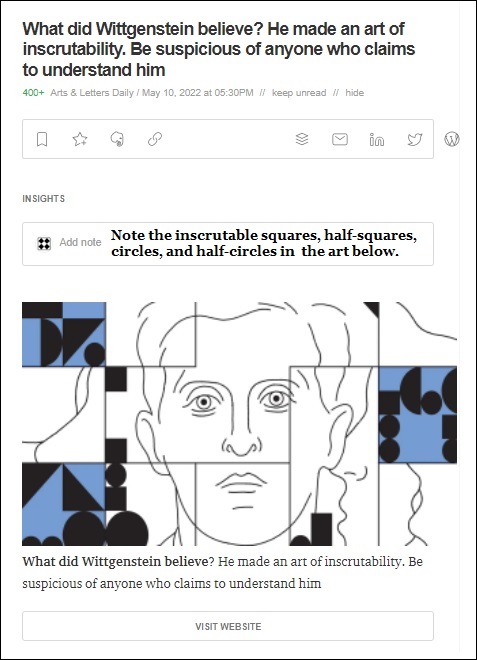
Related remarks: Art Space, a Log24 post of 7 May 2017.
The art above is by one Alexis Beauclair. See as well
an earlier illustration, also credited to Beauclair —

Comments Off on Inscrutable Art
Wednesday, December 1, 2021


Saturday, October 16, 2021
Th’ Honor
The online New York Times yesterday on a dead adman —
"His childhood hero was Bill Mauldin, the Pulitzer Prize-winning
editorial cartoonist, whose drawings Mr. Kennedy traced while
learning to draw."

Some will prefer the Hawkline Monster version of heroes —

Comments Off on Th’ Honor
Thursday, October 7, 2021
Louis Menand, Coordinator Wannabe

See also previous references to Menand in this journal.
Comments Off on Louis Menand, Coordinator Wannabe
Thursday, July 15, 2021
Vacuous Aspirations

The above links are to . . .
https://www.artnews.com/art-in-america/features/
pessimistic-art-world-novels-1234598728/ and
See also the previous post.
Comments Off on Vacuous Aspirations
Monday, June 21, 2021
The Bauhaus Dance
"If you have built castles in the air,
your work need not be lost;
that is where they should be.
Now put the foundations under them.”
— Henry David Thoreau


Comments Off on The Bauhaus Dance
Thursday, June 10, 2021


Sunday, January 17, 2021
The Miscast Spell
See Spectre and Spectral in this journal.

Details — “California Health Care Facility inmate Phillip Spector, 80,
was pronounced deceased of natural causes at 6:35 p.m. [California time]
on Saturday, January 16, 2021, at an outside hospital. His official cause of
death will be determined by the medical examiner in the San Joaquin
County Sheriff’s Office.”
— California Department of Corrections and Rehabilitation
Comments Off on The Miscast Spell
Saturday, December 12, 2020
The Wrong Stuff


Comments Off on The Wrong Stuff
Wednesday, September 9, 2020
Artspeak Eulogy
“… several writers called Mr. Gorchov’s paintings ‘primitive,’
but he preferred ‘rudimentary.’ They took painting back to basics,
to a primal state and a set of motifs that changed only a little,
flirting with repetition but rarely succumbing to it.”
— Roberta Smith in The New York Times this afternoon.
Gorchov reportedly “died on Aug. 18 at his home in Red Hook, Brooklyn.”
See as well some art remarks on Aug. 18 in this journal —

More generally, see other posts tagged Kampf.
Update of 1:16 PM ET Sept. 9 —

Comments Off on Artspeak Eulogy
Wednesday, June 3, 2020



Theology for Jews


See also Aloha.

But see as well . . .


Click to enlarge the above story by Paul Meyer, Dayton sports writer.
Comments Off on Theology for Jews
Saturday, May 23, 2020
Structure for Linguists
"MIT professor of linguistics Wayne O’Neil died on March 22
at his home in Somerville, Massachusetts."
— MIT Linguistics, May 1, 2020

The "deep structure" above is the plane cutting the cube in a hexagon
(as in my note Diamonds and Whirls of September 1984).
See also . . .

Comments Off on Structure for Linguists
Thursday, May 21, 2020

Monday, February 17, 2020
RIP Charles Portis

See also "True Grid " in this journal.
|
Rosalind Krauss "If we open any tract– Plastic Art and Pure Plastic Art or The Non-Objective World , for instance– we will find that Mondrian and Malevich are not discussing canvas or pigment or graphite or any other form of matter. They are talking about Being or Mind or Spirit. From their point of view, the grid is a staircase to the Universal, and they are not interested in what happens below in the Concrete. Or, to take a more up-to-date example…."
"He was looking at the nine engravings and at the circle,
"And it's whispered that soon if we all call the tune
The nine engravings of The Club Dumas
An example of the universal— or, according to Krauss,
"This is the garden of Apollo, the field of Reason…." |

See as well . . .

Comments Off on RIP Charles Portis
Tuesday, January 28, 2020
Very Stable Kool-Aid
Two of the thumbnail previews
from yesterday's 1 AM post …


Further down in the "6 Prescott St." post, the link 5 Divinity Avenue
leads to …
|
A Letter from Timothy Leary, Ph.D., July 17, 1961
Harvard University July 17, 1961
Dr. Thomas S. Szasz Dear Dr. Szasz: Your book arrived several days ago. I've spent eight hours on it and realize the task (and joy) of reading it has just begun. The Myth of Mental Illness is the most important book in the history of psychiatry. I know it is rash and premature to make this earlier judgment. I reserve the right later to revise and perhaps suggest it is the most important book published in the twentieth century. It is great in so many ways–scholarship, clinical insight, political savvy, common sense, historical sweep, human concern– and most of all for its compassionate, shattering honesty. . . . . |
The small Morton Prince House in the above letter might, according to
the above-quoted remarks by Corinna S. Rohse, be called a "jewel box."
Harvard moved it in 1978 from Divinity Avenue to its current location at
6 Prescott Street.
Related "jewel box" material for those who
prefer narrative to mathematics —
"In The Electric Kool-Aid Acid Test , Tom Wolfe writes about encountering
'a young psychologist,' 'Clifton Fadiman’s nephew, it turned out,' in the
waiting room of the San Mateo County jail. Fadiman and his wife were
'happily stuffing three I-Ching coins into some interminable dense volume*
of Oriental mysticism' that they planned to give Ken Kesey, the Prankster-
in-Chief whom the FBI had just nabbed after eight months on the lam.
Wolfe had been granted an interview with Kesey, and they wanted him to
tell their friend about the hidden coins. During this difficult time, they
explained, Kesey needed oracular advice."
— Tim Doody in The Morning News web 'zine on July 26, 2012**
Oracular advice related to yesterday evening's
"jewel box" post …
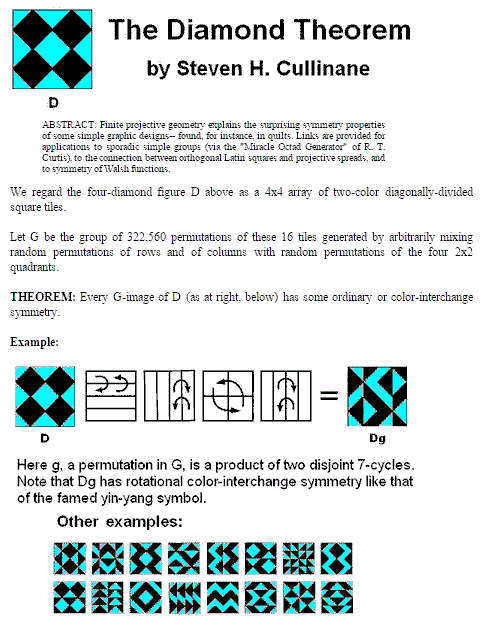
A 4-dimensional hypercube H (a tesseract ) has 24 square
2-dimensional faces. In its incarnation as a Galois tesseract
(a 4×4 square array of points for which the appropriate transformations
are those of the affine 4-space over the finite (i.e., Galois) two-element
field GF(2)), the 24 faces transform into 140 4-point "facets." The Galois
version of H has a group of 322,560 automorphisms. Therefore, by the
orbit-stabilizer theorem, each of the 140 facets of the Galois version has
a stabilizer group of 2,304 affine transformations.
Similar remarks apply to the I Ching In its incarnation as
a Galois hexaract , for which the symmetry group — the group of
affine transformations of the 6-dimensional affine space over GF(2) —
has not 322,560 elements, but rather 1,290,157,424,640.
* The volume Wolfe mentions was, according to Fadiman, the I Ching.
** See also this journal on that date — July 26, 2012.
Comments Off on Very Stable Kool-Aid
Monday, December 2, 2019
Aesthetics at Harvard

"What the piece of art is about is the gray space in the middle."
— David Bowie, as quoted in the above Crimson piece.
Bowie's "gray space" is the space between the art and the beholder.
I prefer the gray space in the following figure —

Context: The Trinity Stone (Log24, June 4, 2018).
Comments Off on Aesthetics at Harvard
Wednesday, November 20, 2019

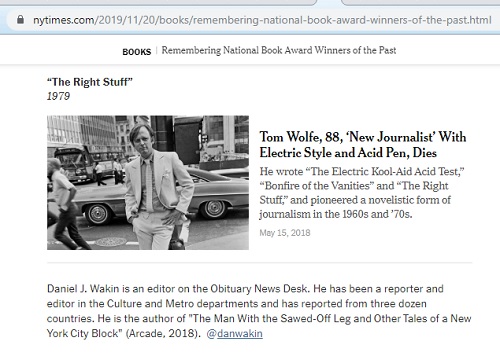
After Rothko
RED
_____________________________________________________________________________

GRAY
______________________
Arya on Rothko

Comments Off on After Rothko
Monday, August 26, 2019
Firsts: Farmer’s Daughter

See as well the firsts of Sophia Lillis (Saturday, August 24).
Comments Off on Firsts: Farmer’s Daughter
Wednesday, August 21, 2019


Saturday, August 17, 2019
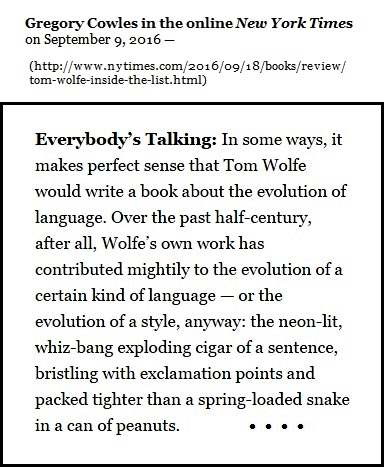
Crystalline Complexity
Burroway on Hustvedt in The New York Times ,
Sunday, March 9, 2003 —

See as well "Putting the Structure in Structuralism."
Comments Off on Crystalline Complexity
Tuesday, July 23, 2019
Gate of Heavenly Peace
"The Tian'anmen (also Tiananmen or Tienanmen)
([tʰjɛ́n.án.mə̌n]), or the Gate of Heavenly Peace, is
a monumental gate in the centre of Beijing, widely
used as a national symbol of China. First built during
the Ming dynasty in 1420, Tiananmen was the entrance
to the Imperial City . . . ."
A related article on Chinese history, The Critical Moment,
suggests an associated (if only by title) webpage —

See as well The Painted Word .
Comments Off on Gate of Heavenly Peace
Wednesday, May 15, 2019
A Wrinkle in Time and Space

Comments Off on A Wrinkle in Time and Space
Saturday, May 4, 2019
The Long Strange Trip of Abstract Art


Comments Off on The Long Strange Trip of Abstract Art
Friday, March 22, 2019
Charles Jencks’s Grand Unified Theory
"The stars and galaxies seem static, eternal, or moving slowly
in deterministic patterns, becoming the background stage
on which we move. But if we could speed up the sequence,
we would see how dramatic and unpredictable this background
really is — an actor, director, script and stage all at once.
Moreover, it is a unified universe, a single unfolding event
of which we are an embedded part, a narrative of highly
dangerous and fine-tuned events, something more like
a detective thriller with many crimes and last-minute escapes
than the impersonal account of astronomy textbooks.
We are only just beginning to decipher the plot and figure out
the Cosmic Code, as Heinz Pagels puts it."
— Charles Jencks, The Architecture of the Jumping Universe :
A Polemic (How Complexity Science is Changing Architecture
and Culture), Academy Editions, 1995, rev. ed. 1997
"A Grand Unified Theory (GUT) is a model in particle physics…."
— Wikipedia
"Under the GUT symmetry operation these field components
transform into one another. The reason quantum particles
appear to have different properties in nature is that the unifying
symmetry is broken. The various gluons, quarks and leptons
are analogous to the facets of a cut diamond, which appear
differently according to the way the diamond is held but in
fact are all manifestations of the same underlying object."
— Heinz Pagels, Perfect Symmetry , Bantam paperback, 1986, p. 284
See also the recent post Multifaceted Narrative.
Comments Off on Charles Jencks’s Grand Unified Theory
Thursday, October 25, 2018
Clerisy
Two images from a post of April 11, 2014 —


Tom Cruise at the Vatican in MI3
_____________________________________________________________________
Michelle Monaghan, star of "The Path," in MI3 —

Comments Off on Clerisy
Saturday, September 22, 2018
The Venturi Manifesto
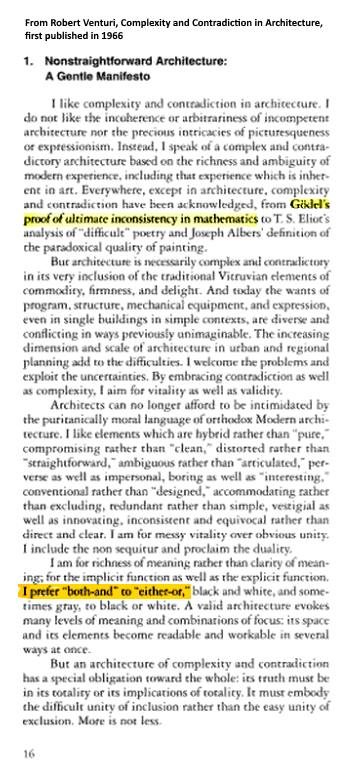
Venturi reportedly died on Tuesday, September 18.*
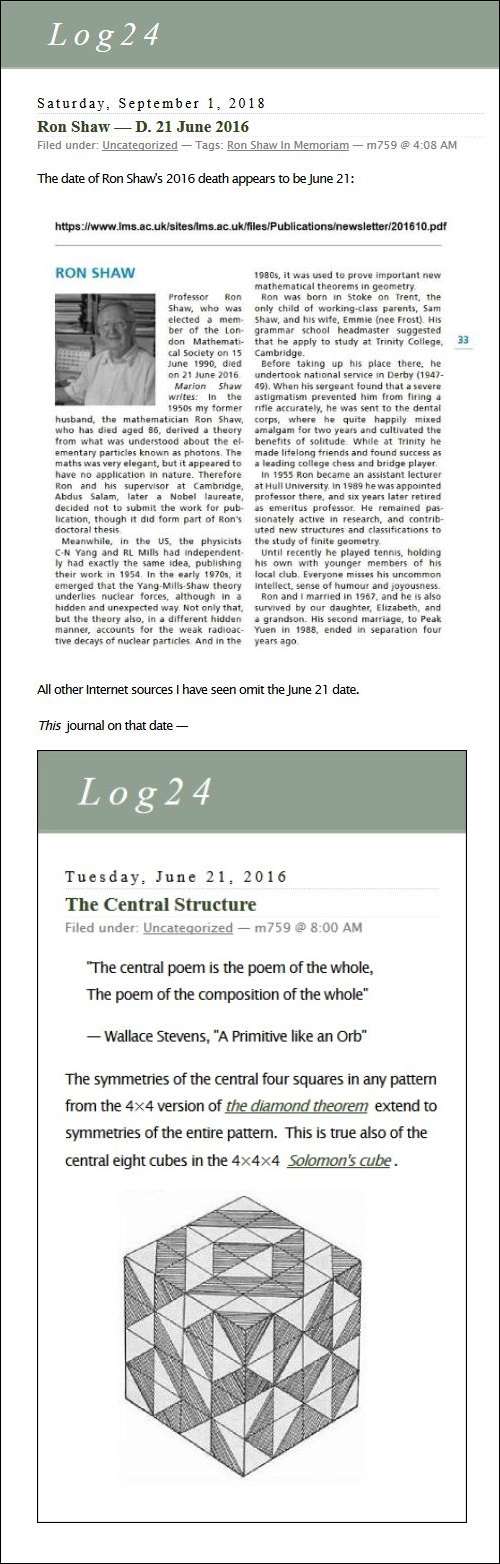
See also this journal on that date.
* Fact check:

Comments Off on The Venturi Manifesto
Tuesday, September 11, 2018
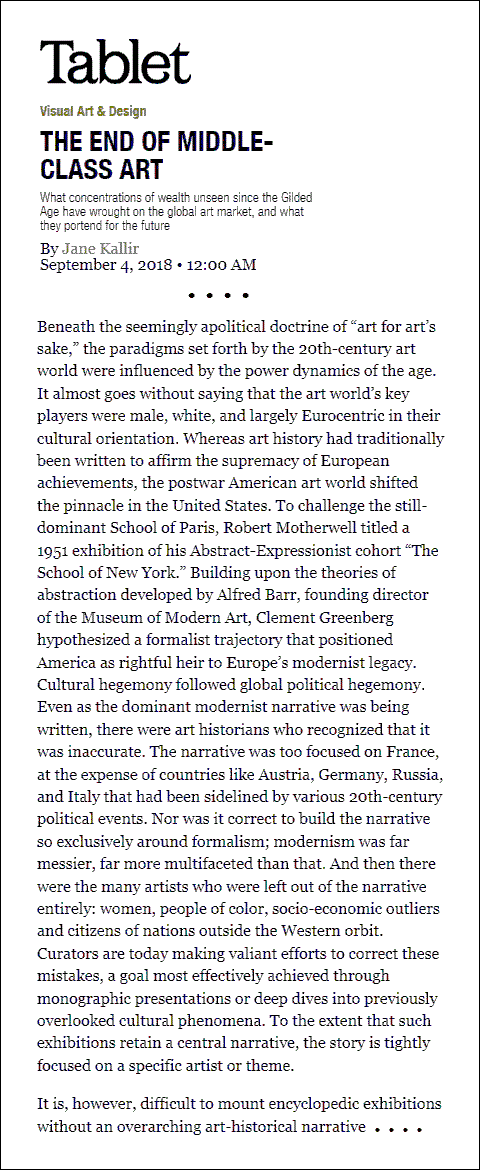
Wednesday, September 5, 2018
Midnight Art
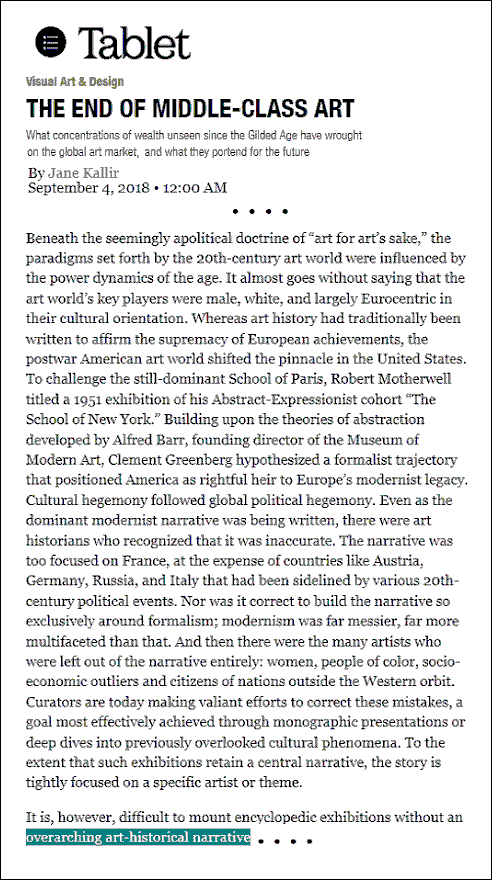
See also 12 AM Sept. 4 in this journal, "Identity Crisis."
Related material — "Overarching" in this journal.
Update of 4:12 AM ET —
The name of the New Yorker artist in the Identity Crisis post,
Tamara Shopsin, has now been added to the illustrated excerpt.
See as well . . .
https://www.nytimes.com/2018/09/04/obituaries/
kenny-shopsin-dead.html.
itemprop="datePublished"
content="2018-09-04T22:17:59.000Z"
Comments Off on Midnight Art
Friday, August 24, 2018
The Wandelweiser Manifesto


Comments Off on The Wandelweiser Manifesto
Tuesday, July 17, 2018
Deep Learning for Jews

From The New York Times on June 20, 2018 —
" In a widely read article published early this year on arXiv.org,
a site for scientific papers, Gary Marcus, a professor at
New York University, posed the question:
'Is deep learning approaching a wall?'
He wrote, 'As is so often the case, the patterns extracted
by deep learning are more superficial than they initially appear.' "

See as well an image from posts tagged Quantum Suffering . . .


The time above, 10:06:48 PM July 16, is when I saw …

"What you mean 'we,' Milbank?"
Comments Off on Deep Learning for Jews
Sunday, July 15, 2018
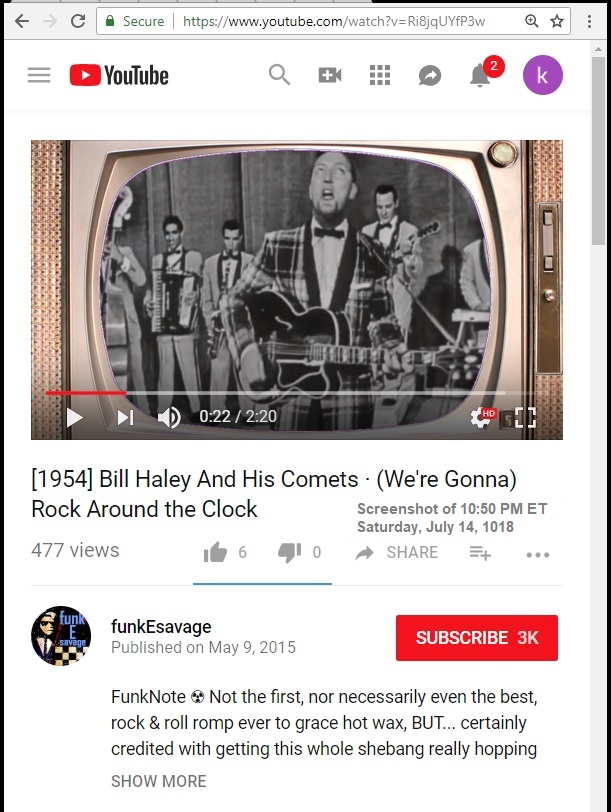
Fashion Statements
Comments Off on Fashion Statements
Thursday, July 12, 2018
The Bell
Three hidden keys open three secret gates
Wherein the errant will be tested for worthy traits
And those with the skill to survive these straits
Will reach The End where the prize awaits
— Ready Player One , by Ernest Cline
“Look, my favorite expression is,
‘When you go up to the bell, ring it,
or don’t go up to the bell.’ …
We’ve gone too far. We have to ring the bell.”
— Mel Brooks on “The Producers”
in The New York Times today.
A 2016 Scribner edition of Stephen King’s IT —

Related material —

Mystery box merchandise from the 2011 J. J. Abrams film Super 8
Comments Off on The Bell
Saturday, July 7, 2018
Easter Eggs for Rosalind

Three hidden keys open three secret gates
Wherein the errant will be tested for worthy traits
And those with the skill to survive these straits
Will reach The End where the prize awaits
— Ready Player One , by Ernest Cline
Related text —
Tu es Petrus et super hanc petram
aedificabo ecclesiam meam et tibi
dabo claves regni caelorum
Related imagery —
From Steven Spielberg's film "Ready Player One" (2018) —

From this journal on June 17, 2003 —

From The New York Times on Easter night, 2007 —

See as well Rosalind Krauss on LeWitt:

Comments Off on Easter Eggs for Rosalind
Tuesday, July 3, 2018
The Ant and the WASP

See also posts tagged "Lost" and a search for "Excellent Adventure."
Comments Off on The Ant and the WASP
Monday, May 28, 2018
Epstein on Art
Joseph Epstein in the online Weekly Standard
on May 24, 2018, at 3:03 PM —
| Hilton Kramer, in a powerful essay called “Revenge of the Philistines,” praised Wolfe’s account of the sociology of the visual art of the time. On the comedy inherent in the subject, he noted, Wolfe “is illuminating and often hilarious.” Yet, when it came to the analysis of ideas, Kramer felt, “when it comes down to actual works of art and the thinking they both embody and inspire, Wolfe is hopelessly out of his depth . . . and, no doubt, beyond his true interests.” He faulted Wolfe for his inability to understand the historical context of the contemporary situation in art or how we have come to where we are in a way that carries us well beyond “the drawing-room comedy of The Painted Word .” Kramer concluded: “It is this fundamental incomprehension of the role of criticism in the life of art—this enmity to the function of theory in the creation of culture—that identifies The Painted Word , despite its knowingness and its fun, as a philistine utterance, an act of revenge against a quality of mind it cannot begin to encompass and must therefore treat as a preposterous joke.” |
For Kramer in greater depth, see an online biography.
Comments Off on Epstein on Art
Friday, May 18, 2018
Central Square


This journal 10 years ago today had a link to a post on
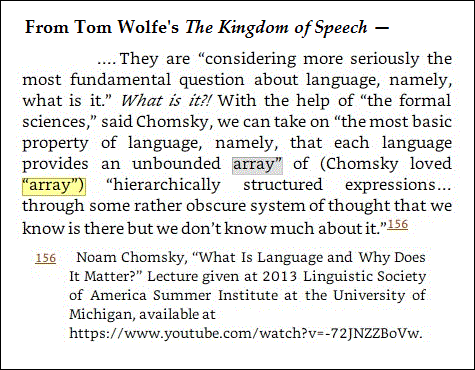
Tom Wolfe's "Sorry, but Your Soul Just Died."
Comments Off on Central Square
Thursday, May 17, 2018
Leap

Quoted here on May 5, 2018 —

|
" Lying at the axis of everything, zero is both real and imaginary. Lovelace was fascinated by zero; as was Gottfried Leibniz, for whom, like mathematics itself, it had a spiritual dimension. It was this that let him to imagine the binary numbers that now lie at the heart of computers: 'the creation of all things out of nothing through God's omnipotence, it might be said that nothing is a better analogy to, or even demonstration of such creation than the origin of numbers as here represented, using only unity and zero or nothing.' He also wrote, 'The imaginary number is a fine and wonderful recourse of the divine spirit, almost an amphibian between being and nonbeing.' "
— A footnote from page 229 of Sydney Padua's |
The page number 229 may also be interpreted, cabalistically,
as the date 2/29, Leap Day.
See Leap Day 2016 among the posts tagged Mind Spider.
Comments Off on Leap
Speak, Memory
On the film "Anna" in the previous post —

See also the above world premiere date in the posts of October 2013 —
esp. the post Conundrum.
Related material — An early scene in "Mindscape" . . .

. . . and "The Abacus Conundrum" in this journal.
Comments Off on Speak, Memory
DATA
Quoted here on May 7, 2018 —
Novelist George Eliot and programming pioneer Ada Lovelace —

PBS last night —

Trailer for last night's PBS program on artificial intelligence —

Piano roll for "I am sixteen going on seventeen" (see previous post) —

From yesterday evening's "Strong Women" post —
"It's been dirty for dirty
Down the line . . ."
— Joni Mitchell,
"For the Roses" album (1972)

"… for the roses
Had the look of flowers that are looked at.”
— T. S. Eliot, Four Quartets
Comments Off on DATA
May 17
"Well, she was just 17 …" — Song lyric
See as well, from last Christmas Eve, Piano Roll.
Comments Off on May 17
Wednesday, May 16, 2018


Review
The title of the previous post, "Church and Temple," together
with today's online New York Times obituaries for singer
Lara Saint Paul (d. May 8) and playwright Leah Rose Napolin
(d. May 13), suggests a review…

See as well a Log24 search for Isaac Singer.
Comments Off on Review


Tuesday, May 15, 2018
Monday, May 14, 2018
Space

Comments Off on Space
Logos at Harvard
In 2013, Harvard University Press changed its logo to an abstract "H."

Both logos now accompany a Harvard video first published in 2012,
"The World of Mathematical Reality."
In the video, author Paul Lockhart discusses Varignon's theorem
without naming Varignon (1654-1722) . . .

A related view of "mathematical reality" —

Note the resemblance to Plato's Diamond.
Comments Off on Logos at Harvard
Saturday, May 12, 2018
The McLean Awakening

Comments Off on The McLean Awakening
Wednesday, August 30, 2017
Horn and Hard Art
Or: Bee Season Continues

Click the automat image above to enlarge.
Click the Horn & Hardart image below for the source.

See as well Catskills Heaven (Log24 on August 20, 2017) —
The Coen brothers, 2007 screenplay —

(From a novel by Cormac McCarthy)
Comments Off on Horn and Hard Art
Monday, September 12, 2016
Tuesday, May 19, 2015
The Lindbergh Manifesto
"Creation is the birth of something, and
something cannot come from nothing."
— Photographer Peter Lindbergh at his website
From a biography of Lindbergh —
"… it took Lindbergh awhile to find his true métier.
Born in Krefeld, Germany, in 1944….
Barely out of his teens, he became a painter who
embraced conceptual art and — for reasons he
has since forgotten — adopted the professional
name « Sultan. » Lindbergh… was a few years
short of his 30th birthday when he turned to
photography…."
— "The Man Who Loves Women," by Pamela Young,
Toronto Globe & Mail , September 19, 1996
A Lindbergh work (at right below) from his conceptual-art days —
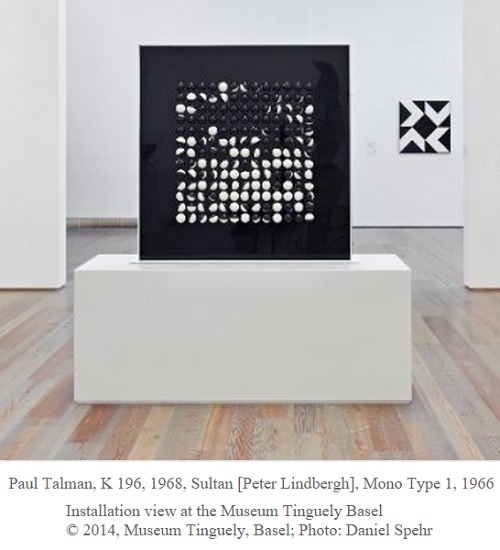
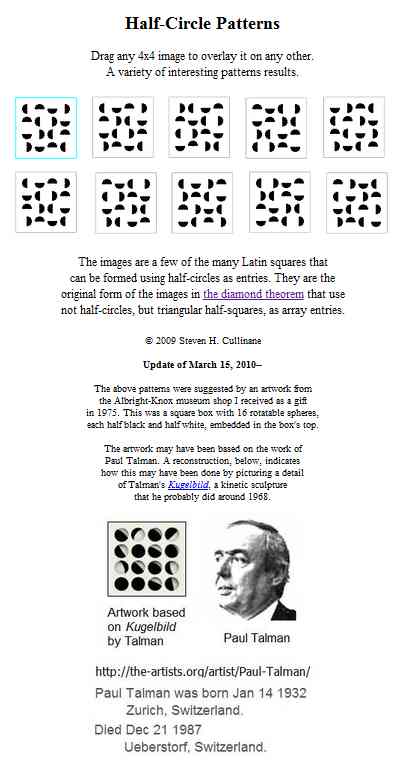
For a connection between the above work by Paul Talman and the
above "Mono Type 1" of Lindbergh, see…
Comments Off on The Lindbergh Manifesto
Friday, February 21, 2014
Night’s Hymn of the Rock
One way of interpreting the symbol 
at the end of yesterday's post is via
the phrase "necessary possibility."
See that phrase in (for instance) a post
of July 24, 2013, The Broken Tablet .
The Tablet post may be viewed in light
of a Tom Wolfe passage quoted here on
the preceding day, July 23, 2013—

On that day (July 23) another weblog had
a post titled
Wallace Stevens: Night's Hymn of the Rock.
Some related narrative —

I prefer the following narrative —
Part I: Stevens's verse from "The Rock" (1954) —
"That in which space itself is contained"
Part II: Mystery Box III: Inside, Outside (2014)
Comments Off on Night’s Hymn of the Rock
Monday, March 2, 2009
Monday March 2, 2009
Joyce's Nightmare
continues
Today in History – March 2
|

|
From Gravity's Rainbow (Penguin Classics, 1995), page 563:
"He brings out the mandala he found.
Slothrop gives him the mandala. He hopes it will work like the mantra that Enzian told him once, mba-kayere (I am passed over), mba-kayere… a spell […]. A mezuzah. Safe passage through a bad night…."
In lieu of Slothrop's mandala, here is another… 
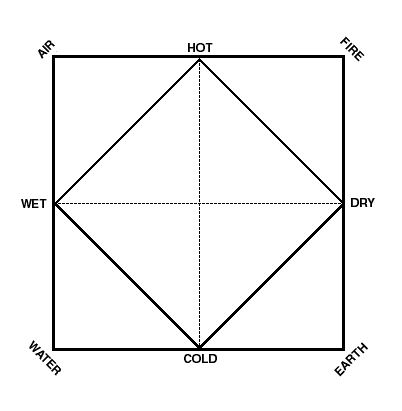
Christ and the Four Elements
This 1495 image is found in
Related mandalas:
For further details,
click on any of the three mandalas above. |


Happy birthday to
Tom Wolfe, author of
The Painted Word.
Comments Off on Monday March 2, 2009