Gell-Mann Meets Bosch . . .

At Hiroshima . . .

* The Bosch cuboctahedron is from an exhibition at Napoli in 2021.
See also, from that exhibition's starting date,
the Log24 post Desperately Seeking Symmetry.
Gell-Mann Meets Bosch . . .
At Hiroshima . . .
* The Bosch cuboctahedron is from an exhibition at Napoli in 2021.
See also, from that exhibition's starting date,
the Log24 post Desperately Seeking Symmetry.
The title is from a post of January 10, 2019.
A figure from this journal on June 1, 2019 —

The following figure may help relate labelings of the
truncated octahedron ("permutahedron") to labelings
of its fellow Archimedean solid, the cuboctahedron.

See as well other posts tagged Aitchison.
The 759 octads of the Steiner system S(5,8,24) are displayed
rather neatly in the Miracle Octad Generator of R. T. Curtis.
A March 9, 2018, construction by Iain Aitchison* pictures the
759 octads on the faces of a cube , with octad elements the
24 edges of a cuboctahedron :

The Curtis octads are related to symmetries of the square.
See my webpage "Geometry of the 4×4 square" from March 2004.
Aitchison's p. 42 slide includes an illustration from that page —

Aitchison's octads are instead related to symmetries of the cube.
Note that essentially the same model as Aitchison's can be pictured
by using, instead of the 24 edges of a cuboctahedron, the 24 outer
faces of subcubes in the eightfold cube .
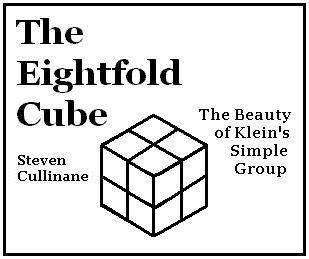
Image from Christmas Day 2005.
* http://www.math.sci.hiroshima-u.ac.jp/branched/files/2018/
presentations/Aitchison-Hiroshima-2-2018.pdf.
See also Aitchison in this journal.

Shown below are Aitchison's March 2018 M24 permutations
and their relabeling, with digits only, for MAGMA checking.
In the versions below, r g b stand for red, green, blue.
Infinity has been replaced by 7 (because a digit was needed,
and the position of the infinity symbol in the Aitchison cube
was suited to the digit 7).
(r7,r1)(b2,g4)(r3,r5)(r6,g0)
mu0= (g7,g2)(r4,b1)(g6,g3)(g5,b0)
(b7,b4)(g1,r2)(b5,b6)(b3,r0)
mu1 = (r7,r2,)(b3,g5)(r4,r6)(r0,g1)
(g7,g3)(r5,b2)(g0,g4)(g6,b1)
(b7,b5)(g2,r3)(b6,b0)(b4,r1)
mu2 = (r7,r3)(b4,g6)(r5,r0)(r1,g2)
(g7,g4)(r6,b3)(g1,g5)(g0,b2)
(b7,b6)(g3,r4)(b0,b1)(b5,r2)
mu3 = (r7,r4)(b5,g0)(r6,r1)(r2,g3)
(g7,g5)(r0,b4)(g2,g6)(g1,b3)
(b7,b0)(g4,r5)(b1,b2)(b6,r3)
mu4 = (r7,r5)(b6,g1)(r0,r2)(r3,g4)
(g7,g6)(r1,b5)(g3,g0)(g2,b4)
(b7,b1)(g5,r6)(b2,b3)(b0,r4)
mu5 = (r7,r6)(b0,g2)(r1,r3)(r4,g5)
(g7,g0)(r2,b6)(g4,g1)(g3,b5)
(b7,b2)(g6,r0)(b3,b4)(b1,r5)
mu6 = (r7,r0)(b1,g3)(r2,r4)(r5,g6)
(g7,g1)(r3,b0)(g5,g2)(g4,b6)
(b7,b3)(g0,r1)(b4,b5)(b2,r6)
Table 1 —
0 1 2 3 4 5 6 7
r 1 2 3 4 5 6 7 8
g 9 10 11 12 13 14 15 16
b 17 18 19 20 21 22 23 24
The wReplace program was used with Table 1 above
to rewrite mu0-mu6 for MAGMA.
The resulting code for MAGMA —
|
G := sub< Sym(24) |
(8,3)(20,14)(5,7)(1,10)
(8,4)(21,15)(6,1)(2,11)
(8,5)(22,9)(7,2)(3,12)
(8,6)(23,10)(1,3)(4,13)
(8,7)(17,11)(2,4)(5,14)
(8,1)(18,12)(3,5)(6,15)
G; |
The Aitchison generators passed the MAGMA test.
Commemorating a talk given by Iain Aitchison
at Hiroshima a year ago today.

Two examples from the Wikipedia article "Archimedean solid" —

Iain Aitchison said in a talk last year at Hiroshima that
the Mathieu group M24 can be represented as permuting
naturally the 24 edges of the cuboctahedron.
The 24 vertices of the truncated octahedron are labeled
naturally by the 24 elements of S4 in a permutahedron —

Can M24 be represented as permuting naturally
the 24 vertices of the truncated octahedron?
The New Yorker reviewing "Bumblebee" —
"There is one reliable source for superhero sublimity,
and it’s all the more surprising that it’s a franchise with
no sacred inspiration whatsoever but, rather, of purely
and unabashedly mercantile origins: the 'Transformers'
series, based on a set of toys, in which Michael Bay’s
exhilarating filmmaking offers phantasmagorical textures
of an uncanny unconscious resonance."
— Richard Brody on December 29, 2018
"Before time began, there was the Cube."
— Optimus Prime

Some backstory — A Riddle for Davos, Jan. 22, 2014.
This journal ten years ago today —
Surprise Package

From a talk by a Melbourne mathematician on March 9, 2018 —

The source — Talk II below —
Search Results
|
Related material —
The 56 triangles of the eightfold cube . . .
Image from Christmas Day 2005.
“This is the relativity problem: to fix objectively a class of
equivalent coordinatizations and to ascertain the group of
transformations S mediating between them.”
— Hermann Weyl, The Classical Groups ,
Princeton University Press, 1946, p. 16
See also Relativity Problem and Diamonds and Whirls.
A search this morning for articles mentioning the Miracle Octad Generator
of R. T. Curtis within the last year yielded an abstract for two talks given
at Hiroshima on March 8 and 9, 2018 —
|
http://www.math.sci.hiroshima-u.ac.jp/ branched/files/2018/abstract/Aitchison.txt
Iain AITCHISON Title: Construction of highly symmetric Riemann surfaces, related manifolds, and some exceptional objects, I, II Abstract: Since antiquity, some mathematical objects have played a special role, underpinning new mathematics as understanding deepened. Perhaps archetypal are the Platonic polyhedra, subsequently related to Platonic idealism, and the contentious notion of existence of mathematical reality independent of human consciousness. Exceptional or unique objects are often associated with symmetry – manifest or hidden. In topology and geometry, we have natural base points for the moduli spaces of closed genus 2 and 3 surfaces (arising from the 2-fold branched cover of the sphere over the 6 vertices of the octahedron, and Klein's quartic curve, respectively), and Bring's genus 4 curve arises in Klein's description of the solution of polynomial equations of degree greater than 4, as well as in the construction of the Horrocks-Mumford bundle. Poincare's homology 3-sphere, and Kummer's surface in real dimension 4 also play special roles. In other areas: we have the exceptional Lie algebras such as E8; the sporadic finite simple groups; the division algebras: Golay's binary and ternary codes; the Steiner triple systems S(5,6,12) and S(5,8,24); the Leech lattice; the outer automorphisms of the symmetric group S6; the triality map in dimension 8; and so on. We also note such as: the 27 lines on a cubic, the 28 bitangents of a quartic curve, the 120 tritangents of a sextic curve, and so on, related to Galois' exceptional finite groups PSL2(p) (for p= 5,7,11), and various other so-called `Arnol'd Trinities'. Motivated originally by the `Eightfold Way' sculpture at MSRI in Berkeley, we discuss inter-relationships between a selection of these objects, illustrating connections arising via highly symmetric Riemann surface patterns. These are constructed starting with a labeled polygon and an involution on its label set. Necessarily, in two lectures, we will neither delve deeply into, nor describe in full, contexts within which exceptional objects arise. We will, however, give sufficient definition and detail to illustrate essential inter-connectedness of those exceptional objects considered. Our starting point will be simplistic, arising from ancient Greek ideas underlying atomism, and Plato's concepts of space. There will be some overlap with a previous talk on this material, but we will illustrate with some different examples, and from a different philosophical perspective. Some new results arising from this work will also be given, such as an alternative graphic-illustrated MOG (Miracle Octad Generator) for the Steiner system S(5,8,24), and an alternative to Singerman – Jones' genus 70 Riemann surface previously proposed as a completion of an Arnol'd Trinity. Our alternative candidate also completes a Trinity whose two other elements are Thurston's highly symmetric 6- and 8-component links, the latter related by Thurston to Klein's quartic curve. |
See also yesterday morning's post, "Character."
Update: For a followup, see the next Log24 post.
Things of August*
Related narratives:
Related mathematics:

*


Related material: Theodore Sturgeon's novel The Dreaming Jewels
and his story "What Dead Men Tell" . . .


About the author of the above —
A related questionable "proof of concept" :
Aitchison at Hiroshima in this journal — a scholar's 2018 investigation
of M24 actions on a cuboctahedon — and . . .
Two examples from the Wikipedia article "Archimedean solid" —
Iain Aitchison said in a 2018 talk at Hiroshima that
the Mathieu group M24 can be represented as permuting
naturally the 24 edges of the cuboctahedron.
The 24 vertices of the truncated octahedron are labeled
naturally by the 24 elements of S4 in a permutahedron —
Can M24 be represented as permuting naturally
the 24 vertices of the truncated octahedron?
Related material from the day Orson Welles and Yul Brynner died —

At Hiroshima on March 9, 2018, Aitchison discussed another
"hexagonal array" with two added points… not at the center, but
rather at the ends of a cube's diagonal axis of symmetry.
See some related illustrations below.
Fans of the fictional "Transfiguration College" in the play
"Heroes of the Fourth Turning" may recall that August 6,
another Hiroshima date, was the Feast of the Transfiguration.

The exceptional role of 0 and ∞ in Aitchison's diagram is echoed
by the occurence of these symbols in the "knight" labeling of a
Miracle Octad Generator octad —

Transposition of 0 and ∞ in the knight coordinatization
induces the symplectic polarity of PG(3,2) discussed by
(for instance) Anne Duncan in 1968.
From The New York Times on May 5, 2011 —
"… What Paris says to me is love story, awash with painters,
shots of the Seine, Champagne. Thank God I have a
can’t-miss notion to sell you. I call it ‘Midnight in Paris.’ ”
“Romantic title,” I had to admit. “Is there a script?”
“Actually, there’s nothing on paper yet, but I can spitball
the main points,” he said, slipping on his tap shoes.
“Maybe some other time,” I said, mindful of Cubbage’s
unbroken string of theatrical Hiroshimas.
— Woody Allen
The above passage is in memory of a French film director
who, like the reporter in yesterday's post Primary Colors,
reportedly died on April 21, 2022.
See also Aitchison at Hiroshima and Easter for Aitchison.
Shown below is an illustration from "The Puzzle Layout Problem" —

Exercise: Using the above numerals 1 through 24
(with 23 as 0 and 24 as ∞) to represent the points
∞, 0, 1, 2, 3 … 22 of the projective line over GF(23),
reposition the labels 1 through 24 in the above illustration
so that they appropriately* illustrate the cube-parts discussed
by Iain Aitchison in his March 2018 Hiroshima slides on
cube-part permutations by the Mathieu group M24.
A note for Northrop Frye —
Interpenetration in the eightfold cube — the three midplanes —

A deeper example of interpenetration:
Aitchison has shown that the Mathieu group M24 has a natural
action on the 24 center points of the subsquares on the eightfold
cube's six faces (four such points on each of the six faces). Thus
the 759 octads of the Steiner system S(5, 8, 24) interpenetrate
on the surface of the cube.
* "Appropriately" — I.e. , so that the Aitchison cube octads correspond
exactly, via the projective-point labels, to the Curtis MOG octads.
Geometry for Jews continues.

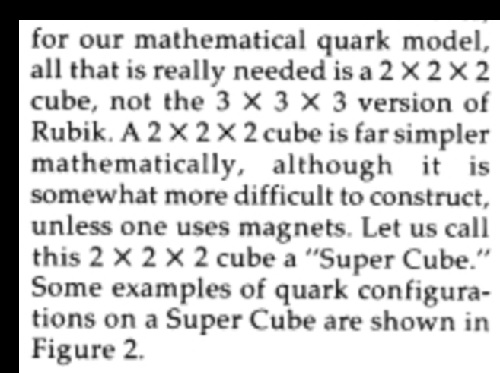

The conclusion of Solomon Golomb's
"Rubik's Cube and Quarks,"
American Scientist , May-June 1982 —

Related geometric meditation —
Archimedes at Hiroshima
in posts tagged Aitchison.
* As opposed to Solomon's Cube .
“To conquer, three boxes* have to synchronize and join together into the Unity.”
―Wonder Woman in Zack Snyder’s Justice League

See also The Unity of Combinatorics and The Miracle Octad Generator.
* Cf. Aitchison’s Octads —


Related vocabulary —

See as well the word facet in this journal.
Analogously, one might write . . .
A Hiroshima cube consists of 6 faces ,
each with 4 squares called facets ,
for a total of 24 facets. . . ."
(See Aitchison's Octads , a post of Feb. 19, 2020.)

Click image to enlarge. Background: Posts tagged 'Aitchison.'"

For the Sith Pyramid, see posts tagged Pyramid Game.
For the Jedi Cube, see posts tagged Enigma Cube
and cube-related remarks by Aitchison at Hiroshima.
This post was suggested by two events of May 16, 2019 —
A weblog post by Frans Marcelis on the Miracle Octad
Generator of R. T. Curtis (illustrated with a pyramid),
and the death of I. M. Pei, architect of the Louvre pyramid.
That these events occurred on the same date is, of course,
completely coincidental.
Perhaps Dan Brown can write a tune to commemorate
the coincidence.
Saturday evening's post Diamond Globe suggests a review of …
Iain Aitchison on symmetric generation of M24 —
* A Greek version for the late John SImon:
«Ἀνερρίφθω κύβος».
An image from All Souls' Day 2010 —

This is from earlier posts tagged Permutahedron.
See also
Wallace Stevens:
A World of Transforming Shapes.
From that book (click to enlarge) —

"Before time began, there was the Cube."
— Optimus Prime.
Also from earlier posts tagged Permutahedron —
An illustration from the April 20, 2016, post
Symmetric Generation of a Simple Group —

"The geometry of unit cubes is a meeting point
of several different subjects in mathematics."
— Chuanming Zong, Bulletin of the American
Mathematical Society , January 2005
From religionnews.com —
"The word 'Hanukkah' means dedication.
It commemorates the rededicating of the
ancient Temple in Jerusalem in 165 B.C. . . . ."
From The New York Times this morning —

Related material —
From this journal on Wednesday, December 5, 2018 —
Megan Fox in "Transformers" (2007) —

From a Google image search this morning —

The image search was suggested by recent posts tagged Aitchison
and by this morning's previous post.
Powered by WordPress


