Monday, October 9, 2023
|
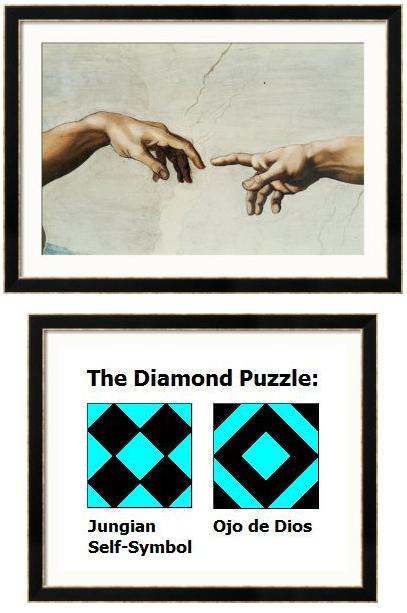
Compare and contrast . . .
The Disney version —
Update at 6:36 AM EDT Monday, March 16, 2026 —

Monday, October 9, 2023
|
Compare and contrast . . .
The Disney version —
Update at 6:36 AM EDT Monday, March 16, 2026 —

Image reposted here on 9 October last year —
Moulin Bleu
Kaleidoscope turning…
Shifting pattern
within unalterable structure…
— Roger Zelazny, Eye of Cat
Instagram today —
Related art —
From part two of the recent film triptych "Kinds of Kindness" . . .
Window with Couch and Cat —

More later.
Update of 6:06 PM ET — An image from a post of Oct. 12, 2008 —
Moulin Bleu
Kaleidoscope turning…
Shifting pattern
within unalterable structure…
— Roger Zelazny, Eye of Cat
"Many of these same characters wonder whether
they are creating these special places anew, or
are merely finding places which already exist
(very much like 'the problem of universals' in
classical metaphysics)."
— Wikipedia article on author Roger Zelazny
Related material —
* For the title, see a story by Zelazny.
Daniel Radcliffe in the recent film "The Lost City" —
|
301
302
303
304 |
From the Log24 post "Fish Babel" —
The final page, 759, of the Harry Potter saga —
|
Sunday, July 14, 2013
Working Backwards
|
|
"I twisted my mind like a bright ribbon, folded it,
"All manner of thing shall be well |
See also some context for these quotations.
|
Changing Woman: “Kaleidoscope turning…
Shifting pattern — Roger Zelazny, Eye of Cat |
"Center loosens, forms again elsewhere." — Roger Zelazny
See also an image in memory of the Coppertone artist
from a post of May 18, 2006 —
“My God, it’s
full of stars!”
"Warming to the question of what it means to read a poem backward…."
— Essayist in a New Yorker weblog on July 11, 2013
“Death itself would start working backwards.”
— Aslan in The Chronicles of Narnia , 1950
|
"I twisted my mind like a bright ribbon, folded it,
"All manner of thing shall be well |
See also some context for these quotations.
Lurching Toward Decision
"Suskind… nails, I think, Obama's intellectual blind spot. Indeed, Obama himself nails it, telling Suskind that he was too inclined to search for 'the perfect technical answer' to the myriad of complex issues coming at him."
— Frank Rich on Ron Suskind's new book about the White House, Confidence Men
Very distantly related material—
From "Confidence Game," an Oct. 12, 2008, post in this journal, a quasi-European perspective—
|
Kaleidoscope turning… – Roger Zelazny, Eye of Cat |
See also …
Gravity’s Rainbow , Penguin Classics, 1995, page 742:
"… knowing his Tarot, we would expect to look among the Humility, among the gray and preterite souls, to look for him adrift in the hostile light of the sky, the darkness of the sea….
Now there’s only a long cat’s-eye of bleak sunset left over the plain tonight, bright gray against a purple ceiling of clouds, with an iris of
742"
"Center loosens, forms again elsewhere…"
— Zelazny, quoted here for Women's History Month.
"I know it's not much but it's the best I can do.
My gift is my song and this one's for you."
— Elton John song. John hosts SNL tonight.
|
Blue Jean Baby… |
LA Lady… |
The Center

Anonymous Woman
Adapted from Harvard Crimson
March 2008 photo by Isabella N. Lai
at the Harvard Women's Center
See also …
Yeats –
“the centre cannot hold,”
Stevens –
“the center of resemblance,”
and Zelazny –
“center loosens,
forms again elsewhere.”
Mathematics and Narrative continued
A search for Ursula in this journal yields a story…
“The main character is a slave woman who discovers new patterns in the mosaics.”
Other such stories: Plato’s Meno and Changing Woman —
|
“Kaleidoscope turning…
Shifting pattern within — Roger Zelazny, Eye of Cat |
Philosophical postscript—
“That Lévi-Strauss should have been able to transmute the romantic passion of Tristes Tropiques into the hypermodern intellectualism of La Pensée Sauvage is surely a startling achievement. But there remain the questions one cannot help but ask. Is this transmutation science or alchemy? Is the ‘very simple transformation’ which produced a general theory out of a personal disappointment real or a sleight of hand? Is it a genuine demolition of the walls which seem to separate mind from mind by showing that the walls are surface structures only, or is it an elaborately disguised evasion necessitated by a failure to breach them when they were directly encountered? Is Lévi-Strauss writing, as he seems to be claiming in the confident pages of La Pensée Sauvage, a prolegomenon to all future anthropology? Or is he, like some uprooted neolithic intelligence cast away on a reservation, shuffling the debris of old traditions in a vain attempt to revivify a primitive faith whose moral beauty is still apparent but from which both relevance and credibility have long since departed?”
— Clifford Geertz, conclusion of “The Cerebral Savage: On the Work of Claude Lévi-Strauss“
This journal on October 12 (the traditional Columbus day)—
"The text is a two-way mirror
that allows me to look into
the life and times of the reader."
– The French Mathematician
(Galois), by Tom Petsinis
It is not clear how this is supposed to work.
However, there is synchronicity and the New York Lottery—
October 12, 2010—
Midday 765, Evening 365 —
Life and Times.
Life
|
From Log24 on April 21, the date of Mark Twain’s death– Psychoshop, by Alfred Bester and Roger Zelazny:
The Pennsylvania Lottery
and hence Log24, 9/23 (2007), and page 765 of From Here to Eternity (Delta paperback, 1998):
|
Times
|
See "Seasons of Love" from the musical "Rent." |
See also Mark 15:38— "And the veil of the temple…"
The Running
"Budd Schulberg, who wrote the award-winning screenplay for 'On the Waterfront' and created a classic American archetype of naked ambition, Sammy Glick, in his novel What Makes Sammy Run?, died on Wednesday. He was 95…."
See, too, Blue Matrices, and
a link for Beethoven's birthday:
"Edward T. Hall, a cultural anthropologist
who pioneered the study of nonverbal
communication and interactions between
members of different ethnic groups,
died July 20 at his home in
Santa Fe, N.M. He was 95."
NY Times piece quoted here on
the date of Hall's death:
|
"July 20, 1969, was the moment NASA needed, more than anything else in this world, the Word. But that was something NASA's engineers had no specifications for. At this moment, that remains the only solution to recovering NASA's true destiny, which is, of course, to build that bridge to the stars." Commentary — |
"Mr. Hall first became interested in
space and time as forms of cultural
expression while working on
Navajo and Hopi reservations
in the 1930s."
Log24, July 29:
|
"Kaleidoscope turning…
Shifting pattern within |
"We are the key."
— Eye of Cat
Paul Newall, "Kieślowski's Three Colours Trilogy"—
"Julie recognises the music of the busker outside playing a recorder as that of her husband's. When she asks him where he heard it, he replies that he makes up all sorts of things. This is an instance of a theory of Kieślowski's that 'different people, in different places, are thinking the same thing but for different reasons.' With regard to music in particular, he held what might be characterised as a Platonic view according to which notes pre-exist and are picked out and assembled by people. That these can accord with one another is a sign of what connects people, or so he believed."
The above photo of Juliette Binoche in Blue accompanying the quotations from Zelazny illustrates Kieślowski's concept, with graphic designs instead of musical notes. Some of the same designs are discussed in Abstraction and the Holocaust (Mark Godfrey, Yale University Press, 2007). (See the Log24 entries of June 11, 2009.)
Related material:
"Jeffrey Overstreet, in his book Through a Screen Darkly, comments extensively on Blue. He says these stones 'are like strands of suspended crystalline tears, pieces of sharp-edged grief that Julie has not been able to express.'….
Throughout the film the color blue crops up, highlighting the mood of Julie's grief. A blue light occurs frequently, when Julie is caught by some fleeting memory. Accompanied by strains of an orchestral composition, possibly her husband's, these blue screen shots hold for several seconds while Julie is clearly processing something. The meaning of this blue light is unexplained. For Overstreet, it is the spirit of reunification of broken things."
— Martin Baggs at Mosaic Movie Connect Group on Sunday, March 15, 2009. (Cf. Log24 on that date.)
For such a spirit, compare Binoche's blue mobile in Blue with Binoche's gathered shards in Bee Season.

Related material:
Dialogue from Forbidden Planet —
Dialogue from another story —
“Sizewise?”
“Brainwise, but what they did was multiply me by myself into a quadratic.”
— Psychoshop, by Bester and Zelazny, 1998 paperback, p. 7
“… which would produce a special being– by means of that ‘cloned quadratic crap.’ [P. 75] The proper term sounds something like ‘Kaleideion‘….”
“So Adam is a Kaleideion?”
She shook her head.
“Not a Kaleideion. The Kaleideion….”
— Psychoshop, 1998 paperback, p. 85
|
“Kaleidoscope turning…
Shifting pattern within
|
“When life itself seems lunatic,
who knows where madness lies?”
— For the source, see
Joyce’s Nightmare Continues.
Welcome to the
Black Hole Café
"Our lifelong friendship made me not only an admirer of the depth, scholarship, and sheer energy of his mathematical work (and of his ceaseless activities as an editorial entrepreneur on behalf of mathematics) but one in awe of his status as the ultimate relaxed sophisticate."
|
Psychoshop
by Alfred Bester
|
"For every kind of vampire,
there is a kind of cross."
— Thomas Pynchon


Related material:
Dec. 16, 2003—
|
Kaleidoscope turning… |
(continued from the birthday
this year of Pope Benedict XVI)
"History, Stephen said,
is a nightmare from which
I am trying to awake."
— Ulysses
|
When? Going to dark bed there was a square round Sinbad the Sailor roc's auk's egg in the night of the bed of all the auks of the rocs of Darkinbad the Brightdayler. Where?
— Ulysses, conclusion of Chapter 17 |
|
His manner was all charm and grace; pure cafe society…. He purred a chuckle. "Love to. The Luogo Nero? "That's what the locals call it.
— Psychoshop, by |
In memory of
special effects wizard
Stan Winston,
who died Sunday at 62:
"The energetic Winston
was always looking
to the next project."
— Today's LA Times,
story by
Dennis McLellan

From
“On the Holy Trinity,”
the entry in the 3:20 PM
French footprint:
“…while the scientist sees
everything that happens
in one point of space,
the poet feels
everything that happens
in one point of time…
all forming an
instantaneous and transparent
organism of events….”
From
“Angel in the Details,”
the entry in the 3:59 PM
French footprint:
“I dwell in Possibility –
A fairer House than Prose”
These, along with this afternoon’s
earlier entry, suggest a review
of a third Log24 item, Windmills,
with an actress from France as…
|
Changing Woman: “Kaleidoscope turning…
Shifting pattern |
“When life itself seems lunatic,
who knows where madness lies?”
— For the source, see
Joyce’s Nightmare Continues.
— Yale art student
Aliza Shvarts,
quoted today in
The Harvard Crimson
From Log24 on
March 14:
|
Rite of Spring
From the online Related material:
A figure from
— and
The center referred
See also Yeats —
Stevens —
and Zelazny —
|
Related material
from Google:
|
JSTOR: Killing Time
|
Other ways
of killing time:
|
From Log24 on April 21, the date of Mark Twain's death–
Psychoshop, by Alfred Bester and Roger Zelazny:
The Pennsylvania Lottery
and hence Log24, 9/23 (2007), and page 765 of From Here to Eternity (Delta paperback, 1998):
|
Poetry for Physicists:
The Gates of Hell
From the obituary of physicist John Archibald Wheeler at Princeton:
That was it. "I had been searching for just the right term for months, mulling it over in bed, in the bathtub, in my car, wherever I had quiet moments," he later said. "Suddenly this name seemed exactly right." He kept using the term, in lectures and on papers, and it stuck.
From Log24 last year on this date ("Happy Birthday, Benedict XVI"):
From Dante, The Inferno, inscription on the gates of Hell:
From Psychoshop, an unfinished novel by Alfred Bester completed by Roger Zelazny:
He purred a chuckle. "My place. If you want to come, I'll show you."
"Love to. The Luogo Nero? The Black Place?"
"That's what the locals call it. It's really Buoco Nero, the Black Hole."
"Like the Black Hole of Calcutta?"
"No. Black Hole as in astronomy. Corpse of a dead star, but also channel between this universe and its next-door neighbor."
"Here? In Rome?"
"Sure. They drift around in space until they run out of gas and come to a stop. This number happened to park here."
"How long ago?"
"No one knows," he said. "It was there six centuries before Christ, when the Etruscans took over a small town called Roma and began turning it into the capital of the world."
Log24 on
narrative–
Life of the Party
(March 24, 2006),
and
'Nauts
(March 26, 2006)
(continued from
March 7, 2008)

A search for the evening
number, 332, in Log24
yields a rather famous
line from Sophocles…
Sophocles, Antigone,
edited by Mark Griffith,
Cambridge University Press,
1999:

— Antigone, lines 332-333, in Valdis Leinieks, The Plays of Sophokles, John Benjamins Publishing Company, 1982, p. 62
Continuing the search within Antigone for the mid-day number, 874, we find…

“Power (kratos), for one who is concerned with power (kratos), is in no way to be transgressed.”
— Antigone, lines 873-874, Leinieks, op. cit. p. 69
Both passages from Sophocles seem not unrelated to yesterday’s entry for the Ides of March and to last night’s opening routine on “Saturday Night Live.”
The above word deina (formidable, wonderful, awesome) in the latter context suggests the following meditation:
— Anne McCaffrey,
Radcliffe ’47,
To Ride Pegasus
Related material:
The Log24 Pi Day
mantra from
Roger Zelazny —
“center loosens,
forms again elsewhere.”
From the online
Harvard Crimson —
Related material:
A figure from
Monday's entry —
— and
June 30, 2007's
Annals of Theology,
with a link to a film:
The Center of the World.
The center referred
to in that film is the
same generic "center"
displayed at Harvard
and in the above
mandorla: not the
Harvard Women's
Center, but rather
the women's center.
See also Yeats —
"the centre cannot hold,"
Stevens —
"the center of resemblance,"
and Zelazny —
"center loosens,
forms again elsewhere."
"I wasn’t expecting Ernst Gombrich, but surely three writers, among them, could inject a touch of class."
The "Jumper" theme, teleportation, has been better developed by three other writers– Bester, Zelazny, and King–
"As a long-time fan of both Alfie Bester and Roger Zelazny, I was delighted to find this posthumous collaboration. Psychoshop is, I think, true to both authors' bodies of work. After all, Bester's influence on Zelazny is evident in a a number of works, most notably Eye of Cat with its dazzling experimental typography so reminiscent of what Bester had done in The Demolished Man and The Stars My Destination."
— Amazon.com customer review
"'This is the last call for Jaunt-701,' the pleasant female voice echoed through the Blue Concourse of New York's Port Authority Terminal."
— Stephen King, "The Jaunt"
|
From another "Jaunt-701"– Log24, Feb. 7:
The Football
Mandorla New York Lottery, 2008: "He pointed at the football "The |
"It's eternity in there,"
he said, and dropped dead….
— Stephen King, "The Jaunt"
Related material:
the previous entry.
| "I was reading Durant's section on Plato, struggling to understand his theory of the ideal Forms that lay in inviolable perfection out beyond the phantasmagoria. (That was the first, and I think the last, time that I encountered that word.)" |
Part I: Phantasmagoria


Photo by Phil Bray
Transcendence through spelling:
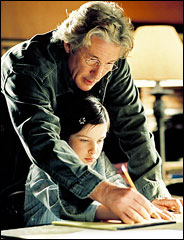
Richard Gere and Flora Cross
as father and daughter
in the film of Bee Season.
"Every aspect of the alef's
construction has been
Divinely designed
to teach us something."
— Alef– The Difference Between
Exile And Redemption,
by Rabbi Aaron L. Raskin
Related material–
Art Theory for Yom Kippur
and
Log24 entries, Nov. 2005.
The Alphabet Versus the Goddess:
The Conflict Between Word and Image.
See also the references
to Zelazny's Eye of Cat
in the Nov. 2005 entries
as well as
today's previous entry—
with the Norton Simon motto
"Hunt for the best"– and…
— Arthur Lubow in The New York Times, Feb. 25, 2007
(continued from
Life of the Party, March 24)
Exhibit A —
From (presumably) a Princeton student
(see Activity, March 24):
Exhibit B —
From today's Sunday comics:
Exhibit C —
From a Smith student with the
same name as the Princeton student
(i.e., Dagwood's "Twisterooni" twin):
Related illustrations
("Visual Stimuli") from
the Smith student's game —
Literary Exercise:
Continuing the Smith student's
Psychonauts theme,
compare and contrast
two novels dealing with
similar topics:
A Wrinkle in Time,
by the Christian author
Madeleine L'Engle,
and
Psychoshop,
by the secular authors
Alfred Bester and
Roger Zelazny.
Presumably the Princeton student
would prefer the Christian fantasy,
the Smith student the secular.
Those who prefer reality to fantasy —
not as numerous as one might think —
may examine what both 4×4 arrays
illustrated above have in common:
their structure.
Both Princeton and Smith might benefit
from an application of Plato's dictum:
Powered by WordPress