
Thursday, February 12, 2026
Sunday, August 17, 2025
Narrative for Nevermore
From a post on Friday the Thirteenth (of July, 2018) —
"Wishin' on a falling star, waitin' for the early train
Sorry boy, but I've been hit by a purple rain
Aw, come on Joe, you can always change your name
Thanks a lot son, just the same"
— Ventura Highway lyrics
A candidate for the lyrics' "Joe" . . .
Joe Caroff in his obituary today — "I always meet my deadlines."
Some cartoon graveyards are better than others.
Comments Off on Narrative for Nevermore
Friday, August 23, 2024
For Harlan Kane: The Sicilian Defense

From the Feast of Saint Nicholas, 2023 . . .

Comments Off on For Harlan Kane: The Sicilian Defense
Sunday, February 25, 2024


Wednesday, December 6, 2023
Sicilians at Annenberg Hall, or “Look Homeward, Marshall”
" One of many miniature rotund Sicilians in blue work uniforms,
employed by Harvard to sit on steps and smoke cheap cigars,
or lean for hours against the handles of rakes, was opening
the great door. Sunlight washed through the hall as if a dam
had broken, and was met from the other end, where another
maintenance man, rake in hand, opened the facing doors.
They met in the middle and disappeared through some
swinging panels which led to a staircase going down.
Marshall heard one of them say: 'Just anothah weahdo . . .' ”
— Helprin, Mark. Refiner's Fire (pp. 238-239).
Houghton Mifflin Harcourt. Kindle Edition.
(The first edition was from New York: Alfred A. Knopf, 1977.)

Comments Off on Sicilians at Annenberg Hall, or “Look Homeward, Marshall”
Tuesday, December 5, 2023
The Annenberg Knell
From a Log24 search for the above phrase . . .
|
"For many of us, the geometry course sounded the death knell — "Shape and Space in Geometry" © 1997-2003 Annenberg/CPB. All rights reserved. |
See also Annenberg Hall.
Comments Off on The Annenberg Knell
Monday, October 23, 2023
For the Church of Stephen King


Comments Off on For the Church of Stephen King
Wednesday, June 28, 2023
“Fail Again. Fail Better.” — Samuel Beckett


Also on January 21, 2023, the
"Consecration" upload date —

Comments Off on “Fail Again. Fail Better.” — Samuel Beckett
Tuesday, June 27, 2023
Wednesday, July 15, 2020


Saturday, March 2, 2019
Fashion Story
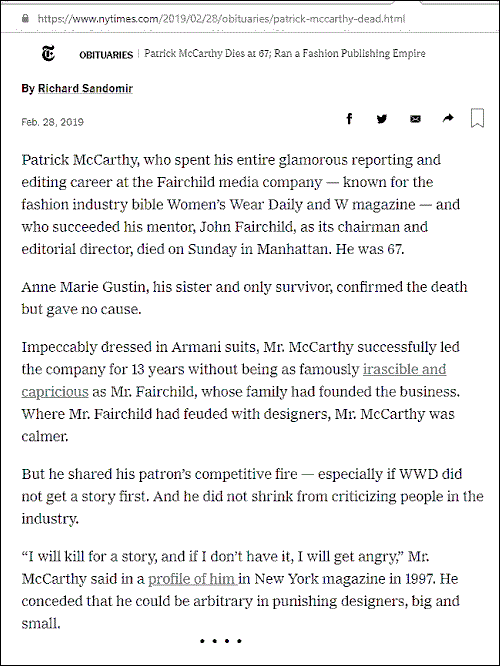
A death last Sunday —
Meanwhile . . .

Amy Adams attends the 2019 Vanity Fair Oscar Party
at Wallis Annenberg Center for the Performing Arts on
Sunday, February 24, 2019, in Beverly Hills, California.
Comments Off on Fashion Story
Thursday, September 20, 2018
1971 Mystery Box
Vincent Canby in The New York Times ,
January 28, 1971, reviews the film "The Statue" —
There is not much point in going into the dialogue,
but you'll get the idea from the line spoken by
a little girl who is shown gazing in wonderment
at the copy of Michelangelo's work in the
Piazza della Signoria in Florence.
"Golly," she says, "if that's David, I'd like to see Goliath!"
"The Statue" may have the distinction of being the first
adolescent comedy about penis envy.
In keeping with filmmaker J.J. Abrams's philosophy of the "mystery box" —
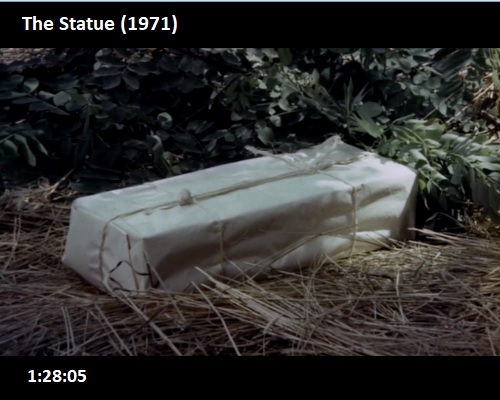
Canby's phrase "you'll get the idea" suggests a Log24 review . . .

Comments Off on 1971 Mystery Box
Saturday, July 21, 2018
Comic-Con 2018


|
"For many of us, the geometry course sounded the death knell — "Shape and Space in Geometry"
© 1997-2003 Annenberg/CPB. All rights reserved. |
Comments Off on Comic-Con 2018
Friday, July 13, 2018
Segue for Harlan Ellison


From a Log24 post of March 13, 2003 —
|
"For many of us, the geometry course sounded the death knell — "Shape and Space in Geometry"
© 1997-2003 Annenberg/CPB. All rights reserved. |
Comments Off on Segue for Harlan Ellison
Tuesday, March 10, 2015
Literary Notes
From an interview by Glen Duncan with author
Susanna Moore published on January 29, 2013 —
|
When did you first realize that you wanted to write fiction? Was there an epiphanic moment? I was a voracious reader as a child, clearing out the local library (my mother had given me a letter for the librarian, attesting that the books that I borrowed were for her reading alone), and I began to write plays, usually starring myself, when I was 9 or 10. There were years of bad poetry. I was features editor of the Punahou school newspaper. But at no moment did I clearly decide that I was going to be a writer, nor did it feel as if I had always been one. I left home for the mainland (I grew up in Hawaii) when I was 17 with no money or education beyond Punahou and the books that I’d read, and knew that I had to earn my living. I had a fantasy that I’d be a reporter and was sent by an equally naïve friend to Walter Annenberg, the owner of The Philadelphia Inquirer , who promptly sent me to the classified ad room, where I became an ad-taker. I’ve always thought that it was very good training: A man would call to place an ad in the hope of selling his used bed, and I would have to write a convincing few sentences on his behalf. I later read scripts for Jack Nicholson and oddly enough had to do the same thing – condense a complicated proposal into a statement of a dozen words. We’ve talked before about how feeling different from the people around us – “mutant” was the word you used – informs or underpins the burgeoning writer’s mentality. Could you expand on that? By mutant, I mean that state in childhood and adolescence of isolation, sometimes blissful, often bewildering, when you realize that you have little in common with the people closest to you – not because you are superior in intelligence or sensitivity, but because you perceive the world in an utterly different way, which you assume to be a failing on your part. It was only through reading and discovering characters who shared that feeling that I realized when I was about 14 that I wasn’t insane. And yes, I think that the sensation, the awareness and then the conviction that your perception of the world is not what might be called conventional, is essential to the making of an artist. It is a little like speaking a different language from the people around you – it affords you solitude, but it also means that you are sometimes misunderstood. |
Related material:
Midnight Politics, X-Woman, "Welcome to Me," and
the following meditation on the word "binder"—

Comments Off on Literary Notes
Thursday, June 26, 2014
Study This Example, Part II
(Continued from 10:09 AM today)
The quotation below is from a webpage on media magnate
Walter Annenberg.
Annenberg Hall at Harvard, originally constructed to honor
the Civil War dead, was renamed in 1996 for his son Roger,
Harvard Class of ’62.
www.broadcastpioneers.com/
walterannenberg.html —
“It was said that Roger was ‘moody and sullen’
spending large parts of his time reading poetry
and playing classical music piano. It had been
reported that Roger attempted suicide at the
age of eleven by slitting his wrists. He recovered
and was graduated Magna Cum Laude from
Episcopal Academy in our area. For awhile,
Roger attended Harvard, but he was removed
from the school’s rolls after Roger stopped doing
his school work and spent almost all his time
reading poetry in his room. He then was sent to
an exclusive and expensive treatment center
in Bucks County, Pennsylvania. At that facility,
Roger became more remote. It was said that he
often didn’t recognize or acknowledge his father.
On August 7, 1962, Roger Annenberg died from
an overdose of sleeping pills.”
A more appropriate Annenberg memorial, an article
in The Atlantic magazine on June 25, notes that…
“Among those who ended up losing their battles
with mental illness through suicide are
Virginia Woolf, Ernest Hemingway, Vincent van Gogh,
John Berryman, Hart Crane, Mark Rothko, Diane Arbus,
Anne Sexton, and Arshile Gorky.”
Comments Off on Study This Example, Part II
Study This Example
The authors of the following offer an introduction to symmetry
in quilt blocks. They assume, perhaps rightly, that their audience
is intellectually impaired:

“A quilt block is made of 16 smaller squares.
Each small square consists of two triangles.”
Study this example of definition.
(It applies quite precisely to the sorts of square patterns
discussed in the 1976 monograph Diamond Theory , but
has little relevance for quilt blocks in general.)
Some background for those who are not intellectually impaired:
Robinson’s book Definition , in this journal and at Amazon.
Comments Off on Study This Example
The McLuhan Dimension
"History is a deep and complicated puzzle—
especially when it involves more dimensions than time."
— Introduction to a novella in Analog Science Fiction

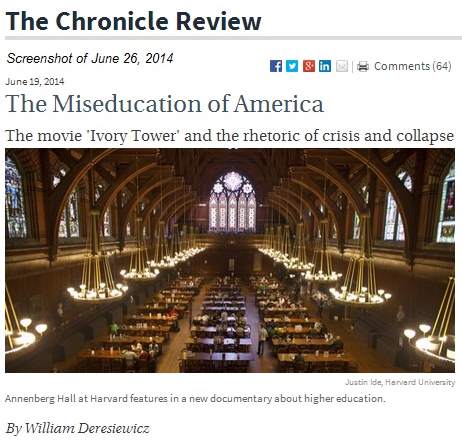

"Annenberg Hall" at Harvard was originally part of a memorial for
Civil War dead. Formerly "Alumni Hall," it was renamed in 1996.
Comments Off on The McLuhan Dimension
Saturday, August 28, 2010
Rally Round the Flag
Chaplin's Great Dictator—

Related material—
That X (August 25) as interpreted on August 18 by Benjamin Kaplan and Martin Dannenberg.
Comments Off on Rally Round the Flag
Thursday, March 4, 2010
Against Stupidity
""Against stupidity the gods themselves contend in vain."
("Mit der Dummheit kämpfen Götter selbst vergebens.")
— Friedrich Schiller (1759-1805) German poet, playwright, critic,
Die Jungfrau von Orleans [The Maid of Orleans], Act III, sc. vi (1801)
To be fair and balanced, we also offer a contrary view–
"Weird Science—Why Editors Must Dare to be Dumb,"
by K.C. Cole, Columbia Journalism Review, 2006
Comments Off on Against Stupidity
Friday, February 20, 2009
Friday February 20, 2009
A Kind of Cross

"For every kind of vampire,
there is a kind of cross."
— Thomas Pynchon in
Gravity's Rainbow

Related material:
A memorial service
held at 2 PM today at the
U.S. Space & Rocket Center
in Huntsville, Alabama, and
today's previous entry.
Comments Off on Friday February 20, 2009
Monday, November 19, 2007
Monday November 19, 2007
Lament for a DJ
In memory of Philadelphia DJ Hy Lit, who died on Saturday at 73:
"Chuck Berry didn't need prompting to insert, in his 'Sweet Little Sixteen,' the lines 'Well, they'll be rockin' on Bandstand, Philadelphia, P.A.' I remember 'Bandstand' before it was 'American…' It started in 1952, when Walter Annenberg, whose Triangle Publications owned the WFIL radio and television stations, suggested an afternoon TV dance party…."
— Richard Corliss, TIME magazine, July 14, 2001
Related material: Back to the Future (Log24 on Sunday)
Comments Off on Monday November 19, 2007
Thursday, March 13, 2003
Thursday March 13, 2003
Death Knell
In memory of Howard Fast, novelist and Jewish former Communist,
who died yesterday, a quotation:
|
"For many of us, the geometry course sounded the death knell — "Shape and Space in Geometry"
© 1997-2003 Annenberg/CPB. All rights reserved. |
See also
Geometry for Jews.

|
Added March 16, 2003: See, too, the life of |
Thursday March 13, 2003
Birthday Song
Today is the birthday of the late Jewish media magnate and art collector Walter H. Annenberg, whose name appears on a website that includes the following text:
|
“Making quilt blocks is an excellent way to explore symmetry. A quilt block is made of 16 smaller squares. Each small square consists of two triangles. Study this example of a quilt block:
 This block has a certain symmetry. The right half is a mirror image of the left, and the top half is a mirror of the bottom.”
© 1997-2003 Annenberg/CPB. All rights reserved. |
Symmetries of patterns such as the above are the subject of my 1976 monograph “ Diamond Theory,” which also deals with “shape and space in geometry,” but in a much more sophisticated way. For more on Annenberg, see my previous entry, “Daimon Theory.” For more on the historical significance of March 13, see Neil Sedaka, who also has a birthday today, in “ Jews in the News.”
Sedaka is, of course, noted for the hit tune “Happy Birthday, Sweet Sixteen,” our site music for today.
See also Geometry for Jews and related entries.
For the phrase “diamond theory” in a religious and philosophical context, see
Pilate, Truth, and Friday the Thirteenth.
“It’s quarter to three….” — Frank Sinatra
Comments Off on Thursday March 13, 2003
Wednesday, March 12, 2003
Wednesday March 12, 2003
Daimon Theory
Today is allegedly the anniversary of the canonization, in 1622, of two rather important members of the Society of Jesus (Jesuits):
Ignatius Loyola…
Click here for Loyola’s legacy of strategic intelligence.
Francis Xavier…
Click here for Xavier’s legacy of strategic stupidity.
We can thank (or blame) a Jesuit (Gerard Manley Hopkins) for the poetic phrase “immortal diamond.” He may have been influenced by Plato, who has Socrates using a diamond figure in an argument for the immortality of the soul. Confusingly, Socrates also talked about his “daimon” (pronounced dye-moan). Combining these similar-sounding concepts, we have Doctor Stephen A. Diamond writing about daimons — a choice of author and topic that neatly combines the strategic intelligence of Loyola with the strategic stupidity of Xavier.

The cover illustration is perhaps not of Dr. Diamond himself.
A link between diamond theory and daimon theory is furnished by the charitable legacy of the non-practicing Jew Walter Annenberg.
For Annenberg and diamond theory, see this site on the elementary geometry of quilt blocks, which credits the Annenberg Foundation for support.
For Annenberg and daimon theory, see this site on Socrates, which has a similar Annenberg support credit.
Advanced disciples of Annenberg can learn much from the Perseus site about daimon theory. Let us pray that Abrahamic religious bigotry does not stand in their way. Less advanced disciples of Annenberg may find fulfillment in teaching children the beauty of elementary 4×4 quilt-block symmetry. Let us pray that academic bigotry does not prevent these same children, when they have grown older, from learning the deeper, and more difficult, beauties of diamond theory.


Comments Off on Wednesday March 12, 2003