"Synthematic totals" and the Cremona-Richmond configuration
The relationship between synthematic totals and the Cremona–Richmond configuration lies in Sylvester's classical combinatorics of a 6-element set, which provides a geometric framework for understanding the outer automorphism of the symmetric group S₆. [1]
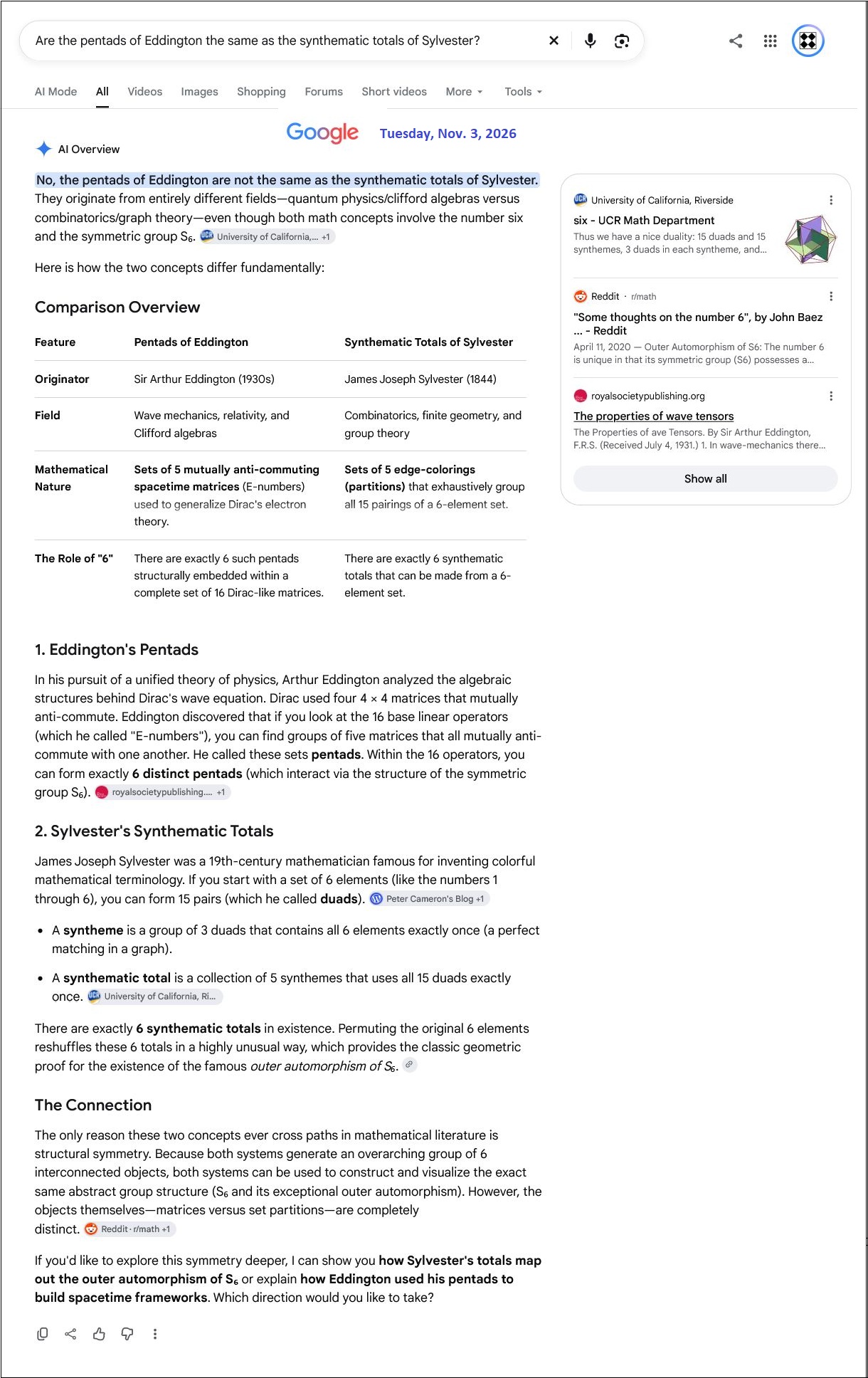
1. Defining the Combinatorial Objects
Starting with a basic set S of 6 elements (e.g., \(S = \{1, 2, 3, 4, 5, 6\}\)):
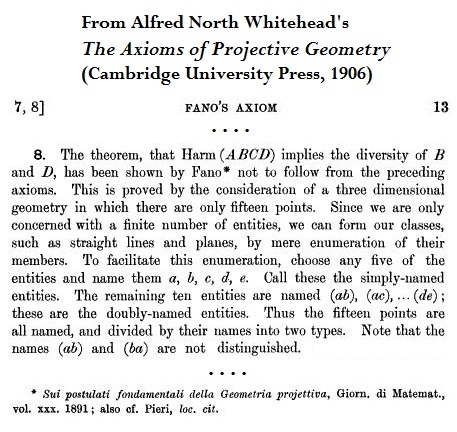
Duad: A subset of 2 elements from S (e.g., \(\{1, 2\}\)). There are \(\binom{6}{2} = 15\) possible duads.
Syntheme: A set of 3 disjoint duads that completely partition S (e.g., \(\{\{1,2\}, \{3,4\}, \{5,6\}\}\)). There are exactly 15 unique synthemes.
Synthematic Total: A collection of 5 synthemes that partition the entire set of 15 duads. Each duad appears exactly once across the 5 synthemes. There are exactly 6 synthematic totals in total. [1, 2]
2. The Cremona–Richmond Configuration (15₃)
The Cremona–Richmond configuration is a geometric configuration consisting of 15 points and 15 lines, where 3 lines pass through every point and 3 points lie on every line. Crucially, it contains no triangles (three mutually intersecting lines). [1]
We can map the combinatorics of S₆ directly onto this configuration: [1, 2]
Points: The 15 points correspond exactly to the 15 duads.
Lines: The 15 lines correspond exactly to the 15 synthemes.
Incidence: A point lies on a line if and only if its underlying duad belongs to that line's underlying syntheme. Because each syntheme contains exactly 3 duads, and each duad belongs to exactly 3 synthemes, the 15₃ balance is perfectly achieved. [1, 2]
3. The Role of Synthematic Totals
Because there are exactly 6 synthematic totals, any permutation of the original 6-element set S acts on the 6 totals. This reveals an exceptional property of S₆: the outer automorphism. [1]
Geometrically, a synthematic total corresponds to a set of 5 mutually skew (completely non-intersecting) lines within the Cremona–Richmond configuration. These 5 lines collectively contain all 15 points of the configuration, forming a perfect matching or "spread" of lines. The 6 totals represent the 6 different ways to partition the configuration's lines into these parallel spreads. [1, 2]
If you would like to explore this configuration further, let me know if you want to look at:
How this system relates to the Tutte–Coxeter graph (the Levi graph of the configuration).
A explicit example of constructing a syntheme and a total using numbers 1–6.
How this geometry links to the bipartite double cover of the Petersen graph.
"In this way mathematics gets a footing
in knowledge which intrinsically is not
of a kind suggesting mathematical conceptions.
Its function is to elucidate the group-structure
of that knowledge. It dismisses the individual
elements by assigning to them symbols . . . ."
— Eddington, 1939, The Philosophy of Physical Science, page 141
To me, the new URL "Songlines.space" suggests both the Outback
and the University of Western Australia. For the former, see
"'Max Barry' + Lexicon" in this journal. For the latter, see SymOmega.
The new URL forwards to a combination of these posts.
Actually, Dirac “bridged math and physics” much earlier —
“Spinors, which are a kind of square root of vectors, had been introduced
in algebra and also in physics as part of Paul Dirac’s theory of the electron.
A spin structure on a manifold allows such square roots to exist.”
Fiction set in Duke Humfrey's Reading Room at the Bodleian Library, University of Oxford:
"I walked quickly through the original, fifteenth-century part of the library, past the rows of Elizabethan reading desks with their three ascending bookshelves and scarred writing surfaces. Between them, Gothic windows directed the reader’s attention up to the coffered ceilings, where bright paint and gilding picked out the details of the university’s crest of three crowns and open book and where its motto, 'God is my illumination,' was proclaimed repeatedly from on high."
— Harkness, Deborah. A Discovery of Witches:
A Novel (2011) (All Souls Trilogy, Book 1 ) (p. 2).
Penguin Publishing Group. Kindle Edition.
Related non-fiction about an event on Jan. 26, 2019 —
2. The Facebook glider suggests a tune from "The Thomas Crown Affair"
(1968) that appeared in a Dec. 16, 2018 post on Christianity and
"interlocking names"—
The reader may contrast the above Squarespace.com logo
(a rather serpentine version of the acronym SS) with a simpler logo
for a square space (the Galois window ):