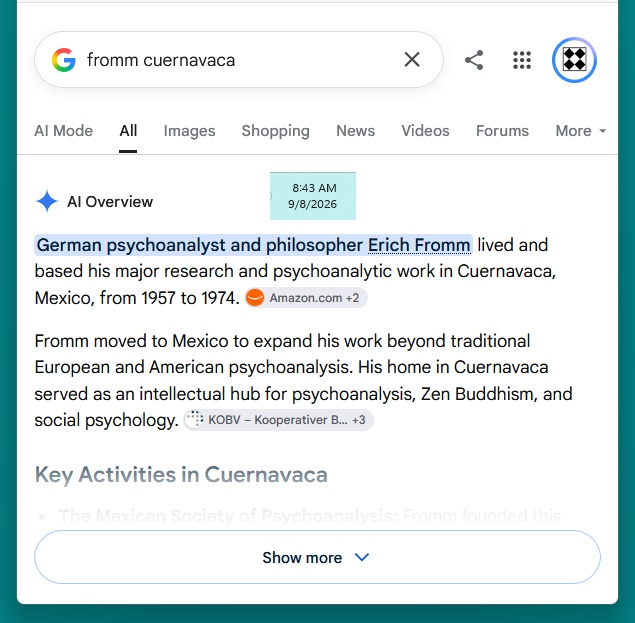
Related reading — Fromm in Wikipedia,
and other posts tagged Revelado.
Related reading — Fromm in Wikipedia,
and other posts tagged Revelado.
260409-Oct_8_2019-Kummer_at_Noon.jpg

For those who prefer Trudeau's "Story Theory of Truth" —
260409-All_Souls_Hootenanny-poster-Oct_8_2019.jpg

Related cultural artifacts . . .
This journal on All Souls' Day 2025 —

260409-Greetings-from-Derry-sign.jpg

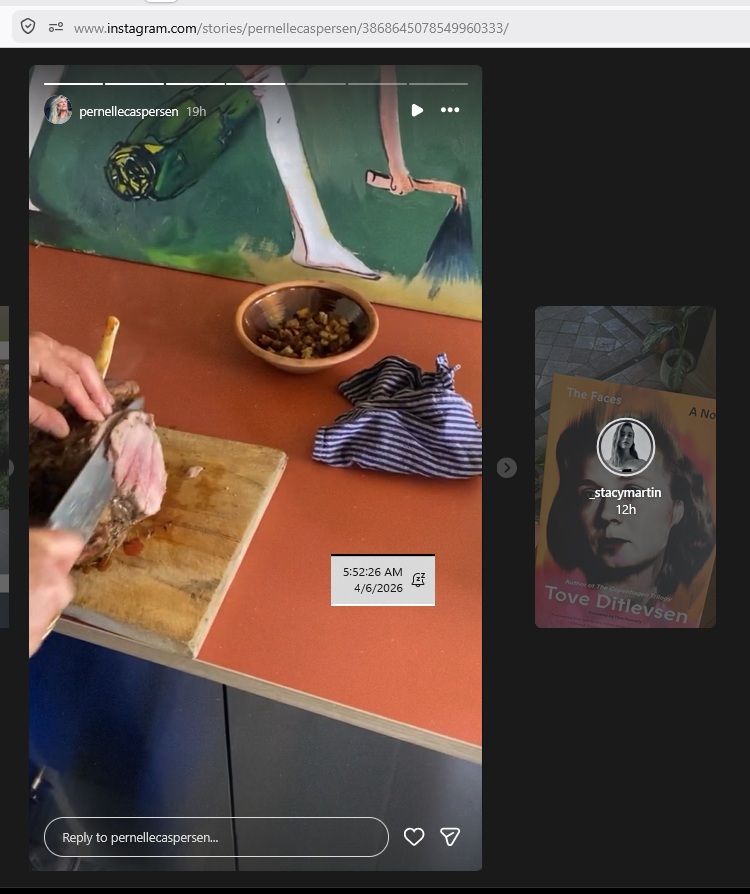
Not recommended for Easter Monday . . .
"The Faces is a short, blistering work, a picture of a woman’s journey
through mental illness. We follow Lise on her path into hell and back . . . ."
Addendum . . .
The above book review of "The Faces" is dated Feb. 2, 2021 . . .
For this journal on that Groundhog Day, vide
http://m759.net/wordpress/?tag=double .



260405-Alix_E_Harrow-metadata.jpg

Addendum . . . Wetterdienst für Gretel . . .




See as well this journal on the above publication date.
* For the the Peter Craig who wrote Blood Father ,
reportedly a son of actress Sally Field, see . . .


This post was suggested in part by the phrase "animation player"
in this morning's post "Sneak Preview."

— Adapted in 2021 from art at the home of Marcela Nowak. A variation:

Lilydale and Rain , by Like No. 90 (Rain is the one on the left) —

A perhaps more useful coach . . .

Some prose by Harrington —
| By 1956, Fromm was dining at Suzuki’s part-time home in New York City, and talking with him about ways in which Zen could contribute to a wholesale reimagining of psychoanalytic therapeutics and theory (see Friedman and Schreiber 2013). By this time, also, Fromm was himself spending considerable periods of time at a new home in Cuernavaca, Mexico. At one point he suggested that Suzuki consider moving in with him permanently. When Suzuki politely declined, Fromm conceived instead a major conference based in Mexico that would try to take stock of the entire current state of the conversation between Zen and psychotherapy (see Friedman and Schreiber 2013). In 1957, some fifty psychotherapists—double the original expected number—participated in a week of presentations and discussions. Fromm later recalled the event as a magical time: what began as a traditional conference with the usual ‘over-emphasis on thoughts and words' changed over a few days, as people 'became more concentrated and more quiet.' |
See as well a web page on what is now called "shadow work" —
an activity completely different from the "shadow work" described
some years ago by Ivan Illich, the so-called "Prophet of Cuernavaca."
Note the book subtitle below: "minutes from an infinite paradise."

For further details, see other posts tagged Revelado.

Image taken from an Instagram story
by marrific, artist not named.
From the Aug. 30 post "A Brief Introduction to Ideas,"
an epigraph from Four Quartets —

Another view of the way up and the way down:
"Of course, presentation of the effect in the cause
is exactly what blending the Buddhist Monk's
two journeys provides. The cause is the dynamics
of the two input journeys; the effect is the existence
of a location on the path they occupy at the same time
of day. In the blend, the location and the encounter are
presented directly as part of the causal dynamics of motion."
— Page 78 in The Way We Think: Conceptual Blending ,
by Fauconnier and Turner, Basic Books, 2002.
The Source —

… who reportedly "died at home in London on Thursday morning" —

From a Log24 post of May 25, 2005 —
"We will go to Asgard...now," he said.
Continued from September 8 .
The New York Times yesterday —
“Art is another way to try to exercise your imagination
at connecting incongruous things,” Anthony Doerr said.
“It’s a way to say, hey, reader, let’s work together and
practice and train our imagination to connect things
that you don’t readily think of as connected.”


For those too young to remember the 20th century . . .

Related illustrations —


The previous post suggests a review . . .

"This is the purpose of being alive, to find someone
who sharpens the corners of the world for you and
allows you to peer into the souls of your fellow man!"
[“Corners” link added.]
— Rosa Lyster two hours ago at
https://www.gawker.com/culture/george-ann
For instance —


"Rock music from car . . ."

|
Harvard University Press on a book, Persons and Things, it published on March 31, 2010 Moving effortlessly between symbolist poetry and Barbie dolls, artificial intelligence and Kleist, Kant, and Winnicott, Barbara Johnson not only clarifies psychological and social dynamics; she also re-dramatizes the work of important tropes—without ever losing sight of the ethical imperative with which she begins: the need to treat persons as persons. In Persons and Things , Johnson turns deconstruction around to make a fundamental contribution to the new aesthetics. She begins with
the most elementary thing we know: and reveals that their claims upon us are fraudulent. Johnson revolutionizes the method by showing that the inanimate thing exposed as a delusion is central to fantasy life, that fantasy life, however deluded, should be taken seriously, and that although a work of art “is formed around something missing,” this “void is its vanishing point, not its essence.” She shows deftly and delicately that the void inside Keats’s urn, Heidegger’s jug, or Wallace Stevens’s jar forms the center around which we tend to organize our worlds. The new aesthetics should restore fluidities between persons and things. In pursuing it, Johnson calls upon Ovid, Keats, Poe, Plath, and others who have inhabited this in-between space. The entire process operates via a subtlety that only a critic of Johnson’s caliber could reveal to us. |
I prefer the more straightforward insanity of Operators and Things .
Barbara Johnson reportedly died on Aug. 27, 2009. See that date
in other posts now tagged Autistic Enchantment. (That phrase is
the sort of sneering tag one may expect from deplorable academics.)
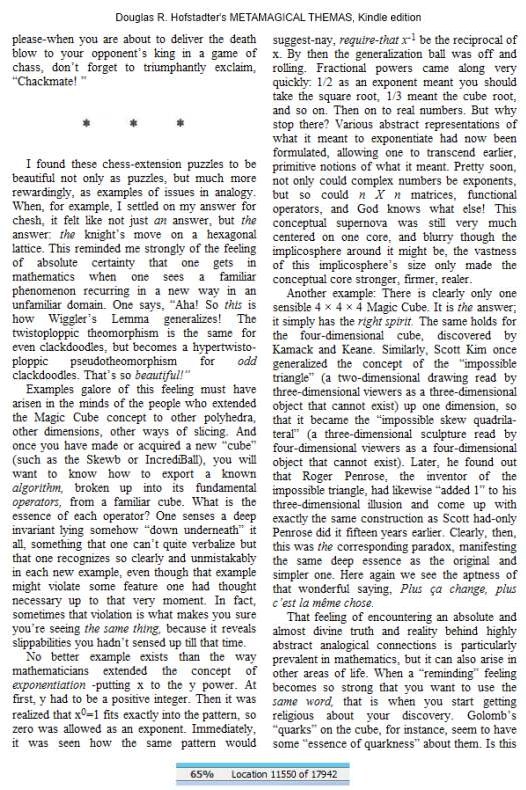
"Examples galore of this feeling must have arisen in the minds of the people who extended the Magic Cube concept to other polyhedra, other dimensions, other ways of slicing. And once you have made or acquired a new 'cube'… you will want to know how to export a known algorithm , broken up into its fundamental operators , from a familiar cube. What is the essence of each operator? One senses a deep invariant lying somehow 'down underneath' it all, something that one can’t quite verbalize but that one recognizes so clearly and unmistakably in each new example, even though that example might violate some feature one had thought necessary up to that very moment. In fact, sometimes that violation is what makes you sure you’re seeing the same thing , because it reveals slippabilities you hadn’t sensed up till that time….
… example: There is clearly only one sensible 4 × 4 × 4 Magic Cube. It is the answer; it simply has the right spirit ."
— Douglas R. Hofstadter, 1985, Metamagical Themas: Questing for the Essence of Mind and Pattern (Kindle edition, locations 11557-11572)
See also Many Dimensions in this journal and Solomon's Cube.
(Continued from Sept. 22–
"A Rose for Ecclesiastes.")
From Kibler's
"Variations on a Theme of
Heisenberg, Pauli, and Weyl,"
July 17, 2008:
"It is to be emphasized
that the 15 operators…
are underlaid by the geometry
of the generalized quadrangle
of order 2…. In this geometry,
the five sets… correspond to
a spread of this quadrangle,
i.e., to a set of 5 pairwise
skew lines…."
— Maurice R. Kibler,
July 17, 2008
For ways to visualize
this quadrangle,

see Inscapes.
|
Related material
A remark of Heisenberg
"… die Schönheit… [ist] die
richtige Übereinstimmung der Teile miteinander und mit dem Ganzen."
"Beauty is the proper conformity |
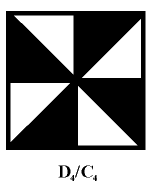
Symmetry in Diamond Theory:
Robbing Peter to Pay Paul
"Groups arise in most areas of pure and applied mathematics, usually as a set of operators or transformations of some structure. The appearance of a group generally reflects some kind of symmetry in the object under study, and such symmetry may be considered one of the fundamental notions of mathematics."
"Counter-change is sometimes known as Robbing Peter to Pay Paul."
|
|
|
|
Paul Robeson in |
For a look at the Soviet approach
to counterchange symmetry, see
The Kishinev School of Discrete Geometry.
The larger cultural context:
See War of Ideas (Oct. 24),
The Hunt for Red October (Oct. 25),
On the Left (Oct. 25), and
ART WARS for Trotsky's Birthday (Oct. 26).
Powered by WordPress