Other posts now tagged Cube-Motif Octads.
A check of the dates in the search results shown in
the previous post yields an exercise . . .
Perhaps not.

The New York Times asks above,
"Are art and science forever divided?
Or are they one and the same?"
A poet's approach . . .
“The old man of ‘Sailing to Byzantium’ imagined the city’s power
as being able to ‘gather’ him into ‘the artifice of eternity’—
presumably into ‘monuments of unageing intellect,’ immortal and
changeless structures representative of or embodying all knowledge,
linked like a perfect machine at the center of time.”
— Karl Parker, Yeats’ Two Byzantiums
A mathematician's approach . . .
Compare and contrast the 12-dimensional extended binary Golay code
with the smaller 8-dimensional code below, which also has minimum
weight 8 . . .
From Sept. 20, 2022 —


Perhaps someone can prove there is no way that adding more generating
codewords can turn the cube-motif code into the Golay code, or perhaps
someone can supply such generating codewords.
The exercise posted here on Sept. 11, 2022, suggests a
more precisely stated problem . . .
The 24 coordinate-positions of the 4096 length-24 words of the
extended binary Golay code G24 can be arranged in a 4×6 array
in, of course, 24! ways.
Some of these ways are more geometrically natural than others.
See, for instance, the Miracle Octad Generator of R. T. Curtis.
What is the size of the largest subcode C of G24 that can be
arranged in a 4×6 array in such a way that the set of words of C
is invariant under the symmetry group of the rectangle itself, i.e. the
four-group of the identity along with horizontal and vertical reflections
and 180-degree rotation.
Recent Log24 posts tagged Bitspace describe the structure of
an 8-dimensional (256-word) code in a 4×6 array that has such
symmetry, but it is not yet clear whether that "cube-motif" code
is a Golay subcode. (Its octads are Golay, but possibly not all its
dodecads; the octads do not quite generate the entire code.)
Magma may have an answer, but I have had little experience in
its use.
* Footnote of 30 September 2022. The 4×6 problem is a
special case of a more general symmetric embedding problem.
Given a linear code C and a mapping of C to parts of a geometric
object A with symmetry group G, what is the largest subcode of C
invariant under G? What is the largest such subcode under all
such mappings from C to A?

Update of 5:20 AM ET on Sept. 29. 2022 —
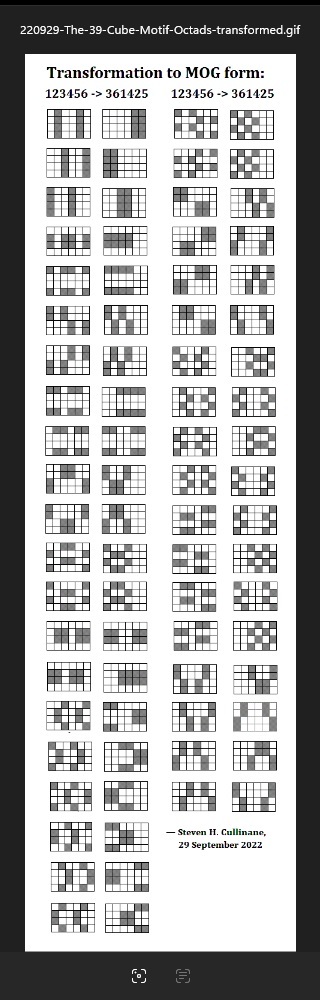
The octads of the [24, 8, 8] cube-motif code
can be transformed by the permutation below
into octads recognizable, thanks to the Miracle
Octad Generator (MOG) of R. T. Curtis, as
belonging to the Golay code.

A linear code of length 24, dimension 8, and minimum weight 8
(a "[24, 8, 8] code") that was discussed in recent posts tagged
Bitspace might, viewed as a vector space, be called "motif space."
Yesterday evening's post "From a Literature Search for Binary [24, 8, 8] Codes"
has been updated. A reference from that update —
Computer Science > Information Theory
|
| Comments: | To appear in IEEE Trans. on Information Theory Vol. 24 No. 8 |
| Subjects: | Information Theory (cs.IT) |
| Cite as: | arXiv:cs/0607074 [cs.IT] |
From Peng and Farrell, 2006 —

For one example of a binary [24, 8, 8] code, see other bitspace posts.
It is not clear whether that example is a subcode of the Golay code.

See also
http://www.codetables.de/BKLC/
Tables.php?q=2&n0=1&n1=256&k0=1&k1=256
and
http://www.codetables.de/BKLC/BKLC.php?q=2&n=12&k=8 .
Update of 3:22 AM ET on 20 September 2022 —

Update of 3:44 AM ET 20 September 2022 —
Another relevant document:


The above is about a subspace of the
24-dimensional vector space over GF(2)
. . . "An entire world of just 24 squares,"
to adapt a phrase from other Log24
posts tagged "Promises."
Update of 1:45 AM ET Sept. 18, 2022 —
It seems* from a Magma calculation that
the resemblance of the above extended
cube-motif code to the Golay code is only
superficial.

Without the highly symmetric generating codewords that were added
to extend its dimension from 8 to 12, the cube-motifs code apparently
does , like the Golay code, have nonzero weights of only 8, 12, 16, and 24 —
Perhaps someone can prove there is no way that adding more generating
codewords can turn the cube-motif code into the Golay code.
* The "seems" is because I have not yet encountered any of these
relatively rare (42 out of 4096) purported weight-4 codewords. Their
apparent existence may be due to an error in my typing of 0's and 1's.
Some background for the exercise of 9/11 —
Vera Pless, "More on the uniqueness of the Golay codes,"
Discrete Mathematics 106/107 (1992) 391-398 —
"Several people [1-2,6] have shown that
any set of 212 binary vectors of length 24,
distance ≥ 8, containing 0, must be the
unique (up to equivalence) [24,12,8] Golay code."
[1] P. Delsarte and J.M. Goethals, "Unrestricted codes
with the Golay parameters are unique,"
Discrete Math. 12 (1975) 211-224.
[2] A. Neumeier, private communication, 1990.
[6] S.L. Snover, "The uniqueness of the
Nordstrom-Robinson and the Golay binary codes,"
Ph.D. Thesis, Dept. of Mathematics,
Michigan State Univ., 1973.
Related images —
"Before time began, there was the Cube."
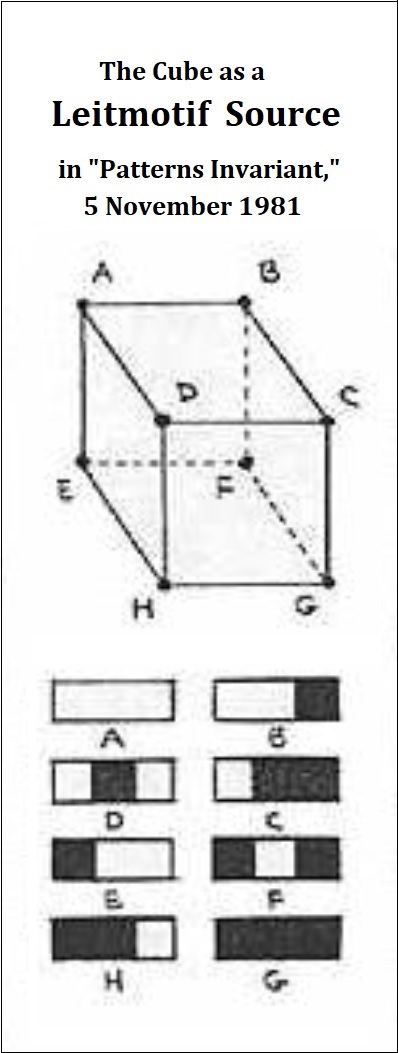

"Remember, remember the fifth of November"

The previous post's quotation of the word "leitmotif" suggests a review:
See as well Sunday's post "Raiders of the Lost Space."
Powered by WordPress


