Log24

Sunday, June 7, 2026

“Innies and Outies” Meet Inner and Outer Automorphisms

Filed under: General — Tags: , — m759 @ 6:59 pm

From Log24 on September 6, 2006 —

Hamlet, 2.2:

"… Something have you heard
Of Hamlet's transformation; so call it,
Sith nor the exterior nor the inward man
Resembles that it was…."

The transformation:

The image “http://www.log24.com/theory/images/DTinscapes4-Trans.gif” cannot be displayed, because it contains errors.

         Click on picture for details.

NotebookLM on June 7, 2026  —

The relationship between the Cullinane Diamond Theorem and R. T. Curtis's Miracle Octad Generator (MOG) represents a profound mathematical unification of visual patterns, finite geometry, and sporadic simple groups. The MOG is a combinatorial tool that utilizes a 4×6 array to study the Mathieu group M24, the Steiner system S(5,8,24), and the binary Golay code.
The Diamond Theorem provides the geometric and algebraic foundation for the MOG through the following key connections:
 
1. Isomorphic Combinatorial Structures
The core connection is that the 35 distinct square patterns analyzed in the Diamond Theorem are fundamentally the same as the 35 square patterns utilized within the MOG. In both contexts, these patterns are visually and algebraically isomorphic to the 35 lines of the finite projective space PG(3,2). The same visual "line diagrams" that explain the symmetries of the Diamond Theorem's 4×4 figures identically explain the structural symmetries of Curtis's MOG patterns.
 
2. The Octad Stabilizer Subgroup of M24
The transformation group G that scrambles the 4×4 array in the Diamond Theorem consists of 322,560 permutations and is isomorphic to the affine group AGL(4,2). Within the framework of the MOG, Curtis demonstrated that this exact symmetry group (which he denoted as 24.A8) functions as the octad stabilizer subgroup of the sporadic simple group M24. Thus, the group defining the symmetries of the 4×4 diamond configurations is mathematically identical to the subgroup that stabilizes an 8-element "octad" within the 24-point Steiner system S(5,8,24).
 
3. The Conwell/Klein Correspondence
The mathematical architecture bridging these concepts is the Klein correspondence (and Conwell's 1910 correspondence), which establishes a mapping between the 35 lines of PG(3,2) and the 35 ways to partition an 8-set into two 4-sets. The MOG physically illustrates this correspondence by pairing partitions of an 8-set (represented by a 4×2 array) with the 35 partitions of the 4×4 affine space. The Diamond Theorem translates these abstract combinatorial partitions into concrete symmetric properties governed by binary arithmetic (where components sum to zero via XOR).
 
Ultimately, the Diamond Theorem serves as the geometric justification that explains why the 4×4 subarrays of the Miracle Octad Generator possess their highly structured symmetries, linking simple 2D tile arrangements to the complex algebra required for error-correcting codes, lattice theory, and the construction of the Leech lattice.
 

Wednesday, October 9, 2019

The Joy of Six

Note that in the pictures below of the 15 two-subsets of a six-set,
the symbols 1 through 6 in Hudson's square array of 1905 occupy the
same positions as the anticommuting Dirac matrices in Arfken's 1985
square array. Similarly occupying these positions are the skew lines
within a generalized quadrangle (a line complex) inside PG(3,2).

Anticommuting Dirac matrices as spreads of projective lines

Related narrative The "Quantum Tesseract Theorem."

Wednesday, February 27, 2019

Construction of PG(3,2) from K6

Filed under: General,Geometry — Tags: , , — m759 @ 11:38 am

From this journal on April 23, 2013

IMAGE- Geometry of the Six-Set, Steven H. Cullinane, April 23, 2013

From this journal in 2003

From Wikipedia on Groundhog Day, 2019

Tuesday, February 26, 2019

Annals of Philology

Filed under: General — Tags: — m759 @ 11:05 pm

"What kind of person bokehs an inscape?"

— Question adapted from the weblog Barefooted Philologists

An illustration (click to enlarge) —

Citation

Filed under: General — Tags: , , , — m759 @ 12:00 pm

Some related material in this journal — See a search for k6.gif.

Some related material from Harvard —

Elkies's  "15 simple transpositions" clearly correspond to the 15 edges of
the complete graph K6 and to the 15  2-subsets of a 6-set.

For the connection to PG(3,2), see Finite Geometry of the Square and Cube.

The following "manifestation" of the 2-subsets of a 6-set might serve as
the desired Wikipedia citation —

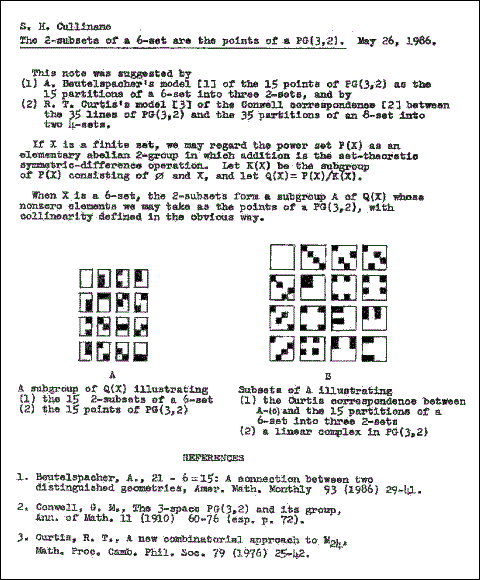
See also the above 1986 construction of PG(3,2) from a 6-set
in the work of other authors in 1994 and 2002 . . .

IMAGE- Dolgachev and Keum, coordinatization of the 4x4 array in 'Birational Automorphisms of Quartic Hessian Surfaces,' AMS Transactions, 2002

Monday, February 18, 2019

Sacerdotal K6, Continued

Filed under: General,Geometry — Tags: , , , — m759 @ 12:12 pm

From yesterday's post on sacerdotal jargon

A related note from May 1986 —

Sunday, February 17, 2019

Sacerdotal K6

Filed under: General,Geometry — Tags: , , — m759 @ 7:35 pm

From a recently created Wikipedia article —

See also Sacerdotal Jargon (Log24, Dec. 5, 2002).

Powered by WordPress