
Thursday, February 12, 2026
DJ School Today: The Erection

"Suggest an improvement to earn IQ" . . .
Update at 9:06 AM EST —

Wednesday, February 11, 2026


Tuesday, February 10, 2026
DJ School 2026 —
From a South Florida Cinderella Yesterday . . .
Blue-Black Lyrics

Speak, Memory
A 1956 passage by Robert Silverberg—
"There was something in the heart of the diamond—
not the familiar brown flaw of the others, but something
of a different color, something moving and flickering.
Before my eyes, it changed and grew.
And I saw what it was. It was the form of a girl—
a woman, rather, a voluptuous, writhing nude form
in the center of the gem. Her hair was a lustrous blue-black,
her eyes a piercing ebony. She was gesturing to me,
holding out her hands, incredibly beckoning from within
the heart of the diamond."
The Day I Turned 14:
The Chicago Hangover

Monday, February 9, 2026

Sunday, February 8, 2026


Lower-case “e” . . .
Honoring Euler and Einheit


In this journal, "e" often signifies "Einheit,"
German for "identity" in algebra.
And then there is the identity of one
Michael Harris . . .
From yesterday's post "Lowell Space" —
A Song for Harris to Sing

I prefer Kerouac.
Saturday, February 7, 2026
DJ School . . . Related Reading
Related reading from http://m759.net/wordpress/?s=Hot+Wife —
|
From Tom McCarthy's review of The Maniac , a novel about 1940s social life at Los Alamos — "The mathematician Martin Davis’s wife, Lydia, storms out of a Trinity dinner party, condemning the men’s failure to fully take on board the consequences of their atom splitting. Besides sharing her name with our own age’s great translator of Blanchot and Proust, this Lydia Davis is a textile artist — a hanging detail that points back toward the novel’s many looms and weavings. For the Greeks, the fates spinning the threads of human lives were female (as Conrad knew, recasting them as Belgian secretaries in 'Heart of Darkness'). So was Theseus’ wool-ball navigator, Ariadne. And so, too, was the Ithacan ur-weaver Penelope, whose perpetual making and unraveling of her tapestry beat Gödel to an incompleteness theory by thousands of years. 'Text,' by the way, means something woven, from which we get 'textile.' It might just be that Penelope was not only testing her own version of the ontological limit, but also embedding it — in absent form, a hole — within the weft and warp of what we would eventually call the novel." |
"A Hanging Detail" — 1531*
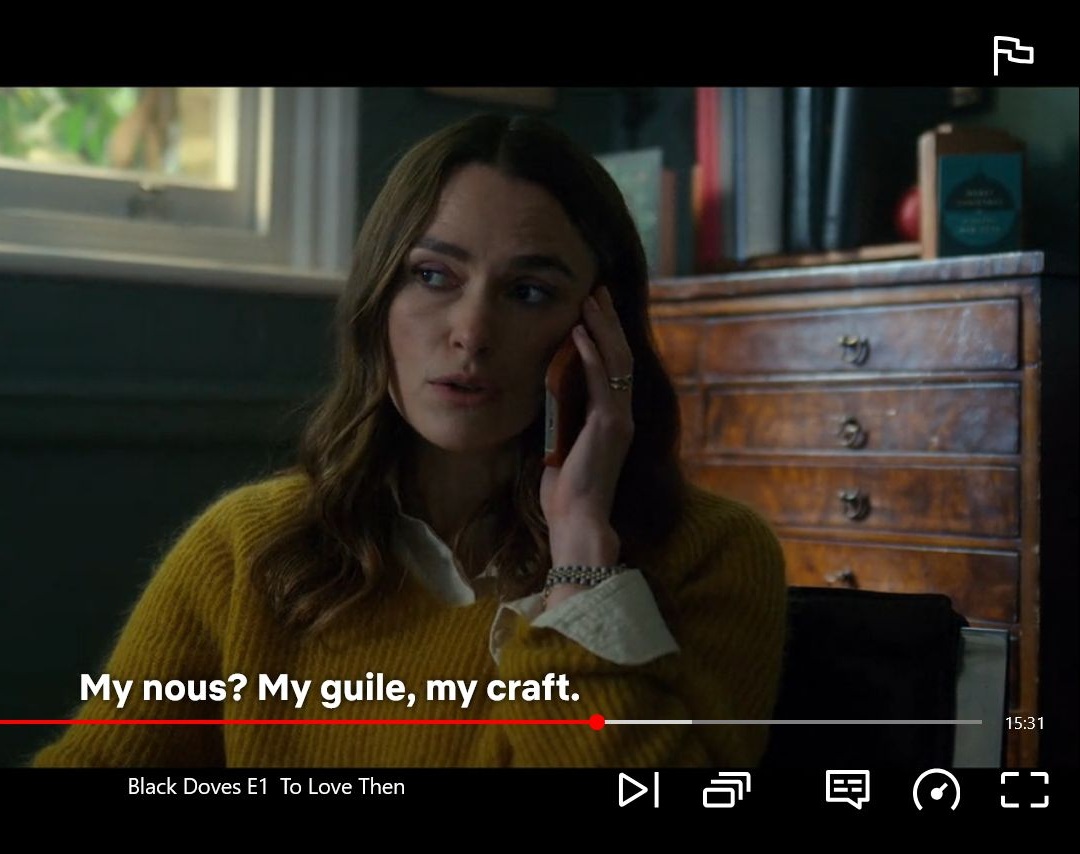
* This "Wolf Hall" year was suggested by the 15:31 time-remaining data above.

Friday, February 6, 2026
Innie-Outie . . . Continues.
For the title, see http://m759.net/wordpress/?s=Inner+Outer .
Earlier . . .

Tonight . . .


"Between aliens and music . . . ."
or "Between a rock and a hard place."

From Appalachian Theology (March 20, 2025) —
"A key concept in Augustine's great
The City of God is that the Christian church
is superior and essentially alien
to its earthly surroundings."
— David Van Biema in Time Magazine
(May 2, 2005, p. 43)

Wednesday, February 4, 2026
Floor Show


Related reading from http://m759.net/wordpress/?s=Hot+Wife —
|
From Tom McCarthy's review of The Maniac , a novel about 1940s social life at Los Alamos — "The mathematician Martin Davis’s wife, Lydia, storms out of a Trinity dinner party, condemning the men’s failure to fully take on board the consequences of their atom splitting. Besides sharing her name with our own age’s great translator of Blanchot and Proust, this Lydia Davis is a textile artist — a hanging detail that points back toward the novel’s many looms and weavings. For the Greeks, the fates spinning the threads of human lives were female (as Conrad knew, recasting them as Belgian secretaries in 'Heart of Darkness'). So was Theseus’ wool-ball navigator, Ariadne. And so, too, was the Ithacan ur-weaver Penelope, whose perpetual making and unraveling of her tapestry beat Gödel to an incompleteness theory by thousands of years. 'Text,' by the way, means something woven, from which we get 'textile.' It might just be that Penelope was not only testing her own version of the ontological limit, but also embedding it — in absent form, a hole — within the weft and warp of what we would eventually call the novel." |
Thursday, May 1, 2003
Thursday May 1, 2003
Rhymes with Puck
Readings for May Day, also known as Beltane.
I. The Playboy of the Western World
- Operation Playmate
- Puck Fair
-
Playboy Magazine, June 2003:
See cover headline at top left.
II. Beltane
III. A is for Art
- Wrestling Pablo Picasso
- Terpsichore's Birthday
- Bell/Taine (see below)
Bell/Taine
In 1993, The Mathematical Association of America published Constance Reid's
THE SEARCH FOR E. T. BELL
also known as John Taine.
This is a biography of Eric Temple Bell, a mathematician and writer on mathematics, who also wrote fiction under the name John Taine.
On page 194, Reid records a question Bell's son asked as a child. Passing a church and seeing a cross on the steeple, he inquired, "Why is the plus up there?"
For an answer that makes some sort of sense
-
in the context of Part II above, and
-
in the context of last month's "Math Awareness Month" theme, mathematics and art,
consider the phrase "A is for Art," so aptly illustrated by Olivia Newton-John in "Wrestling Pablo Picasso," then examine the photograph of ballerina Margaret "Puck" Petit on page 195 of Reid's book. Puck, as the mother of Leslie Caron (see Terpsichore's Birthday), clearly deserves an A+.