260926-The_Alphabet_of_Things.jpg
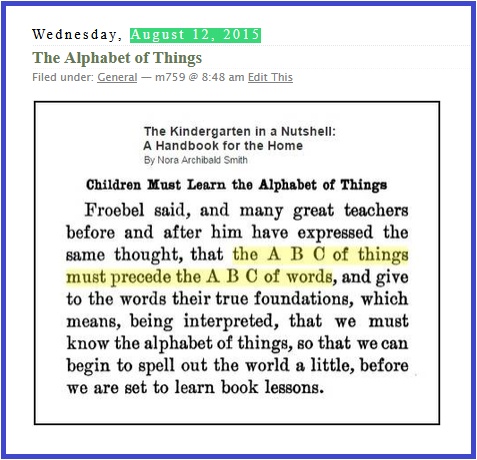
260926-The_Alphabet_of_Things.jpg
There are, of course, purely secular forms of prayer . . .

The above remarks were suggested by the award today of a Nobel Prize
for Hopfield networks, and by the Hebbian theory I learned
in a 1960-1961 Harvard Freshman Seminar on Prescott Street.
Updates:


See also Prescott Street in this journal.
In memory of an economist who reportedly died on Nov. 6 —

See also a Log24 post from Prescott's reported death date,
and a search in this journal for Prescott Street.
Or: MDT-48 Meets COMP360.
‘It doesn’t have a street-name and that’s because, as yet,
it doesn’t have any street profile – which is incidentally
the way we want it to stay. The boys in the kitchen are
keeping it low-key and anonymous. They’re calling it MDT-48.’
The boys in the kitchen?
— Glynn, Alan. Limitless: A Novel (p. 40).
Picador. Kindle Edition.
(Originally published by Little, Brown
in Great Britain in 2001 as The Dark Fields .)
From Log24 on Nov. 29, 2020 —

CNN story from All Souls' Day 2022 —
“This drug can be extracted from magic mushrooms,
but that is not the way our compound is generated.
It’s synthesized in a purely chemical process
to produce a crystalline form,” said Goodwin, who is
the chief medical officer of COMPASS Pathways,
the company that manufactures COMP360 and
conducted the study."
See as well "To Think That It Happened on Prescott Street"
and related posts.
Or: Geometric Logic Continued
Part I: Mystic Twaddle —

Part II: Meanwhile, on that same date —

Part III: Back at Harvard —
A link from the above post, infra —
“Some Harvard-related material — See Leary and 6 Prescott .”
“Plan 9 deals with the resurrection of the dead.”


* See the previous post‘s link to the phrase
“Turn on, tune in, drop dead.”
For a member of a 1960-1961 Harvard Freshman Seminar
at 8 Prescott Street —

Dusenbury’s study of color was published on June 9, 2015.
This journal on that date —

"Freshman Seminar Program Department Administrator Corinna S. Rohse
described the program’s courses, which allow students to study subjects
that vary from Sanskrit to the mathematical basis for chess, as
'jewel-like: small and incredibly well-cut.' "
— The Harvard Crimson , Dec. 10, 2008
For remarks related to Sanskrit, chessboard structure, and "jewel-like"
mathematics, see A Prince of Darkness (Log24, March 28, 2006).
See also Walsh Functions in this journal and …
Lecture notes on dyadic harmonic analysis
(Cuernavaca, 2000)

Compare and contrast these remarks of Pereyra with the following
remarks, apparently by the same Corinna S. Rohse quoted above.

* Location of the Harvard Freshman Seminar program in the 2008
article above. The building at 6 Prescott was moved there from
5 Divinity Avenue in 1978. When the seminar program was started
in the fall of 1959, it was located in a house at 8 Prescott St. (In
1958-1959 this was a freshman dorm, the home of Ted Kaczynski.)
"At the exact moment artificial intelligence is making
human consciousness feel mechanized and unstable,
people are turning to psychedelics for revelation."
— Rolling Stone, November 2026 issue,
"Inside the New Psychedelic Awakening,"
by Claire Hoffman, page 72.
Related reading . . .
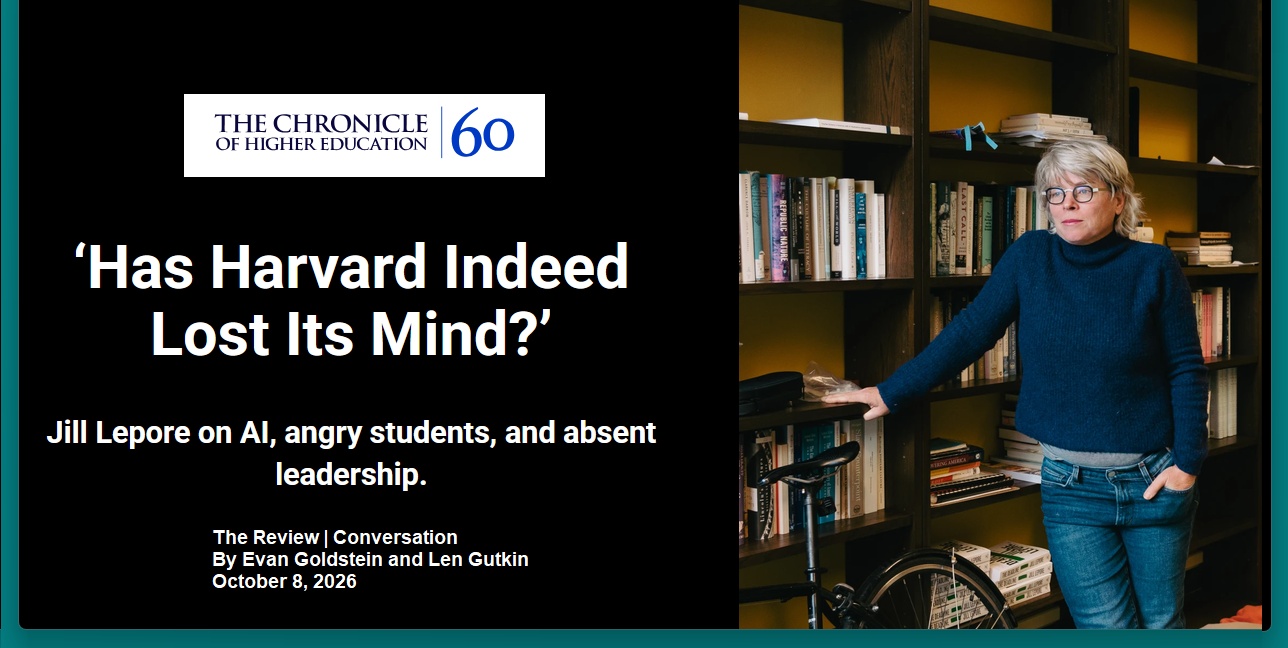
"What mind?"
See other posts tagged Prescott Street.
|
"George R. Goethals was born at West Point, the son of Major General George W. Goethals, who was known as builder of the Panama Canal. In 1908, he graduated from the United States Military Academy at West Point and was assigned to develop fortifications for the Pacific side of the canal. In 1919, he retired from the United States Army and was employed by an engineering firm. He returned to active duty in 1940. During World War II he served as assistant chief of the Army Corps of Engineers in the District of Columbia. In 1946, he retired from the United States Army for a second time and became a professor of mathematics at the University of New Mexico. He retired from the university in 1958. He died at age 87 on Thursday, June 28, 1973 at the Veterans Administration Hospital in the Jamaica Plains section of Boston, Massachusetts. Interment was at the United States Academy with a military funeral. Survivors included one son, George W.L. Goethals of Watertown, Massachusetts." — Source: Springfield Union, Springfield Massachusetts, Saturday, June 30, 1973. |
|
Obit from Harvard College – Psychology Lecturer Goethals Dead at 74 Retired Senior Lecturer of Psychology Dr. George W. Goethals II '43 died in his home Monday after a brief illness. He was 74. Goethals, a Watertown native, graduated from the College after serving in the army during World War II. He taught high school in Edgartown, Mass, and returned to Harvard to earn his masters and doctorate degrees in education, the Boston Globe reported yesterday. Goethals taught at Sarah Lawrence College from 1952 to 1956 and joined the Harvard faculty, where he taught in the School of Education, the departments of Social Relations and Psychology and the Extension School from 1956 to 1992. In the 1970s he became a lecturer on psychology and psychiatry at Harvard Medical School and principal psychologist at Cambridge Hospital. In 1992 he received the Petra Shattuck Teaching Award at the Extension School. Goethals continued to teach at the Extension School until December, when he became sick and had to be admitted to the hospital. An avid baseball player, he pitched for a semi-pro baseball team during his years as a graduate student, according to the Globe report. Goethals was the author of "The Role of Schools in Mental Health" and "Experiencing Youth." His teaching and research focused on adolescents. — The Harvard Crimson, February 3, 1995 |
Dr. Goethals led a Harvard Freshman Seminar at 8 Prescott St., Cambridge,
in the academic year 1960-1961.
Vide "Prescott Street" in this journal.
"The personalities come and go in kaleidoscopic succession,
many changes often being made in the course of twenty-four hours."
"By a breaking up of the original personality at different moments
along different lines of cleavage, there may be formed several different
secondary personalities which may take turns with one another."
— Morton Prince, The Dissociation of a Personality ,
Longmans, Green, and Co., 1906, pages 2 and 3.
Related reading . . .

In 1978, Harvard moved a structure known as the Morton Prince House
from Divinity Avenue to Prescott Street, where it occupies the former Hurlbut
Parking Lot, which was the vista from my 1960-61 freshman room.
From the Log24 post "Very Stable Kool-Aid" —
|
A Letter from Timothy Leary, Ph.D., July 17, 1961
Harvard University July 17, 1961
Dr. Thomas S. Szasz Dear Dr. Szasz: Your book arrived several days ago. I've spent eight hours on it and realize the task (and joy) of reading it has just begun. The Myth of Mental Illness is the most important book in the history of psychiatry. I know it is rash and premature to make this earlier judgment. I reserve the right later to revise and perhaps suggest it is the most important book published in the twentieth century. It is great in so many ways–scholarship, clinical insight, political savvy, common sense, historical sweep, human concern– and most of all for its compassionate, shattering honesty. . . . . |
|
Morton Prince, a Boston neurologist, founded the Journal of Abnormal Psychology in 1906 as an outlet especially for those who took a psychogenic view of neurotic disorders. Through experiments with hypnotism, he added appreciably to knowledge of subconscious and coconscious mental processes; The Dissociation of a Personality (Prince, 1905) still ranks as a classic. He early saw that studying normal people in the depth and detail with which one studied patients could make significant contributions to our whole understanding of human nature. Before his death he established and briefly directed the Harvard Psychological Clinic, devising the research environment out of which presently sprang major contributions to the study of personality.
— "Who Was Morton Prince?," by R. W. White, |
See as well Who Was R. W. White?
For the Dr. Seuss School of
Neuropsychopharmacology —

From the school itself —

Related material — Pilgrim's Progress in this journal and . . .
an image from Log24 on December 8, 2012 —
See as well "To Think That It Happened on Prescott Street"
and related posts.
For the title, see the previous post as well as Prescott Street
and Psychedelic Club in this journal.
Some related art —


Sheehy reportedly died on Monday, August 24, 2020.

YouTube has the Vermont speech:

From this journal on that date —

Summary: “Turn on, tune in, drop dead.“
"In July, 1960, having just received a doctorate from Harvard
and a research and training fellowship from the National Institute
of Mental Health, I drove, together with my wife, Sandylee,
from Cambridge, Massachusetts to Cuernavaca, Mexico."
— Michael Maccoby, June 26, 2014,
"Building on Erich Fromm's Scientific Contributions"
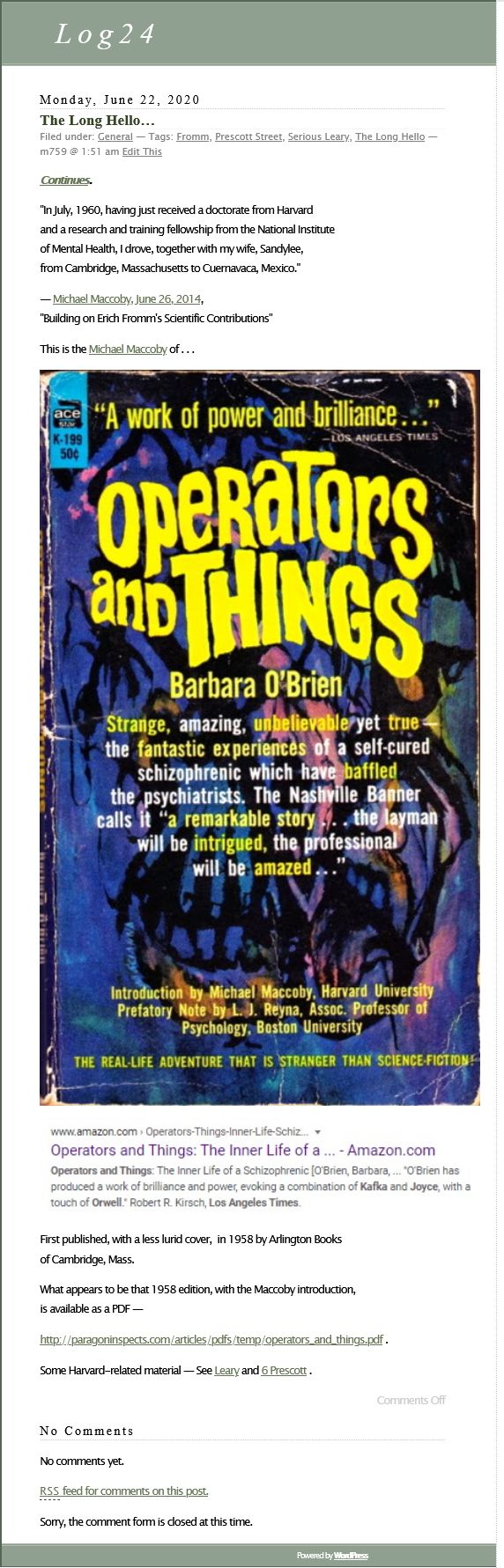
This is the Michael Maccoby of . . .


First published, with a less lurid cover, in 1958 by Arlington Books
of Cambridge, Mass.
What appears to be that 1958 edition, with the Maccoby introduction,
is available as a PDF —
http://paragoninspects.com/articles/pdfs/temp/operators_and_things.pdf .
Some Harvard-related material — See Leary and 6 Prescott .
Two of the thumbnail previews
from yesterday's 1 AM post …

Further down in the "6 Prescott St." post, the link 5 Divinity Avenue
leads to …
|
A Letter from Timothy Leary, Ph.D., July 17, 1961
Harvard University July 17, 1961
Dr. Thomas S. Szasz Dear Dr. Szasz: Your book arrived several days ago. I've spent eight hours on it and realize the task (and joy) of reading it has just begun. The Myth of Mental Illness is the most important book in the history of psychiatry. I know it is rash and premature to make this earlier judgment. I reserve the right later to revise and perhaps suggest it is the most important book published in the twentieth century. It is great in so many ways–scholarship, clinical insight, political savvy, common sense, historical sweep, human concern– and most of all for its compassionate, shattering honesty. . . . . |
The small Morton Prince House in the above letter might, according to
the above-quoted remarks by Corinna S. Rohse, be called a "jewel box."
Harvard moved it in 1978 from Divinity Avenue to its current location at
6 Prescott Street.
Related "jewel box" material for those who
prefer narrative to mathematics —
"In The Electric Kool-Aid Acid Test , Tom Wolfe writes about encountering
'a young psychologist,' 'Clifton Fadiman’s nephew, it turned out,' in the
waiting room of the San Mateo County jail. Fadiman and his wife were
'happily stuffing three I-Ching coins into some interminable dense volume*
of Oriental mysticism' that they planned to give Ken Kesey, the Prankster-
in-Chief whom the FBI had just nabbed after eight months on the lam.
Wolfe had been granted an interview with Kesey, and they wanted him to
tell their friend about the hidden coins. During this difficult time, they
explained, Kesey needed oracular advice."
— Tim Doody in The Morning News web 'zine on July 26, 2012**
Oracular advice related to yesterday evening's
"jewel box" post …
A 4-dimensional hypercube H (a tesseract ) has 24 square
2-dimensional faces. In its incarnation as a Galois tesseract
(a 4×4 square array of points for which the appropriate transformations
are those of the affine 4-space over the finite (i.e., Galois) two-element
field GF(2)), the 24 faces transform into 140 4-point "facets." The Galois
version of H has a group of 322,560 automorphisms. Therefore, by the
orbit-stabilizer theorem, each of the 140 facets of the Galois version has
a stabilizer group of 2,304 affine transformations.
Similar remarks apply to the I Ching In its incarnation as
a Galois hexaract , for which the symmetry group — the group of
affine transformations of the 6-dimensional affine space over GF(2) —
has not 322,560 elements, but rather 1,290,157,424,640.
* The volume Wolfe mentions was, according to Fadiman, the I Ching.
** See also this journal on that date — July 26, 2012.
"Hum a few bars, Steely Dan."

Related material — "For 6 Prescott Street" and "SAT."
_________________________________________________________________
Links' thumbnail previews —
"SAT"

ART WARS
The Rhetoric of Power:
A meditation for Mental Health Month
From “Secondary Structures,” by Tom Moody, Sculpture Magazine, June 2000:
“By the early ’90s, the perception of Minimalism as a ‘pure’ art untouched by history lay in tatters. The coup de grâce against the movement came not from an artwork, however, but from a text. Shortly after the removal of Richard Serra’s Tilted Arc from New York City’s Federal Plaza, Harvard art historian Anna Chave published ‘Minimalism and the Rhetoric of Power’ (Arts Magazine, January 1990), a rousing attack on the boys’ club that stops just short of a full-blown ad hominem rant. Analyzing artworks (Walter de Maria’s aluminum swastika, Morris’s ‘carceral images,’ Flavin’s phallic ‘hot rods’), critical vocabulary (Morris’s use of ‘intimacy’ as a negative, Judd’s incantatory use of the word ‘powerful’), even titles (Frank Stella’s National Socialist-tinged Arbeit Macht Frei and Reichstag), Chave highlights the disturbing undercurrents of hypermasculinity and social control beneath Minimalism’s bland exterior. Seeing it through the eyes of the ordinary viewer, she concludes that ‘what [most] disturbs [the public at large] about Minimalist art may be what disturbs them about their own lives and times, as the face it projects is society’s blankest, steeliest face; the impersonal face of technology, industry and commerce; the unyielding face of the father: a face that is usually far more attractively masked.’ ”
From Maureen Dowd’s New York Times column of June 9, 2002:
“The shape of the government is not as important as the policy of the government. If he makes the policy aggressive and pre-emptive, the president can conduct the war on terror from the National Gallery of Art.”
|
From the New York Times, The National Gallery of Art in Washington has just acquired Tony Smith’s first steel sculpture: “Die,” created in 1962 and fabricated in 1968. “It’s a seminal icon of postwar American art,” said Earl A. Powell III, director of the National Gallery. |
|
|
Die (Tony Smith) |
|
|
Bishop Moore |
|
From a New York Times obituary, Bishop Dies Paul Moore Jr., the retired Episcopal bishop of New York who for more than a decade was the most formidable liberal Christian voice in the city, died yesterday at home in Greenwich Village. He was 83…. Bishop Moore argued for his agenda in the most Christian of terms, refusing to cede Biblical language to the Christian right. Although he retired as bishop in 1989, he continued to speak out, taking to the pulpit of his former church as recently as March 24, even as illness overtook him, to protest the war in Iraq. “It appears we have two types of religion here,” the bishop said, aiming his sharpest barbs at President Bush. “One is a solitary Texas politician who says, `I talk to Jesus, and I am right.’ The other involves millions of people of all faiths who disagree.” He added: “I think it is terrifying. I believe it will lead to a terrible crack in the whole culture as we have come to know it.”…. [In reference to another question] Bishop Moore later acknowledged that his rhetoric was strong, but added, “In this city you have to speak strongly to be heard.” Paul Moore’s early life does not immediately suggest an affinity for the kinds of social issues that he would later champion…. His grandfather was one of the founders of Bankers Trust. His father was a good friend of Senator Prescott Bush, whose son, George H. W. Bush, and grandson, George W. Bush, would become United States presidents. |
Related material (update of May 12, 2003):
Question:
Which of the two theories of truth in reading (2) above is exemplified by Moore’s March 24 remarks?
Powered by WordPress