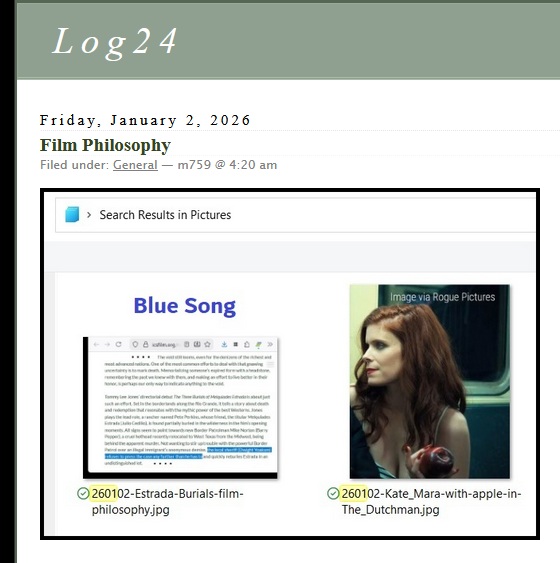
Opening Act . . . Blue Song —
Better than "Eddington"?

"Posey’s characters, even the minor ones, seem as if they could
beckon the camera into filming a whole other movie — perhaps
a movie more interesting than the one they’re in."
— https://www.nytimes.com/2025/02/24/
magazine/parker-posey-white-lotus.html .
Amen.

From Columbus Day, 2004 —
Tuesday October 12, 2004
|

A Google search for "four color decomposition" yields an AI Overview —

My "four-color decomposition" theorem supplies some background
for last New Year's Eve's post on the Klein Correspondence.

The previous two posts suggest a look at an earlier post
on the theme of artworks related to the number 64 —
"The Yarrow Stalker," from a Log24 search for "Chinatown."
Yesterday, Peter Woit posted on Bill Gates's new autobiography.
An excerpt from his post:

In other Harvard-related news . . .

A computer-related fantasy film — "The Net" — and the above
headline from February 6 suggest a look at . . .

* Vide "Paranoia Strikes Deep" (Log24, Dec. 1, 2011).

This post's "Points with Parts" title may serve as an introduction to
what has been called "the most powerful diagram in mathematics" —
the "Miracle Octad Generator" (MOG) of Robert T. Curtis.
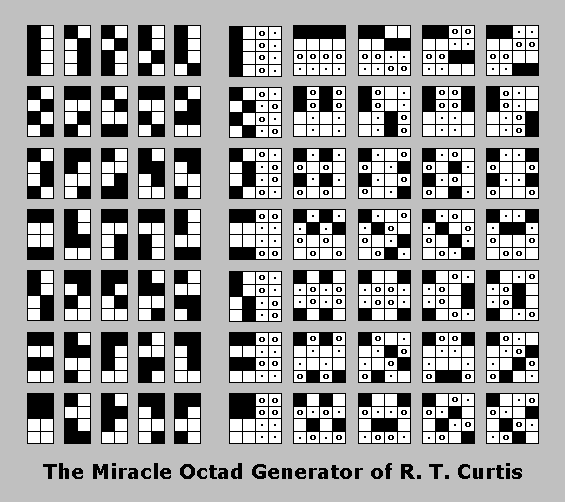
Curtis himself has apparently not written on the geometric background
of his diagram — the finite projective spaces PG(5,2) and PG(3,2), of
five and of three dimensions over the two-element Galois field GF(2).
The component parts of the MOG diagram, the 2×4 Curtis "bricks,"
may be regarded* as forming both PG(5,2) and PG(3,2) . . .
Pace Euclid, points with parts. For more on the MOG's geometric
background, see the Klein correspondence in the previous post.
For a simpler example of "points with parts, see
http://m759.net/wordpress/?s=200229.
* Use the notions of Galois (XOR, or "symmetric-difference") addition
of even subsets, and such addition "modulo complementation," to
decrease the number of dimensions of the spaces involved.

See also a more accurate AI report from January 9, 2025 —

HTML version, with corrections, of the above 9 January Grok 2 report —
|
Grok 2: Klein Correspondence and MOG, 9 Jan. 2025 . . . The Klein correspondence is closely related to the Miracle Octad Generator (MOG) through the mathematical structure they both engage with, particularly in the context of finite geometry and combinatorics.
Klein Correspondence: This refers to a mathematical framework that establishes a correspondence between Miracle Octad Generator (MOG): Introduced by R.T. Curtis, the MOG is a tool used in the study of the Mathieu group M24, the binary Golay code, and related structures like the Steiner system S(5,8,24). It consists of a 4×6 array where the positions are used to construct octads (sets of 8 elements) from given sets of 5 elements, reflecting the structure of the Steiner system. Relation Between Klein Correspondence and MOG:
Thus, the Klein correspondence serves as a foundational link that allows the MOG to operate by translating combinatorial problems into geometric ones, facilitating the study of complex mathematical structures like the Mathieu groups and Steiner systems. * Correction: Should be "a correspondence between points in a five-dimensional projective space and lines in a three-dimensional projective space." |
Update of ca. 9 AM ET Monday, Feb. 10, 2024 —
Neither AI report above mentions the Cullinane model of the five-
dimensional projective space PG(5,2) as a brick space — a space
whose points are the 2×4 bricks used in thte MOG. This is
understandable, as the notion of using bricks to model both PG(5,2)
and PG(3,2) has appeared so far only in this journal. See an
illustration from New Year's Eve . . . Dec. 31, 2024 —

Powered by WordPress