
This post's "Points with Parts" title may serve as an introduction to
what has been called "the most powerful diagram in mathematics" —
the "Miracle Octad Generator" (MOG) of Robert T. Curtis.
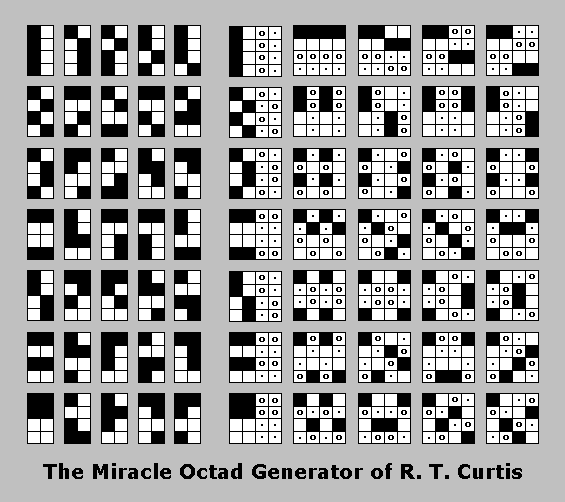
Curtis himself has apparently not written on the geometric background
of his diagram — the finite projective spaces PG(5,2) and PG(3,2), of
five and of three dimensions over the two-element Galois field GF(2).
The component parts of the MOG diagram, the 2×4 Curtis "bricks,"
may be regarded* as forming both PG(5,2) and PG(3,2) . . .
Pace Euclid, points with parts. For more on the MOG's geometric
background, see the Klein correspondence in the previous post.
For a simpler example of "points with parts, see
http://m759.net/wordpress/?s=200229.
* Use the notions of Galois (XOR, or "symmetric-difference") addition
of even subsets, and such addition "modulo complementation," to
decrease the number of dimensions of the spaces involved.


