Log24

Sunday, July 5, 2026

Exhibition Text

Filed under: General — Tags: , — m759 @ 1:51 pm

Norwegian artist Josefine Lyche's current exhibition, Geometric Utopias

https://www.nilsaas.no/utstillinger-kunstrom-jakob/josefine-lyche . . .

To look for the light

There is art that shows us the world as it is. And then there is art that insists that the world is more than what we can see and think. Josefine Lyche's art belongs to the latter category. In her world, colour, form, light, body and imagination are not separate entities, but parts of a large, coherent and sensual landscape.

In Geometric Utopias, Lyche invites us into a space where geometry is not cold or distant. It begins to pulsate. It becomes a small system of hope, an order that does not close the world but opens it, as if lines, circles and light could be traces of a greater tenderness in the universe. It points not only towards systems and structures, but towards the possibility of deeper connections between the world we know and the world that may exist just behind it. Utopia is not a finished model for a better world. It is a direction, a movement, a desire that something else can exist.

In the Space of Possibility
Geometric Utopias is not about presenting a finished vision, but about dwelling in the space of possibility. The exhibition invites us to negotiate between what we know, what we believe, what we sense, and what we can imagine. It does not ask whether we literally believe in other dimensions, cosmic messages, or hidden energies. Rather, it asks what happens when we allow such notions to have space. What happens when art is allowed to be a place where reality can be expanded, where the contours of established truths become a little looser, a little more porous, so that new light – new knowledge – can enter?

It is an important question today. We live in an era governed by control, documentation and measurability. Most things should be recorded, explained, analyzed and streamlined. At the same time, the present is full of crises that make the future difficult to imagine: climate crisis, war, unrest, technological acceleration and an unimaginable flow of information. In such a time, it may seem naive, perhaps even irresponsible, to talk about beauty, light, hope and transcendence. But perhaps that is precisely why such experiences are needed.

An order behind the world
Geometry is often associated with order. With structure, proportions, systems and mathematical principles. Utopia points towards something that does not yet exist, or that may never be fully found: an idea of ​​​​a different and more harmonious world. When these words are put together, an image emerges of a universe where form and hope are interconnected. A universe where geometry is not just decoration or composition, but a possible structure behind reality.

Josefine Lyche links this to the notion of a perfect, eternal and harmonious universe built on mathematical and geometric principles. We can think of Plato's world of ideas, where the sensible world is only an imperfect reflection of a more perfect reality. We can think of the Platonic solids, these basic forms that throughout history have been given cosmological and metaphysical significance. And we can think of how artists, philosophers, mystics and mathematicians have tried again and again to understand whether the world has a hidden order.

The image as a portal
An important track in the exhibition is the idea of ​​​​the image as a portal. The Russian theologian and philosopher Pavel Florensky described the icon as more than an image: it was a window, or a door, to an invisible reality. In this tradition, the image is not primarily a representation of the world as we see it. Rather, it is an opening to another form of experience. In a similar way, Lyche's works can be understood as portals – not because they explain the invisible, but because they invite us to approach it. This is particularly clear in the series Halo I–IX , nine round paintings in which the halo emerges as both a natural phenomenon, a cosmic circle and a sacred halo. A halo can arise when light is refracted in ice crystals in the atmosphere. At the same time, we know it as the luminous circle around the head in icon paintings and church art, where it marks the illuminated, the sacred, that which does not only belong to the ordinary human sphere.

In Lyche's paintings, these meanings come together: the natural phenomenon, the icon tradition, the cosmic circle and the painting's own world of colour. She has looked at icons in her mother's collection, where the halo is often multi-coloured and round. She has also drawn inspiration from illustrations of the creation story in the Nuremberg Chronicle from 1493. These paintings can be seen as portals. Windows to the afterlife. They do not attempt to depict light, but to approach light as an experience.

The cosmic kinship of abstraction
There is also a clear art historical line to artists such as Hilma af Klint, Emma Kunz, Wassily Kandinsky, Kazimir Malevich and Mark Rothko. These are artists who in various ways used abstraction to approach the spiritual, the cosmic or the invisible. For them, abstraction is not just a formal language, but a way of examining reality.

Hilma af Klint painted diagrams of spiritual worlds. Kandinsky saw colors and abstract forms as something that could bypass the logic of the material world and touch the soul directly. Malevich sought a zero point and a new space through the Suprematist image. Rothko wanted the floating surfaces of color to become places of intense emotional experience – tragedy, ecstasy and awe. For Emma Kunz, art was a cosmic research tool, a way of mapping invisible dimensions through geometry, pendulum and drawing.

Lyche is part of this tradition, but without repeating it in a loud or serious way. In her work, the spiritual goes hand in hand with popular culture, science fiction, cosplay, manga and contemporary visual excess. This gives her works a unique duality. They can be beautiful and strange at the same time. Precise and playful. Loud and humorous. They draw energy both from art historical notions of the sublime and from the visual culture that surrounds us today.

Between faith and skepticism
This mixture is important. Lyche does not treat the esoteric as a closed system that we must believe in. She uses it rather as a poetic and visual material. Notions of other dimensions, extraterrestrial intelligence, auras and cosmic messages do not become claims, but openings. They give us images to think with. Perhaps that is also why the exhibition feels so liberating. You do not have to choose between faith and skepticism, between seriousness and irony, between art history and popular culture. They are allowed to exist simultaneously. The works can be read as abstract compositions, as sensual material studies, as cosmic signs, as humorous speculations or as quiet meditations on light. None of the readings exclude the others.

In our time, the mystical has acquired a strange status. On the one hand, we live in a technological and scientifically oriented culture. On the other hand, interest in astrology, alternative understandings of reality, science fiction, spirituality and occult symbols is everywhere in contemporary culture. It can be interpreted as a symptom of confusion, but also as an expression of longing.

Lyche takes this longing seriously. She opens up to wonder as an active force. Not as an escape from the world, but as a way to expand reality. Instead of saying, “This is how the world is,” she asks, “What if the world could also be this?”

The cosmic in the material At the same time,
Geometric Utopias are rooted in the concrete. The materials are clear: hair, surfaces, reliefs, light, color, space. The cosmic and metaphysical are manifested in the body and architecture. It is precisely in the meeting between the material and the immaterial that the works gain power. They point outward, but they stand here. They suggest other dimensions, but they do so through physical materials that we can see, move around and relate to.

These material manifestations can be psychopomps, muses, extraterrestrial beings – or perhaps a departed great-grandmother visiting from the afterlife, as the artist himself says with a smile. But they can also be seen simply as abstract color compositions. It is this duality that is beautiful. The works do not require us to choose between the mystical and the concrete. They allow both to be present at the same time.

Seeing through the light
The interactive work Mot Lyset 2026 is a direct homage to Jakob Weidemann's painting Mot Lyset from 1976. With fifty years between the works, Lyche continues their shared longing for beauty and a movement towards the light. Instead of painting a picture of this movement, she gives the audience a tool to experience the world differently. The glasses can be put on. They can be used in the exhibition, but also taken out into the world. When you look towards the light with the glasses on, everything takes on a spectrum-coloured halo.

It's a simple gesture, but it holds a lot. Suddenly the artwork is not just something we look at. It's something we see through. It doesn't change the world itself, but it changes our perception of it. And perhaps that's precisely what art often does best. It doesn't necessarily change reality directly, but it changes the way we encounter reality. With the glasses, the world becomes a little more halo. A little more iconic. A little more cosmic. A little more strange. It's a reminder that the amazing isn't always far away. Sometimes it lies in a small shift in how we see.

Between Steinkjer and the universe
In this way, a fine tension arises between the local and the boundless. The exhibition is shown in Steinkjer, in a space linked to Weidemann's legacy, but it also opens up to the universe, to other worlds, to ideas that cannot be placed geographically. This encounter between place and cosmos is characteristic of Lyche's art. She does not make the cosmic distant and inaccessible. She draws it into space, into the body, into the gaze.

Josefine Lyche does not give us a ready-made utopia. She gives us a space where we can look up, inward, and through. She gives us forms that shine on the edge of understanding, materials that seem to recall other worlds, signs that we cannot fully decipher. Perhaps it is nature itself that communicates through codes that we have not yet learned to read. It is a beautiful thought. And a thought that also contains a certain humility. Because it reminds us that the human way of understanding the world is not necessarily the only one. Perhaps there are patterns, connections, and languages ​​that we do not yet have access to.

Geometric Utopias can therefore be understood as an exhibition about the longing for connection. Between art history and popular culture. Between the body and the universe. Between the visible and the invisible. Between what we can explain and what we can only experience.

Marianne Zamecznik
Curator, Trondheim Art Museum

[ Translated with Firefox browser ]

A more cinematic meditation from an AI yesterday . . .

Lost Horizon

In the Projective Plane, the narrative is one of unification. Parallelism—that Euclidean staple—does not exist here. Every line is fated to meet every other line. In this space, the "horizon" is not a distant, unreachable limit, but a reachable set of points that binds the geometry into a seamless whole. To find the familiar grace of parallels, we must strategically "break" this projective perfection.

The Affine Plane: The Birth of Parallelism
The transition from Projective to Affine space is an act of mathematical subtraction. If we take a Projective plane and choose to ignore a specific "line at infinity," we create an Affine plane. By removing this "horizon," we allow lines that once met there to become parallel.

Vide Cameron's Parallelisms of Complete Designs.

Saturday, July 4, 2026

Foundational Narrative

Filed under: General — Tags: , — m759 @ 3:15 pm

"Generated by AI based on user-provided sources and instructions"

Sunday, August 9, 2020

A Turner Classic

Filed under: General — Tags: — m759 @ 3:24 pm

The New York Times  eulogizes a man who died Friday

"Rabbi Steinsaltz was a prolific and wide-ranging writer
and a sharp observer of humanity who wrote more than
60 books on philosophy, mysticism, theology, even zoology.
His study of kabbalah, 'The Thirteen Petalled Rose,' is
considered a classic and has been translated into eight languages."

Another classic of Jewish thought:

Thoughts of the young Carl Reiner as rendered above in 1967 —

"Somewhere, someplace… there must be a lost horizon…
A Shangri-La where a man can find peace, happiness,
and lots of naked ladies."

Voilà.

Thursday, January 4, 2018

For a Cartoon Graveyard

Filed under: General — Tags: , , , — m759 @ 4:56 am

“… the horizon is not the limit of meaning,
but that which extends meaning
from what is directly given
to the whole context in which it is given,
including a sense of a world.”

— David Vessey,
Gadamer and the Fusion of Horizons

(Quoted here on Saturday, June 4, 2005.)

Tuesday, January 2, 2018

Hell and Easter

Filed under: General — Tags: — m759 @ 11:22 pm

This post was suggested by the reported Monday, Jan. 1, 2018,
death of the Juilliard String Quartet founding violinist and by the
reported Thursday, Feb. 25, 2016 death of his brother, a
biotech entrepreneur.

Details from Feb. 25-26, 2016

Related material from this evening's New York Times

The archaeologist above reportedly died on Friday, Dec. 29, 2016. 
See too a Log24 post from that date, On Becket's Day.

Sunday, January 1, 2017

Like the Horizon

(Continued from a remark by art critic Peter Schjeldahl quoted here
last  year on New Year's Day in the post "Art as Religion.")

"The unhurried curve got me.
It was like the horizon of a world
that made a non-world of
all of the space outside it."

— Peter Schjeldahl, "Postscript: Ellsworth Kelly,"
The New Yorker , December 30, 2015

This suggests some further material from the paper
that was quoted here yesterday on New Year's Eve —

"In teaching a course on combinatorics I have found
students doubting the existence of a finite projective
plane geometry with thirteen points on the grounds
that they could not draw it (with 'straight' lines)
on paper although they had tried to do so. Such a
lack of appreciation of the spirit of the subject is but
a consequence of the elements of formal geometry
no longer being taught in undergraduate courses.
Yet these students were demanding the best proof of
existence, namely, production of the object described."

— Derrick Breach (See his obituary from 1996.)

A related illustration of the 13-point projective plane
from the University of Western Australia:

Projective plane of order 3

(The four points on the curve
at the right of the image are
the points on the line at infinity .)

The above image is from a post of August 7, 2012,
"The Space of Horizons."  A related image —
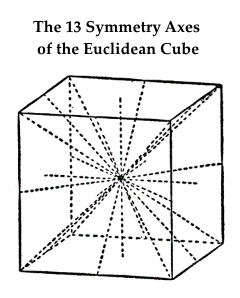
Click on the above image for further remarks.

Powered by WordPress