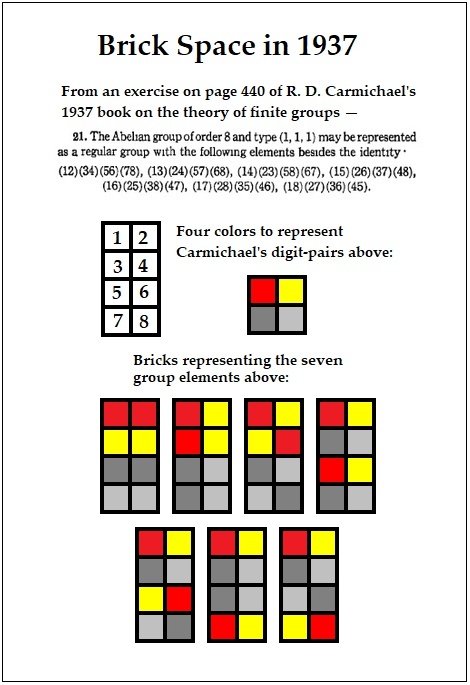
A companion to the webpage "Diamond Theory in 1937" —
Related Art

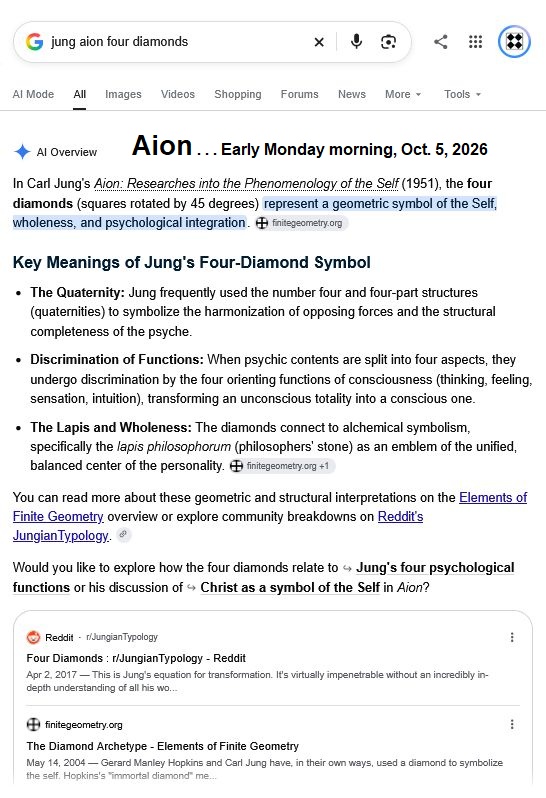
261005-Jung-Aion-four-diamonds-AI-Overview.jpg
261005-Katie_Benn-book-Cha-ching.jpg

261005-Kindle-screenshot-with-
Alchemy_of_Melancholy-book-and-others.jpg

"Cha-ching!"
Encoding PG(3,2): The Cullinane Diamond Theorem
|
Zelazny-and-Bester … Psychoshop … Old Urtch
"To continue," I said, "why don't we have a detectable God in our universe? You said they're almost indispensable." |
The Control Section
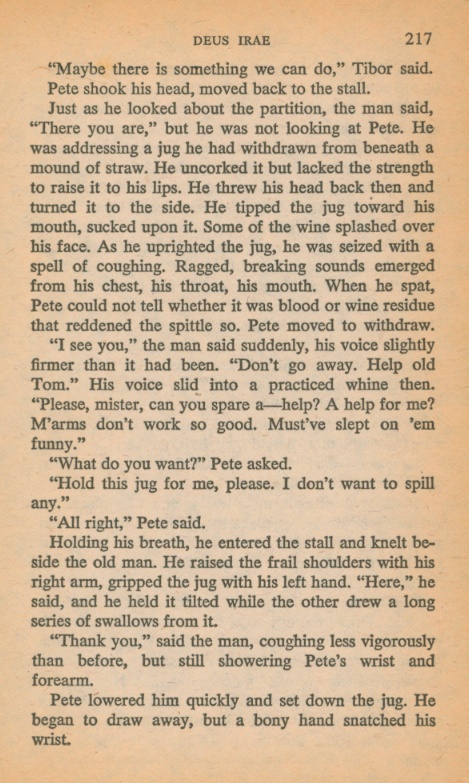
261004-Zelazny-Dick-Deus_Irae-p217.jpg
Related Art:
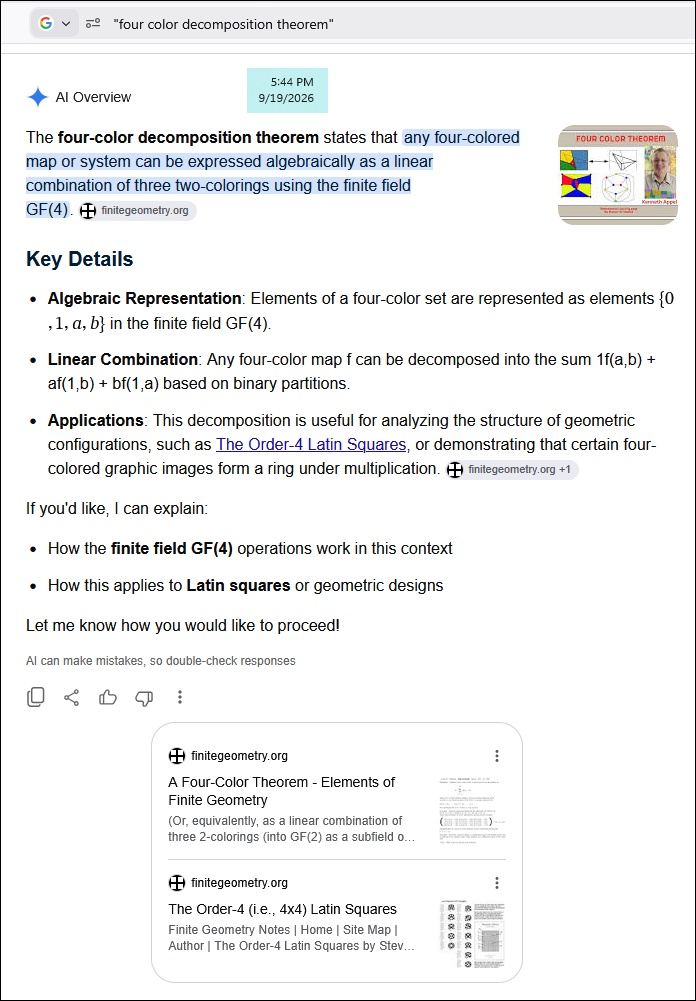
The above presentation of the Cullinane four-color decomposition theorem
is now available, via a Google search, to a global audience.
It will perhaps suggest to someone that the decomposition theorem
might be used in a conceptual proof of the classic four-color map theorem.
I myself never cared to attempt such a proof, feeling it would be
beyond my own capability. But these days it seems likely that some
mathematician, or even a mere math enthusiast, might ask an advanced
AI to look for such a conceptual proof. (The four-color map theorem
was, it is said, proved using a computer some years ago, but that
proof — and a later improved version — was far from being conceptual.)
For the original 1976 version of the decomposition theorem, see a Log24
post from February 6, 2026.

As for time … See this journal on the above Sting date.
A professional hallucinator that
some will find more entertaining:


The release date of "Annihilation" was February 23, 2018.
See also "Snow Games" in this journal on that date
and, more generally, posts tagged Verwandlungslehre .
Argument for the Existence of Rebecca
Adapted from YouTube's "Mathematics and Religion," starring Rebecca Newberger Goldstein, author of the recent novel 36 Arguments for the Existence of God—

The added Quaternion picture is from
Groundhog Day, 2009.
The Plane of Time
From tomorrow's NY Times Book Review, Geoff Dyer's review of DeLillo's new novel Point Omega is now online—
"The book begins and ends with Douglas Gordon’s film project '24 Hour Psycho' (installed at the Museum of Modern Art in Manhattan in 2006), in which the 109-minute Hitchcock original is slowed so that it takes a full day and night to twitch by. DeLillo conveys with haunting lucidity the uncanny beauty of 'the actor’s eyes in slow transit across his bony sockets,' 'Janet Leigh in the detailed process of not knowing what is about to happen to her.' Of course, DeLillo being DeLillo, it’s the deeper implications of the piece— what it reveals about the nature of film, perception and time— that detain him. As an unidentified spectator, DeLillo is mesmerized by the 'radically altered plane of time': 'The less there was to see, the harder he looked, the more he saw.'
This prologue and epilogue make up a phenomenological essay on one of the rare artworks of recent times to merit the prefix 'conceptual.'"
Related material:
Steering a Space-Plane
(February 2, 2003)
Holly Day
(February 3, 2010)
Attitude Adjustment
(February 3, 2010)

Cover illustration by Stephen Savage,
NY Times Book Review,
Feb. 2 (Candlemas), 2003
“We live the time that a match flickers.”
– Robert Louis Stevenson, Aes Triplex
Powered by WordPress