Log24

Wednesday, May 27, 2026

CounterClockwise Brick Space

Filed under: General — Tags: , , , — m759 @ 9:02 am

". . . Southbound . . . ." —Mary Chapin Carpenter song lyric

Some will prefer lyrics by Stevie Nicks . . .

". . . Turn Around . . . ." 

Thursday, November 20, 2025

On Brick Space

Filed under: General — Tags: , — m759 @ 6:24 pm

A question suggested by NotebookLM in the "Diamond Theory" notebook,
and its answer today by NotebookLM —

How are algebraic, combinatorial, and geometric structures unified within the Brick Space model?

The unification of algebraic, combinatorial, and geometric structures within the Brick Space model is achieved through its role as a graphic, isomorphic representation of key finite geometries, particularly the projective spaces PG(5,2) and PG(3,2), and their fundamental relationship via the Klein correspondence

.
The term "Brick Space" originates from the arrays, or "bricks," coined by R. T. Curtis as component parts of his Miracle Octad Generator (MOG)

. These physical or graphic arrangements serve as a concrete visualization (or model) of highly abstract mathematical structures

.
1. Geometric Unification
The Brick Space model provides a geometric foundation for combinatorial objects through direct visualization of finite geometries defined over the two-element field, GF(2)
.
Modeling Projective Space: The Brick Space model is the natural geometric setting for the MOG's components, which may be regarded as forming both the 5-dimensional projective space and the 3-dimensional projective space
.
Visualizing PG(5,2) and the Klein Quadric: The model visually represents the space, which has 63 points, by partitioning these points into 28 points lying off the Klein quadric and 35 points lying on the Klein quadric

. The geometry of is linked to the concept of the 8-set

.
The Klein Correspondence: The geometric relationship between and is formalized by the Klein correspondence

. The model, developed as a brick space, is analogous to the "line diagrams" construction of found in the Cullinane diamond theorem

.
Lines and Points: The Brick Space implicitly models how the 35 lines of correspond to the 35 points on the Klein quadric in
.
2. Combinatorial Unification
Combinatorial structures, primarily partitions of sets and block designs, are mapped directly onto geometric entities within the Brick Space framework
.
Partitions and Lines: The central combinatorial equivalence involves mapping partitions of sets to geometric objects

. The 35 combinatorial structures arising from permutations of diamond tiles (related to the bricks) are isomorphic to the 35 lines of . These 35 structures also mirror the 35 square patterns within the original MOG

.
Partitions of the 8-Set: The lines correspond to the 35 partitions of an 8-set into two 4-sets

. This same framework connects to the 105 partitions of an 8-set into four 2-sets, which are essentially the same as the 105 lines contained in the Klein quadric

.
Latin Squares: The combinatorial property of orthogonality of Latin squares (specifically, order-4 Latin squares) is unified geometrically by corresponding exactly to the property of skewness of lines (non-intersecting lines) in

. This provides a geometric dictionary for abstract algebraic combinatorics

.
3. Algebraic Unification
Algebraic structures, rooted in finite field theory and group theory, govern the behavior and symmetries observed in the combinatorial and geometric models
.
Binary Field : The foundation of the geometry is the Galois field of two elements, (binary arithmetic: )

. The algebraic rules of dictate the structure of the affine and projective spaces represented by the bricks

.
Binary Addition (XOR): The line diagrams used to formalize the patterns (related to the bricks) can be "added" via component-wise binary addition (XOR)

. The closure property of lines in is represented algebraically by the fact that the three line diagrams corresponding to a pattern always sum to zero ()

.
Group Theory and Symmetry: The massive permutation group (of order 322,560) that transforms the visual patterns is isomorphic to the affine group

. This group, which explains the pervasive symmetry found in all -images, is the automorphism group of the underlying finite geometry, establishing the algebraic control over the system's geometric and combinatorial properties

.
Ring Theory: The patterns can be endowed with algebraic structure to generate an ideal within a ring of symmetric patterns, leading to an infinite family of "diamond rings" isomorphic to rings of matrices over

. This links the geometry to the machinery of abstract algebra

.
M24 Connection: The affine group is identified as the octad stabilizer subgroup of the Mathieu group

, linking the visual patterns and the underlying geometries to the abstract world of sporadic simple groups, coding theory (Golay code), and lattice theory (Leech lattice)

.
The Brick Space model, therefore, functions as a visual tapestry where graphic arrangements (geometry/visualization) encode set partitions (combinatorics) that behave according to the rules of binary algebra ( and affine groups)

. The entire structure is unified by powerful isomorphisms relating these three mathematical domains through finite geometries like and .

Sunday, November 2, 2025

The Mystery of Brick Space . . .

Filed under: General — Tags: , — m759 @ 11:42 pm

. . . is the title of a NotebookLM video now on YouTube —

See https://youtu.be/6zUKg4dNEbM .

The current NotebookLM summary for the Diamond Theory notebook, the source of the above video —

"These sources comprehensively explore the deep connections between finite geometry, particularly the projective spaces PG(3,2) and PG(5,2) over GF(2), and various topics in combinatorics, group theory, and coding theory. Central to this discussion are the Miracle Octad Generator (MOG) and the Cullinane Diamond Theorem, which model highly symmetric structures like the affine group AGL(4,2) and the sporadic Mathieu group M24 using geometric figures such as 4×4 arrays or 'brick space.' The geometry of PG(3,2), described as the 'smallest perfect universe,' is shown to be crucial, relating to concepts like Conwell's Heptads, Klein correspondence, spreads, and mutually orthogonal Latin squares (MOLS), which also have applications in error-correcting codes and quantum information theory involving n-qubits. Ultimately, these texts demonstrate how abstract mathematical symmetry is intrinsically linked across algebra, geometry, and visual art, often leveraging automorphism groups to reveal structural invariants."

Saturday, November 1, 2025

Brick Space Update

Filed under: General — Tags: , , — m759 @ 1:22 pm

Last night at the museum . . .

Today . . . The Mystery of Brick Space

Saturday, May 10, 2025

Six-Set and Eight-Set:
I Ching* and Brick Space

Filed under: General — Tags: , , — m759 @ 2:25 pm

Earlier . . .

Today . . .

* For a connection with I Ching  geometry,  see  a different 8×8 array.

Friday, April 11, 2025

Brick Space: The Yellow Brick* Road Now and in 2014

Filed under: General — Tags: , , , — m759 @ 12:20 pm

Now —

… and in 2014 —

* "Brick" is a term coined by R. T. Curtis that denotes any of the three
4-row 2-column arrays that form his 4-row 6-column Miracle Octad Generator.

Thursday, April 3, 2025

The Fano Entity … in Brick Space

Filed under: General — Tags: , , — m759 @ 4:40 pm

Sunday, March 23, 2025

Annals of Brick Space . . .
Not-so-free Masonry

Filed under: General — Tags: — m759 @ 4:23 pm

A Google search today for "brick space" —

Related art apparently suggested by the phrase "building blocks"

Wednesday, March 12, 2025

“Prime Target” Scholium:
Brick Space for Apple TV

Filed under: General — Tags: , , , , — m759 @ 9:53 pm

For Astra herself, see . . .

Monday, February 10, 2025

Brick Space: Points with Parts

Filed under: General — Tags: , , , , — m759 @ 3:47 pm

This post's "Points with Parts" title may serve as an introduction to
what has been called "the most powerful diagram in mathematics" —
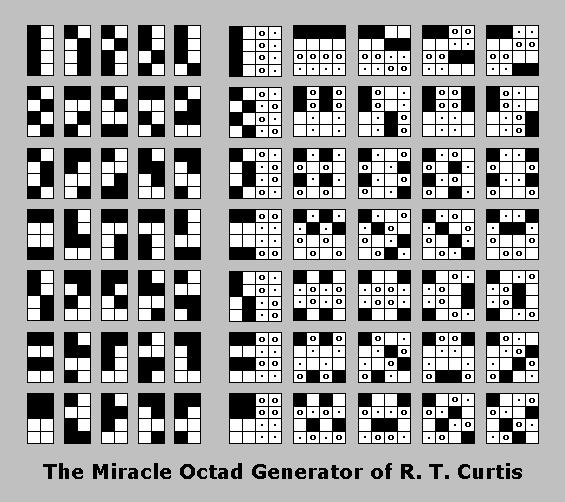
the "Miracle Octad Generator" (MOG) of Robert T. Curtis.

The Miracle Octad Generator (MOG) of R. T. Curtis

Curtis himself has apparently not written on the geometric background
of his diagram — the finite projective spaces PG(5,2) and PG(3,2), of 
five and of three dimensions over the two-element Galois field GF(2).

The component parts of the MOG diagram, the 2×4 Curtis "bricks,"
may be regarded* as forming both PG(5,2) and PG(3,2) . . .
Pace  Euclid, points with parts. For more on the MOG's geometric
background, see the Klein correspondence  in the previous post.

For a simpler example of "points with parts, see
http://m759.net/wordpress/?s=200229.

* Use the notions of Galois (XOR, or "symmetric-difference") addition
of even  subsets, and such addition "modulo complementation," to
decrease the number of dimensions of the spaces involved.

Wednesday, December 25, 2024

Coordinatizing Brick Space

Filed under: General — Tags: — m759 @ 12:07 am

For the assignment of zero-one coordinates (over GF(2)), the earlier
layout of the space posted here yesterday is less convenient than
the layout begun below (a work in progress with different basis vectors) —

Saturday, December 21, 2024

Coordinatizing Brick Space

Filed under: General — Tags: , — m759 @ 4:10 am

The Miracle Octad Generator (MOG) of R. T. Curtis

Exercise:  The eight-part diagrams in the graphic "brick space"
model of PG(5,2) below need to be suitably labeled with six-part
GF(2) coordinates to help illustrate the Klein correspondence that
underlies the large Mathieu group M24.

A possible approach:  The lines  separating dark squares from light
(i.e., blue from white or yellow) in the figure above may be added
in XOR fashion (as if they were diamond theorem  line diagrams)
to form a six  dimensional vector space, which, after a suitable basis
is chosen, may be represented by six-tuples of 0's and 1's.

Related reading —

log24.com/log24/241221-'Brick Space « Log24' – m759.net.pdf .

This is a large (15.1 MB) file.  The Foxit PDF reader is recommended.

The PDF is from a search for Brick Space  in this journal.

Some context:  http://m759.net/wordpress/?s=Weyl+Coordinatization.

Thursday, September 19, 2024

The Zen of Brick Space:
Embedding the Null Brick

Filed under: General — Tags: , — m759 @ 2:21 am


The "Brick Space" model of PG(5,2) —

Brick space: The 2x4 model of PG(5,2)

Related reading . . .

See also "Zero System."

Tuesday, September 17, 2024

Brick Space Exercise

Filed under: General — Tags: , — m759 @ 1:23 am

Exercise: Assign coordinates over GF(2) to the graphic

Thursday, August 1, 2024

For Coppola’s Megalopolis:
Brick Space in the Big Apple

Filed under: General — Tags: — m759 @ 12:00 am

See also Big Apple and Brick Space.

Thursday, July 25, 2024

Brick Space

Filed under: General — Tags: — m759 @ 6:09 am

http://m759.net/wordpress/?s=2×4

Related reading:

http://m759.net/wordpress/?tag=knight-move .

Thursday, July 18, 2024

Brick Space

Filed under: General — Tags: , , — m759 @ 1:45 am
 

Compare and Contrast


A rearranged illustration from . . .

R. T. Curtis, "A New Combinatorial Approach to M24 ,"
Mathematical Proceedings of the Cambridge Philosophical Society ,
Volume 79 , Issue 1 , January 1976 , pp. 25 – 42
DOI: https://doi.org/10.1017/S0305004100052075

The image “MOGCurtis03.gif” cannot be displayed, because it contains errors.


The "Brick Space" model of PG(5,2) —

Brick space: The 2x4 model of PG(5,2)

Background: See "Conwell heptads" on the Web.

See as well Nocciolo  in this journal and . . .

Friday, May 8, 2026

Function Decomposition and the Klein Quadric

Filed under: General — Tags: — m759 @ 7:48 am

"Grid models" in finite geometry include the 4-row 2-column
"brick space" arrays of the R. T. Curtis Miracle Octad Generator.

The remarks below on grid models suggested this post's title,
"Function Decomposition and the Klein Quadric." The result of
applying the Cullinane decomposition theorem to the final 
remarks in Cameron's Parallelisms of Complete Designs

http://m759.net/wordpress/?s=Brick+Color+Monolith .

Connecting Diverse Mathematical Fields
The grid model acts as a unifying framework for several other abstract concepts:
  • The Klein Quadric: The correspondence extends to higher dimensions via the Klein correspondence. This maps the 35 lines of  PG(3,2) (the grid structures) to 35 points on the Klein quadric in a 5-dimensional projective space, PG(5,2). This connects the combinatorial partitions of the grid to the geometry of quadric surfaces.
  • Latin Squares: The model provides a geometric interpretation of combinatorial design. The concept of orthogonality between Latin squares corresponds to the geometric concept of skewness (non-intersecting lines) in PG(3,2).
  • Walsh Functions: The symmetries and binary additions inherent in the line diagrams reflect the structure of Walsh functions, which are orthogonal functions used in digital signal processing and discrete harmonic analysis.
  • Ring Theory: The patterns can be organized algebraically to form "diamond rings," which are isomorphic to rings of matrices over the field GF(4), linking the visual design to abstract algebra and function decomposition.
Summary
The 4×4 grid model acts as a "kaleidoscope" of mathematical structure. Just as a kaleidoscope rearranges simple elements into symmetric patterns, this grid rearranges simple binary tiles to reveal the invariant structures of finite geometries, sporadic groups, and error-correcting codes. It transforms what appears to be a simple problem of tiling into a visualization of the affine 4-space over GF(2)

Tuesday, April 14, 2026

Color Bodies

Filed under: General — Tags: , , — m759 @ 10:15 am

The above L2(23) is closely related to the "Seventh Seal" color bodies implied
by the conclusion of Cameron's classic Parallelisms of Complete Designs.

One such color body, from the set of 105 Klein quadric lines in brick space . . .

Wednesday, April 8, 2026

Space Mystery

Filed under: General — Tags: — m759 @ 11:23 am

Transcript of NotebookLM video
"The Mystery of Brick Space" —

Okay, so our first clue
0:35
comes from the movies. You've got
0:37
Stanley Kubrick's masterpiece, 2001: A 
0:39
Space Odyssey. And this … this bizarre
0:42
black monolith just shows up. It's this
0:45
object of perfect almost unsettling
0:47
geometry that always signals some huge
0:50
leap in evolution. . . . 

"We did not explicitly train Mythos Preview to have these capabilities.
Rather, they emerged as a downstream consequence of general improvements
in code, reasoning, and autonomy." — red.anthropic.com, April 7th, 2026

Wednesday, January 14, 2026

Today Is World Logic Day 2026

Filed under: General — Tags: , — m759 @ 12:34 pm

"The date chosen to celebrate World Logic Day, 14 January, corresponds to
the date of death of Kurt Gödel and the date of birth of Alfred Tarski,.
two of the most prominent logicians of the twentieth century." — Wikipedia

Some "presentatonal symbols" — The Gray Lotus.

Diamond Theory
by NotebookLM

94 sources

The Cullinane diamond theorem establishes a profound link between visual 4×4 patterns and advanced mathematical structures such as finite geometry and group theory. By analyzing symmetry-preserving transformations within a group of 322,560 permutations, the research connects simple grid designs to the complex projective space PG(3,2). These geometric frameworks further extend into coding theory, illustrating how "diamond" rings are isomorphic to matrix algebras over the finite field GF(4). The sources also highlight the Miracle Octad Generator (MOG) and its relationship to the Mathieu group M24, which is essential for understanding error-correcting codes and sphere packings. Beyond pure mathematics, the text explores "brick space" and the Klein correspondence, suggesting that these abstract symmetries represent a "universal" order found in both art and nature. Ultimately, this body of work bridges the gap between ancient motifs and modern computational science through the elegant study of structural invariants.

 
Thursday, November 20, 2025

How are algebraic, combinatorial, and geometric structures unified within the Brick Space model?

The unification of algebraic, combinatorial, and geometric structures within the Brick Space model is achieved through its role as a graphic, isomorphic representation of key finite geometries, particularly the projective spaces PG(5,2) and PG(3,2), and their fundamental relationship via the Klein correspondence.

————————————————————————————.

The term "Brick Space" originates from the arrays, or "bricks," coined by R. T. Curtis as component parts of his Miracle Octad Generator (MOG)

. These physical or graphic arrangements serve as a concrete visualization (or model) of highly abstract mathematical structures.

1. Geometric Unification
The Brick Space model provides a geometric foundation for combinatorial objects through direct visualization of finite geometries defined over the two-element field, GF(2)
.
Modeling Projective Space: The Brick Space model is the natural geometric setting for the MOG's components, which may be regarded as forming both the 5-dimensional projective space and the 3-dimensional projective space
.
Visualizing PG(5,2) and the Klein Quadric: The model visually represents the space, which has 63 points, by partitioning these points into 28 points lying off the Klein quadric and 35 points lying on the Klein quadric

. The geometry of is linked to the concept of the 8-set

.
The Klein Correspondence: The geometric relationship between and is formalized by the Klein correspondence

. The model, developed as a brick space, is analogous to the "line diagrams" construction of found in the Cullinane diamond theorem

.
Lines and Points: The Brick Space implicitly models how the 35 lines of correspond to the 35 points on the Klein quadric in
.
2. Combinatorial Unification
Combinatorial structures, primarily partitions of sets and block designs, are mapped directly onto geometric entities within the Brick Space framework
.
Partitions and Lines: The central combinatorial equivalence involves mapping partitions of sets to geometric objects

. The 35 combinatorial structures arising from permutations of diamond tiles (related to the bricks) are isomorphic to the 35 lines of . These 35 structures also mirror the 35 square patterns within the original MOG

.
Partitions of the 8-Set: The lines correspond to the 35 partitions of an 8-set into two 4-sets

. This same framework connects to the 105 partitions of an 8-set into four 2-sets, which are essentially the same as the 105 lines contained in the Klein quadric

.
Latin Squares: The combinatorial property of orthogonality of Latin squares (specifically, order-4 Latin squares) is unified geometrically by corresponding exactly to the property of skewness of lines (non-intersecting lines) in

. This provides a geometric dictionary for abstract algebraic combinatorics

.
3. Algebraic Unification
Algebraic structures, rooted in finite field theory and group theory, govern the behavior and symmetries observed in the combinatorial and geometric models
.
Binary Field : The foundation of the geometry is the Galois field of two elements, (binary arithmetic: )

. The algebraic rules of dictate the structure of the affine and projective spaces represented by the bricks

.
Binary Addition (XOR): The line diagrams used to formalize the patterns (related to the bricks) can be "added" via component-wise binary addition (XOR)

. The closure property of lines in is represented algebraically by the fact that the three line diagrams corresponding to a pattern always sum to zero ()

.
Group Theory and Symmetry: The massive permutation group (of order 322,560) that transforms the visual patterns is isomorphic to the affine group

. This group, which explains the pervasive symmetry found in all -images, is the automorphism group of the underlying finite geometry, establishing the algebraic control over the system's geometric and combinatorial properties

.
Ring Theory: The patterns can be endowed with algebraic structure to generate an ideal within a ring of symmetric patterns, leading to an infinite family of "diamond rings" isomorphic to rings of matrices over

. This links the geometry to the machinery of abstract algebra

.
M24 Connection: The affine group is identified as the octad stabilizer subgroup of the Mathieu group

, linking the visual patterns and the underlying geometries to the abstract world of sporadic simple groups, coding theory (Golay code), and lattice theory (Leech lattice)

.
The Brick Space model, therefore, functions as a visual tapestry where graphic arrangements (geometry/visualization) encode set partitions (combinatorics) that behave according to the rules of binary algebra ( and affine groups)

. The entire structure is unified by powerful isomorphisms relating these three mathematical domains through finite geometries like and

Monday, December 29, 2025

Octad Art — Bricks, Cubes, Flowers

For the bricks of the title, see other posts tagged Brick Space
For some cubes* and flowers, see below.

Combining features of the above two images, one might picture the 24
cells of the 4×6 array underlying the Curtis Miracle Octad Generator
(MOG) as each containing an eightfold cube, pictured as above with seven
of its subcubes showing and an eighth subcube hidden behind them.

The seven visible subcubes may be colored, as in the Curtis image of
the Klein map, with seven distinct colors… corresponding to the seven
edge-colors used in the Curtis-Klein map. Each of the seven visible
subcubes in a cell may also be labeled, on its visible faces, with a symbol
denoting one of the 24 points of the projective line over GF(23), just as the
faces in the Curtis-Klein map are labeled.  The hidden subcube in each cell
may be regarded as also so labeled, by the MOG label of the cell's position.

There is then enough information in the array's eightfold cubes' colors and
labels to construct the seven generating permutations of M24 described by
Curtis, and the 24 array cells may be regarded as now containing 24 distinct
entities — which perhaps might be called "octoids."

Those desiring a more decorative approach may replace the 24 labeled cubes
with 24 labeled "flowers." Each flower — like the map's symmetric seven
"petals" and the central "infinity heptagon" they surround — forms an octad.

Related Illustrations . . .

* See as well posts tagged Mathieu Cube . . .

Related material — 

The 56 triangles of  the eightfold cube . . .

The Eightfold Cube: The Beauty of Klein's Simple Group

   Image from Christmas Day 2005.

Post last revised:  December 30, 2025 @ 21:30 E.S.T.

Tuesday, December 2, 2025

Today’s NotebookLM “Diamond Theory” Summary

Filed under: General — Tags: , — m759 @ 10:07 am
 

Diamond Theory by NotebookLM

92 sources

This collection of texts examines the profound mathematical unity connecting finite geometry, group theory, and visual combinatorics, centered largely on the projective space PG(3,2) and the associated Affine Group AGL(4,2). The geometry is often modeled using structures like the 4×4 array or "Brick Space," where the action of the group AGL(4,2) (order 322,560) explains the symmetries of abstract diamond patterns. Central to this framework are classical structures like Conwell's Heptads and the Klein Quadric, which are shown to be crucial in partitioning spaces like PG(5,2) and constructing spreads used in coding theory. The material extensively links these geometric models, including the Miracle Octad Generator (MOG), to the exceptional symmetries of the Mathieu group M24 through stabilizer subgroups. Furthermore, these abstract concepts find applications in diverse fields, providing geometric insights into Mutually Orthogonal Latin Squares (MOLS), algebraic ring structures, and analogies within quantum physics related to qubit observables. The overarching theme demonstrates how symmetry, whether in abstract geometric configurations or visual quilt designs, is rooted in the deep logic of finite algebraic structure.

Monday, November 3, 2025

The Monolith Mystery

Filed under: General — Tags: , , , — m759 @ 1:25 pm

Transcript of NotebookLM video
"The Mystery of Brick Space" —

Okay, so our first clue
0:35
comes from the movies. You've got
0:37
Stanley Kubrick's masterpiece, 2001: A 
0:39
Space Odyssey. And this … this bizarre
0:42
black monolith just shows up. It's this
0:45
object of perfect almost unsettling
0:47
geometry that always signals some huge
0:50
leap in evolution. And what's really
0:52
wild is that while Kubrick was filming
0:53
this, minimalist artists like John
0:55
McCracken were creating nearly identical
0:57
sculptures totally independently of the
1:00
film. 

Scholium 

Related material 

From a post for the opening of Cullinane College
on January 29, 2003:

"Young man sings 'Dry Bones'"

Illustrations:

http://www.log24.com/log/pix10B/101228-ThePrisonerTrial.jpg

http://www.log24.com/log/pix10B/101228-ThePrisonerEandE.jpg

See as well "Monolith" in this  journal.

Bullshit fans may also enjoy "the monolith to El" 
in James Michener's archaeology epic The Source :

Levels of Tell Makor, from Michener's 'The Source'

Sunday, April 20, 2025

Merton College Barometer . . . Continues.

Filed under: General — Tags: — m759 @ 3:46 am

For fans of "Meet Joe Black" …

Friday, April 11, 2025

Brick Space: The Yellow Brick Road
Now and in 2014

Tags: ,
— m759 @ 12:20 pm

That April 11, 2025, post suggests . . .

An image reproduced here on December 11, 2018 
("Carried Away") —

The new American Mathematical Society logo suggests 
the Jamaican Bobsled Team:

Wednesday, April 2, 2025

Dramarama: The SIX Train

Filed under: General — Tags: — m759 @ 10:26 am

From a post of August 31, 2022 — "Release Dates: The Iceman Goeth" —

Also in May 1986 —

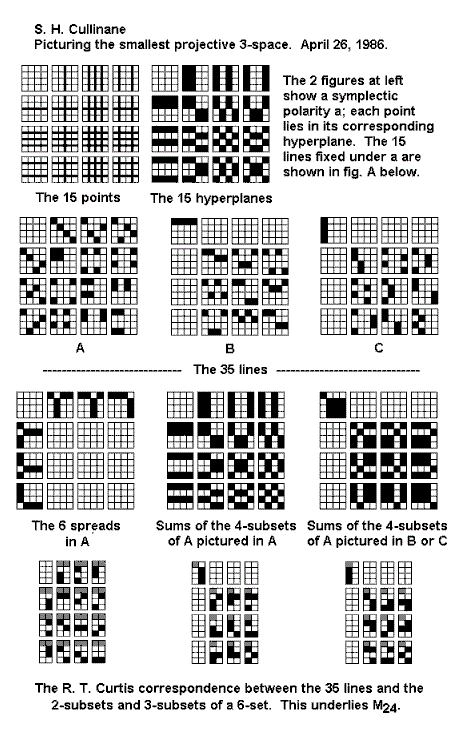
86-05-08… A linear complex related to M24 .

Anatomy of the polarity pictured in the 86-04-26 note.

86-05-26… The 2-subsets of a 6-set are the points of a PG(3,2).

Beutelspacher's model of the 15 points of PG(3,2)
compared with a 15-line complex in PG(3,2).

More recently, Harrison Ford in the New York subway,
reportedly
on Monday, March 31 —

See as well Agent Smith in Brick Space.

Sunday, March 23, 2025

A Mystery Popup

Filed under: General — Tags: — m759 @ 2:35 pm

The recent URL cubebrick.space forwards to . . .

http://m759.net/wordpress/?tag=brick-space.

The web posts so tagged are, as one would expect,
NOT in the Harvard Library system.  I was therefore
somewhat surprised to see the following popup today —

Clicking on the "Get article" link yields . . .

This metadata is actually quite helpful, as the cited article
does, in fact, give good references for what I have called,
using a term from the "Miracle Octad Generator" of R. T. Curtis,
"brick space" — the finite projective space PG(5,2).

Friday, February 28, 2025

Art Space for the Year of the Serpent

Filed under: General — Tags: , , — m759 @ 12:22 pm

See as well Log24 searches for Chess King  and  Brick Space .

Tuesday, February 18, 2025

Grok 3 on the Log24 post of last New Year’s Eve

Filed under: General — Tags: , — m759 @ 1:01 am

The Miracle Octad Generator (MOG) of R. T. Curtis —

The Miracle Octad Generator (MOG) of R. T. Curtis

Grok 3 beta, 12:56 AM ET Feb. 18, 2025 —

The diagram you've provided from the webpage titled "The Yellow Brick Road to the Miracle Octad Generator; with Conwell's Heptads" illustrates the concept of "brick space" within the context of projective geometry, specifically PG(5,2), which is the 5-dimensional projective space over the field with 2 elements (GF(2)). Here's a detailed breakdown based on the image:

Diagram Explanation:

    Components of the Diagram:
        Left Side:
            There are 28 points off the Klein quadric represented by grids with some cells shaded in blue.
        Middle Section:
            The 35 points of the Klein quadric are shown, which are added to the 28 points off the Klein quadric. This section shows grids with additional yellow shading.
        Right Side:
            The result of adding these points together to form the 63 points of PG(5,2), represented by grids with blue and yellow shading combined. This section also includes the 8 Conwell heptads (each heptad represented as a column).
    Mathematical Context:
        PG(5,2): As mentioned, this is the projective 5-space over GF(2), which has
        2^6 – 1 = 63
         points (since points in projective space are equivalence classes of non-zero vectors, excluding the zero vector).
        Klein Quadric: A specific geometric structure within PG(5,2) that can be visualized in this context as a subset of points with particular properties. Here, it's shown as contributing 35 points.
        Conwell Heptads: These are subsets of 7 points (heptads) in this geometry, named after Conwell, and are visually represented in columns on the right side.
    Visual Representation:
        The "brick space" metaphor likely comes from the way these points and subspaces are arranged in a grid-like or block-like fashion, similar to bricks in a wall. Each grid represents a configuration of points or subspaces within this projective space, and the combination of different colored shadings (blue, yellow) helps to distinguish different sets or properties of points.
    Purpose of the Diagram:
        This diagram is part of an exploration of the Miracle Octad Generator (MOG) by R. T. Curtis, where the Klein quadric serves as a background. The MOG is a structure used in the study of combinatorial designs and has applications in finite group theory, particularly with the Mathieu groups. The diagram visually aids in understanding how these points and heptads relate to each other within this geometric framework.
    Additional Notes:
        The note at the bottom mentions that 28 + 35 = 63, which matches the total number of points in PG(5,2).
        The mention of heptads being added on December 31, 2024, indicates updates or additions to the original concept or visualization.


This diagram, therefore, serves as a visual aid to understand the structure of PG(5,2) in terms of its points, subspaces, and specific combinatorial designs like the Conwell heptads, all within the context of the Miracle Octad Generator. It's an advanced mathematical visualization, combining geometric and combinatorial aspects in a way that's accessible to those familiar with these concepts.

For some remarks by Grok 3 beta made before it saw the
"yellow brick" diagram, see a PDF of prompts and responses.

Sunday, February 9, 2025

An AI Overview of Klein Quadric and MOG

Filed under: General — Tags: , , — m759 @ 2:15 pm

See also a more accurate AI report from January 9, 2025 —

Grok 2 on the MOG and the Klein Correspondence:

HTML version, with corrections, of the above 9 January Grok 2 report —

Grok 2: Klein Correspondence and MOG, 9 Jan. 2025 . . .
______________________________________________

The Klein correspondence is closely related to the Miracle Octad Generator (MOG) through the mathematical structure they both engage with, particularly in the context of finite geometry and combinatorics.

Klein Correspondence: This refers to a mathematical framework that establishes a correspondence between points and lines in a projective space.* Specifically, in the context of the MOG, it relates to the geometry of PG(3,2), the three-dimensional projective space over the field with two elements. The Klein correspondence, in this context, essentially connects the combinatorial aspects of partitions of an 8-set to the geometric structure of lines in PG(3,2).

Miracle Octad Generator (MOG): Introduced by R.T. Curtis, the MOG is a tool used in the study of the Mathieu group M24, the binary Golay code, and related structures like the Steiner system S(5,8,24). It consists of a 4×6 array where the positions are used to construct octads (sets of 8 elements) from given sets of 5 elements, reflecting the structure of the Steiner system.

Relation Between Klein Correspondence and MOG:

  • Combinatorial and Geometric Link: The MOG uses the Klein correspondence to map partitions of an 8-set (into two 4-sets) to [the sets of] 4 parallel affine planes [that represent lines] within PG(3,2). This mapping is natural and symmetrical, which is crucial for the MOG's functionality. The 35 partitions of an 8-set correspond to the 35 lines in PG(3,2), and this correspondence helps in understanding how to generate and visualize octads within the MOG framework.
     
  • Structural Insight: The Klein correspondence provides a way to see how the MOG's method of generating octads can be understood geometrically. This insight is vital for exploring the symmetry and subgroup structure of M24, as the MOG's layout preserves these symmetries.

Thus, the Klein correspondence serves as a foundational link that allows the MOG to operate by translating combinatorial problems into geometric ones, facilitating the study of complex mathematical structures like the Mathieu groups and Steiner systems.

* Correction: Should be "a correspondence between points in a five-dimensional projective space and lines in a three-dimensional projective space."

Update  of ca. 9 AM ET Monday, Feb. 10, 2024 —

Neither AI report above mentions the Cullinane model of the five-
dimensional projective space PG(5,2) as a brick space — a space
whose points are the 2×4 bricks  used in thte MOG. This is
understandable, as the notion of using bricks to model both  PG(5,2)
and PG(3,2) has appeared so far only in this journal. See an
illustration from New Year's Eve . . . Dec. 31, 2024 —

The Miracle Octad Generator (MOG) of R. T. Curtis

Older Posts »

Powered by WordPress