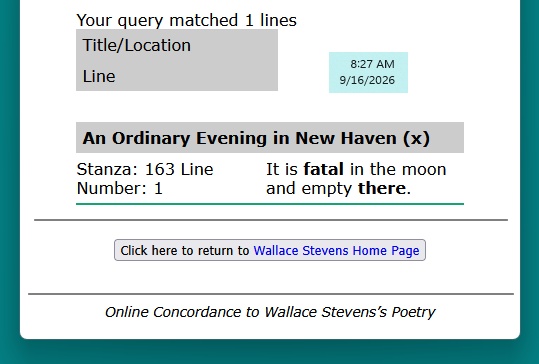
Stevens for those who prefer hallucinations to reality . . .
This faithfulness of reality, this mode,
This tendance and venerable holding-in
Make gay the hallucinations in surfaces.
Stevens for those who prefer hallucinations to reality . . .
This faithfulness of reality, this mode,
This tendance and venerable holding-in
Make gay the hallucinations in surfaces.
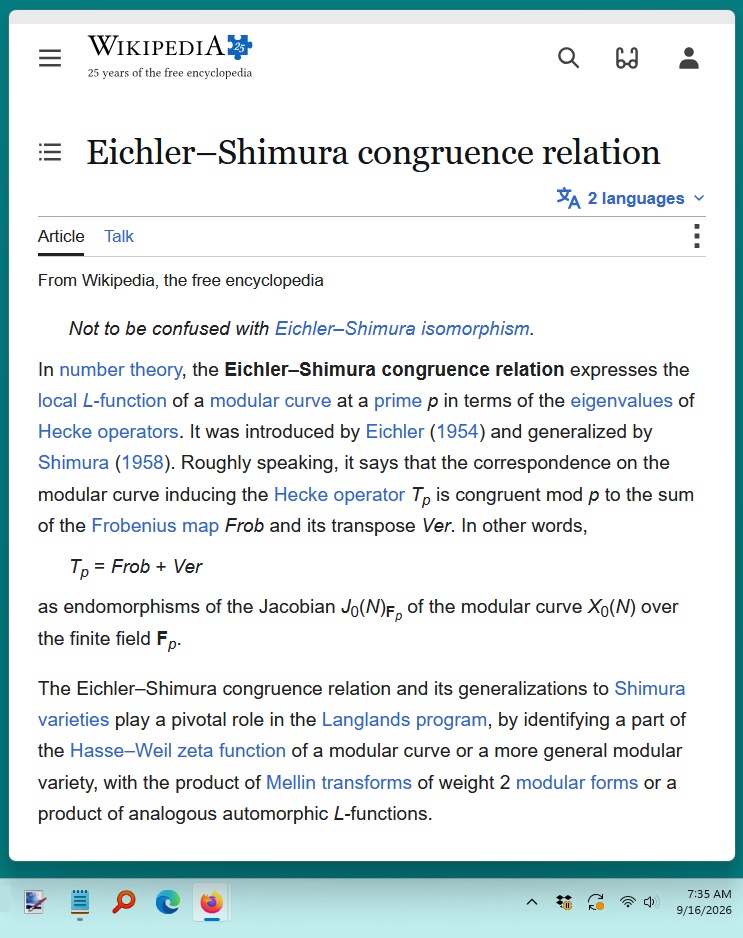
260916-Eichler-Shimura-congruence-relation.jpg
On Siri Hustvedt:
“… she explores the nature of identity
in a structure of crystalline complexity.”
— Janet Burroway, quoted in ART WARS


“Is it safe?”
— Annals of Art Education:
Geometry and Death

260915-AI_Math_Misalignment_Declaration-of-9-11-2026.jpg
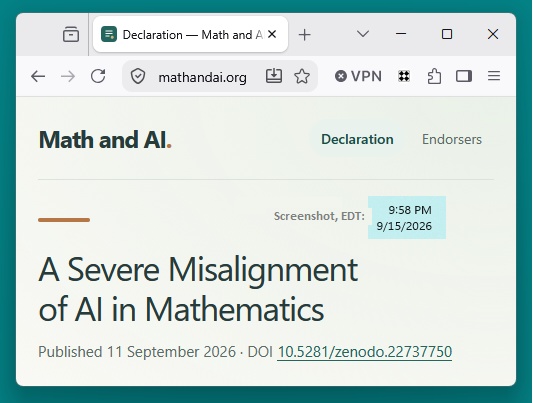
From the above declaration . . .
"In recent months, the success of AI in solving major
mathematical problems has made headlines even outside
mathematical circles. But solving problems is only a tool
and proxy for achieving the primary goal
of conceptual understanding and insight."
Related reading —
Maps: Four Color Theorem Computer Proofs
Mappings: Four Color Decomposition Theorem.
The previous post suggests a search in this journal
for "Bamberg." That search yields . . .
http://m759.net/wordpress/?p=20002 —
Beauty, Truth, Halloween (October 31, 2011).
From that Log24 post —
"Now resemblance (or similitude or likeness) is a relation.
If such relations are realities, then we can say that there are realities
out there that correspond to our conceptual structures."
— R.J. Kilcullen at Macquarie University, course labeled Phil360
"Beauty then is a relation."
"An Attempt to Understand the Problem of Universals"
is the title of a talk by Fabian Geier, University of Bamberg.
From a link target at the end of that post —
On Siri Hustvedt:
“… she explores the nature of identity
in a structure of crystalline complexity.”
— Janet Burroway, quoted in ART WARS
“Is it safe?”

Related art . . .
The New York Times obituary today of
an artist who reportedly died today at 88 —
He "mounted a frontal attack on
Minimalism and Conceptualism."

“Anomalies must be expected along the conceptual frontier
between the temporal and the eternal.”
— The Death of Adam, by Marilynne Robinson, Houghton Mifflin,
1998, essay on Marguerite de Navarre.
* See a Calvin in this journal on the dies natalis of Professor MacIntyre.
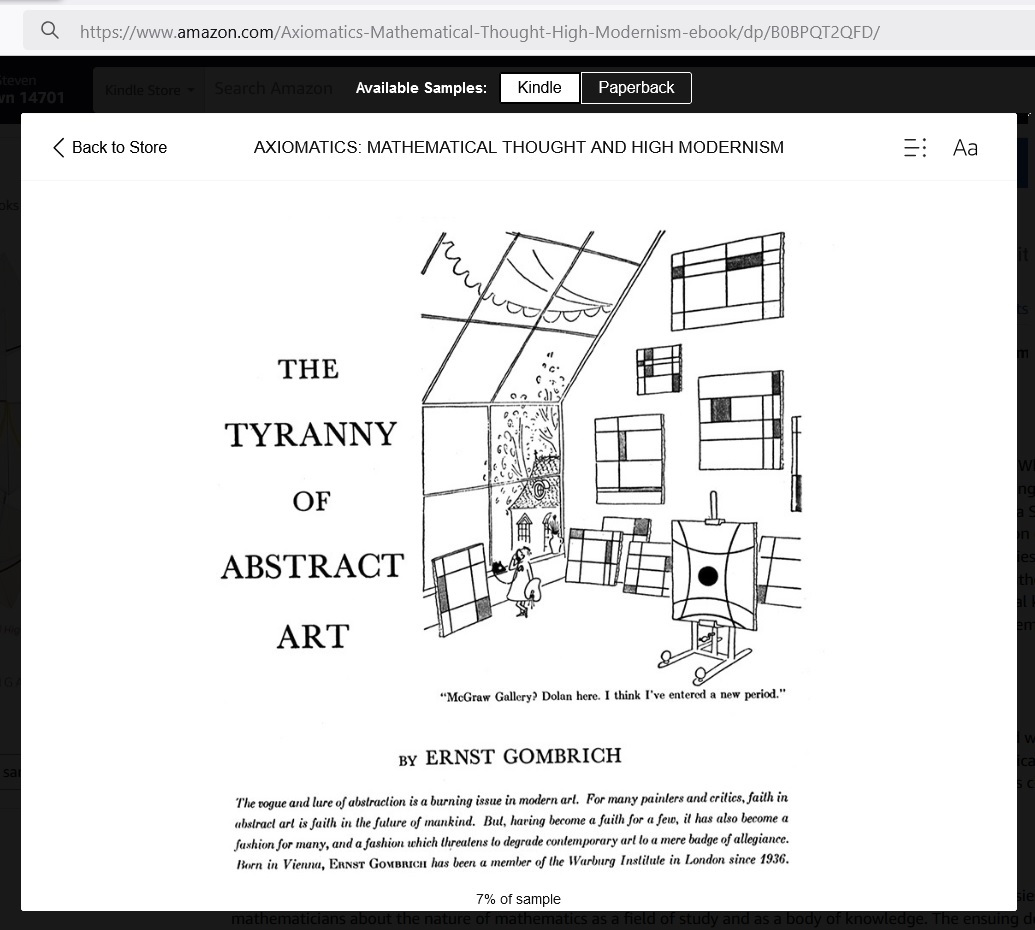
Axiomatics: Mathematical Thought and High Modernism
by Alma Steingart (University of Chicago Press, 2023) has an
illustration of interest.
The illustration and its caption are from an article by Ernst Gombrich
in The Atlantic, April 1958.
But seriously . . . For Calvin University —
“Anomalies must be expected along the conceptual frontier
between the temporal and the eternal.”
— The Death of Adam, by Marilynne Robinson, Houghton Mifflin,
1998, essay on Marguerite de Navarre.
“D’exterieur en l’interieur entre
Qui va par moi, et au milieu du centre
Me trouvera, qui suis le point unique,
La fin, le but de la mathematique;
Le cercle suis dont toute chose vient,
Le point ou tout retourne et se maintient.”
— Marguerite de Navarre
From this journal on March 7, 2003 —

Chez Mondrian
Kertész, Paris, 1926
The domain bitcube.space has now been renewed for another year.
It leads to — among other things — the following remarks . . .
|
Towards a Philosophy of Real Mathematics, by David Corfield, Cambridge U. Press, 2003, p. 206: “Now, it is no easy business defining what one means by the term conceptual…. I think we can say that the conceptual is usually expressible in terms of broad principles. A nice example of this comes in the form of harmonic analysis, which is based on the idea, whose scope has been shown by George Mackey (1992) to be immense, that many kinds of entity become easier to handle by decomposing them into components belonging to spaces invariant under specified symmetries.” For a simpler example of this idea, see the entities in The Diamond Theorem, the decomposition in A Four-Color Theorem, and the space in Geometry of the 4×4 Square. The decomposition differs from that of harmonic analysis, although the subspaces involved in the diamond theorem are isomorphic to Walsh functions– well-known as discrete analogues of the trigonometric functions of traditional harmonic analysis. |
* See that phrase in this journal.
"Colin Cantwell, an animator, conceptual artist and computer expert
who played significant production roles in seminal science fiction films
like '2001: A Space Odyssey,' 'Star Wars' and 'WarGames,' died
on May 21 [2022] at his home in Colorado Springs, Colo. He was 90."
— New York Times obituary quoted here two years ago
Related literature: The 1953 Philip K. Dick story
“Paycheck” —

"Before time began, there was the Cube." — Optimus Prime in "Transformers"
This journal at 9 PM ET March 17, 2023 —
The use of binary coordinate systems as a conceptual tool
Natural physical transformations of square or cubical arrays
of actual physical cubes (i.e., building blocks) correspond to
natural algebraic transformations of vector spaces over GF(2).
This was apparently not previously known.
See "The Thing and I."
See as well today's post Geometry for Belgium.

As for time … See this journal on the above Sting date.
A professional hallucinator that
some will find more entertaining:

Book description at Amazon.com, translated by Google —
|
Las matemáticas como herramienta
Mathematics as a tool by Raúl Ibáñez Torres Kindle edition in Spanish, 2023 Although the relationship between mathematics and art can be traced back to ancient times, mainly in geometric and technical aspects, it is with the arrival of the avant-garde and abstract art at the beginning of the 20th century that mathematics takes on greater and different relevance: as a source of inspiration and as a tool for artistic creation. Let us think, for example, of the importance of the fourth dimension for avant-garde movements or, starting with Kandisnky and later Max Bill and concrete art, the vindication of mathematical thinking in artistic creation. An idea that would have a fundamental influence on currents such as constructivism, minimalism, the fluxus movement, conceptual art, systematic art or optical art, among others. Following this approach, this book analyzes, through a variety of examples and activities, how mathematics is present in contemporary art as a creative tool. And it does so through five branches and the study of some of its mathematical topics: geometry (the Pythagorean theorem), topology (the Moebius strip), algebra (algebraic groups and matrices), combinatorics (permutations and combinations) and recreational mathematics (magic and Latin squares). |
From the book ("Cullinane Diamond Theorem" heading and picture of
book's cover added) —

Publisher: Los Libros de La Catarata (October 24, 2023)
Author: Raúl Ibáñez Torres, customarily known as Raúl Ibáñez
(Ibáñez does not mention Cullinane as the author of the above theorem
in his book (except indirectly, quoting Josefine Lyche), but he did credit
him fully in an earlier article, "The Truchet Tiles and the Diamond Puzzle"
(translation by Google).)
About Ibáñez (translated from Amazon.com by Google):
Mathematician, professor of Geometry at the University of the Basque Country
and scientific disseminator. He is part of the Chair of Scientific Culture of the
UPV/EHU and its blog Cuaderno de Cultura Cientifica. He has been a scriptwriter
and presenter of the program “Una de Mates” on the television program Órbita Laika.
He has collaborated since 2005 on the programs Graffiti and La mechanica del caracol
on Radio Euskadi. He has also been a collaborator and co-writer of the documentary
Hilos de tiempo (2020) about the artist Esther Ferrer. For 20 years he directed the
DivulgaMAT portal, Virtual Center for the Dissemination of Mathematics, and was a
member of the dissemination commission of the Royal Spanish Mathematical Society.
Author of several books, including The Secrets of Multiplication (2019) and
The Great Family of Numbers (2021), in the collection Miradas Matemáticas (Catarata).
He has received the V José María Savirón Prize for Scientific Dissemination
(national modality, 2010) and the COSCE Prize for the Dissemination of Science (2011).


Illustrations of object and gestures
from finitegeometry.org/sc/ —
Object
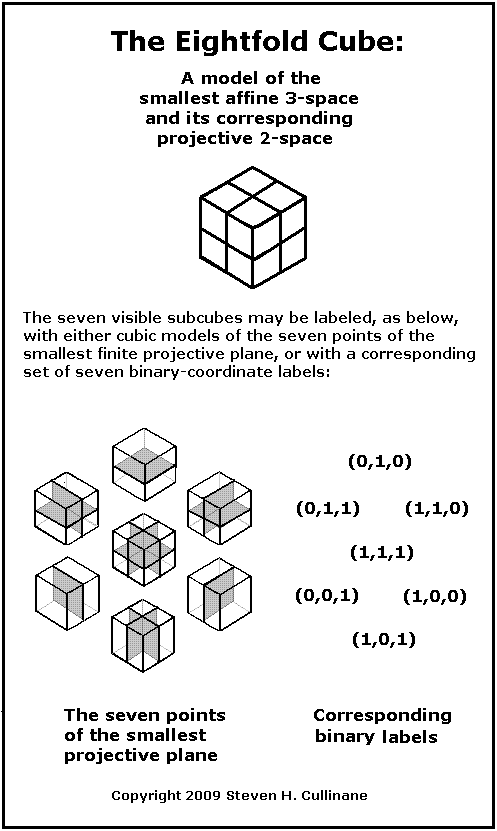
Gestures
An earlier presentation of the above
seven partitions of the eightfold cube:
|
|
Related mathematics:
|
The use of binary coordinate systems
Natural physical transformations of square or cubical arrays See "The Thing and I." |
and . . .
Related entertainment:

Or Matt Helm by way of a Jedi cube.
"Infinity Cube" … hinged plaything, for sale —

"Eightfold Cube" … un hinged concept, not for sale—

See as well yesterday's Trickster Fuge ,
and a 1906 discussion of the eightfold cube:

The New York Times reports a March 2 death —
"A product of Britain’s Royal Academy of Art,
Mr. Stobart moved to the United States in 1970,
when conceptual art, Op Art and minimalism
were riding high in the wake of Abstract Expressionism.
Affable, unassuming and unfailingly candid, Mr. Stobart
would have none of it. 'I’ve never bought it, and the
general public has never bought it either,' he said of
abstract art in an interview with The Boston Globe in 1986.
'That’s a lot of baloney, that stuff.' ”
See also duck art from the Groucho school.
From last night's update to the previous post —
|
The use of binary coordinate systems
Natural physical transformations of square or cubical arrays See "The Thing and I." |
From a post of May 1, 2016 —
|
Mathematische Appetithäppchen: Autor: Erickson, Martin —
"Weitere Informationen zu diesem Themenkreis finden sich |


Update at 9 PM ET March 17: A related observation by SHC —
The use of binary coordinate systems as a conceptual tool
Natural physical transformations of square or cubical arrays
of actual physical cubes (i.e., building blocks) correspond to
natural algebraic transformations of vector spaces over GF(2).
This was apparently not previously known.
See "The Thing and I."
Modernism, Fiction and Mathematics
by Nina Engelhardt
(Edinburgh Critical Studies in Modernist Culture)
From a review by Johann A. Makowsky in
Notices of the American Mathematical Society,
November 2020, pp. 1589-1595 —
"Engelhardt’s goal in this study is to put the interplay
between fiction and mathematical conceptualizations
of the world into its historical context. She sees her work
as a beginning for further studies on the role of mathematics,
not only modern, in fiction in the wider field of literature and
science. It is fair to say that in her book Nina Engelhardt does
succeed in giving us an inspiring tour d’horizon of this interplay."
Another such tour —

On the title of Westworld Season 4 Episode 5, "Zhuangzi" —

A song for Teddy: "Across my dreams, with nets of wonder . . ."

See Zhuangzi also in the 2022 Black Rock CIty manifesto, "Waking Dreams" . . .

The New York Times yesterday ("2022-05-24T21:54:19.000Z")
on a Saturday, May 21, death —
"Colin Cantwell, an animator, conceptual artist and computer expert
who played significant production roles in seminal science fiction films
like '2001: A Space Odyssey,' 'Star Wars' and 'WarGames,' died
on May 21 at his home in Colorado Springs, Colo. He was 90."
Cantwell at Teotihuacan pyramid, September 26, 2019 —

A different image, also from September 26, 2019,
in other Log24 posts tagged Pyramid Game —

The letter labels, but not the tetrahedron, are from Whitehead’s
The Axioms of Projective Geometry (Cambridge U. Press, 1906),
page 13.
Compare and contrast with the Glass-Bead essay in the previous post —

The Caramello essay is backed up by some impressive technical work:

This afternoon's post with the phrase
"Eternal Word Meets Eternal World"
suggests a book —

A search in this journal for "world within" yields . . .
|
"Instead of the 'static spacetime jewel' of blockworld that is often invoked by eternalists to help their readers conceptualize of what a blockworld would 'look like' from the outside, now imagine that a picture on a slide is being projected onto the surface of this space-time jewel. From the perspective of one inside the jewel, one might ask 'Why is this section blue while this section is black?,' and from within the jewel, one could not formulate an answer since one could not see the entire picture projected on the jewel; however, from outside the jewel, an observer (some analogue of Newton's God, perhaps, looking down on his 'sensorium' from the 5th dimension) could easily see the pattern and understand that all of the 'genuinely fortuitous' events inside the space-time jewel are, in fact, completely determined by the pattern in the projector." — "Genuine Fortuitousness, Relational Blockworld, Realism, and Time" (pdf), by Daniel J. Peterson, Honors Thesis, Swarthmore College, December 13, 2007, footnote 55, page 114 |
A related image from pure mathematics —

* The title is thanks to William Gass.

Kristen Stewart on Saturday, Sept. 18, in Los Angeles.
Related conceptual art from a short film by Dylan Meyer —

Everyone needs a personal day sometimes.

From the Aug. 30 post "A Brief Introduction to Ideas,"
an epigraph from Four Quartets —

Another view of the way up and the way down:
"Of course, presentation of the effect in the cause
is exactly what blending the Buddhist Monk's
two journeys provides. The cause is the dynamics
of the two input journeys; the effect is the existence
of a location on the path they occupy at the same time
of day. In the blend, the location and the encounter are
presented directly as part of the causal dynamics of motion."
— Page 78 in The Way We Think: Conceptual Blending ,
by Fauconnier and Turner, Basic Books, 2002.
The Source —

“Rosenbaum has a fluent style that can
pivot and change direction on a single word ….”
The above quotation results from a search
in this journal for golem.
That search resulted from today’s previous post,
Clay Risen.
Related conceptual art —


“You’ve got to be carefully taught . . . .” — Oscar Hammerstein II.
See as well the word undoing in a post of December 6.
Powered by WordPress


