
— R. T. Curtis, "A New Combinatorial Approach to M 24 ,"
Mathematical Proceedings of the Cambridge Philosophical Society (1976),
Related material —

— R. T. Curtis, "A New Combinatorial Approach to M 24 ,"
Mathematical Proceedings of the Cambridge Philosophical Society (1976),
Related material —

A more sophisticated alpha and omega . . .
— R. T. Curtis, "A New Combinatorial Approach to M 24 ,"
Mathematical Proceedings of the Cambridge Philosophical Society (1976),
A related key . . .
"It must be remarked that these 8 heptads are the key to an elegant proof…."
— Philippe Cara, "RWPRI Geometries for the Alternating Group A8," in
Finite Geometries: Proceedings of the Fourth Isle of Thorns Conference
(July 16-21, 2000), Kluwer Academic Publishers, 2001, ed. Aart Blokhuis,
James W. P. Hirschfeld, Dieter Jungnickel, and Joseph A. Thas, pp. 61-97.
A transcription—
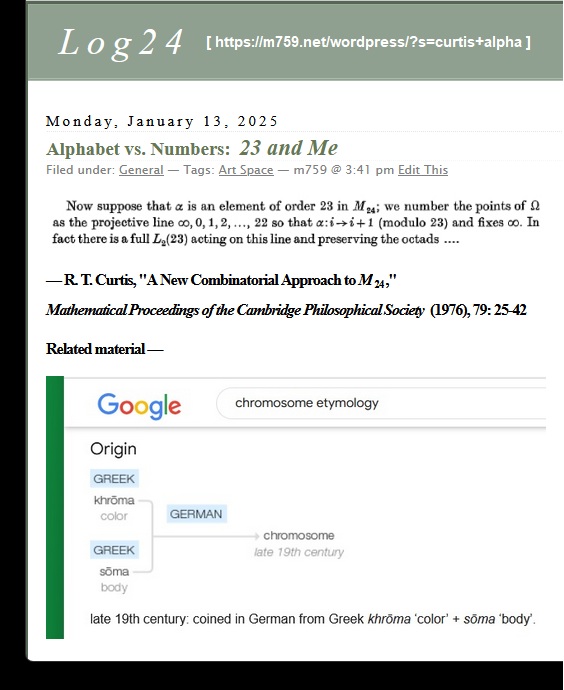
"Now suppose that α is an element of order 23 in M 24 ; we number the points of Ω
as the projective line ∞, 0, 1, 2, … , 22 so that
fact there is a full L 2 (23) acting on this line and preserving the octads…."
— R. T. Curtis, "A New Combinatorial Approach to M 24 ,"
Mathematical Proceedings of the Cambridge Philosophical Society (1976),
Geometric Models of Solomon's Cube 12:15 AM October 29, 2026
Google AI Studio using Argon 4
solcube.html (“Solomon’s Cube”) is linked to the Klein quadric and R. T. Curtis’s Miracle Octad Generator (MOG) through a chain of finite geometries over the two-element field $\mathbb{F}_2 = \text{GF}(2)$.
solcube.html, Cullinane contrasts MSRI’s book The Eightfold Way—which focuses on the Klein quartic curve and its 28 bitangents—with a finite-geometry counterpart embedded inside the 63 non-origin cells of the $4 \times 4 \times 4$ cube ($PG(5,2)$):
Conwell’s 8 Heptads and $A_8 \cong GL(4,2)$: As Conwell (1910) showed, the 28 points of $PG(5,2)$ lying outside the Klein quadric contain 8 "heptads" (sets of 7 points, any two sharing a single point off the quadric, corresponding to 8 heptads of linear complexes in $PG(3,2)$). The symmetries of the Klein quadric permute these 8 heptads, providing a geometric proof of the exceptional group isomorphisms: $$O^+(6,2) \cong S_8 \quad \text{and} \quad PSL(4,2) \cong GL(4,2) \cong A_8$$
|
Geometric / Combinatorial Object
|
Finite Space / Group
|
Role in the Chain
|
|---|---|---|
|
$4 \times 4 \times 4$ Cube ("Solomon's Cube")
|
$AG(6,2)$ (64 points)<br>Group: $AGL(6,2)$
|
Visualizes 6D binary affine space; layer/block permutations preserve 3D diamond symmetries.
|
|
$4 \times 4 \times 4$ Cube minus Origin
|
$PG(5,2)$ (63 points)<br>Group: $GL(6,2)$
|
The 63 non-origin subcubes form 5D binary projective space, home of the Klein quadric.
|
|
Klein Quadric $Q^+(5,2)$
|
35 points in $PG(5,2)$<br>Group: $O^+(6,2) \cong S_8$
|
Represents the 35 lines of $PG(3,2)$ via the Klein correspondence; determines 8 heptads in the 28 exterior points, yielding $GL(4,2) \cong A_8$.
|
|
$4 \times 4$ Square (One layer of the cube)
|
$AG(4,2)$ (16 points)<br>Group: $AGL(4,2) \cong 2^4:A_8$
|
Forms two-thirds of the $4 \times 6$ MOG array; its 35 Diamond-Theorem patterns (parallelisms) correspond to the 35 lines of $PG(3,2)$ and 35 points of the Klein quadric.
|
|
Miracle Octad Generator (MOG)
|
$8 + 16 = 24$ points<br>Group: $M_{24}$
|
Pairs the 35 partitions of an 8-set (Conwell's 8 heptads from the Klein quadric) with the 35 plane-partitions of the $4 \times 4$ square to generate the 759 octads of $S(5,8,24)$.
|
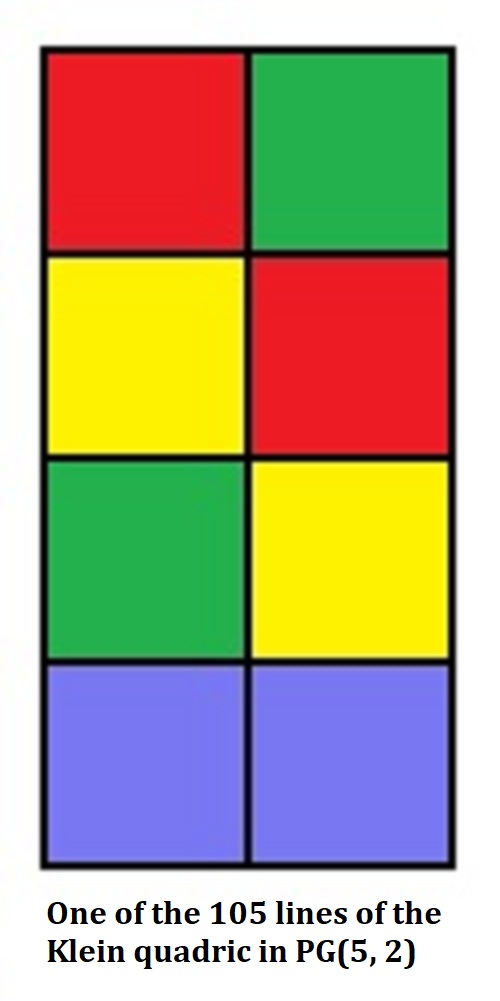
The above L2(23) is closely related to the "Seventh Seal" color bodies implied
by the conclusion of Cameron's classic Parallelisms of Complete Designs.
One such color body, from the set of 105 Klein quadric lines in brick space . . .
The New York Times 's online T Magazine yesterday —

"A version of this article appears in print on December 4, 2016, on page
M263 of T Magazine with the headline: The Year of Magical Thinking."
* Thanks to Emily Witt for inadvertently publicizing the
Miracle Octad Generator of R. T. Curtis, which
summarizes the 759 octads found in the large Witt design.
Powered by WordPress

