Log24

Monday, July 6, 2026

Pieces of Eight: The Klein Quadric in PG(5,2)

Filed under: General — Tags: , , — m759 @ 7:24 pm

A challenge today for NotebookLM video creation . . .

"Explain how the four-color decomposition theorem works,
applying it to both the 4×4 arrays of the diamond theorem proof
and to the 4-row 2-column arrays that illustrate the 105 lines of
the Klein quadric in PG(5,2).  Then explain how the four-color
decomposition theorem illustrates the way that the thirty 7-point
planes of PG(5,2) [Error in the prompt: Should have been 'of the
Klein quadric']
 correspond to the fifteen points and the fifteen
7-point hyperplanes of PG(3,2)."

"Generating Cinematic Video Overview . . .
This may take a while." — 7:21 pm ET

Update the same day —

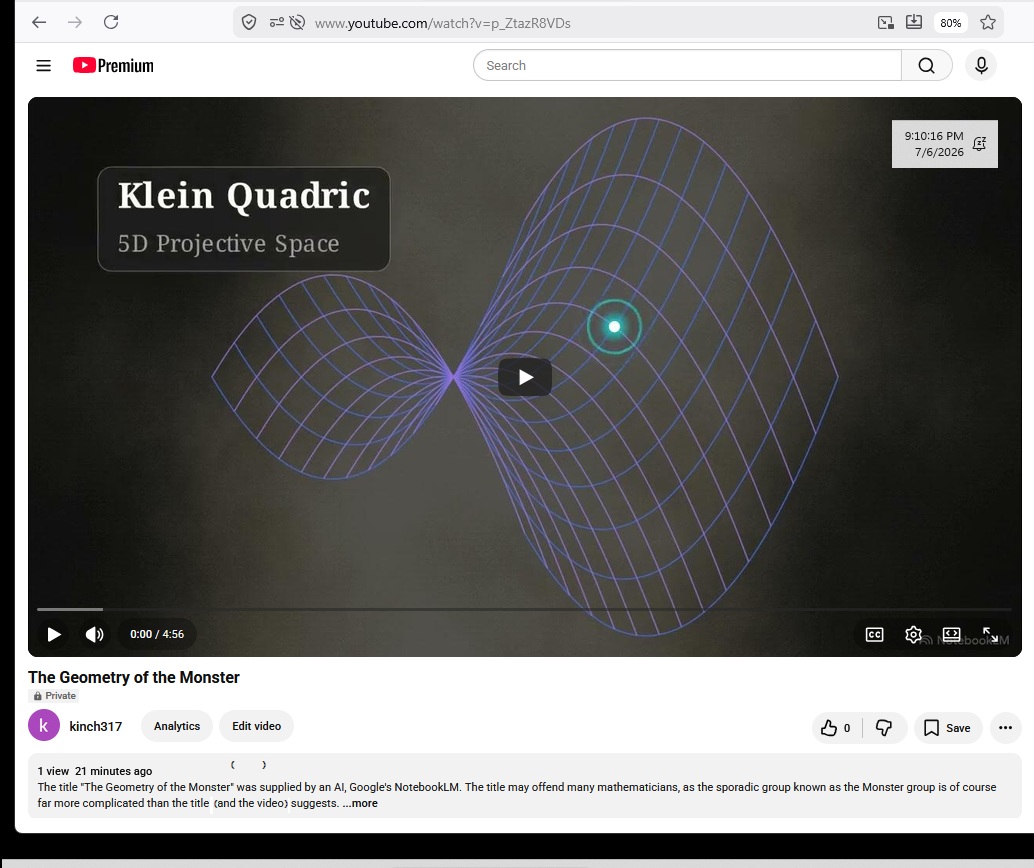
Completed at 7:42 pm —a 4 min., 56 sec. video — provocatively
titled by the NotebookLM AI "The Geometry of the Monster."

The AI-supplied title does not refer to the sporadic group known
to mathematicians as "the Monster," but instead (and wrongly)
to its much smaller subgroup, the Mathieu group M24.  Understanding
the geometry of M24 may, however, help somewhat in understanding 
the real  Monster group.  (Vide Griess, Twelve Sporadic Groups.)

The video is on YouTube at . . .

https://www.youtube.com/watch?v=p_ZtazR8VDs .

260706-AI-named-'Geometry_of_the_Monster'-YouTube-video.jpg —

Friday, May 8, 2026

Function Decomposition and the Klein Quadric

Filed under: General — Tags: — m759 @ 7:48 am

"Grid models" in finite geometry include the 4-row 2-column
"brick space" arrays of the R. T. Curtis Miracle Octad Generator.

The remarks below on grid models suggested this post's title,
"Function Decomposition and the Klein Quadric." The result of
applying the Cullinane decomposition theorem to the final 
remarks in Cameron's Parallelisms of Complete Designs —

http://m759.net/wordpress/?s=Brick+Color+Monolith .

Connecting Diverse Mathematical Fields
The grid model acts as a unifying framework for several other abstract concepts:
  • The Klein Quadric: The correspondence extends to higher dimensions via the Klein correspondence. This maps the 35 lines of  PG(3,2) (the grid structures) to 35 points on the Klein quadric in a 5-dimensional projective space, PG(5,2). This connects the combinatorial partitions of the grid to the geometry of quadric surfaces.
  • Latin Squares: The model provides a geometric interpretation of combinatorial design. The concept of orthogonality between Latin squares corresponds to the geometric concept of skewness (non-intersecting lines) in PG(3,2).
  • Walsh Functions: The symmetries and binary additions inherent in the line diagrams reflect the structure of Walsh functions, which are orthogonal functions used in digital signal processing and discrete harmonic analysis.
  • Ring Theory: The patterns can be organized algebraically to form "diamond rings," which are isomorphic to rings of matrices over the field GF(4), linking the visual design to abstract algebra and function decomposition.
Summary
The 4×4 grid model acts as a "kaleidoscope" of mathematical structure. Just as a kaleidoscope rearranges simple elements into symmetric patterns, this grid rearranges simple binary tiles to reveal the invariant structures of finite geometries, sporadic groups, and error-correcting codes. It transforms what appears to be a simple problem of tiling into a visualization of the affine 4-space over GF(2)

Wednesday, December 17, 2025

The Klein Quadric and the MOG

Filed under: General — Tags: — m759 @ 10:05 am

A screenshot of a Gemini 3 summary . . .

Tuesday, August 26, 2025

Using AI for Search:
Combinatorial Partitions as Projective Lines …
Within the Klein Quadric

Filed under: General — Tags: , , , — m759 @ 1:17 pm

Some backstory: yesterday's post "Using AI: Search vs. Chat."

Vide  a PDF of the complete Grok report —

In its five-and-a-half-minute research and reasoning process
Grok was able to reference a post from this weblog, but it missed
the correct  answer to the prompt — Cullinane's "four-color
decomposition theorem
" in the following weblog image:

Thursday, August 14, 2025

The Klein Quadric and 105 Lines

Filed under: General — Tags: , — m759 @ 7:20 pm

Earlier Log24 posts tagged 105 Partitions suggest a look at . . .

Version 4 of the above paper is at https://arxiv.org/abs/2105.13798.

See also this  journal on the Version 2 date — April 9, 2022 —
a post titled Academic Rhetoric on visual diagrams in mathematics.

Sunday, February 9, 2025

An AI Overview of Klein Quadric and MOG

Filed under: General — Tags: , , — m759 @ 2:15 pm

See also a more accurate AI report from January 9, 2025 —

Grok 2 on the MOG and the Klein Correspondence:

HTML version, with corrections, of the above 9 January Grok 2 report —

Grok 2: Klein Correspondence and MOG, 9 Jan. 2025 . . .
______________________________________________

The Klein correspondence is closely related to the Miracle Octad Generator (MOG) through the mathematical structure they both engage with, particularly in the context of finite geometry and combinatorics.

Klein Correspondence: This refers to a mathematical framework that establishes a correspondence between points and lines in a projective space.* Specifically, in the context of the MOG, it relates to the geometry of PG(3,2), the three-dimensional projective space over the field with two elements. The Klein correspondence, in this context, essentially connects the combinatorial aspects of partitions of an 8-set to the geometric structure of lines in PG(3,2).

Miracle Octad Generator (MOG): Introduced by R.T. Curtis, the MOG is a tool used in the study of the Mathieu group M24, the binary Golay code, and related structures like the Steiner system S(5,8,24). It consists of a 4×6 array where the positions are used to construct octads (sets of 8 elements) from given sets of 5 elements, reflecting the structure of the Steiner system.

Relation Between Klein Correspondence and MOG:

  • Combinatorial and Geometric Link: The MOG uses the Klein correspondence to map partitions of an 8-set (into two 4-sets) to [the sets of] 4 parallel affine planes [that represent lines] within PG(3,2). This mapping is natural and symmetrical, which is crucial for the MOG's functionality. The 35 partitions of an 8-set correspond to the 35 lines in PG(3,2), and this correspondence helps in understanding how to generate and visualize octads within the MOG framework.
     
  • Structural Insight: The Klein correspondence provides a way to see how the MOG's method of generating octads can be understood geometrically. This insight is vital for exploring the symmetry and subgroup structure of M24, as the MOG's layout preserves these symmetries.

Thus, the Klein correspondence serves as a foundational link that allows the MOG to operate by translating combinatorial problems into geometric ones, facilitating the study of complex mathematical structures like the Mathieu groups and Steiner systems.

* Correction: Should be "a correspondence between points in a five-dimensional projective space and lines in a three-dimensional projective space."

Update  of ca. 9 AM ET Monday, Feb. 10, 2024 —

Neither AI report above mentions the Cullinane model of the five-
dimensional projective space PG(5,2) as a brick space — a space
whose points are the 2×4 bricks  used in thte MOG. This is
understandable, as the notion of using bricks to model both  PG(5,2)
and PG(3,2) has appeared so far only in this journal. See an
illustration from New Year's Eve . . . Dec. 31, 2024 —

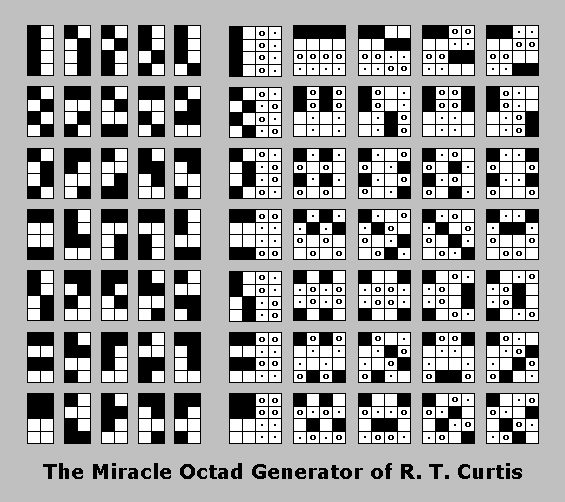
The Miracle Octad Generator (MOG) of R. T. Curtis

Sunday, January 5, 2025

Klein Quadric Octad Generator

Filed under: General — Tags: , — m759 @ 1:23 pm

Friday, July 5, 2024

De Bruyn on the Klein Quadric

Filed under: General — Tags: , , , , — m759 @ 10:31 pm

— De Bruyn, Bart. “Quadratic Sets on the Klein Quadric.”
JOURNAL OF COMBINATORIAL THEORY SERIES A,
vol. 190, 2022, doi:10.1016/j.jcta.2022.105635.

Related material —

Log24 on Wednesday, July 3, 2024: "The Nutshell Miracle" . . .

In particular, within that post, my own 2019 "nutshell" diagram of PG(5,2):

PG(5,2)

Wednesday, December 11, 2019

Klein Quadric

Filed under: General — Tags: , , — m759 @ 1:06 am

The architecture of the recent post 
Geometry of 6 and 8 is in part
a reference to the Klein quadric.

Friday, September 26, 2025

On the Klein Correspondence in Finite Geometry

Filed under: General — Tags: , , , , — m759 @ 1:04 am

Illustration using Cullinane's four-color decomposition theorem —

" … fare forward, voyager . . . ." — T. S. Eliot

Sunday, September 21, 2025

Klein-Space Grok

Filed under: General — Tags: , , , — m759 @ 10:38 pm

Thursday, January 9, 2025

Grok 2 on the MOG and the Klein Correspondence

Filed under: General — Tags: , , , — m759 @ 1:04 pm

Related illustration —

The Miracle Octad Generator (MOG) of R. T. Curtis

— Transcription —

Grok 2 on Klein correspondence and MOG — 9 Jan. 2025
______________________________________________________________

Prompt:

How is the Klein correspondence related to the Miracle Octad Generator?

Grok 2 response (with citations and links removed):

The Klein correspondence is closely related to the Miracle Octad Generator (MOG) through the mathematical structure they both engage with, particularly in the context of finite geometry and combinatorics.

Klein Correspondence: This refers to a mathematical framework that establishes a correspondence between points and lines in a projective space. Specifically, in the context of the MOG, it relates to the geometry of PG(3,2), the three-dimensional projective space over the field with two elements. The Klein correspondence, in this context, essentially connects the combinatorial aspects of partitions of an 8-set to the geometric structure of lines in PG(3,2).

Miracle Octad Generator (MOG): Introduced by R.T. Curtis, the MOG is a tool used in the study of the Mathieu group M24, the binary Golay code, and related structures like the Steiner system S(5,8,24). It consists of a 4×6 array where the positions are used to construct octads (sets of 8 elements) from given sets of 5 elements, reflecting the structure of the Steiner system.

Relation Between Klein Correspondence and MOG:

    Combinatorial and Geometric Link: The MOG uses the Klein correspondence to map partitions of an 8-set (into two 4-sets) to 4 parallel affine planes within PG(3,2). This mapping is natural and symmetrical, which is crucial for the MOG's functionality. The 35 partitions of an 8-set correspond to the 35 lines in PG(3,2), and this correspondence helps in understanding how to generate and visualize octads within the MOG framework.

    Structural Insight: The Klein correspondence provides a way to see how the MOG's method of generating octads can be understood geometrically. This insight is vital for exploring the symmetry and subgroup structure of M24, as the MOG's layout preserves these symmetries.

Thus, the Klein correspondence serves as a foundational link that allows the MOG to operate by translating combinatorial problems into geometric ones, facilitating the study of complex mathematical structures like the Mathieu groups and Steiner systems.

Thursday, June 28, 2018

Eine Kleine Nachtmusik

Filed under: General — Tags: — m759 @ 1:00 am

See  Klein Quartic  and  Klein Quadric.

Saturday, November 7, 2026

Combinatorial Partitions and Finite Geometry

Filed under: General — Tags: — m759 @ 6:03 pm

From Gemini Notebooks' "Diamond Theory" this evening —

The provided texts explore the fascinating intersection of finite geometry, combinatorics, and group theory, focusing heavily on the research of Steven H. Cullinane and related mathematical structures. A recurring theme is the deep correspondence between combinatorial partitions—such as those of an 8-set into four 2-sets or 4-sets—and the geometric properties of finite projective spaces like PG(3,2) and the Klein quadric. This structural harmony extends to R.T. Curtis’s Miracle Octad Generator (MOG), which connects these geometric configurations to the Steiner system S(5,8,24) and the sporadic Mathieu group M24. Furthermore, the sources examine algebraic and visual representations of these symmetries, including affine groups like AGL(4,2), orthogonal groups, Latin-square orthogonality, and grid-based models of Boolean logic. Ultimately, these mathematical frameworks bridge abstract algebraic structures with tangible visual designs, revealing a profound unity underlying discrete geometry, coding theory, and art.

Beyond the Yellow Brick Road

Filed under: General — m759 @ 9:49 am

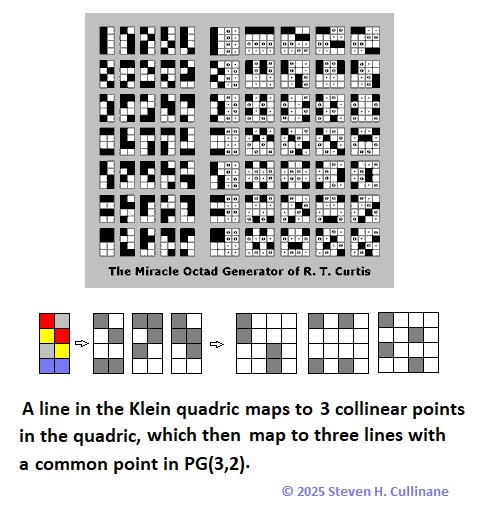
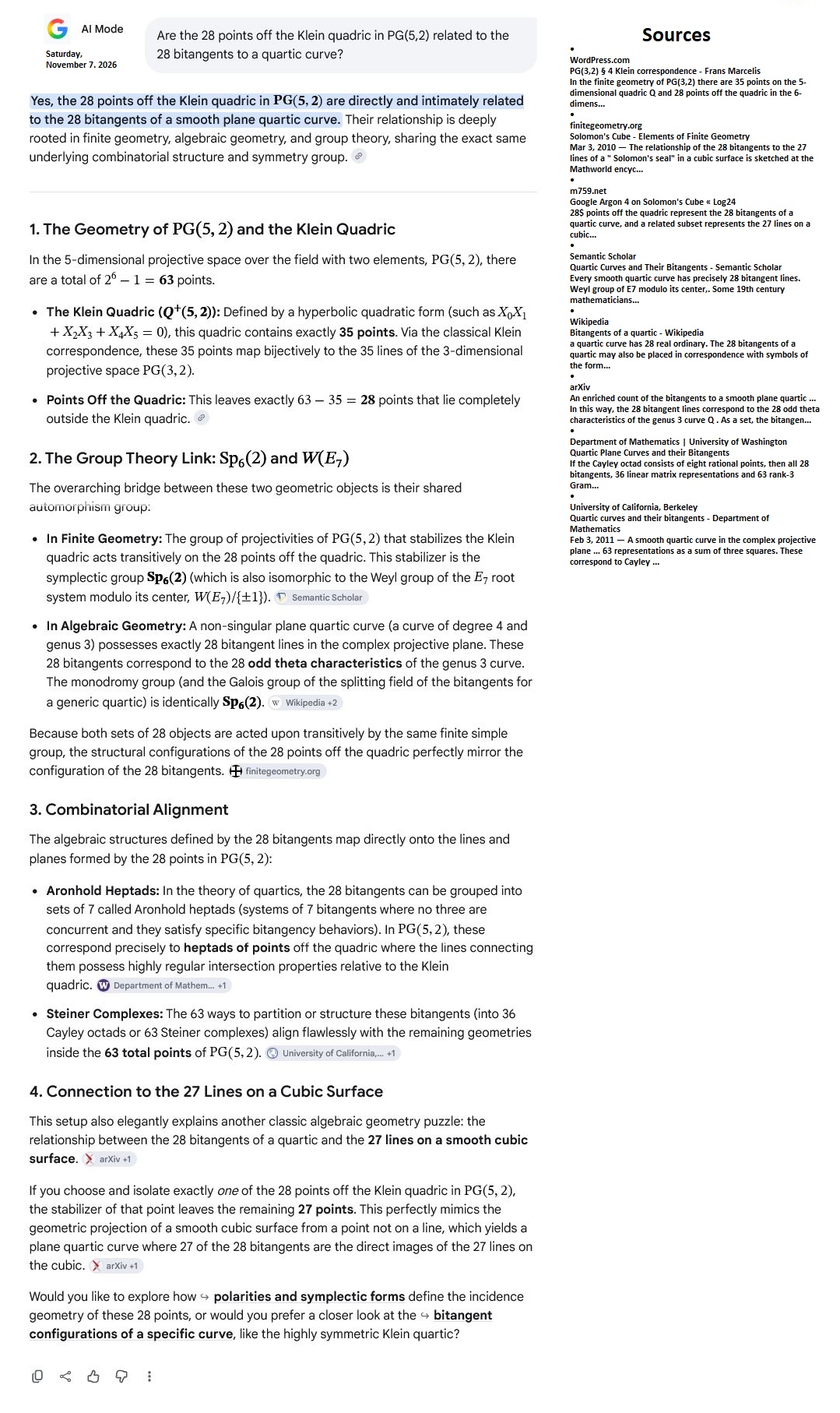
These 28 points off the Klein quadric in PG(5,2) are pictured
at left in the illustration below.

The Klein quadric as background for the
Miracle Octad Generator of R. T. Curtis —

The Klein quadric, PG(5,2), and the 'bricks' of the Miracle Octad Generator

Friday, November 6, 2026

Lyrics Games:
Shallow Blue

Filed under: General — Tags: , , — m759 @ 1:19 pm

The Klein quadric, PG(5,2), and the 'bricks' of the Miracle Octad Generator

Saturday, October 31, 2026

History of Mathematics (Background for October 12, 2026)

Filed under: General — Tags: , , , — m759 @ 9:30 am

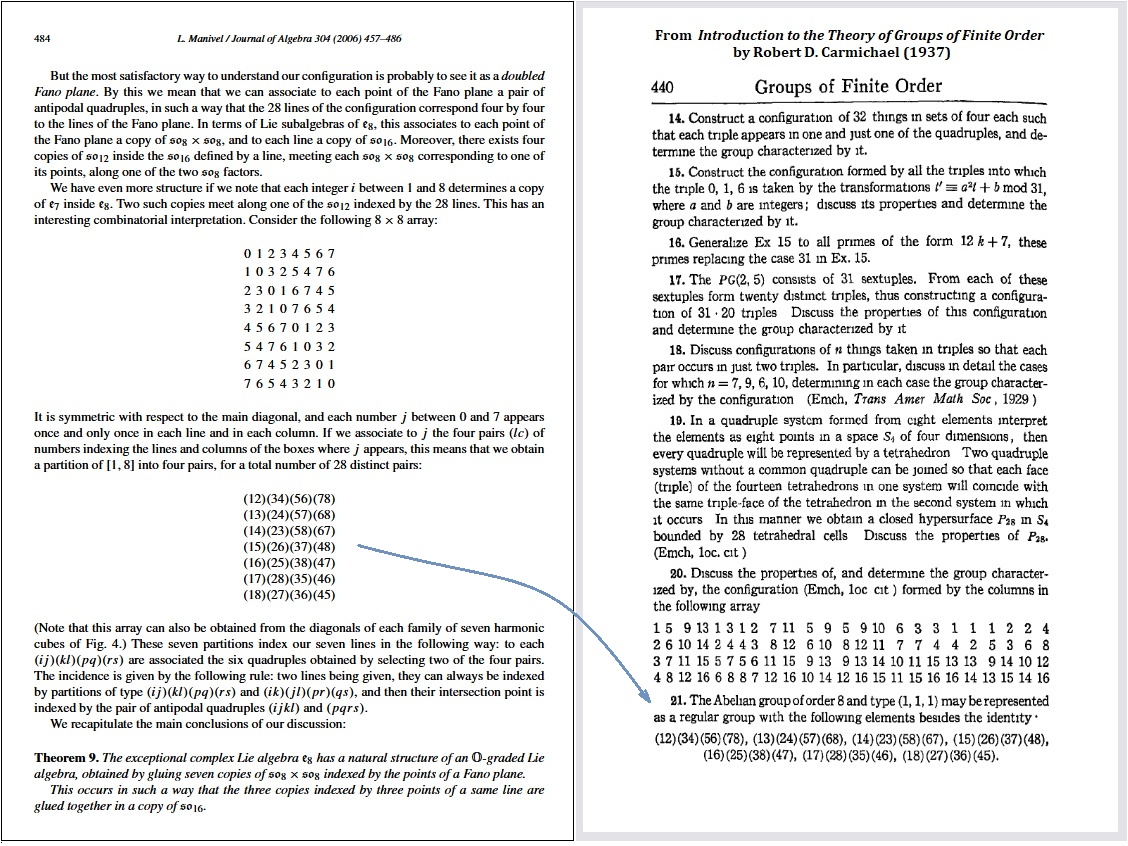
Click to enlarge:
261031-Manivel-Configurations_of_Lines-2006-p484-and-Carmichael-1937-p440.jpg

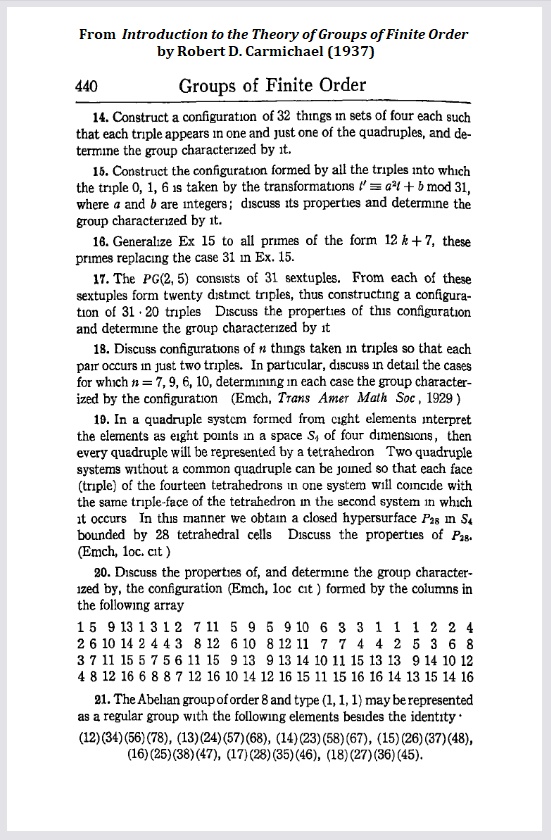
From an October 12 Log24 post on the above Carmichael page . . .

Somewhat less abstract . . . A pictured  plane — not group —whose lines
correspond to the seven 8-set partitions in Carmichael's exercise 21 above —

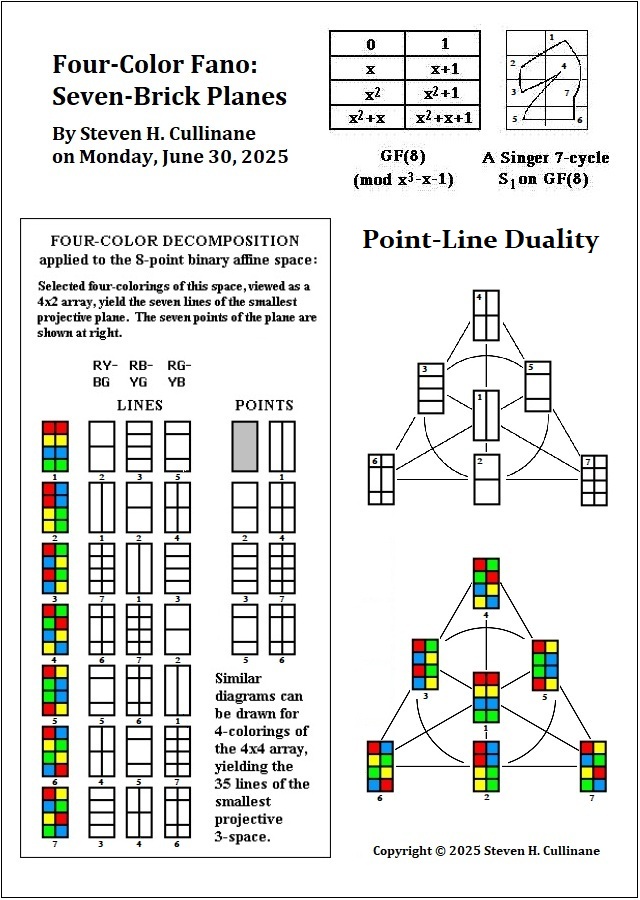
The seven four-colored boxes are lines  in the Klein quadric over GF(2), 
and are the seven lines of a plane  in PG(5,2).

Thursday, October 29, 2026

On Theta Characteristics over GF(2)

Filed under: General — Tags: — m759 @ 12:48 pm

Markdown version for input to AI . . .

Theta Characteristics and the Klein Quadric over GF(2)
Search result, Google AI Mode, Oct. 29, 2026

https://www.google.com/search?q=theta+characteristics+and+the+klein+quadric+over+gf(2)

The relationship between theta characteristics on an algebraic curve of genus \(g\) and quadratic forms over \(\mathbb{F}_{2}\) (or \(\text{GF}(2)\)) is a cornerstone of finite geometry and algebraic curves. When we specify the genus to be \(g=3\)—such as for the famous smooth plane quartic known as the Klein Quartic—the underlying space of quadratic forms naturally aligns with the geometry of the Klein Quadric. [1] (https://www.mathematik.hu-berlin.de/~farkas/milan.pdf), [2] (https://arxiv.org/pdf/2403.19599)

1. Theta Characteristics as Quadratic Forms over \(\text{GF}(2)\)

A theta characteristic on a smooth projective curve \(C\) of genus \(g\) is a line bundle \(\theta \) that acts as a "square root" of the canonical bundle \(K_{C}\). [1] (https://arxiv.org/html/1201.2557v3), [2] (https://arxiv.org/pdf/2403.19599)
• The Torsor Structure: The set of all theta characteristics, \(\text{Th}(C)\), is an affine space (a torsor) over the group of \(2\)-torsion points of the Jacobian, \(J[2] \cong \mathbb{F}_2^{2g}\). [1] (https://rigtriv.wordpress.com/2010/11/03/theta-characteristics-and-quadrics-in-characteristic-two/), [2] (https://arxiv.org/html/1201.2557v3)
• The Symplectic Form: The Jacobian \(J[2]\) possesses a natural non-degenerate, skew-symmetric bilinear form \(\langle \cdot, \cdot \rangle\) given by the Weil pairing. [1] (https://arxiv.org/html/1201.2557v3)
• The Quadratic Refinement: Following the insights of Coble and Mumford, each theta characteristic \(\theta \) uniquely defines a quadratic form \(q_\theta: \mathbb{F}_2^{2g} \to \mathbb{F}_2\) whose polarization evaluates to the Weil pairing: [1] (https://www.mathematik.hu-berlin.de/~farkas/milan.pdf), [2] (https://arxiv.org/html/1201.2557v3)
\(q_{\theta }(x+y)=q_{\theta }(x)+q_{\theta }(y)+\langle x,y\rangle \)
The parity (even or odd) of the theta characteristic matches the Arf invariant of its corresponding quadratic form. For a general genus \(g\), the total number of theta characteristics is \(2^{2g}\): [1] (https://rigtriv.wordpress.com/2010/11/03/theta-characteristics-and-quadrics-in-characteristic-two/)
• Even theta characteristics: \(2^{g-1}(2^g + 1)\)
• Odd theta characteristics: \(2^{g-1}(2^g – 1)\) [1] (https://www.mathematik.hu-berlin.de/~farkas/milan.pdf)

2. The Genus 3 Case (The Klein Quartic Lineage)

For a smooth plane quartic curve (like the Klein quartic), the genus is \(g=3\). Plugging \(g=3\) into our formula yields exactly 64 theta characteristics: [1] (https://arxiv.org/pdf/2403.19599)
• 28 Odd Theta Characteristics: Geometrically, these correspond to the 28 bitangent lines of the quartic curve.
• 36 Even Theta Characteristics: These correspond to vanishing or even-dimensional spaces of global sections (\(h^0(\theta) = 0\) or \(2\)). [1] (https://arxiv.org/pdf/2403.19599), [2] (https://rigtriv.wordpress.com/2010/11/03/theta-characteristics-and-quadrics-in-characteristic-two/)

3. Connection to the Klein Quadric

The term Klein Quadric usually refers specifically to the 4-dimensional hyperbolic quadric \(\mathcal{Q}^+(5, q)\) in the projective space \(\mathbb{P}^{5}\), parameterizing the lines of \(\mathbb{P}^{3}\) via Plücker coordinates.
When we restrict our attention to the finite field \(\mathbb{F}_{2}\), the interplay between \(\mathcal{Q}^+(5, 2)\) and \(g=3\) theta characteristics becomes beautifully explicit:

Concept    Symplectic Geometry Vector Space (\(V = \mathbb{F}_2^6\))    Projective Geometry (\(\mathbb{P}^5(\mathbb{F}_2)\))
The Base Space    \(J[2] \cong \mathbb{F}_2^6\) (6-dimensional vector space)    \(\mathbb{P}^{5}\) over \(\mathbb{F}_{2}\) (consisting of \(2^6 – 1 = 63\) points)
The Polar Grid    Non-degenerate symplectic form (Weil pairing)    A null polarity defining a special symplectic line geometry
Hyperbolic Quadric    The set of 28 odd quadratic forms forms a hyperbolic quadric \(\mathcal{Q}^+(5, 2)\).    Projectively, this defines a smooth quadric containing 35 points (\(28\) odd forms + the \(7\) non-zero vectors making up its radical/singular configurations).


4. Group Theory and Automorphisms

The automorphism group of the symplectic structure on \(\mathbb{F}_{2}^{6}\) is the symplectic group \(\text{Sp}(6, 2)\), which has an order of \(1,451,520\).
• The subgroup that preserves a chosen quadratic form of a specific parity is an orthogonal group.
• For the 28 odd theta characteristics, the stabilizer group is \(\text{O}^-(6, 2)\), which is isomorphic to the Weyl group of the \(E_{6}\) root system.
• For the 36 even theta characteristics, the stabilizer group is \(\text{O}^+(6, 2)\), which stabilizes the standard hyperbolic Klein Quadric.
Thus, the 64 theta characteristics can be viewed as the outer affine translates of the orthogonal structures defined inside the 6-dimensional symplectic space over \(\text{GF}(2)\). [1] (https://arxiv.org/html/1201.2557v3)
Would you like to explore the explicit combinatorics of the 28 bitangents (Steiner systems/Azygetic triples), or should we look closer at the Plücker embedding that defines the Klein Quadric?


Google Argon 4 on Solomon’s Cube

Filed under: General — m759 @ 12:37 am

Geometric Models of Solomon's Cube 12:15 AM October 29, 2026
Google AI Studio using Argon 4

Explain how the 4x4x4 cube at http://finitegeometry.org/sc/64/solcube.html is related to the Klein quadric and the Miracle Octad Generator.
 
On Steven H. Cullinane’s website (Finite Geometry / Diamond Theory), the $4 \times 4 \times 4$ cube featured on solcube.html (“Solomon’s Cube”) is linked to the Klein quadric and R. T. Curtis’s Miracle Octad Generator (MOG) through a chain of finite geometries over the two-element field $\mathbb{F}_2 = \text{GF}(2)$.
In short: the $4 \times 4 \times 4$ cube is a geometric model of the 6-dimensional affine space $AG(6,2)$ and the 5-dimensional projective space $PG(5,2)$; the Klein quadric lives inside $PG(5,2)$ and maps via the Klein correspondence to the 3-dimensional projective space $PG(3,2)$; and the Miracle Octad Generator is built from a $4 \times 4$ cross-section of that cube ($AG(4,2)$) paired with an 8-element set governed by the geometry of the Klein quadric.
——————————————————————————–
1. The $4 \times 4 \times 4$ Cube as $AG(6,2)$ and $PG(5,2)$
In Cullinane’s Diamond Theory, square and cubical arrays of cells are used to visualize vector, affine, and projective spaces over $\mathbb{F}_2$:
  • Affine 6-Space ($AG(6,2)$): A $4 \times 4 \times 4$ cube consists of $64$ unit subcubes. By numbering the cells $0$ through $63$ in binary, each subcube is assigned a 6-bit coordinate vector in $\mathbb{F}_2^6$, turning the $4 \times 4 \times 4$ cube into a visual model of the 64-point affine space $AG(6,2)$ (which Cullinane also relates to the 64 hexagrams of the I Ching).
  • The Affine Group $AGL(6,2)$: In the $4 \times 4 \times 4$ case of Cullinane’s Diamond Theorem, simple $S_4$ permutations of parallel $1 \times 4 \times 4$ layers and parallel $2 \times 2 \times 4$ blocks generate the entire affine group $AGL(6,2)$ (comprising $1,290,157,424,640 \approx 1.3\text{ trillion}$ transformations). Every transformation in this group preserves ordinary or color-interchange symmetry in 3D diamond patterns inscribed in the cube.
  • Projective 5-Space ($PG(5,2)$): Over $\mathbb{F}_2$, projective points are simply nonzero vectors (since the only nonzero scalar is $1$). Therefore, removing a single subcube chosen as the origin $(0,0,0,0,0,0)$ leaves $63$ non-origin subcubes, which directly represent the 63 points of the finite projective space $PG(5,2)$. Restricting the cube’s layer permutations to $S_3$ actions that fix the origin cell generates the projective linear group $GL(6,2) \cong PSL(6,2)$ acting on $PG(5,2)$.
——————————————————————————–
2. Connection to the Klein Quadric
On solcube.html, Cullinane contrasts MSRI’s book The Eightfold Way—which focuses on the Klein quartic curve and its 28 bitangents—with a finite-geometry counterpart embedded inside the 63 non-origin cells of the $4 \times 4 \times 4$ cube ($PG(5,2)$):
  • The Klein Quadric in $PG(5,2)$: Inside the 63 points of $PG(5,2)$, the quadratic equation $$X_0 X_1 + X_2 X_3 + X_4 X_5 = 0 \pmod 2$$ cuts out a hyperbolic quadric $Q^+(5,2)$ consisting of 35 points. This 35-point surface is the finite Klein quadric (while the remaining $63 – 35 = 28$ points off the quadric represent the 28 bitangents of a quartic curve, and a related subset represents the 27 lines on a cubic surface).
  • The Klein Correspondence: By the classical Klein correspondence (analyzed over $\mathbb{F}_2$ by G. M. Conwell in 1910 and W. L. Edge in 1954), there is a canonical bijection between:

    • The 35 points of the Klein quadric in $PG(5,2)$, and
    • The 35 lines of the 3-dimensional projective space $PG(3,2)$. (Under this correspondence, the 15 points and 15 planes of $PG(3,2)$ map to the two families of 15 projective planes—$\alpha$-planes and $\beta$-planes—lying entirely on the Klein quadric.

    Conwell’s 8 Heptads and $A_8 \cong GL(4,2)$: As Conwell (1910) showed, the 28 points of $PG(5,2)$ lying outside the Klein quadric contain 8 "heptads" (sets of 7 points, any two sharing a single point off the quadric, corresponding to 8 heptads of linear complexes in $PG(3,2)$). The symmetries of the Klein quadric permute these 8 heptads, providing a geometric proof of the exceptional group isomorphisms: $$O^+(6,2) \cong S_8 \quad \text{and} \quad PSL(4,2) \cong GL(4,2) \cong A_8$$

——————————————————————————–
 
3. Connection to the Miracle Octad Generator (MOG)
R. T. Curtis’s Miracle Octad Generator (MOG) is a combinatorial and geometric device used to find the 759 octads of the Steiner system $S(5,8,24)$ and to study its automorphism group, the sporadic simple Mathieu group $M_{24}$ (as well as the extended binary Golay code and the Leech lattice).
The $4 \times 4 \times 4$ cube and the Klein quadric connect to the MOG in two ways:
A. A $4 \times 4$ Layer of the Cube Forms Two-Thirds of the MOG
In its standard $4 \times 6$ array representation, the 24 points of the MOG are split into a $4 \times 2$ brick (8 points) on the left and a $4 \times 4$ square (16 points) on the right:
  • This $4 \times 4$ square is a single $1 \times 4 \times 4$ cross-section of the $4 \times 4 \times 4$ cube, modeling the 16-point affine 4-space $AG(4,2)$.
  • In the 2D ($4 \times 4$) case of Cullinane’s Diamond Theorem, applying $AGL(4,2)$ (generated by row, column, and $2 \times 2$ quadrant permutations) to a 4-diamond pattern yields 35 distinct geometric structures.
  • Algebraically, these 35 structures are the 35 parallelisms of $AG(4,2)$ (ways to partition the $4 \times 4$ square into four parallel 4-point affine planes, which Curtis called "special tetrads").
  • Projectively, taking the "hyperplane at infinity" of $AG(4,2)$ turns these 35 parallelisms into the 35 lines of $PG(3,2)$—which, via the Klein correspondence, are the 35 points of the Klein quadric inside the $4 \times 4 \times 4$ cube’s $PG(5,2)$.
B. Conwell’s Pairing via the Klein Quadric Is the Original MOG
As Cullinane points out in his notes (Generating the Octad Generator and The Miracle Octad Generator), Curtis’s original 1976 paper did not define the MOG merely as an empty $4 \times 6$ grid, but as a visual lookup table illustrating an incidence-preserving bijection between two sets of size 35:
  1. The 35 partitions of an 8-set into two 4-sets (represented in the $4 \times 2$ left brick of the MOG, and geometrically realized by Conwell’s 8 heptads associated with the Klein quadric in $PG(5,2)$).
  2. The 35 partitions of the $4 \times 4$ square ($AG(4,2)$) into four parallel affine planes (corresponding to the 35 lines of $PG(3,2)$ and the 35 points of the Klein quadric).
This exact bijection was first described (without diagrams) by Conwell in 1910 using the Klein quadric in $PG(5,2)$. In $M_{24}$, the subgroup that stabilizes a fixed octad (the $4 \times 2$ brick) is the semidirect product $2^4 : A_8 \cong AGL(4,2)$. Because $GL(4,2) \cong A_8$ (via the Klein quadric), every linear transformation of the $4 \times 4$ square ($AG(4,2)$) simultaneously induces a matching even permutation on the 8 points of the $4 \times 2$ brick, allowing the MOG to construct $M_{24}$ directly from the finite geometry of the square and cube.
——————————————————————————– |
 
Summary Dictionary of the Relationships
Geometric / Combinatorial Object
Finite Space / Group
Role in the Chain
$4 \times 4 \times 4$ Cube ("Solomon's Cube")
$AG(6,2)$ (64 points)<br>Group: $AGL(6,2)$
Visualizes 6D binary affine space; layer/block permutations preserve 3D diamond symmetries.
$4 \times 4 \times 4$ Cube minus Origin
$PG(5,2)$ (63 points)<br>Group: $GL(6,2)$
The 63 non-origin subcubes form 5D binary projective space, home of the Klein quadric.
Klein Quadric $Q^+(5,2)$
35 points in $PG(5,2)$<br>Group: $O^+(6,2) \cong S_8$
Represents the 35 lines of $PG(3,2)$ via the Klein correspondence; determines 8 heptads in the 28 exterior points, yielding $GL(4,2) \cong A_8$.
$4 \times 4$ Square (One layer of the cube)
$AG(4,2)$ (16 points)<br>Group: $AGL(4,2) \cong 2^4:A_8$
Forms two-thirds of the $4 \times 6$ MOG array; its 35 Diamond-Theorem patterns (parallelisms) correspond to the 35 lines of $PG(3,2)$ and 35 points of the Klein quadric.
Miracle Octad Generator (MOG)
$8 + 16 = 24$ points<br>Group: $M_{24}$
Pairs the 35 partitions of an 8-set (Conwell's 8 heptads from the Klein quadric) with the 35 plane-partitions of the $4 \times 4$ square to generate the 759 octads of $S(5,8,24)$.

Saturday, October 24, 2026

The Isomorphism Game

Filed under: General — Tags: , — m759 @ 3:25 am

Plan A —

"After running Google DeepMind, he recently took on the job of Google parent Alphabet’s chief scientist and DeepMind’s chair. For his next act, he’s shifting his attention to accelerating scientific progress even more than he already has. 

A few years ago, after the AlphaFold milestone, Hassabis launched a company inside Google called Isomorphic Labs, a nod to the mathematical term describing objects with the same form, shape or structure. 

As the CEO of Isomorphic, he isn’t satisfied by simple progress. When the DeepMind team entered a competition for predicting the shape of proteins, for example, he didn’t just want to win. He wanted to make the entire premise of the competition obsolete. He wanted to beat the game. He still does."

— Ben Cohen in The Wall Street Journal , Oct. 21, 2026

Plan B —

Monday, October 19, 2026

Teaching an AI How to Think . . .
A Philosophy Lesson as a Search Topic

Filed under: General — Tags: , , — m759 @ 1:28 pm

261019-Hillman _Egalitarian_Typologies-and-
Homotopy_Type_Theory-AI_Mode.jpg

Plan C —

Gemini Notebooks . . . Diamond Theory

"The provided sources explore the mathematical intersections of finite geometry, combinatorics, and group theory, focusing heavily on the research and visual models developed by Steven H. Cullinane. A central theme is the Cullinane diamond theorem, which demonstrates how specific binary patterns on 4×4 arrays preserve structured symmetry and map directly to projective spaces such as PG(3,2). Furthermore, the texts examine exceptional isomorphisms—such as between the orthogonal group $O^+(6,2)$ and the symmetric group $S_8$—as well as their deep connections to the Klein quadric, Latin-square orthogonality, and the Miracle Octad Generator (MOG) used to study the Mathieu group $M_{24}$."

— Summary by Gemini AI, October 23, 2026

Friday, October 23, 2026

Turning 16

Filed under: General — Tags: , , — m759 @ 8:13 am

Later . . .

Gemini Notebooks . . . Diamond Theory

"The provided sources explore the mathematical intersections of finite geometry, combinatorics, and group theory, focusing heavily on the research and visual models developed by Steven H. Cullinane. A central theme is the Cullinane diamond theorem, which demonstrates how specific binary patterns on 4×4 arrays preserve structured symmetry and map directly to projective spaces such as PG(3,2). Furthermore, the texts examine exceptional isomorphisms—such as between the orthogonal group $O^+(6,2)$ and the symmetric group $S_8$—as well as their deep connections to the Klein quadric, Latin-square orthogonality, and the Miracle Octad Generator (MOG) used to study the Mathieu group $M_{24}$."

— Summary by Gemini AI, October 23, 2026

Wednesday, October 14, 2026

Gemini 4 on Brick Space Partitions

Filed under: General — Tags: , , , — m759 @ 12:22 am

# Gemini 4 on 105 8-set partitions and the Klein Quadric in PG(5,2) … Oct. 14, 2026.

### Question . . . How does the Cullinane decomposition theorem show that the 105 partitions of an 8-set into four 2-sets are essentially the same as the 105 lines in the Klein quadric over the two-element field? 

The connection between the 105 partitions of an 8-set and the 105 lines of the Klein quadric is established by mapping combinatorial structures to finite geometry. Steven H. Cullinane’s **Four-Color Decomposition Theorem** provides the exact algebraic mechanism that unifies them, showing how a single 4-part partition inherently breaks down into three collinear points on the quadric.

Here is how the decomposition theorem proves they are essentially the same mathematical object:

**1. The Geometric Setup (The 35 Points)**
In the finite geometry of $PG(5,2)$ (projective space of 5 dimensions over the 2-element field), the Klein quadric $Q^+(5,2)$ contains exactly 35 points. Under the known symmetries of finite geometry, these 35 points correspond directly to the **35 splits** of an 8-element set—that is, the 35 unique ways to partition an 8-set into two sets of 4 (shape 4|4).

**2. The Combinatorial Setup (The 105 Partitions)**
There are exactly 105 ways to partition an 8-set into four disjoint 2-sets (shape 2|2|2|2). If you visualize the 8-set as a $4 \times 2$ array, one of these partitions can be represented as a **4-coloring** of the array, where each of the four colors is assigned to exactly two cells.

**3. Applying the Cullinane Decomposition Theorem**
Cullinane’s theorem states that any 4-coloring (a function mapping into a 4-set) can be algebraically decomposed into a linear combination of exactly three 2-colorings.

He represents the four colors as the elements of the Galois field $GF(4)$—typically $\{0, 1, a, b\}$. The algebraic decomposition separates the 4-color map into three simplified 2-color maps by pairing complementary colors:

* Pairing $\{0, 1\}$ against $\{a, b\}$
* Pairing $\{0, a\}$ against $\{1, b\}$
* Pairing $\{0, b\}$ against $\{1, a\}$

When applied to the partition of the 8-set (the four 2-sets, let's call them $A, B, C, D$), grouping the colors this way creates exactly three distinct splits of the 8-set into two 4-sets:

* $(A \cup B)$ and $(C \cup D)$
* $(A \cup C)$ and $(B \cup D)$
* $(A \cup D)$ and $(B \cup C)$

**4. Forming the Lines in the Klein Quadric**
Because the 35 splits represent the 35 points on the Klein quadric, the three splits generated by the decomposition theorem represent three specific points on the quadric. In $GF(4)$, the non-zero elements satisfy the equation $1 + a + b = 0$ (modulo 2). Because these three 2-colorings sum to zero in the vector space structure over $GF(2)$, the three corresponding points are linearly dependent and perfectly collinear.

In $PG(5,2)$, a line contains exactly 3 points. The three collinear points generated by Cullinane's decomposition form one totally isotropic line lying completely within the Klein quadric.

By applying this decomposition, every single one of the 105 partitions of the 8-set into four 2-sets uniquely maps to one of the 105 lines on the Klein quadric. The theorem acts as the translation layer, proving that the combinatorial action of coloring an 8-set is structurally isomorphic to the geometric action of drawing lines in $Q^+(5,2)$.

Source guide at the Gemini Notebook Diamond Theory

The provided text explores a fascinating bridge between abstract set arrangements and finite geometry by analyzing the Cullinane Decomposition Theorem. It demonstrates how sorting an eight-element set into four distinct pairs translates into 105 unique lines within a specific multidimensional geometric framework known as the Klein quadric. By applying algebraic rules to color-coded groupings, the theorem successfully converts combinatorial sorting tasks into collinear geometric points. Ultimately, this mathematical bridge reveals that grouping elements and plotting lines are structurally identical concepts operating in different domains.

Monday, October 12, 2026

Planes of Reality … An Abstract Version … in 1937

"We live in a constellation
Of patches and of pitches,
Not in a single world,
In things said well in music,
On the piano and in speech,
As in a page of poetry—
Thinkers without final thoughts
In an always incipient cosmos.
The way, when we climb a mountain,
Vermont throws itself together."

— Wallace Stevens,
    from “July Mountain”

"As in a page . . . ." —

Somewhat less abstract . . . A pictured  plane — not group —whose lines
correspond to the seven 8-set partitions in Carmichael's exercise 21 above —

The seven four-colored boxes are lines  in the Klein quadric over GF(2), 
and are the seven lines of a plane  in PG(5,2).

Thursday, October 8, 2026

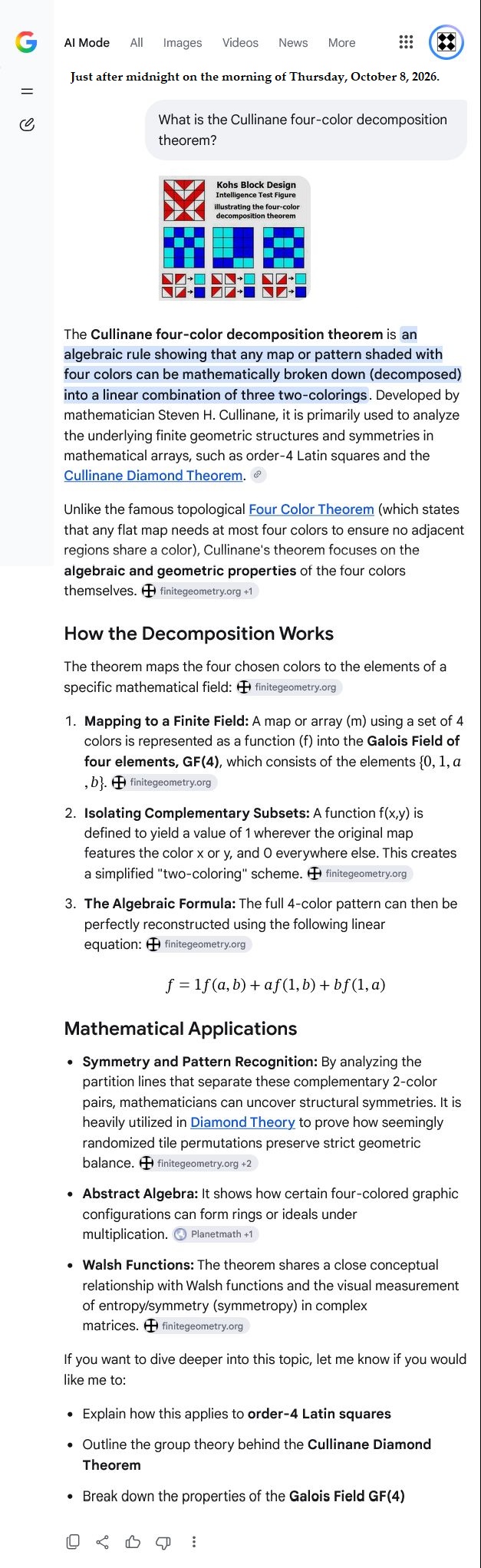
The Cullinane Decomposition Theorem …
A Current AI Version

Filed under: General — Tags: , , — m759 @ 12:14 am

The above summary does not mention the use of this decomposition
theorem to construct, from four-colored "bricks," the 105 lines of the
Klein quadric within the projective space of five dimensions over
the two-element field. That space is the natural home of the 
Klein correspondence, which underlies the Miracle Octad Generator 
(MOG) of R. T. Curtis that is used to study the large Mathieu group and
the "happy family" of sporadic simple groups within the Monster group.

The MOG appears on the cover of a Springer text —

Cover of 'Twelve Sporadic Groups'

HTML version of the Google AI Mode response above . . .

The Cullinane four-color decomposition theorem is an algebraic rule showing that any map or pattern shaded with four colors can be mathematically broken down (decomposed) into a linear combination of three two-colorings. Developed by mathematician Steven H. Cullinane, it is primarily used to analyze the underlying finite geometric structures and symmetries in mathematical arrays, such as order-4 Latin squares and the Cullinane Diamond Theorem. [1, 2, 3]
Unlike the famous topological Four Color Theorem (which states that any flat map needs at most four colors to ensure no adjacent regions share a color), Cullinane's theorem focuses on the algebraic and geometric properties of the four colors themselves. [1, 4]

How the Decomposition Works

The theorem maps the four chosen colors to the elements of a specific mathematical field: [1]
  1. Mapping to a Finite Field: A map or array (m) using a set of 4 colors is represented as a function (f) into the Galois Field of four elements, GF(4), which consists of the elements $\{0, 1, a, b\}$. [1]
  2. Isolating Complementary Subsets: A function f(x,y) is defined to yield a value of 1 wherever the original map features the color x or y, and 0 everywhere else. This creates a simplified "two-coloring" scheme. [1]
  3. The Algebraic Formula: The full 4-color pattern can then be perfectly reconstructed using the following linear equation: [1]

    $$f = 1f(a,b) + af(1,b) + bf(1,a)$$

Mathematical Applications

  • Symmetry and Pattern Recognition: By analyzing the partition lines that separate these complementary 2-color pairs, mathematicians can uncover structural symmetries. It is heavily utilized in Diamond Theory to prove how seemingly randomized tile permutations preserve strict geometric balance. [1, 3, 5]
  • Abstract Algebra: It shows how certain four-colored graphic configurations can form rings or ideals under multiplication. [1, 2]
  • Walsh Functions: The theorem shares a close conceptual relationship with Walsh functions and the visual measurement of entropy/symmetry (symmetropy) in complex matrices. [6]
If you want to dive deeper into this topic, let me know if you would like me to:
  • Explain how this applies to order-4 Latin squares
  • Outline the group theory behind the Cullinane Diamond Theorem
  • Break down the properties of the Galois Field GF(4)

Tuesday, October 6, 2026

Markdown for AI, by Gemini Notebooks

Filed under: General — m759 @ 5:23 pm

Diamond Theory at Gemini Notebooks . . .

# Cullinane Geometries

The provided sources explore the mathematical framework of **finite geometry** and its profound connections to abstract algebra, group theory, and visual design, largely centered on the research of Steven H. Cullinane. A prominent focus is placed on the **Cullinane diamond theorem**, which demonstrates how specific transformations applied to a **4×4 square array** of diagonally divided tiles preserve ordinary or color-interchange symmetries. These visual patterns map directly to the geometric structure of the **projective space PG(3,2)**, revealing that seemingly simple graphical arrangements are underpinned by advanced algebraic systems. Furthermore, the texts examine how these configurations relate to classical structures like the **Klein quadric**, the **Miracle Octad Generator (MOG)**, and the **Mathieu group M24**. Ultimately, the literature illustrates a seamless bridge connecting tangible visual arts, such as traditional quilt patterns, with rigorous mathematical fields including **coding theory, sporadic simple groups, and finite projective spaces**.

Friday, October 2, 2026

Today’s Google Notebooks Summary

Filed under: General — m759 @ 3:26 pm

Google Notebooks occasionally updates its summary of
my work, and today's summary seems clearer than usual.

Cullinane Diamond Theory

The provided sources present an extensive exploration of finite geometry and Diamond Theory, primarily examining the research and visual models developed by mathematician Steven H. Cullinane. At the heart of these texts is the Cullinane diamond theorem, which demonstrates how specific transformations applied to a 4×4 array of diagonally divided tiles consistently preserve fundamental structural symmetries. This geometric framework bridges discrete mathematics with abstract algebra, connecting visual patterns directly to the 35 lines of the three-dimensional projective space PG(3,2) over the Galois field GF(2). Furthermore, the literature highlights deep structural relationships between these square arrays, the Klein quadric, and advanced combinatorial tools such as R.T. Curtis's Miracle Octad Generator (MOG). Ultimately, these interconnected models link elementary visual motifs to complex mathematical domains, including group theory, error-correcting codes, sporadic simple groups like M24, and the geometry of the Leech lattice.

Thursday, October 1, 2026

Road Song

Filed under: General — Tags: — m759 @ 1:04 pm

Tuesday, September 29, 2026

Grok on Heptads

Filed under: General — Tags: — m759 @ 9:28 pm

The statement as written cannot be correct: \(\mathrm{GL}(3,2)\) has order \(168\) and is isomorphic to \(\mathrm{PSL}(2,7)\), while \(A_8\) has order \(20160\). The classical isomorphism that Conwell’s heptads establish is \[ \mathrm{GL}(4,2)\simeq\mathrm{SL}(4,2)\simeq A_8. \] (The two linear groups coincide because the multiplicative group of \(\mathbb{F}_2\) is trivial.) The same construction simultaneously realises \(\mathrm{O}^+(6,2)\simeq S_8\). The Klein correspondence identifies the \(35\) lines of \(\mathrm{PG}(3,2)\) with the points of a hyperbolic quadric \(Q^+(5,2)\) in \(\mathrm{PG}(5,2)\). The complementary set consists of the \(28\) points of \(\mathrm{PG}(5,2)\) that lie off the quadric. A *Conwell heptad* (also called a maximal exterior set) with respect to a fixed copy of \(Q^+(5,2)\) is a set of seven of these exterior points such that the line joining any two of them is skew to the quadric. There are exactly eight such heptads. They satisfy two elementary incidence relations: – any two heptads meet in a unique point, – every exterior point lies in exactly two heptads. Consequently the \(28\) exterior points may be labelled by the \(2\)-subsets of an \(8\)-element set \(\{1,\dots,8\}\). The collineation group of \(\mathrm{PG}(3,2)\) is \(\mathrm{PGL}(4,2)=\mathrm{GL}(4,2)\). Via the Klein correspondence this group becomes the group of linear transformations of the underlying \(6\)-dimensional \(\mathbb{F}_2\)-space that preserve the quadratic form defining \(Q^+(5,2)\). That orthogonal group therefore permutes the eight Conwell heptads. Conwell exhibited six explicit generators of \(\mathrm{GL}(4,2)\) and computed the permutations they induce on the heptads; each generator is a product of two disjoint transpositions (hence even). These six even permutations generate the whole of \(A_8\). Since \[ |\mathrm{GL}(4,2)|=20160=|A_8|, \] the resulting homomorphism \(\mathrm{GL}(4,2)\to A_8\) is an isomorphism. (The same eight objects, viewed as a set of linear complexes in \(\mathrm{PG}(3,2)\), were later reconstructed directly by Edge; both authors used the action on the octad of heptads to identify the groups geometrically.) The labelling of exterior points by pairs also makes the isomorphism visible combinatorially: the lines skew to the quadric become the triples of pairs that form a triangle on eight letters, recovering the well-known model of the \(15_4\)-configuration of \(\mathrm{PG}(3,2)\) inside the complete graph \(K_8\). The statement as written cannot be correct: \(\mathrm{GL}(3,2)\) has order \(168\) and is isomorphic to \(\mathrm{PSL}(2,7)\), while \(A_8\) has order \(20160\). The classical isomorphism that Conwell’s heptads establish is \[ \mathrm{GL}(4,2)\simeq\mathrm{SL}(4,2)\simeq A_8. \] (The two linear groups coincide because the multiplicative group of \(\mathbb{F}_2\) is trivial.) The same construction simultaneously realises \(\mathrm{O}^+(6,2)\simeq S_8\). The Klein correspondence identifies the \(35\) lines of \(\mathrm{PG}(3,2)\) with the points of a hyperbolic quadric \(Q^+(5,2)\) in \(\mathrm{PG}(5,2)\). The complementary set consists of the \(28\) points of \(\mathrm{PG}(5,2)\) that lie off the quadric. A *Conwell heptad* (also called a maximal exterior set) with respect to a fixed copy of \(Q^+(5,2)\) is a set of seven of these exterior points such that the line joining any two of them is skew to the quadric. There are exactly eight such heptads. They satisfy two elementary incidence relations: – any two heptads meet in a unique point, – every exterior point lies in exactly two heptads. Consequently the \(28\) exterior points may be labelled by the \(2\)-subsets of an \(8\)-element set \(\{1,\dots,8\}\). The collineation group of \(\mathrm{PG}(3,2)\) is \(\mathrm{PGL}(4,2)=\mathrm{GL}(4,2)\). Via the Klein correspondence this group becomes the group of linear transformations of the underlying \(6\)-dimensional \(\mathbb{F}_2\)-space that preserve the quadratic form defining \(Q^+(5,2)\). That orthogonal group therefore permutes the eight Conwell heptads. Conwell exhibited six explicit generators of \(\mathrm{GL}(4,2)\) and computed the permutations they induce on the heptads; each generator is a product of two disjoint transpositions (hence even). These six even permutations generate the whole of \(A_8\). Since \[ |\mathrm{GL}(4,2)|=20160=|A_8|, \] the resulting homomorphism \(\mathrm{GL}(4,2)\to A_8\) is an isomorphism. (The same eight objects, viewed as a set of linear complexes in \(\mathrm{PG}(3,2)\), were later reconstructed directly by Edge; both authors used the action on the octad of heptads to identify the groups geometrically.) The labelling of exterior points by pairs also makes the isomorphism visible combinatorially: the lines skew to the quadric become the triples of pairs that form a triangle on eight letters, recovering the well-known model of the \(15_4\)-configuration of \(\mathrm{PG}(3,2)\) inside the complete graph \(K_8\).

## Grok on heptads – by Grok 4.6, Sept. 29. 2026


The Klein correspondence identifies the \(35\) lines of \(\mathrm{PG}(3,2)\) with the points of a hyperbolic quadric \(Q^+(5,2)\) in \(\mathrm{PG}(5,2)\). The complementary set consists of the \(28\) points of \(\mathrm{PG}(5,2)\) that lie off the quadric. A *Conwell heptad* (also called a maximal exterior set) with respect to a fixed copy of \(Q^+(5,2)\) is a set of seven of these exterior points such that the line joining any two of them is skew to the quadric. There are exactly eight such heptads. They satisfy two elementary incidence relations:

– any two heptads meet in a unique point,
– every exterior point lies in exactly two heptads.

Consequently the \(28\) exterior points may be labelled by the \(2\)-subsets of an \(8\)-element set \(\{1,\dots,8\}\).

The collineation group of \(\mathrm{PG}(3,2)\) is \(\mathrm{PGL}(4,2)=\mathrm{GL}(4,2)\). Via the Klein correspondence this group becomes the group of linear transformations of the underlying \(6\)-dimensional \(\mathbb{F}_2\)-space that preserve the quadratic form defining \(Q^+(5,2)\). That orthogonal group therefore permutes the eight Conwell heptads. Conwell exhibited six explicit generators of \(\mathrm{GL}(4,2)\) and computed the permutations they induce on the heptads; each generator is a product of two disjoint transpositions (hence even). These six even permutations generate the whole of \(A_8\). Since
\[
|\mathrm{GL}(4,2)|=20160=|A_8|,
\]
the resulting homomorphism \(\mathrm{GL}(4,2)\to A_8\) is an isomorphism.

(The same eight objects, viewed as a set of linear complexes in \(\mathrm{PG}(3,2)\), were later reconstructed directly by Edge; both authors used the action on the octad of heptads to identify the groups geometrically.)

The labelling of exterior points by pairs also makes the isomorphism visible combinatorially: the lines skew to the quadric become the triples of pairs that form a triangle on eight letters, recovering the well-known model of the \(15_4\)-configuration of \(\mathrm{PG}(3,2)\) inside the complete graph \(K_8\).

## Grok on the Klein correspondence – by Grok 4.6, Sept. 29. 2026

The Klein correspondence is a dictionary between the line geometry of a 3-dimensional projective space and the point geometry of a hyperbolic quadric in 5-dimensional projective space. It is the special case \(k=2\), \(n=4\) of the Plücker embedding of a Grassmannian, and it is the geometric reason the groups \(\mathrm{PGL}(4)\) and \(\mathrm{PO}^+(6)\) are essentially the same. Over \(\mathbb{F}_2\) it is also the stage on which Conwell’s heptads live.

A concrete model of \(\mathrm{PG}(3,2)\): 15 points (red) and 35 lines, drawn as a tetrahedron with midpoints, face-centres and the overall centre. Each of the 15 planes is a Fano plane.

## The algebraic origin

Let \(V\) be a 4-dimensional vector space over a field \(K\). A line of \(\mathrm{PG}(3,K)=\mathbb{P}(V)\) is a 2-dimensional subspace \(U\subset V\). The exterior square \(\bigwedge^2 V\) is 6-dimensional, so
\[
\mathbb{P}(\bigwedge^2 V)\simeq\mathrm{PG}(5,K).
\]
Sending \(U=\langle u,v\rangle\) to the decomposable bivector \([u\wedge v]\) is well-defined (changing basis of \(U\) only rescales the wedge product). The image consists exactly of those points of \(\mathrm{PG}(5,K)\) whose Plücker coordinates
\[
p_{ij}=u_iv_j-u_jv_i
\]
satisfy the single quadratic relation
\[
p_{12}p_{34}+p_{13}p_{42}+p_{14}p_{23}=0
\]
(or an equivalent pairing of the six coordinates). That hypersurface is the **Klein quadric** \(Q^+(5,K)\). It is a non-singular hyperbolic quadric: in suitable coordinates its equation is
\[
X_0X_1+X_2X_3+X_4X_5=0.
\]
The associated bilinear form \(B\) has the geometric meaning
\[
B\bigl(p(\ell),p(m)\bigr)=\det(u,v,w,z)
\]
when \(\ell=\langle u,v\rangle\) and \(m=\langle w,z\rangle\). Hence
\[
\text{two lines of \(\mathrm{PG}(3)\) meet}\quad\Longleftrightarrow\quad\text{their Klein points are orthogonal (the joining line lies on \(Q\))}.
\]
That is the fundamental incidence translation.

## The geometric dictionary

The Klein quadric is ruled by two families of maximal totally singular planes (generators), traditionally called **Latin** (or \(\alpha\)) and **Greek** (or \(\beta\)) planes. They reconstruct \(\mathrm{PG}(3)\) as follows.

| object in \(\mathrm{PG}(3)\) | image on the Klein quadric \(Q^+(5)\) |
|—|—|
| line | point of \(Q\) |
| two intersecting lines | two points of \(Q\) joined by a line of \(Q\) |
| two skew lines | two points of \(Q\) whose joining line is a secant (not on \(Q\)) |
| all lines through a fixed point | a Latin plane on \(Q\) |
| all lines in a fixed plane | a Greek plane on \(Q\) |
| a pencil (all lines through a point in a plane) | a line of \(Q\) |
| a regulus | a conic section of \(Q\) |
| a line spread | an ovoid of \(Q\) |

Two generators of the **same** family always meet in a point; two generators of **opposite** families are either disjoint or meet in a line. A point-plane flag in \(\mathrm{PG}(3)\) therefore appears as a pair of opposite generators intersecting in a line of \(Q\); that line represents the three lines of the flag.

This is also why the Dynkin diagrams \(A_3\) and \(D_3\) are identical: the building of points/lines/planes of \(\mathrm{PG}(3)\) is the same geometry as the building of the two families of generators and the points of \(Q^+(5)\).

## The smallest case: \(\mathrm{PG}(3,2)\) and \(Q^+(5,2)\)

Over \(\mathbb{F}_2\) the numbers become completely explicit.

– \(\mathrm{PG}(3,2)\) has 15 points, 35 lines, 15 planes.
– \(\mathrm{PG}(5,2)\) has 63 points.
– The Klein quadric \(Q^+(5,2)\) has 35 points (one for each line) and two families of 15 planes each.

The 28 points of \(\mathrm{PG}(5,2)\) that lie **off** the quadric, together with the 56 lines that miss the quadric entirely, form a \((28_6,56_3)\)-configuration that is isomorphic to the combinatorial Grassmannian \(G_2(8)\) (the 2-subsets of an 8-set, with triples of pairs that form a triangle as lines). That is where Conwell’s heptads appear.

A **Conwell heptad** is a set of seven exterior points such that the line joining any two of them is skew to \(Q\). There are exactly eight such heptads:

– any two meet in one point,
– every exterior point lies in exactly two heptads.

Labelling the heptads by \(\{1,\dots,8\}\) therefore labels the 28 exterior points by the 2-subsets of an 8-set. The orthogonal group of the Klein quadric permutes the eight heptads. The connected component (or the kernel of the spinor norm, depending on the exact convention) acts as \(A_8\), which is how one sees
\[
\mathrm{SL}(4,2)\simeq A_8,\qquad\mathrm{O}^+(6,2)\simeq S_8
\]
geometrically rather than by counting orders. A correlation of \(\mathrm{PG}(3,2)\) (which swaps points and planes) corresponds to an orthogonal transformation that **swaps** the two families of generators; that is why the full group of collineations and correlations is \(S_8\).

## What the correspondence is good for

Once lines of 3-space are points of a 5-space quadric, many classical constructions become linear-algebraic.

– A **linear line complex** in \(\mathrm{PG}(3)\) is the intersection of \(Q\) with a hyperplane; the special (singular) complexes are those whose hyperplane is tangent to \(Q\).
– A **spread** of \(\mathrm{PG}(3,q)\) (a partition of the point set by \(q^2+1\) lines) maps to an **ovoid** of \(Q^+(5,q)\). Over \(\mathbb{F}_2\) every spread is regular and every ovoid of \(Q^+(5,2)\) is classical.
– A **regulus** becomes a conic on \(Q\); the opposite regulus is the other ruling of the same hyperbolic quadric \(Q^+(3)\) cut out inside \(Q^+(5)\).
– Cameron–Liebler line classes become tight sets on the Klein quadric.

Over \(\mathbb{C}\) the same picture is the compactified space of (complexified) lines, and is the starting point of twistor theory: Minkowski space sits inside the Klein quadric as a real slice, and \(\alpha\)- and \(\beta\)-planes become the two families of totally null planes. The finite geometry over \(\mathbb{F}_2\) is a complete toy model of that incidence structure.

## Group-theoretic shadow

The correspondence intertwines the natural actions:
\[
\mathrm{PGL}(4,K)\;\longrightarrow\;\mathrm{PGO}^+(6,K).
\]
Over finite fields the precise isomorphisms are
\[
\mathrm{PGL}(4,q)\simeq\mathrm{PGO}^+(6,q)
\]
up to the usual issues of determinants, spinor norms and field automorphisms. For \(q=2\) everything collapses to the single isomorphism already used for Conwell’s argument: the collineation group of \(\mathrm{PG}(3,2)\) is \(A_8\), and the full group of collineations and correlations is \(S_8\).

In short: the Klein correspondence is the statement that “the set of lines of a 3-space is itself a 4-dimensional quadric hypersurface”, together with a precise translation of every incidence relation into orthogonality on that quadric. Over \(\mathbb{F}_2\) the 28 points off the quadric organise themselves into eight heptads, and those eight objects are the eight letters of \(A_8\).

Gemini Notebook Source Guide
for the above remarks by Grok 4.6 —

The text explores a fascinating geometric bridge known as the Klein correspondence, which seamlessly translates the lines of a three-dimensional space into the points of a hyperbolic quadric inside a five-dimensional space. By focusing on the specific finite geometry of PG(3,2), the author demonstrates how points situated entirely off this quadric can be neatly arranged into Conwell heptads. These special sets of points interact through precise rules that allow mathematicians to label them using subsets of an eight-element set. Ultimately, this elegant framework reveals a deep structural link, showing how the symmetries of these geometric shapes naturally give rise to the alternating group A_8.


Friday, September 25, 2026

Desargues Square Model

Filed under: General — m759 @ 12:24 pm

From Google Search on Friday, September 25, 2026 —
AI Overview of . . .

Desargues Theorem Cullinane Square Model

The Cullinane Square Model provides a visual, combinatorial framework for understanding the larger Desargues Configuration in the context of finite [Galois geometry](http://finitegeometry.org/sc/20/classical_finite.htm). Developed by independent geometer Steven H. Cullinane, this model uses a grid-based approach to map complex projective space geometries onto a simple square array. [1, 2] 
## 1. The Core Geometric Context

* Desargues' Theorem: In classical projective geometry, [Desargues’ Theorem](https://en.wikipedia.org/wiki/Desargues%27s_theorem) states that two triangles are in perspective from a point (centrally perspective) if and only if they are in perspective from a line (axially perspective). [1, 3] 
* The Classical Configuration: This relationship is typically visualized as a configuration of 10 points and 10 lines (with 3 points on every line and 3 lines meeting at every point). [1] 
* The Galois Extension: In finite fields like $GF(2)$, completely proving the "if and only if" condition of Desargues' Theorem requires an expanded system—the Large Desargues Configuration—which contains 15 points and 20 lines, introducing a necessary third triangle. [4] 

## 2. The Cullinane Square Model Mechanics
Instead of using standard, complex 3D diagrams or intersecting projective planes, Cullinane maps the structure onto a finite geometry square array: [2, 5] 

* Mapping PG(3,2): The 15 points of the projective space $PG(3,2)$ are represented via a $4 \times 4$ square grid (omitting one point, or using the 16 cells to define an affine 4-space vector framework over $GF(2)$). [2] 
* Visualizing Lines: Lines and planes are defined by specific geometric partitions, patterns, or blocks of squares within the grid. [6, 7] 
* The Triangles: The three triangles of the Large Desargues Configuration correspond to distinct, structured sets of blocks or cells within the square array. [4] 
* Simplifying Symmetry: By arranging the 15-point configuration in this manner, the point-line incidences (such as the 20 Rosenhain tetrads) are translated into highly symmetrical, easily scannable matrix-like arrangements rather than a chaotic web of overlapping lines. [4] 

This model serves as an alternative to Burkard Polster's tetrahedral models, bridging the gap between abstract algebra, finite field geometry, and structural visual art. [8, 9] 
To help tailor this explanation, are you studying this from the perspective of abstract algebra/finite fields, looking into its connection to the Miracle Octad Generator (MOG), or trying to generate the visual grid patterns?

[1] [https://finitegeometry.org](http://finitegeometry.org/sc/20/classical_finite.htm)
[2] [https://m759.net](https://m759.net/wordpress/?tag=geometry)
[3] [https://en.wikipedia.org](https://en.wikipedia.org/wiki/Desargues_configuration)
[4] [https://finitegeometry.org](http://finitegeometry.org/sc/20/classical_finite.htm)
[5] [https://www.pinterest.com](https://www.pinterest.com/stevenhcullinane/desargues-via-galois/)
[6] [https://independent.academia.edu](https://independent.academia.edu/StevenHCullinane)
[7] [https://ics.uci.edu](https://ics.uci.edu/~eppstein/junkyard/combinatorial.html)
[8] [https://m759.net](http://m759.net/wordpress/?m=201605)
[9] [https://m759.net](https://m759.net/wordpress/?tag=art-news)

Some Context . . . A Gemini Notebooks ("Diamond Theory") summary
generated this morning —

The Geometry of Symmetries

The provided sources detail the mathematical research of Steven H. Cullinane, specifically focusing on his Diamond Theorem and its intersection with finite geometry. This work explores how 4×4 arrays of two-color tiles can visually represent complex abstract structures, such as the 35 lines of the projective space PG(3,2). Central to these investigations is the Miracle Octad Generator (MOG), a combinatorial tool that links these geometric patterns to the Mathieu group M24 and error-correcting codes. The research further establishes bijections between combinatorial partitions of an 8-set and geometric entities like the Klein quadric. By bridging group theory, linear algebra, and visual art, Cullinane demonstrates that the inherent symmetries in graphic designs are governed by deep algebraic properties. Ultimately, these documents present a unified framework where finite projective spaces serve as the underlying reality for diverse mathematical and aesthetic phenomena.

Wednesday, September 23, 2026

Road Song

Filed under: General — Tags: , — m759 @ 9:14 am

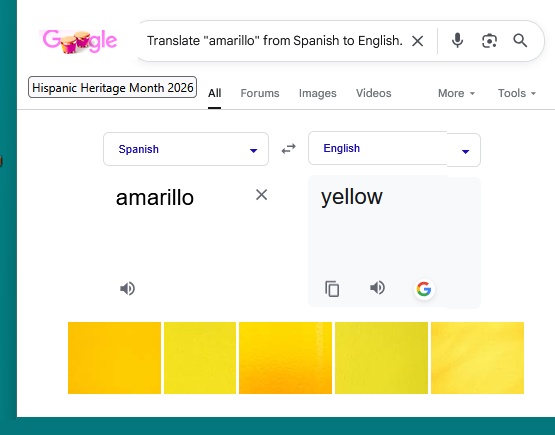
He  always  loved  Amarillo  by  Morning
I  shoulda  taken  that  as  a  warning

— "Choosin'  Texas"  song  lyric

260923-Amarillo-translation-to-English.jpg

Older Posts »

Powered by WordPress