Click to enlarge:
261031-Manivel-Configurations_of_Lines-2006-p484-and-Carmichael-1937-p440.jpg
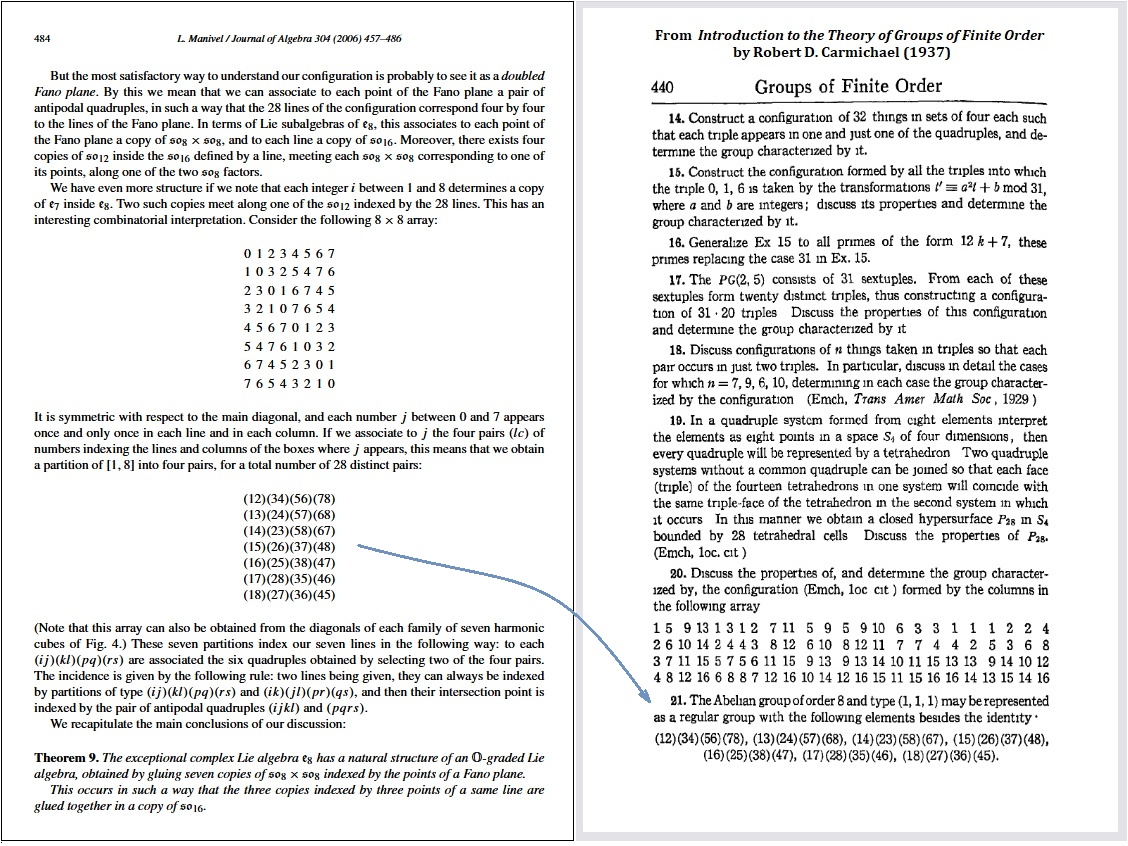
Click to enlarge:
261031-Manivel-Configurations_of_Lines-2006-p484-and-Carmichael-1937-p440.jpg
From an October 12 Log24 post on the above Carmichael page . . .
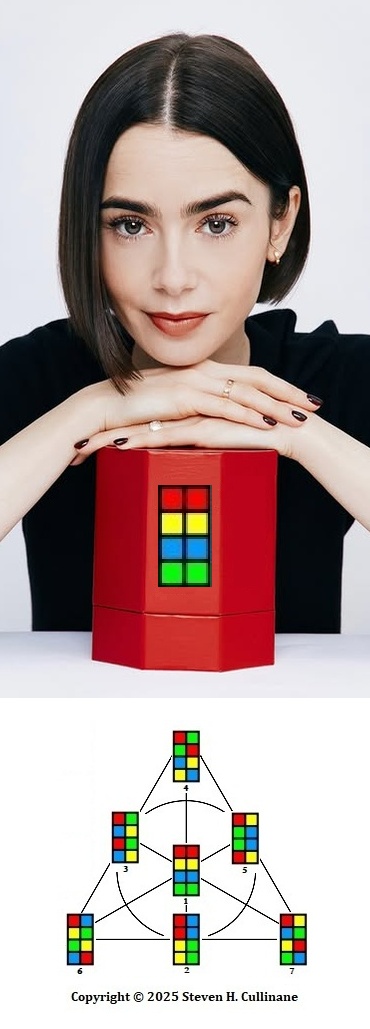
Somewhat less abstract . . . A pictured plane — not group —whose lines
correspond to the seven 8-set partitions in Carmichael's exercise 21 above —
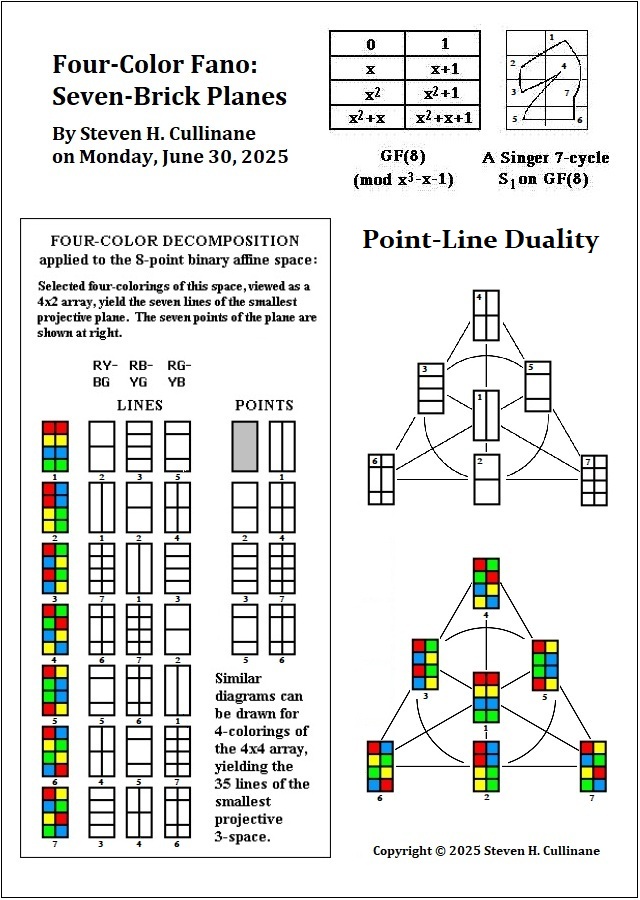
The seven four-colored boxes are lines in the Klein quadric over GF(2),
and are the seven lines of a plane in PG(5,2).

See also this journal on the above premiere date:
January 25, 2011 —
From a Log24 post of October 3, 2008 —
|
On Elke Sommer:
“…Young Elke… studied Erlangen Prize Lecture:
Variations on a Theme of
(Background: |
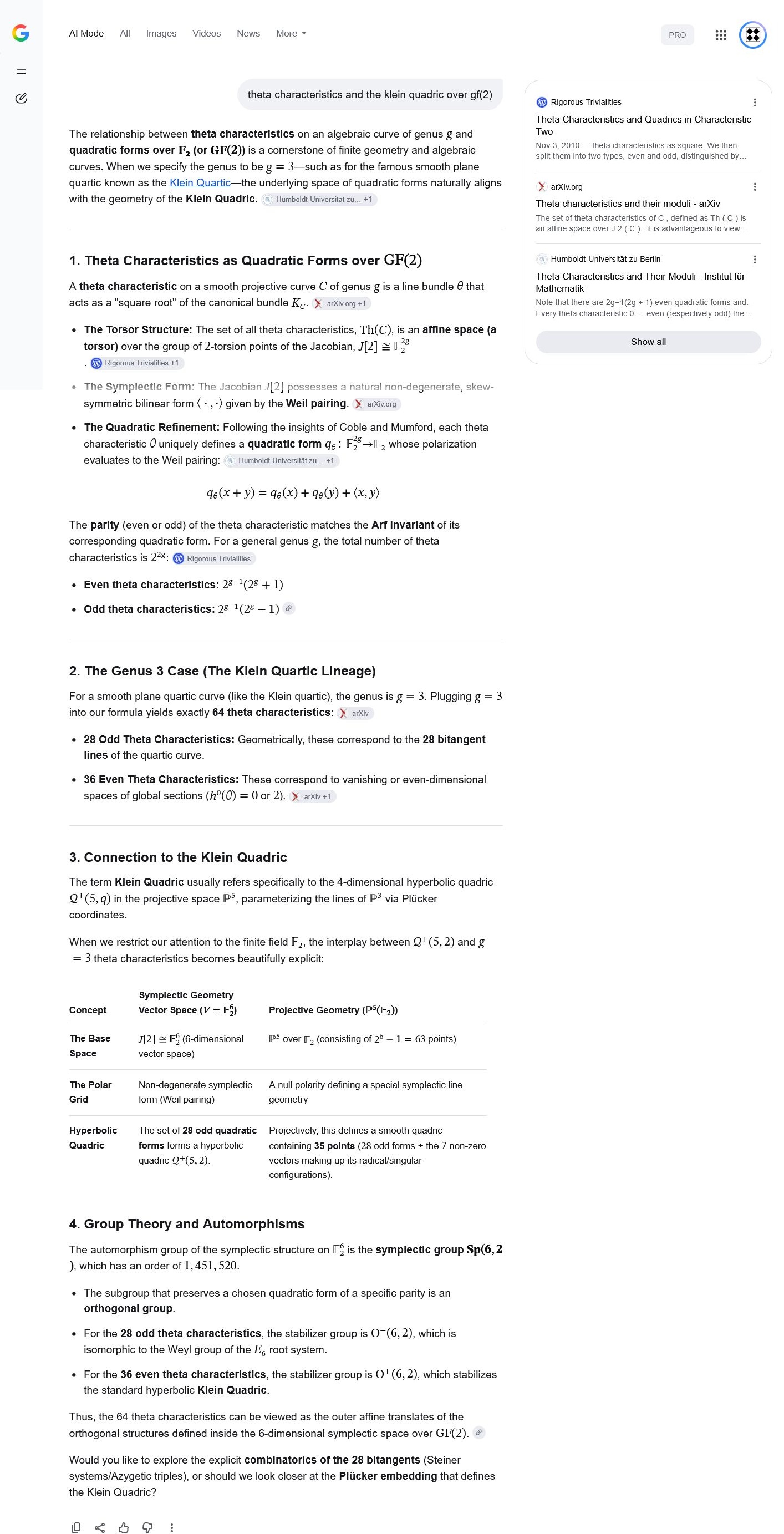
Markdown version for input to AI . . .
Theta Characteristics and the Klein Quadric over GF(2)
Search result, Google AI Mode, Oct. 29, 2026
https://www.google.com/search?q=theta+characteristics+and+the+klein+quadric+over+gf(2)
The relationship between theta characteristics on an algebraic curve of genus \(g\) and quadratic forms over \(\mathbb{F}_{2}\) (or \(\text{GF}(2)\)) is a cornerstone of finite geometry and algebraic curves. When we specify the genus to be \(g=3\)—such as for the famous smooth plane quartic known as the Klein Quartic—the underlying space of quadratic forms naturally aligns with the geometry of the Klein Quadric. [1] (https://www.mathematik.hu-berlin.de/~farkas/milan.pdf), [2] (https://arxiv.org/pdf/2403.19599)
1. Theta Characteristics as Quadratic Forms over \(\text{GF}(2)\)
A theta characteristic on a smooth projective curve \(C\) of genus \(g\) is a line bundle \(\theta \) that acts as a "square root" of the canonical bundle \(K_{C}\). [1] (https://arxiv.org/html/1201.2557v3), [2] (https://arxiv.org/pdf/2403.19599)
• The Torsor Structure: The set of all theta characteristics, \(\text{Th}(C)\), is an affine space (a torsor) over the group of \(2\)-torsion points of the Jacobian, \(J[2] \cong \mathbb{F}_2^{2g}\). [1] (https://rigtriv.wordpress.com/2010/11/03/theta-characteristics-and-quadrics-in-characteristic-two/), [2] (https://arxiv.org/html/1201.2557v3)
• The Symplectic Form: The Jacobian \(J[2]\) possesses a natural non-degenerate, skew-symmetric bilinear form \(\langle \cdot, \cdot \rangle\) given by the Weil pairing. [1] (https://arxiv.org/html/1201.2557v3)
• The Quadratic Refinement: Following the insights of Coble and Mumford, each theta characteristic \(\theta \) uniquely defines a quadratic form \(q_\theta: \mathbb{F}_2^{2g} \to \mathbb{F}_2\) whose polarization evaluates to the Weil pairing: [1] (https://www.mathematik.hu-berlin.de/~farkas/milan.pdf), [2] (https://arxiv.org/html/1201.2557v3)
\(q_{\theta }(x+y)=q_{\theta }(x)+q_{\theta }(y)+\langle x,y\rangle \)
The parity (even or odd) of the theta characteristic matches the Arf invariant of its corresponding quadratic form. For a general genus \(g\), the total number of theta characteristics is \(2^{2g}\): [1] (https://rigtriv.wordpress.com/2010/11/03/theta-characteristics-and-quadrics-in-characteristic-two/)
• Even theta characteristics: \(2^{g-1}(2^g + 1)\)
• Odd theta characteristics: \(2^{g-1}(2^g – 1)\) [1] (https://www.mathematik.hu-berlin.de/~farkas/milan.pdf)
2. The Genus 3 Case (The Klein Quartic Lineage)
For a smooth plane quartic curve (like the Klein quartic), the genus is \(g=3\). Plugging \(g=3\) into our formula yields exactly 64 theta characteristics: [1] (https://arxiv.org/pdf/2403.19599)
• 28 Odd Theta Characteristics: Geometrically, these correspond to the 28 bitangent lines of the quartic curve.
• 36 Even Theta Characteristics: These correspond to vanishing or even-dimensional spaces of global sections (\(h^0(\theta) = 0\) or \(2\)). [1] (https://arxiv.org/pdf/2403.19599), [2] (https://rigtriv.wordpress.com/2010/11/03/theta-characteristics-and-quadrics-in-characteristic-two/)
3. Connection to the Klein Quadric
The term Klein Quadric usually refers specifically to the 4-dimensional hyperbolic quadric \(\mathcal{Q}^+(5, q)\) in the projective space \(\mathbb{P}^{5}\), parameterizing the lines of \(\mathbb{P}^{3}\) via Plücker coordinates.
When we restrict our attention to the finite field \(\mathbb{F}_{2}\), the interplay between \(\mathcal{Q}^+(5, 2)\) and \(g=3\) theta characteristics becomes beautifully explicit:
Concept Symplectic Geometry Vector Space (\(V = \mathbb{F}_2^6\)) Projective Geometry (\(\mathbb{P}^5(\mathbb{F}_2)\))
The Base Space \(J[2] \cong \mathbb{F}_2^6\) (6-dimensional vector space) \(\mathbb{P}^{5}\) over \(\mathbb{F}_{2}\) (consisting of \(2^6 – 1 = 63\) points)
The Polar Grid Non-degenerate symplectic form (Weil pairing) A null polarity defining a special symplectic line geometry
Hyperbolic Quadric The set of 28 odd quadratic forms forms a hyperbolic quadric \(\mathcal{Q}^+(5, 2)\). Projectively, this defines a smooth quadric containing 35 points (\(28\) odd forms + the \(7\) non-zero vectors making up its radical/singular configurations).
4. Group Theory and Automorphisms
The automorphism group of the symplectic structure on \(\mathbb{F}_{2}^{6}\) is the symplectic group \(\text{Sp}(6, 2)\), which has an order of \(1,451,520\).
• The subgroup that preserves a chosen quadratic form of a specific parity is an orthogonal group.
• For the 28 odd theta characteristics, the stabilizer group is \(\text{O}^-(6, 2)\), which is isomorphic to the Weyl group of the \(E_{6}\) root system.
• For the 36 even theta characteristics, the stabilizer group is \(\text{O}^+(6, 2)\), which stabilizes the standard hyperbolic Klein Quadric.
Thus, the 64 theta characteristics can be viewed as the outer affine translates of the orthogonal structures defined inside the 6-dimensional symplectic space over \(\text{GF}(2)\). [1] (https://arxiv.org/html/1201.2557v3)
Would you like to explore the explicit combinatorics of the 28 bitangents (Steiner systems/Azygetic triples), or should we look closer at the Plücker embedding that defines the Klein Quadric?
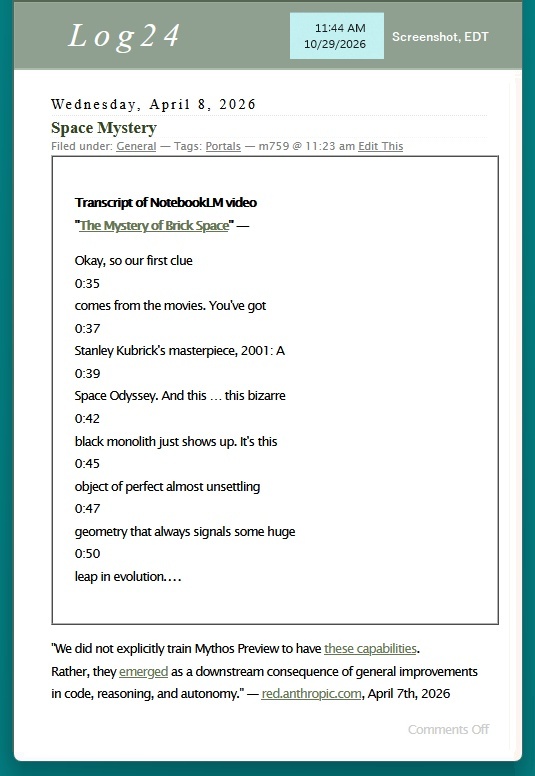
Geometric Models of Solomon's Cube 12:15 AM October 29, 2026
Google AI Studio using Argon 4
solcube.html (“Solomon’s Cube”) is linked to the Klein quadric and R. T. Curtis’s Miracle Octad Generator (MOG) through a chain of finite geometries over the two-element field $\mathbb{F}_2 = \text{GF}(2)$.
solcube.html, Cullinane contrasts MSRI’s book The Eightfold Way—which focuses on the Klein quartic curve and its 28 bitangents—with a finite-geometry counterpart embedded inside the 63 non-origin cells of the $4 \times 4 \times 4$ cube ($PG(5,2)$):
Conwell’s 8 Heptads and $A_8 \cong GL(4,2)$: As Conwell (1910) showed, the 28 points of $PG(5,2)$ lying outside the Klein quadric contain 8 "heptads" (sets of 7 points, any two sharing a single point off the quadric, corresponding to 8 heptads of linear complexes in $PG(3,2)$). The symmetries of the Klein quadric permute these 8 heptads, providing a geometric proof of the exceptional group isomorphisms: $$O^+(6,2) \cong S_8 \quad \text{and} \quad PSL(4,2) \cong GL(4,2) \cong A_8$$
|
Geometric / Combinatorial Object
|
Finite Space / Group
|
Role in the Chain
|
|---|---|---|
|
$4 \times 4 \times 4$ Cube ("Solomon's Cube")
|
$AG(6,2)$ (64 points)<br>Group: $AGL(6,2)$
|
Visualizes 6D binary affine space; layer/block permutations preserve 3D diamond symmetries.
|
|
$4 \times 4 \times 4$ Cube minus Origin
|
$PG(5,2)$ (63 points)<br>Group: $GL(6,2)$
|
The 63 non-origin subcubes form 5D binary projective space, home of the Klein quadric.
|
|
Klein Quadric $Q^+(5,2)$
|
35 points in $PG(5,2)$<br>Group: $O^+(6,2) \cong S_8$
|
Represents the 35 lines of $PG(3,2)$ via the Klein correspondence; determines 8 heptads in the 28 exterior points, yielding $GL(4,2) \cong A_8$.
|
|
$4 \times 4$ Square (One layer of the cube)
|
$AG(4,2)$ (16 points)<br>Group: $AGL(4,2) \cong 2^4:A_8$
|
Forms two-thirds of the $4 \times 6$ MOG array; its 35 Diamond-Theorem patterns (parallelisms) correspond to the 35 lines of $PG(3,2)$ and 35 points of the Klein quadric.
|
|
Miracle Octad Generator (MOG)
|
$8 + 16 = 24$ points<br>Group: $M_{24}$
|
Pairs the 35 partitions of an 8-set (Conwell's 8 heptads from the Klein quadric) with the 35 plane-partitions of the $4 \times 4$ square to generate the 759 octads of $S(5,8,24)$.
|
Remarks on embedding (Log24, March 23, 2012) —
Part I
Review of a new book on linguistics, embedding, and a South American tribe—
"Imagine a linguist from Mars lands on Earth to survey the planet's languages…."
— Chronicle of Higher Education , March 20, 2012
Part II
The Embedding , by Ian Watson (Review of a 1973 novel from Shakespeare's birthday, 2006)
See also . . .

On Theta Characteristics

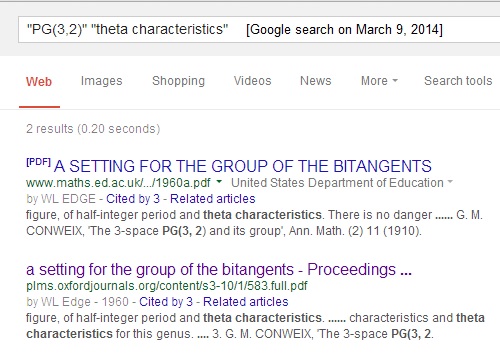
— From Zentralblatt-math.org. Cf. Edge on theta characteristics.


261028-Hexagram_50-The_Cauldron-AI_Mode.jpg

The title is spoken in Coppola's "Megalopolis"
by Julia Cicero. The phrase immediately gains
Cesar Catalina's complete attention.
Related historical fiction . . .
261027-Model_T_Ford-in-Ragtime-by-Doctorow.jpg

"Die Philosophie ist ein Kampf gegen die Verhexung
unsres Verstandes durch die Mittel unserer Sprache."
— Wittgenstein, Philosophical Investigations (1953),
Section 109
|
"… for many 'pure' mathematicians—those who look inward at math’s most theoretical aspects, at its inner beauty and structure, using human creativity, imagination, and logic—AI feels … ambiguous because machines can discover the truths we’re seeking, at the cost of robbing us of the struggle and joy of discovering them ourselves. Pure math is the study of ideal patterns and structures: numbers and shapes, waves and vibrations, order and chaos, symmetry and infinity. There are no perfect circles in nature, only in our minds. Except—and this is eerie—the truths of mathematics also seem to exist outside of human minds. They inhabit a mysterious Platonic realm, casting shadows on our reality." — Steven Strogatz in The Atlantic, Oct. 25, 2026 |
For language modelers —
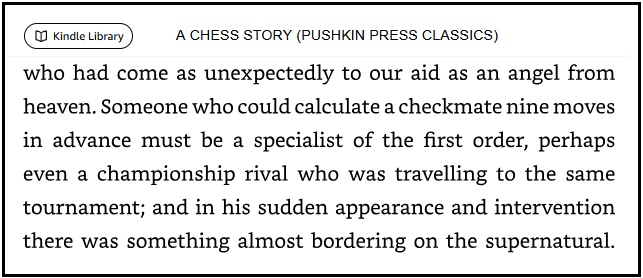
"… the common bond between chess, music, and mathematics
may, finally, be the absence of language."
— George Steiner, Fields of Force: Fischer and Spassky at Reykjavik ,
Viking hardcover, June 1974.
"Whereof one cannot speak, thereof one must be silent"
— Ludwig Wittgenstein
"Shut up, he explained."
— Ring Lardner
Note to an article in today's online New York Times by Fahima Haque —
"A version of this article appears in print on Nov. 1, 2026,
Section F, Page 23 of the New York edition with the headline:
Music That’s Everywhere and Nowhere."
The article is about a ragtime exhibition at the J. P. Morgan
library and museum.

Wikipedia on Morgan in Doctorow's novel Ragtime . . .
"Arch-capitalist financier J. P. Morgan,
pursuing his complex delusions of grandeur,
becomes obsessed with reincarnation and
Egyptian mysticism, and finds an unexpected
kindred spirit in the down-to-earth Henry Ford.
Traveling to Egypt hoping for a vision of his
grand destiny, Morgan only dreams of a past life
as an ordinary peddler"

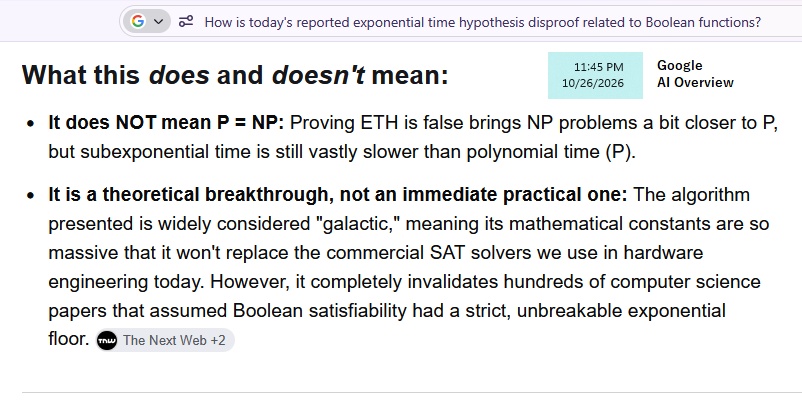
261026-OpenAI-says-Exponential_Time_Hypothesis-is-false.jpg
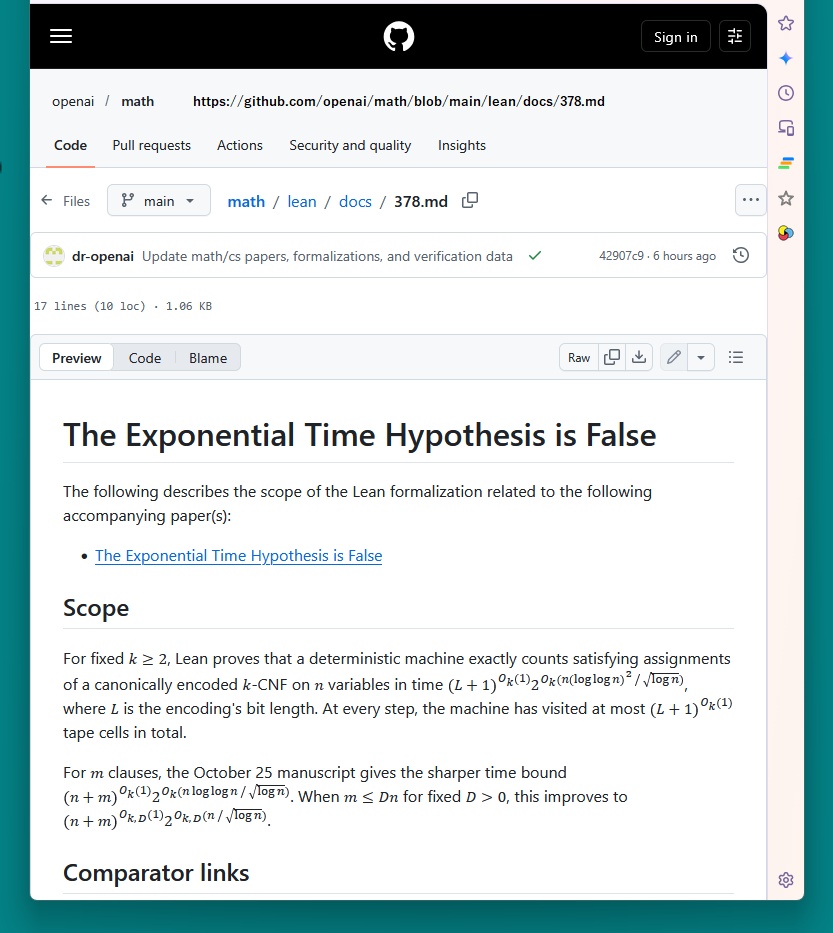
Background . . . OpenAI announcement today.
Scholium from AI Overview . . .
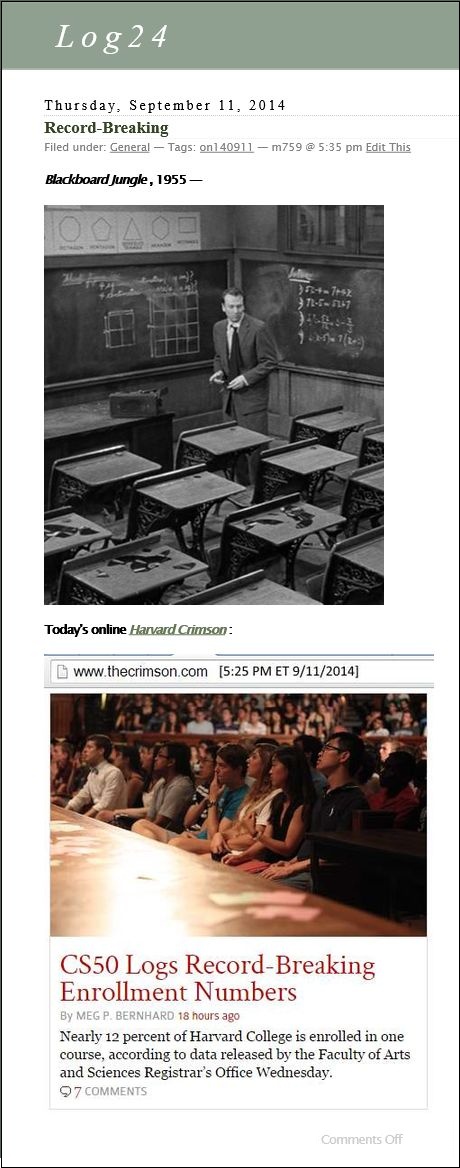

Related meditation on language models, also from April 13, 2016 —

|
". . . users who sense that a high-dimensional vector space still commands a certain degree of reverence"
— "The Sprachgeheimapparat of Dr. Justice," |
"Noah Wyle is reflecting on the legacy of Donnie Darko
ahead of the film’s 25th anniversary on Oct. 26."
See as well . . .
|
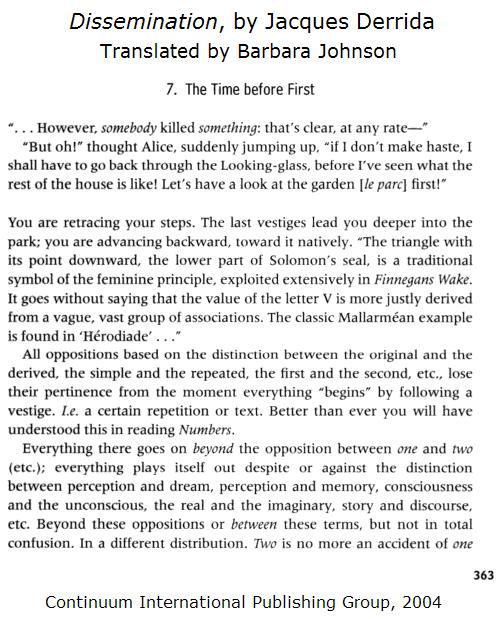
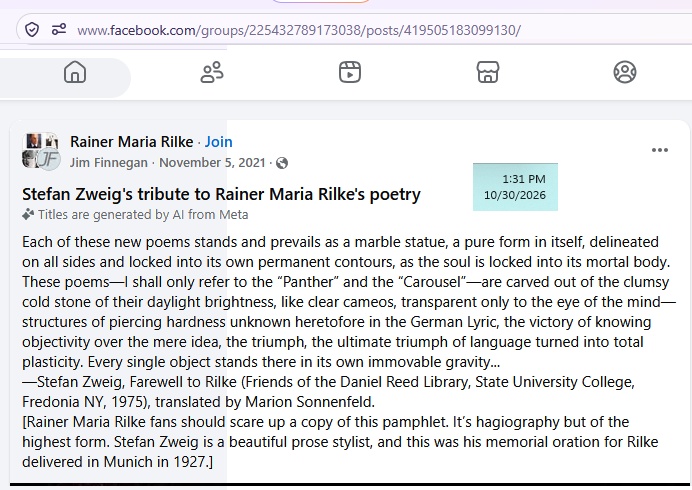
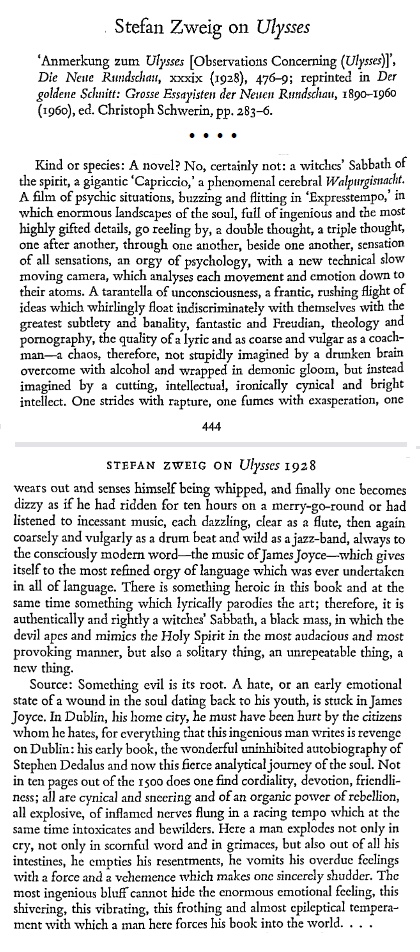
"A film of psychic situations, buzzing and flitting in 'Expresstempo,' in which enormous landscapes of the soul, full of ingenious and the most highly gifted details, go reeling by, a double thought, a triple thought, one after another, through one another, beside one another, sensation of all sensations, an orgy of psychology, with a new technical slow moving camera, which analyses each movement and emotion down to their atoms." — Stefan Zweig in 1928 on James Joyce's Ulysses, translated from "Anmerkung zum Ulysses" in Die Neue Rundschau, xxxix (1928), 476-479. |
Related Merchandise

|
From "Sunday School" (April 17, 2011) . . . A review of a sort of storyteller's MacGuffin — the 3×3 grid. This is … an "artistic focus" that appears to be visually comprehensible but is not as simple as it seems.
The Hesse configuration can serve as more than a sort of Dan Brown MacGuffin. As a post of January 14th [2011] notes, it can (rather fancifullly) illustrate the soul—
" … I feel I understand — Vladimir Nabokov, Pale Fire |
From an Instagram story captioned "An Actor Prepares" —

The Bright Elusive Butterfly Chair of Love
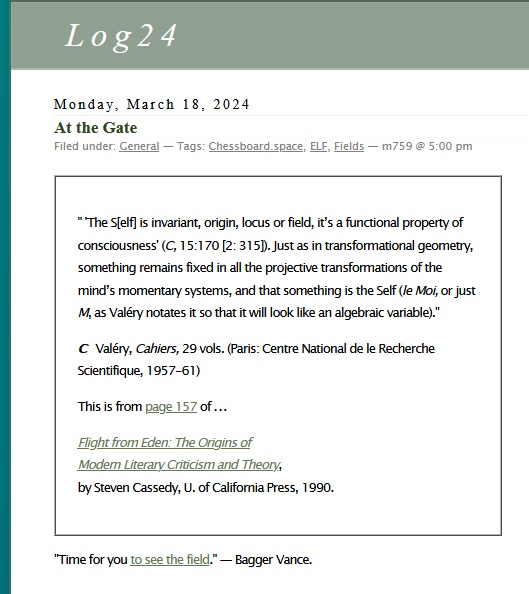
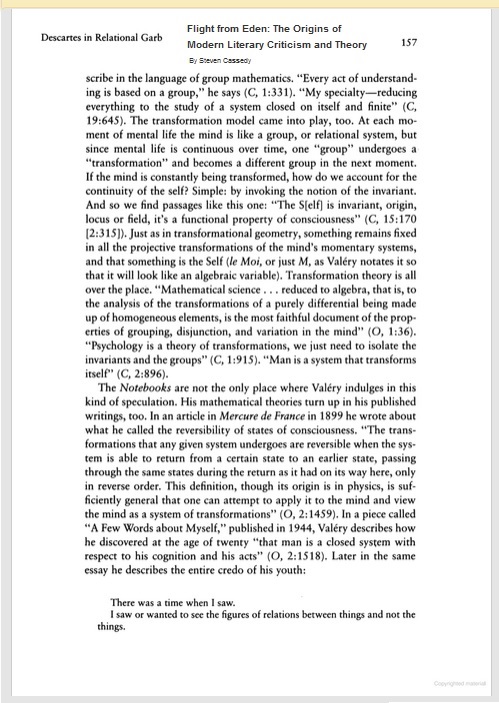
Related entertainment . . .
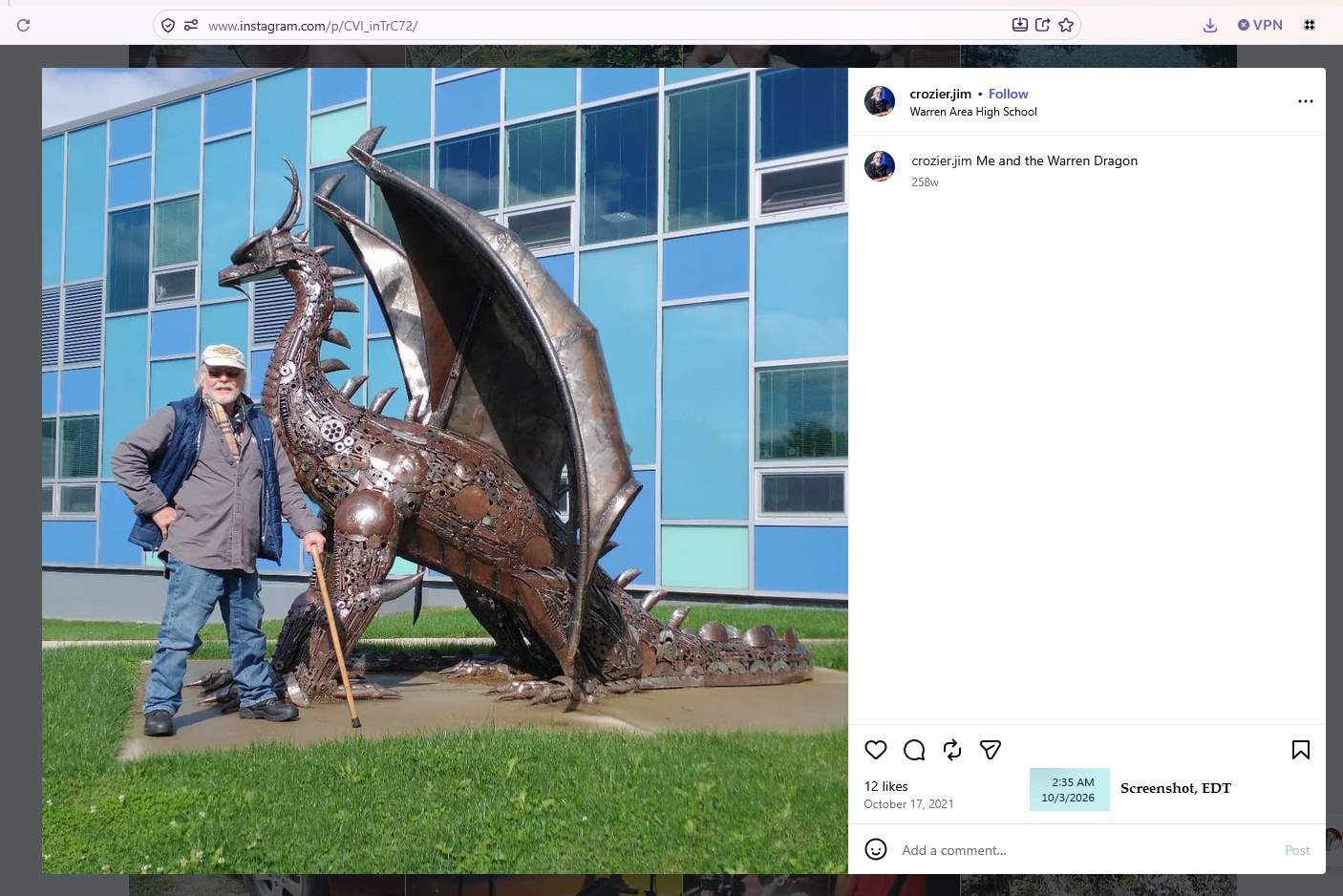
261003-'Touch'-composer-Jim-Crozier-at-Warren-PA-high-school.jpg
Sunday, April 18, 2010
|
|
The Eiger Sanction, by Trevanian –
"Because CII men worked in foreign countries without invitation, and often to the detriment of the established governments, they had no recourse to official protection. Organization men to the core, the CII heads decided that another Division must be established to combat the problem. They relied on their computers to find the ideal man to head the new arm, and the card that survived the final sorting bore the name Yurasis Dragon. In order to bring Mr. Dragon to the United States, it was necessary to absolve him of accusations lodged at the War Crimes Tribunal concerning certain genocidal peccadillos, but CII considered him worth the effort." |
Powered by WordPress