Star Brick

Brick Star

Star Brick
Brick Star
260908-Humanoid-encounter-from-Substack.jpg
260908-Got-her-number-apples-quote-AI-Overview.jpg

By Clay Risen
Thomas S. Hines, an architectural historian whose thorough research, crystalline writing and unending passion for the urban landscape of Los Angeles did much to cement the region’s reputation as a global center for modernist design in the 20th century, died on July 26 in Santa Monica, Calif. He was 89. |
"Throrough, crystalline, unending, global, modernist . . .
stripped-down, rational . . . definitive . . . ."
Related art . . .
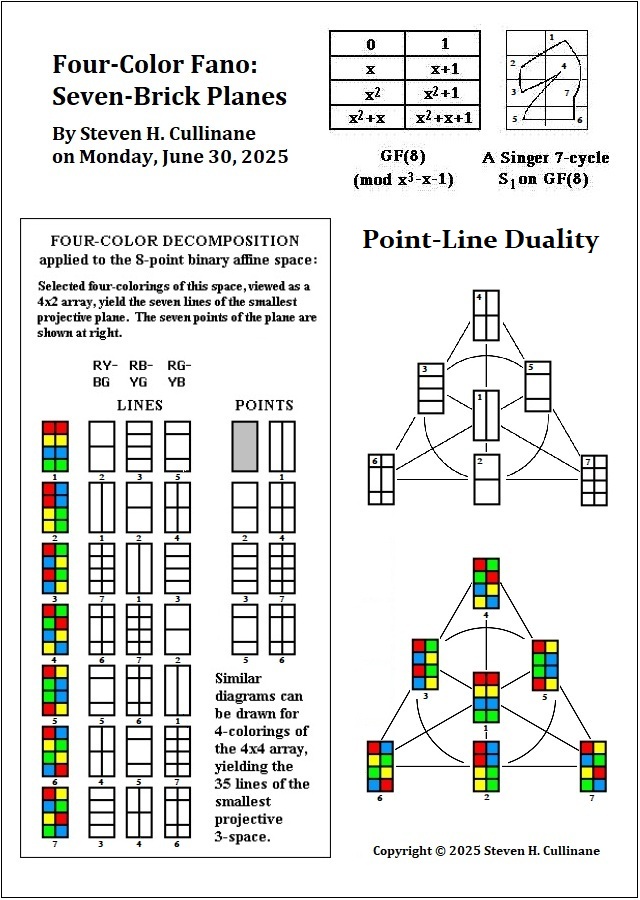
A Cayley superline of the Klein quadric in PG(5,2)
is actually a plane of the quadric. Any such plane can be
pictured as a set of seven partitions of an 8-set into four 2-sets,
with the partitions satisfying certain geometric conditions.
A prototypical example of such a set: the four-colored bricks
numbered 1 through 7 at left in the picture below.
Some will prefer a different architectural approach . . .
260807-Angels-in-the-Architecture-illustrated.jpg

Scholium from Auntie Wow —
A Google AI question recorded here on June 20, 2026 —
"Which aspect of the geometry would you like to explore next?"
A relevant illustration . . .
The authors Taormina and Wendland in the previous post
discussed some mathematics they apparently did not know was
related to a classic 1905 book by R. W. H. T. Hudson, Kummer's
Quartic Surface .
"This famous book is a prototype for the possibility
of explaining and exploring a many-faceted topic of
research, without focussing on general definitions,
formal techniques, or even fancy machinery. In this
regard, the book still stands as a highly recommendable,
unparalleled introduction to Kummer surfaces, as a
permanent source of inspiration and, last but not least,
as an everlasting symbol of mathematical culture."
— Werner Kleinert, Mathematical Reviews ,
as quoted at Amazon.com
Some 4×4 diagrams from that book are highly relevant to the
discussion by Taormina and Wendland of the 4×4 squares within
the 1974 Miracle Octad Generator of R. T. Curtis that were later,
in 1987, described by Curtis as pictures of the vector 4-space over
the two-element Galois field GF(2).
Hudson did not think of his 4×4 diagrams as illustrating a vector space,
but he did use them to picture certain subsets of the 16 cells in each
diagram that he called Rosenhain and Göpel tetrads .
Some related work of my own (click images for related posts)—
Rosenhain tetrads as 20 of the 35 projective lines in PG(3,2)

Göpel tetrads as 15 of the 35 projective lines in PG(3,2)

Related terminology describing the Göpel tetrads above

Powered by WordPress