Ekphrasis: New Brand Day

* Vide log24.com/log/pix26/260810-AI_Overview-scholium-Malibu_Brandy.jpg .
3D Chess on a 4D Board
“The sigil was an eight-limbed asterisk
made of fine dark lines . . . . An X
superimposed on a plus sign.
It looked permanent.”
— Fritz Leiber, “Damnation Morning,”
1959 short story in Changewar
"Yes, you'll be goin' loco
down in Acapulco,
the magic down there
is so strong."
This song is from the 1988 film "Buster."
(Wikipedia: "Buster is a 1988 British
romantic crime comedy-drama
based on events from the Great Train Robbery,
starring Phil Collins….")
For a related religious use of that name —
"Look, Buster, do you want to live?" —
see Fritz Leiber's "Damnation Morning."
Yesterday, January 30, 2024, was Phil Collins's birthday.
For Bird Day . . .
A tweet from Scott Edelman on November 12, 2020 —

This journal on the above tweet date —
Damonizing Your Opponent

Excerpt from Fritz Leiber’s “Damnation Morning,” 1959:
“Time traveling . . . is not quite the good clean boyish fun
it’s cracked up to be . . . ."

The following post suggests the Spiders and Snakes of Fritz Leiber’s
Changewar , a mythology inspired by the hallucinations of delirium tremens .

“The growth of consciousness is everything…
the seed of awareness sending its roots
across space and time. But it can grow in so many ways,
spinning its web from mind to mind like the spider
or burrowing into the unconscious darkness like the snake.
The biggest wars are the wars of thought.”
— Fritz Leiber, “The Oldest Soldier” (1960)
Update of 10 PM Saturday, June 14, 2014:
The first link above now leads to Log24 posts tagged
“Consciousness Growth.” This tag is used only to select
specific posts in this journal. It should not be seen as
related to any material of the sort one can find in
a Web search for “growth of consciousness.”
“…what he was trying to get across was not that he was the Soldier of a Power that was fighting across all of time to change history, but simply that we men were creatures with imaginations and it was our highest duty to try to tell what it was really like to live in other times and places and bodies. Once he said to me, ‘The growth of consciousness is everything… the seed of awareness sending its roots across space and time. But it can grow in so many ways, spinning its web from mind to mind like the spider or burrowing into the unconscious darkness like the snake. The biggest wars are the wars of thought.'”
— Fritz Leiber, “The Oldest Soldier” (1960)

“And that’s the snake.” — Jill Clayburgh in “It’s My Turn” (1980)

Backstory — “For Daedalus,” May 26, 2009.
For a more up-to-date look at Burroway, see a
Chicago Tribune story of March 21, 2014.
See Snakes on a Projective Plane by Andrew Spann (Sept. 26, 2006):

Click image for some related posts.
"…what he was trying to get across was not that he was the Soldier of a Power that was fighting across all of time to change history, but simply that we men were creatures with imaginations and it was our highest duty to try to tell what it was really like to live in other times and places and bodies. Once he said to me, 'The growth of consciousness is everything… the seed of awareness sending its roots across space and time. But it can grow in so many ways, spinning its web from mind to mind like the spider or burrowing into the unconscious darkness like the snake. The biggest wars are the wars of thought.' "
— Fritz Leiber, Changewar , page 22
For Ms. Julie and the Pope
For Ms. Julie:
Nuevas Banderas in this journal…

Click on image
for details.
See also Balakrishnan's Last Problem—

For the Pope:

Now playing; click poster for details.
See also "Damnation Morning" in this journal—
She drew from her handbag a pale grey gleaming implement
that looked by quick turns to me like a knife, a gun, a slim
sceptre, and a delicate branding iron—especially when its
tip sprouted an eight-limbed star of silver wire.

“The test?” I faltered, staring at the thing.

“Yes, to determine whether you can live in the fourth
dimension or only die in it.”

— Fritz Leiber, short story, 1959
* For a time-leap from Leiber's 1959 to Hollywood's 2011, see yesterday's
Marginal Remarks, "The God particle ?" and a different Banderas.
"The yarns of seamen have a direct simplicity, the whole meaning of which lies within the shell of a cracked nut. But Marlow was not typical (if his propensity to spin yarns be excepted), and to him the meaning of an episode was not inside like a kernel but outside, enveloping the tale which brought it out only as a glow brings out a haze, in the likeness of one of these misty halos that sometimes are made visible by the spectral illumination of moonshine."
— Joseph Conrad in Heart of Darkness
Some background—

An image from yesterday's search
God, TIme, Hopkins
"We got tom-toms over here bigger than a monster
Bla Bla Bla Bla Bla Bla Bla Bla"
— "Massive Attack"
"I'm just checking your math on that. Yes, I got the same thing."
"Live… Uh, check that… From New York, it's Saturday Night! "
(True Grid continued)
"They're gonna put me in the movies,
They're gonna make a big star out of me…"

“Thus the whirligig of time brings in his revenges.”
Twelfth Night , Act V, Sc. I [text]
See also this journal on Twelfth Night, 2011.
* Background:
The Changewar stories of Fritz Leiber, including Big Time and "Damnation Morning."
The Shakespearean fool of Dec. 30 is also not without relevance.
Yesterday's New York Lottery— Midday 042, Evening 919.
Here 042 may be seen as referring to New York's 42nd Street…
Below, West 42nd St., facing north, from yesterday's New York Times—

Related material —
 in the post Black Swan
That story is part of the Change War saga by Fritz Leiber, notably represented by Leiber's 1957 novel The Big Time.
See also Comic Book Resources on the new comic-book series Spider-Man: Big Time—
CBR: “Big Time” is this title of this new era of “Amazing Spider-Man.” Why choose that title? What exactly is it referring to?
DAN SLOTT: “Big Time” refers to more than “Amazing Spider-Man,” it also refers to other Spider-Projects: “Astonishing Spider-Man/Iron Man,” the new Norman Osborn mini, and the all-new “Spider-Girl!” With “Amazing,” “Big Time” takes on a lot of meanings. In this book, everything is bigger: bigger stakes for Peter Parker, bigger threats for Spider-Man, and a much bigger comic. We are expanding to 30 pages of material, twice a month!
As for yesterday's evening NY lottery number 919, see 9/19.
… and Finishing Up at Noon
This post was suggested by last evening’s post on mathematics and narrative
and by Michiko Kakutani on Vargas Llosa in this morning’s New York Times.

Above: Frank Langella in Right: Johnny Depp in |
 |
“One must proceed cautiously, for this road— of truth and falsehood in the realm of fiction— is riddled with traps and any enticing oasis is usually a mirage.”
— “Is Fiction the Art of Lying?”* by Mario Vargas Llosa, New York Times essay of October 7, 1984
My own adventures in that realm— as reader, not author— may illustrate Llosa’s remark.
A nearby stack of paperbacks I haven’t touched for some months (in order from bottom to top)—
What moral Vargas Llosa might draw from the above stack I do not know.
Generally, I prefer the sorts of books in a different nearby stack. See Sisteen, from May 25. That post the fanciful reader may view as related to number 16 in the above list. The reader may also relate numbers 24 and 22 above (an odd couple) to By Chance, from Thursday, July 22.
* The Web version’s title has a misprint— “living” instead of “lying.”
"…the ending arrives as if dropped from a passing truck."
— Stephen Hunter, Washington Post review of the 2007 film
"The Invasion" (starring Nicole Kidman)

"The Invasion" |
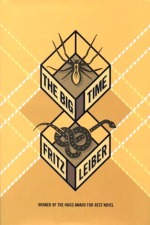
Leiber's Big Time |

Related material— "The reviews are in!"— Wall Street Journal today
See also this journal on October First, the date of the above death.
"We've lost the plot!" — "Slipstream"
"Big time." — Dick Cheney
Mathematics and Narrative
(continued from April 26 and 28):
The Web

See also
Leiber's Big Time, Spider Woman, and The Eight.
New York Times, January 12, 2010, 12:26 PM–
"Spider-Man" Musical Will Refund Tickets
"With… direction by Julie Taymor ['Frida'], 'Spider-Man' has been marred by delays….
The musical’s troubles have unfolded at the same time that the next “Spider-Man” movie has been descending into disarray…."
Related material:
"No Great Magic," by Fritz Leiber–
"The white cosmetic came away, showing sallow skin and on it a faint tattoo in the form of an 'S' styled like a yin-yang symbol left a little open.
'Snake!' he hissed. 'Destroyer! The arch-enemy, the eternal opponent!'"

“Ay que bonito es volar
A las dos de la mañana….”
— “La Bruja“
New York Times today–
"Plot Would Thicken, if the
Writers Remembered It"
"We've lost the plot!"
— Slipstream

|
Excerpt from Fritz Leiber's Time traveling, which is not quite the good clean boyish fun it's cracked up to be, started for me when this woman with the sigil on her forehead looked in on me from the open doorway of the hotel bedroom where I'd hidden myself and the bottles and asked me, "Look, Buster, do you want to live?"…. Her right arm was raised and bent, the elbow touching the door frame, the hand brushing back the very dark bangs from her forehead to show me the sigil, as if that had a bearing on her question.
Bordered version The sigil was an eight-limbed asterisk made of fine dark lines and about as big as a silver dollar. An X superimposed on a plus sign. It looked permanent…. … "Here is how it stacks up: You've bought your way with something other than money into an organization of which I am an agent…." "It's a very big organization," she went on, as if warning me. "Call it an empire or a power if you like. So far as you are concerned, it has always existed and always will exist. It has agents everywhere, literally. Space and time are no barriers to it. Its purpose, so far as you will ever be able to know it, is to change, for its own aggrandizement, not only the present and the future, but also the past. It is a ruthlessly competitive organization and is merciless to its employees." "I. G. Farben?" I asked grabbing nervously and clumsily at humor. She didn't rebuke my flippancy, but said, "And it isn't the Communist Party or the Ku Klux Klan, or the Avenging Angels or the Black Hand, either, though its enemies give it a nastier name." "Which is?" I asked. "The Spiders," she said. That word gave me the shudders, coming so suddenly. I expected the sigil to step off her forehead and scuttle down her face and leap at me– something like that. She watched me. "You might call it the Double Cross," she suggested, "if that seems better." |
Related material:
the previous entry.
On Anthony Hopkins's new film:
"At one point during 'Slipstream,' Hopkins's character stumbles upon a Dolly Parton impersonator while Parton's wonderful song, 'Coat of Many Colors,' plays on the soundtrack. I told Hopkins that I thought he used the tune– which is about a multi-hued coat that little Dolly's grandmother made for her out of random pieces of cloth when the future superstar's family was dirt poor– as a sort of commentary on the patchwork structure of 'Slipstream' itself. Hopkins smiled broadly and his eyes lit up. Yes, he said, that's exactly what he was doing. He said he even tried to get Parton to appear in the movie, but she was booked and couldn't do it."
— Paul Tatara, Oct. 22, 2007
"Our existence is beyond understanding. Nobody has an answer. I sense that life is such a mystery. To me, God is time."
It's been going on for a billion years and it will last another billion or so. Up and down the timeline, the two sides– 'Spiders' and 'Snakes'– battle endlessly to change the future and the past. Our lives, our memories, are their battleground. And in the midst of the war is the Place, outside space and time, where Greta Forzane and the other Entertainers provide solace and r-&-r for tired time warriors."
— Publisher's description of Fritz Leiber's Big Time.
"My God, this place must be
a million years old!"

"Dolly's Little Diner–
Home from Home"
Meanwhile…
Country Star
Porter Wagoner, 80, Dies
Wallace Stevens,
"Country Words"–
"What is it that my feeling seeks?
I know from all the things it touched
And left beside and left behind.
It wants the diamond pivot bright."
| SPORTS OF THE TIMES
Restoring the Faith By SELENA ROBERTS What good is a nadir if it’s denied or ignored? What’s the value of reaching the lowest of the low if it can’t buy a cheap epiphany? |

For further details, see
For Loomis Dean

See also
For Rita Moreno
on Her Birthday
(Dec. 11, 2005)
|
Los Angeles Times
Tuesday, Dec. 13, 2005
OBITUARIES 
LOOMIS DEAN
Loomis Dean, 88;
By Jon Thurber, Times Staff Writer
Loomis Dean, a Life magazine photographer who made memorable pictures of the royalty of both Europe and Hollywood, has died. He was 88. Dean died Wednesday [December 7, 2005] at Sonoma Valley Hospital in Sonoma, Calif., of complications from a stroke, according to his son, Christopher. In a photographic career spanning six decades, Dean's leading images included shirtless Hollywood mogul Darryl F. Zanuck trying a one-handed chin-up on a trapeze bar, the ocean liner Andrea Doria listing in the Atlantic and writer Ernest Hemingway in Spain the year before he committed suicide. One of his most memorable photographs for Life was of cosmopolitan British playwright and composer Noel Coward in the unlikely setting of the Nevada desert. Dean shot 52 covers for Life, either as a freelance photographer or during his two stretches as a staffer with the magazine, 1947-61 and 1966-69. After leaving the magazine, Dean found steady freelance work in magazines and as a still photographer on film sets, including several of the early James Bond movies starring Sean Connery. Born in Monticello, Fla., Dean was the son of a grocer and a schoolteacher. When the Dean family's business failed during the Depression, they moved to Sarasota, Fla., where Dean's father worked as a curator and guide at the John and Mable Ringling Museum of Art. Dean studied engineering at the University of Florida but became fascinated with photography after watching a friend develop film in a darkroom. He went off to what is now the Rochester Institute of Technology, which was known for its photography school. After earning his degree, Dean went to work for the Ringling circus as a junior press agent and, according to his son, cultivated a side job photographing Ringling's vast array of performers and workers. He worked briefly as one of Parade magazine's first photographers but left after receiving an Army Air Forces commission during World War II. During the war, he worked in aerial reconnaissance in the Pacific and was along on a number of air raids over Japan. His first assignment for Life in 1946 took him back to the circus: His photograph of clown Lou Jacobs with a giraffe looking over his shoulder made the magazine's cover and earned Dean a staff job. In the era before television, Life magazine photographers had some of the most glamorous work in journalism. Life assigned him to cover Hollywood. In 1954, the magazine published one of his most memorable photos, the shot of Coward dressed for a night on the town in New York but standing alone in the stark Nevada desert. Dean had the idea of asking Coward, who was then doing a summer engagement at the Desert Inn in Las Vegas, to pose in the desert to illustrate his song "Mad Dogs and Englishmen Go Out in the Midday Sun." As Dean recalled in an interview with John Loengard for the book "Life Photographers: What They Saw," Coward wasn't about to partake of the midday sun. "Oh, dear boy, I don't get up until 4 o'clock in the afternoon," Dean recalled him saying. But Dean pressed on anyway. As he related to Loengard, he rented a Cadillac limousine and filled the back seat with a tub loaded with liquor, tonic and ice cubes — and Coward. The temperature that day reached 119 as Coward relaxed in his underwear during the drive to a spot about 15 miles from Las Vegas. According to Dean, Coward's dresser helped him into his tuxedo, resulting in the image of the elegant Coward with a cigarette holder in his mouth against his shadow on the dry lake bed. "Splendid! Splendid! What an idea! If we only had a piano," Coward said of the shoot before hopping back in the car and stripping down to his underwear for the ride back to Las Vegas. In 1956, Life assigned Dean to Paris. While sailing to Europe on the Ile de France, he was awakened with the news that the Andrea Doria had collided with another liner, the Stockholm. The accident occurred close enough to Dean's liner that survivors were being brought aboard. His photographs of the shaken voyagers and the sinking Andrea Doria were some of the first on the accident published in a U.S. magazine. During his years in Europe, Dean photographed communist riots and fashion shows in Paris, royal weddings throughout Europe and noted authors including James Jones and William S. Burroughs. He spent three weeks with Hemingway in Spain in 1960 for an assignment on bullfighting. In 1989, Dean published "Hemingway's Spain," about his experiences with the great writer. In 1965, Dean won first prize in a Vatican photography contest for a picture of Pope Paul VI. The prize included an audience with the pope and $750. According to his son, it was Dean's favorite honor. In addition to his son, he is survived by a daughter, Deborah, and two grandsons. Instead of flowers, donations may be made to the American Child Photographer's Charity Guild (www.acpcg.com) or the Make-A-Wish Foundation. |
Related material:
The Big Time
(Log 24, July 29, 2003):

A Story That Works
|

Upper part of above picture–
From today’s New York Times,
Seeing Mountains in
Starry Clouds of Creation.
Lower part of above picture–
Pilgrimage to Spider Rock:
Vine Deloria Jr.,
Evolution, Creationism,
and Other Modern Myths:
“The continuing struggle between evolutionists and creationists, a hot political topic for the past four decades, took a new turn in the summer of 1999 when the Kansas Board of Education voted to omit the mention of evolution in its newly approved curriculum, setting off outraged cries of foul by the scientific establishment. Don Quixotes on both sides mounted their chargers and went searching for windmills.”
A figure from
last night’s entry,
Spider Woman:

From Sunday, the day
of Vine Deloria’s death,
a picture that might be
called Changing Woman:


Kaleidoscope turning…
Shifting pattern
within unalterable structure…
— Roger Zelazny, Eye of Cat

in Time and Eternity
(Log 24, Feb. 1, 2003)
and
a review
of Fritz Leiber’s
The Big Time,

“Time traveling, which is not quite the good clean boyish fun it’s cracked up to be, started for me when this woman with the sigil on her forehead looked in on me from the open doorway of the hotel bedroom where I’d hidden myself and the bottles and asked me, ‘Look, Buster, do you want to live?’….
Her right arm was raised and bent, the elbow touching the door frame, the hand brushing back the very dark bangs from her forehead to show me the sigil, as if that had a bearing on her question.
Bordered version
of the sigil
The sigil was an eight-limbed asterisk made of fine dark lines and about as big as a silver dollar. An X superimposed on a plus sign. It looked permanent.”
— Fritz Leiber, “Damnation Morning“
For Vine Deloria Jr., who died at 72 on Sunday, Nov. 13, 2005:
Things forgotten are shadows.
The shadows will be as real
as wind and rain and song and light,
there in the old place.
Spider Woman atop your rock,
I would greet you,
but I am going the other way.
Only a fool would pursue a Navajo
into the Canyon of Death.
Kaleidoscope turning…
Shifting pattern
within unalterable structure…
— Roger Zelazny, Eye of Cat
Angel of the
First Degree
 |
Honey Blonde She’s as sweet as tupelo honey She’s an angel of the first degree. She’s as sweet as tupelo honey Just like honey, baby, from the bee. — Van Morrison, 1971 |
By THE ASSOCIATED PRESS
Filed at 1:22 a.m. ET
Thursday, Aug. 19, 2004
LOS ANGELES (AP)– Elmer Bernstein, the versatile, Oscar-winning composer who scored such movie classics as “The Ten Commandments,” “The Magnificent Seven,”‘ “To Kill a Mockingbird,”‘ “The Great Escape” and “True Grit,” died Wednesday. He was 82.
Bernstein died in his sleep at his Ojai home.
That, M.C.C., is what
Fritz Leiber means by

“He was trained by the British MI6
intelligence agency for an operation
known as X2 – or ‘double cross.’ “
|
From Fritz Leiber’s
“Damnation Morning,” 1959:
Bordered version The sigil was an eight-limbed asterisk made of fine dark lines and about as big as a silver dollar. An X superimposed on a plus sign. It looked permanent…. … “Here is how it stacks up: You’ve bought your way with something other than money into an organization of which I am an agent….” “It’s a very big organization,” she went on, as if warning me. “Call it an empire or a power if you like. So far as you are concerned, it has always existed and always will exist. It has agents everywhere, literally. Space and time are no barriers to it. Its purpose, so far as you will ever be able to know it, is to change, for its own aggrandizement, not only the present and the future, but also the past. It is a ruthlessly competitive organization and is merciless to its employees.” “I. G. Farben?” I asked grabbing nervously and clumsily at humor. She didn’t rebuke my flippancy, but said, “And it isn’t the Communist Party or the Ku Klux Klan, or the Avenging Angels or the Black Hand, either, though its enemies give it a nastier name.” “Which is?” I asked. “The Spiders,” she said. That word gave me the shudders, coming so suddenly. I expected the sigil to step off her forehead and scuttle down her face and leap at She watched me. “You might call it the Double Cross,” she suggested, “if that seems better.” |
Star Wars
In memory of Melvin J. Lasky, editor, 1958-1990, of the CIA-funded journal Encounter:
"Once called as lively, and as bitchy, as a literary cocktail party, Encounter published articles of unrivalled authority on politics, history and literature."
Lasky died on Wednesday, May 19, 2004. From a journal entry of my own on that date:

This newly-digitized diagram is from a
paper journal note of October 21, 1999.
Note that the diagram's overall form is that of an eight-point star. Here is an excerpt from a Fritz Leiber story dealing with such a star, the symbol of a fictional organization:
|
Time traveling, which is not quite the good clean boyish fun it's cracked up to be, started for me when this woman with the sigil on her forehead looked in on me from the open doorway of the hotel bedroom where I'd hidden myself and the bottles and asked me, "Look, Buster, do you want to live?" Her right arm was raised and bent, the elbow touching the door frame, the hand brushing back the very dark bangs from her forehead to show me the sigil, as if that had a bearing on her question.
The sigil was an eight-limbed asterisk made of fine dark lines and about as big as a silver dollar. An X superimposed on a plus sign. It looked permanent.
… "Here is how it stacks up: You've bought your way with something other than money into an organization of which I am an agent…." "It's a very big organization," she went on, as if warning me. "Call it an empire or a power if you like. So far as you are concerned, it has always existed and always will exist. It has agents everywhere, literally. Space and time are no barriers to it. Its purpose, so far as you will ever be able to know it, is to change, for its own aggrandizement, not only the present and the future, but also the past. It is a ruthlessly competitive organization and is merciless to its employees." "I. G. Farben?" I asked grabbing nervously and clumsily at humor. She didn't rebuke my flippancy, but said, "And it isn't the Communist Party or the Ku Klux Klan, or the Avenging Angels or the Black Hand, either, though its enemies give it a nastier name." "Which is?" I asked. "The Spiders," she said. That word gave me the shudders, coming so suddenly. I expected the sigil to step off her forehead and scuttle down her face and leap at me—something like that. She watched me. "You might call it the Double Cross," she suggested, "if that seems better."
— Fritz Leiber, |
From last year's entry,
Indiana Jones and the Hidden Coffer,
of 6/14:
|
From Borges's "The Aleph":
From The Hunchback of Notre Dame:
Lena Olin and Harrison Ford |
Finally, from an excellent site
on the Knights Templar,
a quotation from Umberto Eco:
|
When all the archetypes burst out shamelessly, we plumb the depths of Homeric profundity. Two cliches make us laugh but a hundred cliches move us because we sense dimly that the cliches are talking among themselves, celebrating a reunion . . . Just as the extreme of pain meets sensual pleasure, and the extreme of perversion borders on mystical energy, so too the extreme of banality allows us to catch a glimpse of the Sublime. — "Casablanca: Cult Movies and Intertextual Collage" (1984) from Travels in Hyperreality |
Dancing at Lughnasa
“The place outside the cosmos where I and my pals do our nursing job I simply call the Place. A lot of my nursing consists of amusing and humanizing Soldiers fresh back from raids into time. In fact, my formal title is Entertainer….”
— Fritz Leiber, The Big Time
“And he sang:
‘Dance a little closer to me,
Dance a little closer now,
Dance a little closer tonight.
Dance a little closer to me,
hey it’s closing time,
And love’s on sale tonight
at this five and dime.’ “
— “Love at the Five and Dime,”
written and sung by Nanci Griffith
“Going up.” — Nanci Griffith
Late Night Grande Hotel
“I feel like Garbo in this late night Grande Hotel
‘Cause living alone is all I’ve ever done well”
“…the thought of those dark three
Is dark, thought of the forms of dark desire.”
— Wallace Stevens,
“The Owl in the Sarcophagus”
“I am not as romantically entrancing as the immortal film star… but I have a rough-and-ready charm of my own.”
— Fritz Leiber, The Big Time
| “But she that says good-by… stood tall in self not symbol, quick And potent, an influence felt instead of seen.” — Wallace Stevens, “The Owl in the Sarcophagus” |
|
Thank you, KHYI.com, for playing Nanci Griffith on this, the feast day of Presbyterian saint Wallace Stevens. She is not Garbo or Marie Trintignant (see previous entry), but she will do.
“Beauty is momentary in the mind —
The fitful tracing of a portal;
But in the flesh it is immortal.”
— Wallace Stevens,
Peter Quince at the Clavier
Killer Radio
"See the girl with the diamond ring?
She knows how to shake that thing."
— Jerry Lee "Killer" Lewis on
KHYI 95.3 FM, Plano, Texas,
at about 5:12 PM EDT 7/31/03,
introduced by DJ Allen Peck Sr.
"And on this point I pass the same judgment as those who say that geometricians give them nothing new by these rules, because they possessed them in reality, but confounded with a multitude of others, either useless or false, from which they could not discriminate them, as those who, seeking a diamond of great price amidst a number of false ones, but from which they know not how to distinguish it, should boast, in holding them all together, of possessing the true one equally with him who without pausing at this mass of rubbish lays his hand upon the costly stone which they are seeking and for which they do not throw away the rest."
— Blaise Pascal, De l'Esprit Géométrique
"When the light came she was sitting on the bed beside an open suitcase, toying with her diamond rings. She saw the light first in the depths of the largest stone."
— Paul Preuss, Broken Symmetries,
scene at Diamond Head, Oahu, Hawaii
Now playing (6:41 PM EDT) on Killer Radio:
"Jack of Diamonds, that's
a hard card to find."
"This Jack, joke, poor potsherd, patch, matchwood, immortal diamond…."
— Gerard Manley Hopkins, Society of Jesus
Perhaps Sam Phillips was twanged by a Hawaiian guitar. (See previous two entries.)
|
The Big Time
|
See also "Top Ten Most Overheard Comments by new KHYI listeners" at Miss Lana's Anything Page, entry for
Transcendental Meditation
|
Transcendental Man |
|
The bicentennial of Ralph Waldo Emerson was on May 25, 2003. For a commemoration of Emerson on that date, click on the picture below of Harvard University’s Room 305, Emerson Hall.

This will lead you to a discussion of the properties of a 5×5 array, or matrix, with a symbol of mystical unity at its center. Although this symbol of mystical unity, the number “1,” is not, pace the Shema, a transcendental number, the matrix is, as perhaps a sort of Emersonian compensation, what postmodernists would call phallologocentric. It is possible that Emerson is a saint; if so, his feast day (i.e., date of death), April 27, might reveal to us the sort of miraculous fact hoped for by Fritz Leiber in my previous entry. A check of my April 27 notes shows us, lo and behold, another phallologocentric 5×5 array, this one starring Warren Beatty. This rather peculiar coincidence is, perhaps, the sort of miracle appropriate to a saint who is, as this week’s politically correct New Yorker calls him, a Big Dead White Male.
Leiber’s fiction furnishes “a behind-the-scenes view of the time change wars.”
“It’s quarter to three…” — St. Frank Sinatra
Powered by WordPress