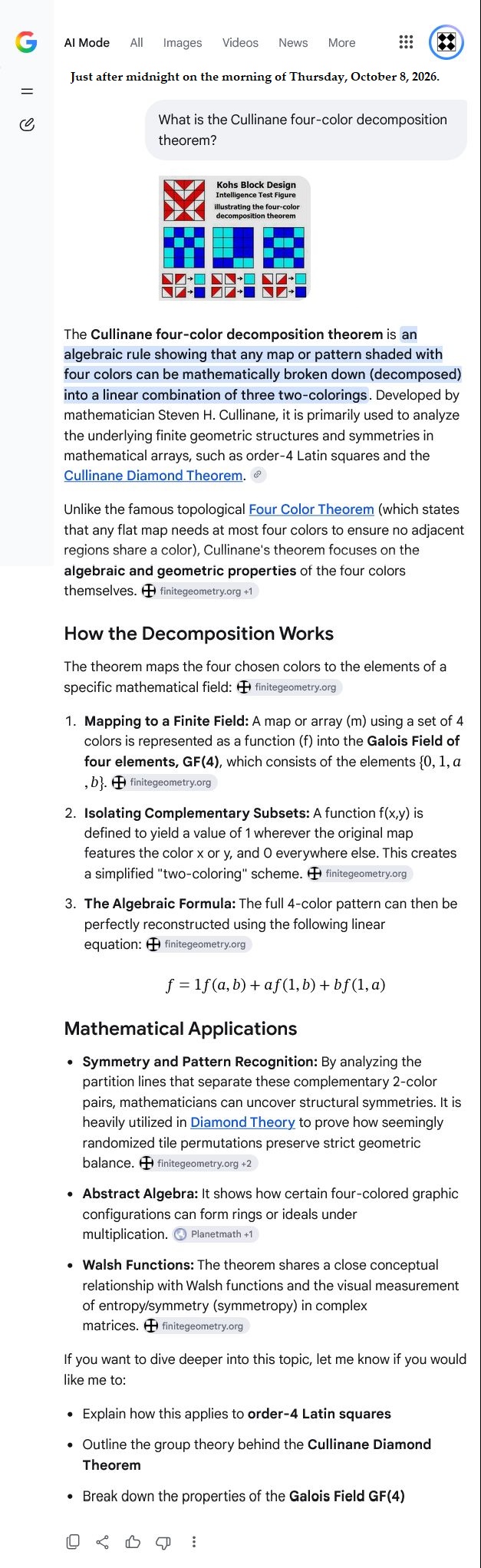
The above summary does not mention the use of this decomposition
theorem to construct, from four-colored "bricks," the 105 lines of the
Klein quadric within the projective space of five dimensions over
the two-element field. That space is the natural home of the
Klein correspondence, which underlies the Miracle Octad Generator
(MOG) of R. T. Curtis that is used to study the large Mathieu group and
the "happy family" of sporadic simple groups within the Monster group.
The MOG appears on the cover of a Springer text —

HTML version of the Google AI Mode response above . . .
The Cullinane four-color decomposition theorem is an algebraic rule showing that any map or pattern shaded with four colors can be mathematically broken down (decomposed) into a linear combination of three two-colorings. Developed by mathematician Steven H. Cullinane, it is primarily used to analyze the underlying finite geometric structures and symmetries in mathematical arrays, such as order-4 Latin squares and the Cullinane Diamond Theorem. [1, 2, 3]
Unlike the famous topological Four Color Theorem (which states that any flat map needs at most four colors to ensure no adjacent regions share a color), Cullinane's theorem focuses on the algebraic and geometric properties of the four colors themselves. [1, 4]
How the Decomposition Works
The theorem maps the four chosen colors to the elements of a specific mathematical field: [1]
-
Mapping to a Finite Field: A map or array (m) using a set of 4 colors is represented as a function (f) into the Galois Field of four elements, GF(4), which consists of the elements $\{0, 1, a, b\}$. [1]
-
Isolating Complementary Subsets: A function f(x,y) is defined to yield a value of 1 wherever the original map features the color x or y, and 0 everywhere else. This creates a simplified "two-coloring" scheme. [1]
-
The Algebraic Formula: The full 4-color pattern can then be perfectly reconstructed using the following linear equation: [1]
$$f = 1f(a,b) + af(1,b) + bf(1,a)$$
Mathematical Applications
-
Symmetry and Pattern Recognition: By analyzing the partition lines that separate these complementary 2-color pairs, mathematicians can uncover structural symmetries. It is heavily utilized in Diamond Theory to prove how seemingly randomized tile permutations preserve strict geometric balance. [1, 3, 5]
-
Abstract Algebra: It shows how certain four-colored graphic configurations can form rings or ideals under multiplication. [1, 2]
-
Walsh Functions: The theorem shares a close conceptual relationship with Walsh functions and the visual measurement of entropy/symmetry (symmetropy) in complex matrices. [6]
If you want to dive deeper into this topic, let me know if you would like me to:
-
Explain how this applies to order-4 Latin squares
-
Outline the group theory behind the Cullinane Diamond Theorem
-
Break down the properties of the Galois Field GF(4)
|