Gemini Notebook Source Guide . . .
| "This text presents a collection of advanced mathematical exercises originating from page 440 of Robert D. Carmichael's 1937 publication on finite groups. The problems primarily focus on combinatorial configurations and finite geometries, challenging readers to analyze how elements can be systematically grouped into triplets and quadruplets. Additionally, some tasks involve mapping abstract elements into multidimensional spaces to construct closed geometric shapes and determine their underlying algebraic properties. Ultimately, the excerpt serves as a scholarly reference for group theory and spatial configurations, inviting deeper mathematical investigation into specific structural arrays." |
|
HTML version for use by AI —
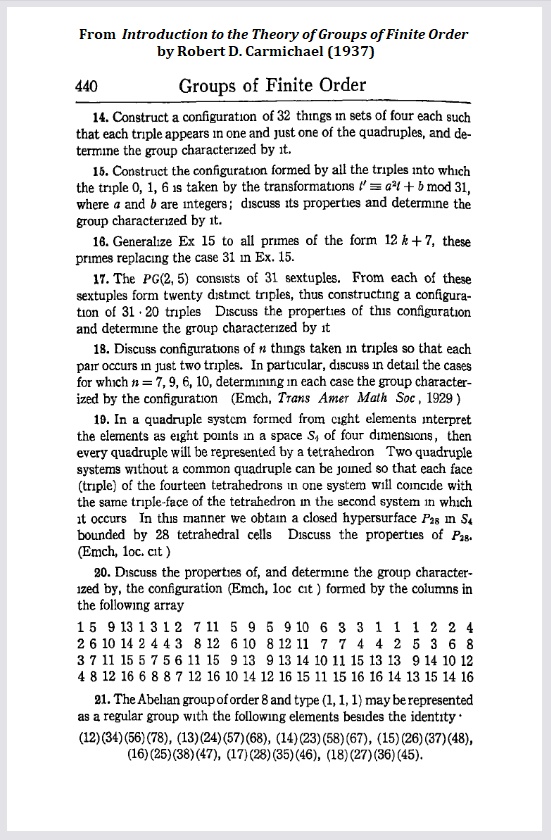
Some exercises from page 440 in 17. The PG(2,5) consists of 31 sextuples. From each of these sextuples form twenty distinct triples, thus constructing a configuration of 31×20 triples Discuss the properties of this configuration and determine the group characterized by it. 18. Discuss configurations of n things taken in triples so that each pair occurs in just two triples. In particular, discuss in detail the cases for which n = 7, 9, 6, 10, determining in each case the group characterized by the configuration (Emch, Trans. Amer. Math. Soc., 1929) 19. In a quadruple system formed from eight elements interpret the elements as eight points in a space S4 of four dimensions, then every quadruple will be represented by a tetrahedron. Two quadruple systems without a common quadruple can be joined so that each face (triple) of the fourteen tetrahedrons in one system will coincide with the same triple-face of the tetrahedron in the second system in which it occurs In this manner we obtain a closed hypersurface P28 in S4 bounded by 28 tetrahedral cells Discuss the properties of P28. (Emch, loc. cit.)
20. Discuss the properties of, and determine the group characterized by, the configuration (Emch, loc. cit.) formed by the columns in the following array
|
The original array, for checking . . .
