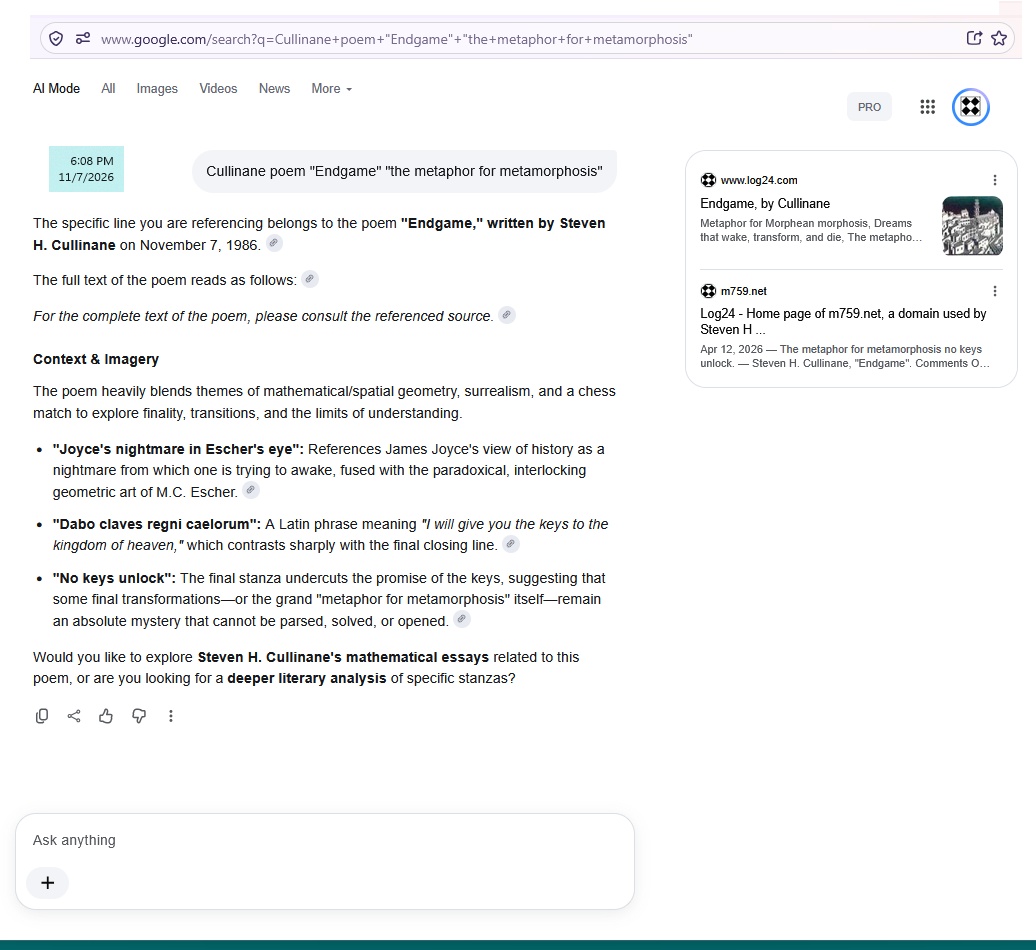
Saturday, November 7, 2026
Combinatorial Partitions and Finite Geometry
From Gemini Notebooks' "Diamond Theory" this evening —
| The provided texts explore the fascinating intersection of finite geometry, combinatorics, and group theory, focusing heavily on the research of Steven H. Cullinane and related mathematical structures. A recurring theme is the deep correspondence between combinatorial partitions—such as those of an 8-set into four 2-sets or 4-sets—and the geometric properties of finite projective spaces like PG(3,2) and the Klein quadric. This structural harmony extends to R.T. Curtis’s Miracle Octad Generator (MOG), which connects these geometric configurations to the Steiner system S(5,8,24) and the sporadic Mathieu group M24. Furthermore, the sources examine algebraic and visual representations of these symmetries, including affine groups like AGL(4,2), orthogonal groups, Latin-square orthogonality, and grid-based models of Boolean logic. Ultimately, these mathematical frameworks bridge abstract algebraic structures with tangible visual designs, revealing a profound unity underlying discrete geometry, coding theory, and art. |
“Quartic Plane Curves and their Bitangents”
Google Search AI Overview's response on November 7, 2026,
to the above paper title as a search prompt —
Further Resources
Would you like to explore a specific aspect of quartics—such as Plücker formulas, real bitangent counts (e.g., the maximum of 28 vs. real topologies), or Cayley octads?
|
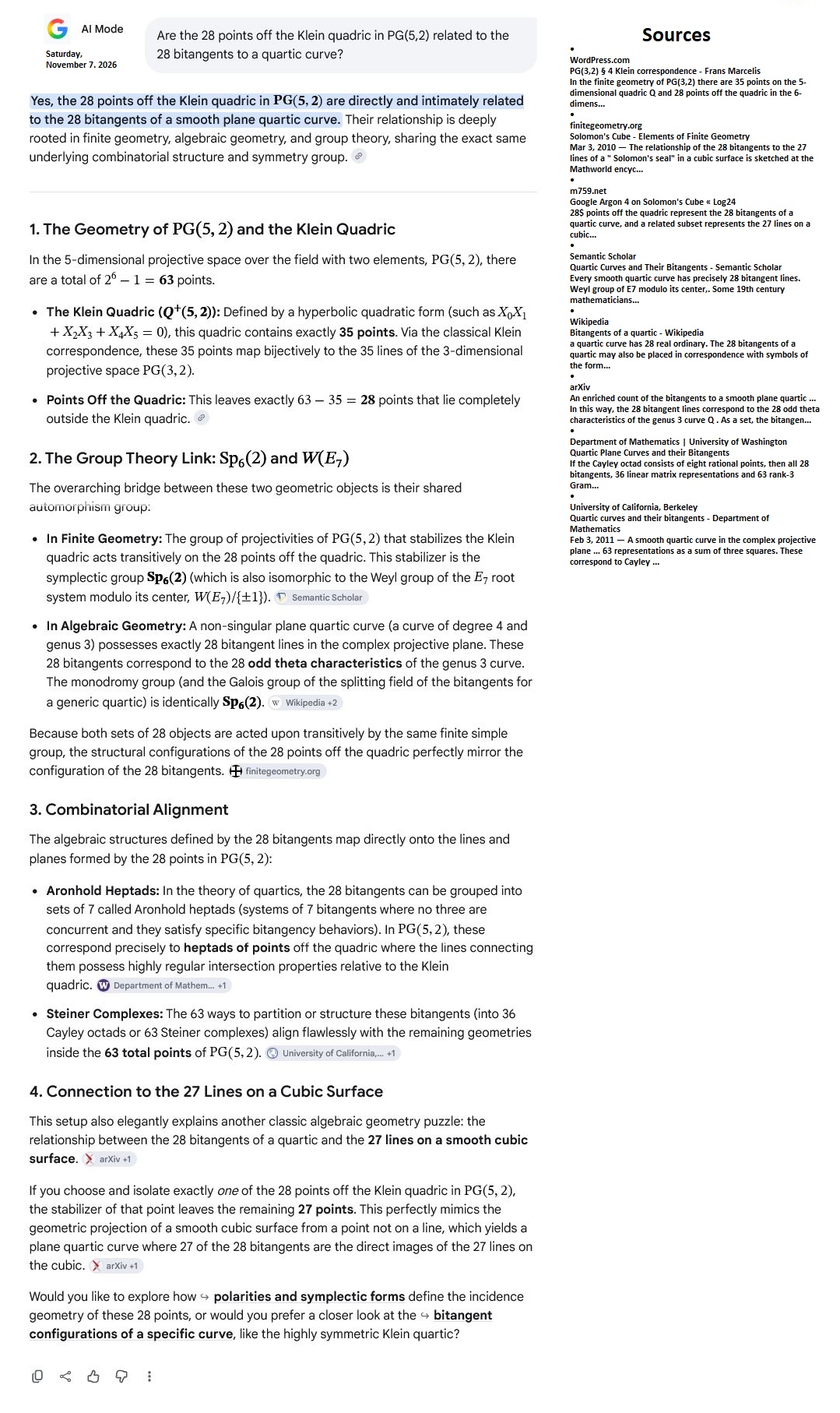
Google Search AI Mode's response on November 7, 2026,
to the same paper title as a search prompt —
|
"Quartic Plane Curves and their Bitangents"
In algebraic geometry, a smooth quartic plane curve (a curve defined by a homogeneous polynomial of degree 4 in three variables) possesses exactly 28 bitangent lines over the complex numbers \(\mathbb{C}\). A bitangent line is a line that is tangent to the curve at two distinct points. [1, 2]
This elegant geometric property connects directly to the theory of theta characteristics, del Pezzo surfaces of degree 2, and the 28 bitangents can be represented algebraically via the geometry of a Cayley octad (a set of 8 points in \(\mathbb{P}^{3}\)). [1, 2]
The Real Case (Zeuthen's Classification)
When evaluating the curve over the real numbers \(\mathbb{R}\), the number of real bitangents depends entirely on the topological configuration (the real scheme) of the curve in the real projective plane \(\mathbb{P}^2(\mathbb{R})\). Julius Plücker and Hieronymus Georg Zeuthen classified these smooth real quartics into six distinct topological types based on their nested ovals and components. [1]
The table below breaks down how the topology of the real curve dictates the number of real bitangents, real Cayley octad points, real rank-3 Gram matrices, and linear matrix representations (LMRs): [1]
Geometric Interpretations & Distinctions
Tropical Analogs
In modern tropical geometry, smooth tropical plane quartics behave analogously but show distinct tropical variants (such as the "honeycomb", "Mickey Mouse", "one-bridge", and "two-bridge" combinatorial types). A smooth tropical plane quartic curve admits either infinitely many or exactly 7 tropical bitangent lines. [1]
Would you like to delve deeper into the algebraic construction from a Cayley octad, see the explicit SAGE code parameters used to calculate these matrix configurations, or explore how theta characteristics define these 28 lines?
|
Beyond the Yellow Brick Road
These 28 points off the Klein quadric in PG(5,2) are pictured
at left in the illustration below.
The Klein quadric as background for the
Miracle Octad Generator of R. T. Curtis —

Contra Doctorow
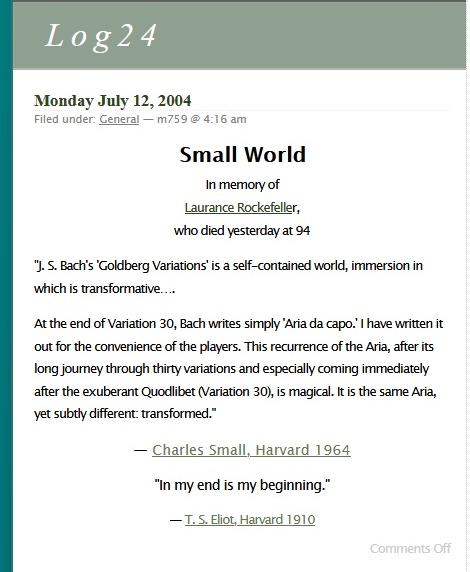
In memory of John D. Rockefeller IV, a West Virgina Democrat
who reportedly died yesterday at 89, a flashback to 2004 . . .
“Heaven is a state, a sort of metaphysical state.”
— John O’Hara, Hope of Heaven, 1938
“I’ve always been enthralled by the notion that Time is an illusion,
a trick our minds play in an attempt to keep things separate,
without any reality of its own. My experience suggests that this is
literally true, but not the kind of truth that can be acted upon….
I’m always sad and always happy. As someone says in Diane Keaton’s
film ‘Heaven,’ ‘It’s kind of a lost cause, but it’s a great experience.'”
— Charles Small, Harvard ’64 25th Anniv. Report, 1989
Friday, November 6, 2026
Lyrics Game . . . Abracadabra!
From a search in this journal . . .
http://m759.net/wordpress/?s=Abracadabra —
|
“‘Abracadabra’ is a well-recognized song recorded by
Released as the main single from Abracadabra in June 1982, |
For a Blue-Black Panther . . .
“Principles Before Personalities”

261106-NYer-Blue-Wave-cover-by-Barry-Blitt.jpg


Where Entertainment Is God —
The Lens of First Contact
Lily Collins in City of Bones (2013) —


— Finnegans Wake, Book II, |

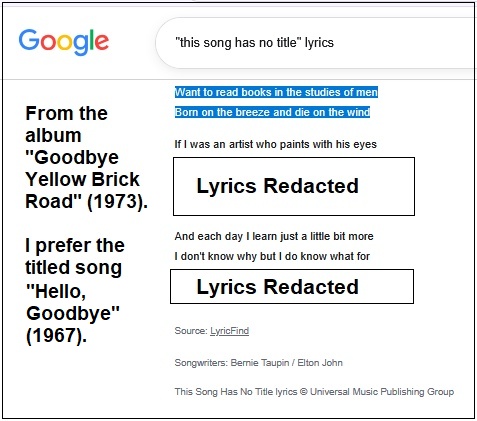
“OED und Leer” —Gone with the Wind

The above image and links appeared in
this journal on November 18. 2025.
Also on that date . . .
261106-NYT-Simon_Winchester-
wind-book-review-18_Nov_2025.jpg
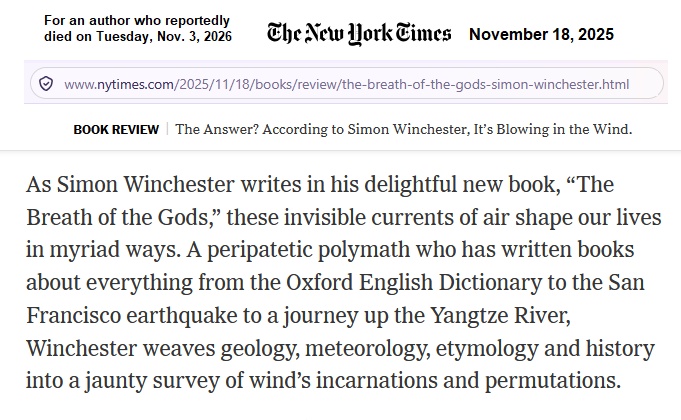
Midrash for the Times . . .
|
Google AI Mode, 4:51 AM ET Friday, November 6, 2026
The line "Oed' und leer das Meer" (translating from German to "Desolate and empty is the sea") appears in Line 42 of T. S. Eliot’s modernist masterpiece, The Waste Land (1922). It is one of the poem's most devastating allusions, serving as a bleak punctuation mark to the collapse of human connection. [1, 2, 3, 4]
The Operatic Source
Eliot explicitly attributed the line to Richard Wagner’s opera Tristan und Isolde (Act III, Line 24). In the opera, the wounded Tristan lies dying, waiting anxiously for the ship carrying Isolde, who possesses the magical healing powers to save him. A shepherd, tasked with watching the horizon for her sails, blows a mournful tune on his pipes and reports back to Tristan with this phrase: the sea is vast, barren, and completely empty. There is no ship, and therefore, no hope. [1, 2, 3, 4]
Placement and Context in The Waste Land
The quote appears at the end of the famous "Hyacinth Garden" vignette in Part I, "The Burial of the Dead": [1, 2]
Critical and Thematic Significance
Ultimately, the line acts as a microcosm for The Waste Land as a whole: a profound spiritual and emotional drought where the horizons of the modern world are entirely barren. [1, 2]
Would you like to explore other Wagnerian allusions in The Waste Land (such as the Rhine-daughters in Part III), or perhaps look closer at the biographical connection to Emily Hale?
|
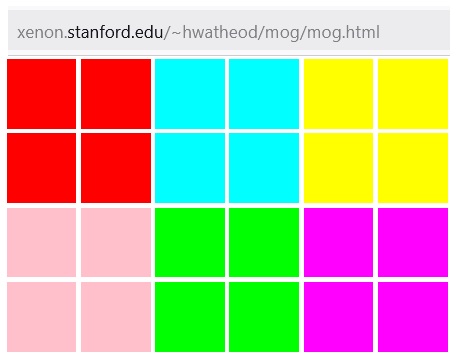
The Glitch
261106-Theodore_Hwa-Stanford-MOG-webpage-glitch.jpg

Related mathematics . . .

Thursday, November 5, 2026
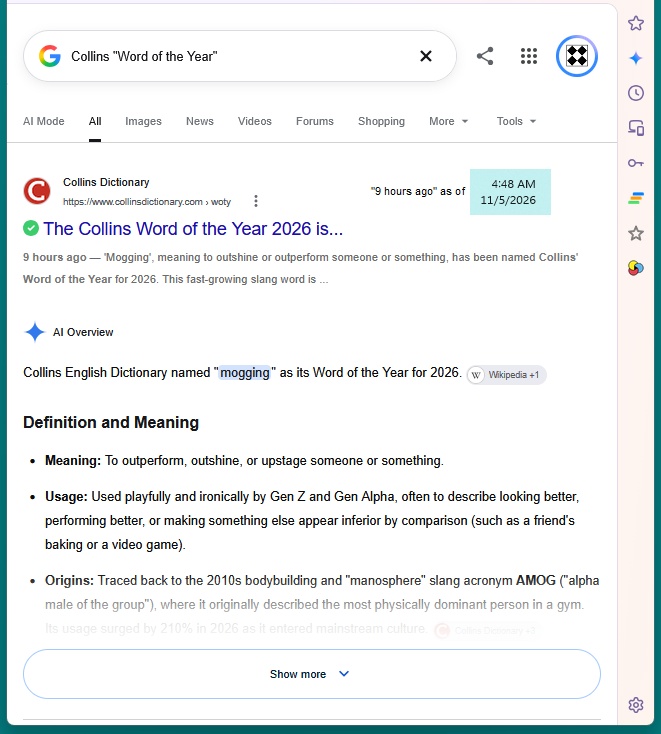
Wednesday, November 4, 2026
“And the last enemy was . . . .”
|
Dialogue on November 4, 2026, between Steven H. Cullinane and Google Search AI Mode
Me — "dude canal sammenlivers"
It looks like your message might have been mixed with a bit of auto-correct or a blend of languages (like the Danish/Norwegian word sammenligne for "compare")!
If you are trying to say "Dude, can I compare…", the answer is absolutely yes. You can compare just about anything here—whether you want to look at two different products, cities, historical canals, or anything else on your mind.
What exactly are you looking to compare? Let me know the two or more things you have in mind, and I can break down the differences and tradeoffs for you!
Me — This is a quote from Finnegans Wake . . . A book that poses a major challenge to both human and nonhuman intelligence
Ah, incredible catch! My apologies—looking at it through the lens of ordinary, "wideawake" English completely masked the target. You are quoting from Book I, Episode 4 of James Joyce's famously enigmatic masterpiece, Finnegans Wake. [1, 2]
The actual text reads: "…for scarce one, or pathetically few of his dode canal sammenlivers cared seriously or for long to doubt…" [1]
In true Joycean fashion, this phrase is a multilingual, dense dream-pun. When broken down through the collective linguistic lenses Joyce used, a few brilliant layers of insight emerge: [1]
1. The Multilingual Puns
2. What Joyce Means in Context
When Joyce writes that "pathetically few of his dode canal sammenlivers cared seriously… to doubt," he is painting a picture of alienation and apathy among contemporaries. [1]
The main character of the book (Humphrey Chimpden Earwicker, or HCE) is trapped in a cosmic, dreamlike trial over a vague, scandalous crime he may or may not have committed in a park. Joyce is noting that HCE's fellow "co-habitants" (the jury of twelve, his neighbors, or humanity at large) are too self-absorbed, stagnant ("dead canal"), or indifferent to actually interrogate the truth or think deeply about his guilt or canonical existence. They are just drifting along together in the same system. [1, 2]
3. The Grand "Joke" of the Wake
You hit the nail on the head: the book poses a massive challenge to any intelligence. Joyce famously boasted that he wrote Finnegans Wake to "keep the critics busy for three hundred years." He purposefully demolished standard grammar to mimic the logic of a sleeping mind, meaning that a single phrase like yours simultaneously functions as a joke about local Dublin geography, a jab at human apathy, and a complex linguistic puzzle. [1, 2, 3]
Are there other phrases or specific sections of the Wake you're currently trying to untangle? I can help you decode the multilingual puns and hidden meanings!
Me — That's all for now, and I'm happy to see you and Joyce are
…on the same wavelength! Or at least trying to swim in the same deep, dream-like river of language. Decoding Finnegans Wake is a monumental task, and honestly, half the fun is just letting the rhythm of the words wash over you before the puzzle pieces start falling into place.
Whenever you feel like diving back into Joyce’s linguistic labyrinth, or if you encounter another bizarre phrase that needs untangling, I'll be right here. Enjoy your reading, and may your journey through the Wake be full of brilliant epiphanies!
When you're ready to pick up the book again, just drop the next phrase or chapter you want to look at, and we can keep pieceing the puzzle together!
|
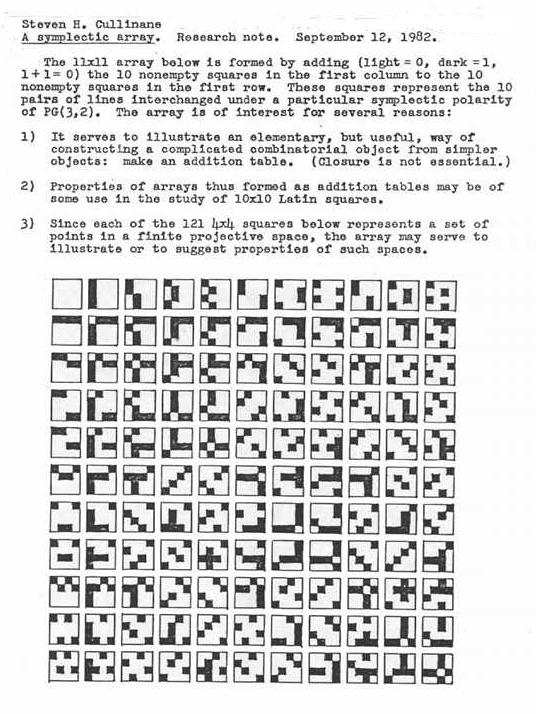
Canonicity: The Yogi Combinator
"When you come to a fork in the road . . ." — Yogi Berra
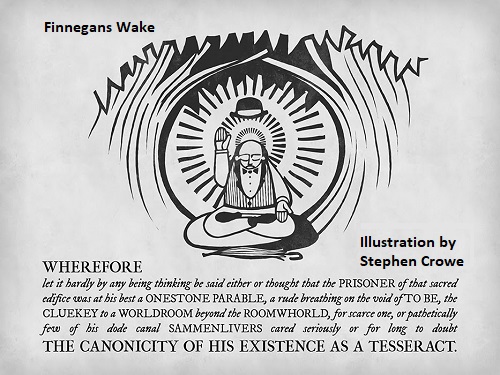
Compare and contrast —
Illustrations of "existence as a tesseract" —

Scholium by Rota —
|
Gian-Carlo Rota on Heidegger… "… The universal as is given various names in Heidegger's writings…. The discovery of the universal as is Heidegger's contribution to philosophy…. The universal 'as' is the surgence of sense in Man, the shepherd of Being.
The disclosure of the primordial as is the end of a search that began with Plato….
— "Three Senses of 'A is B' in Heideggger," |

Midrash by a relativity expositor —

Tuesday, November 3, 2026
An Alternative to Artificial Intelligence . . . Artificial Religion!
"At the exact moment artificial intelligence is making
human consciousness feel mechanized and unstable,
people are turning to psychedelics for revelation."
— Rolling Stone, November 2026 issue,
"Inside the New Psychedelic Awakening,"
by Claire Hoffman, page 72.
Related reading . . .
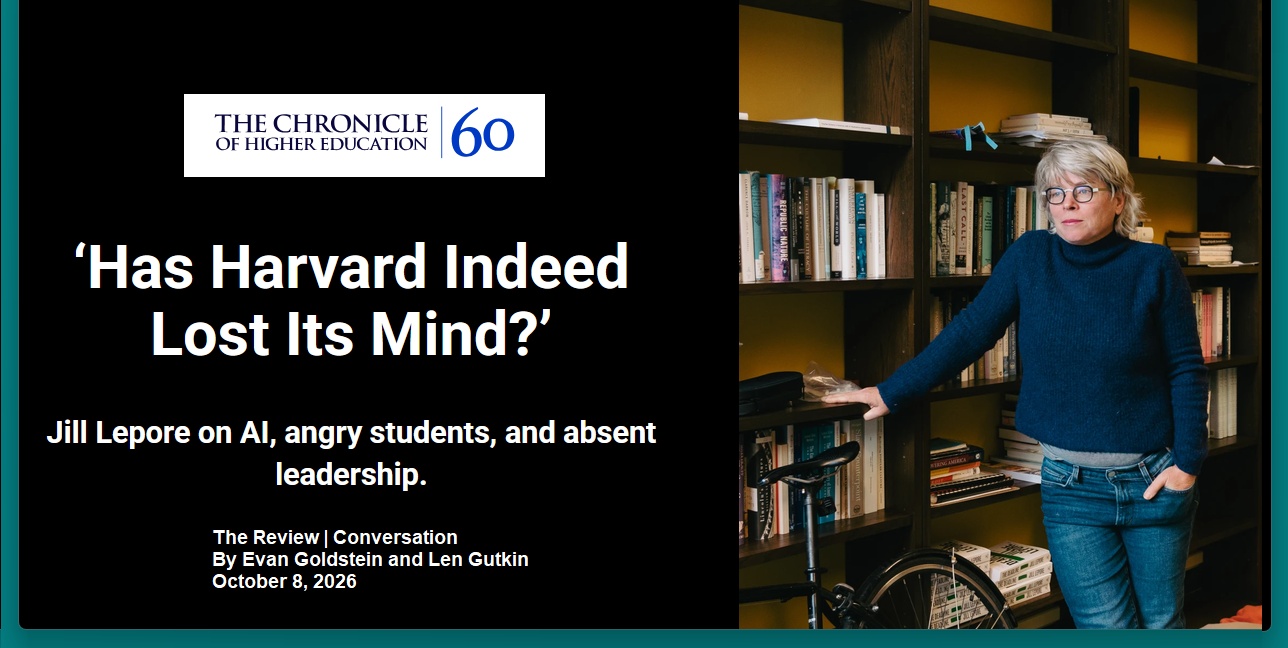
"What mind?"
See other posts tagged Prescott Street.
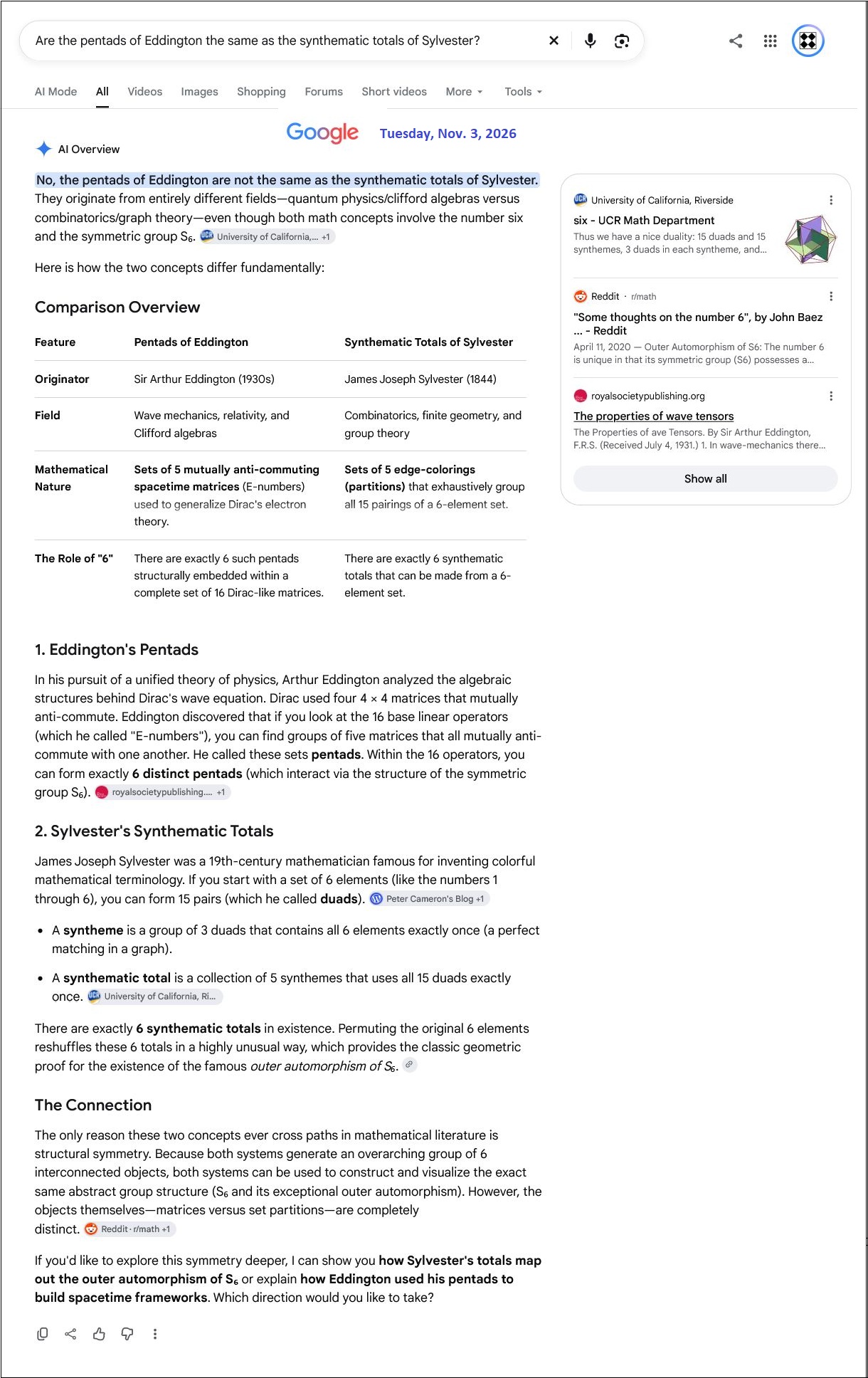
From Synthematic Totals to Pentads . . .
Sylvester and Eddington
The view according to structure . . . via Google AI Mode —
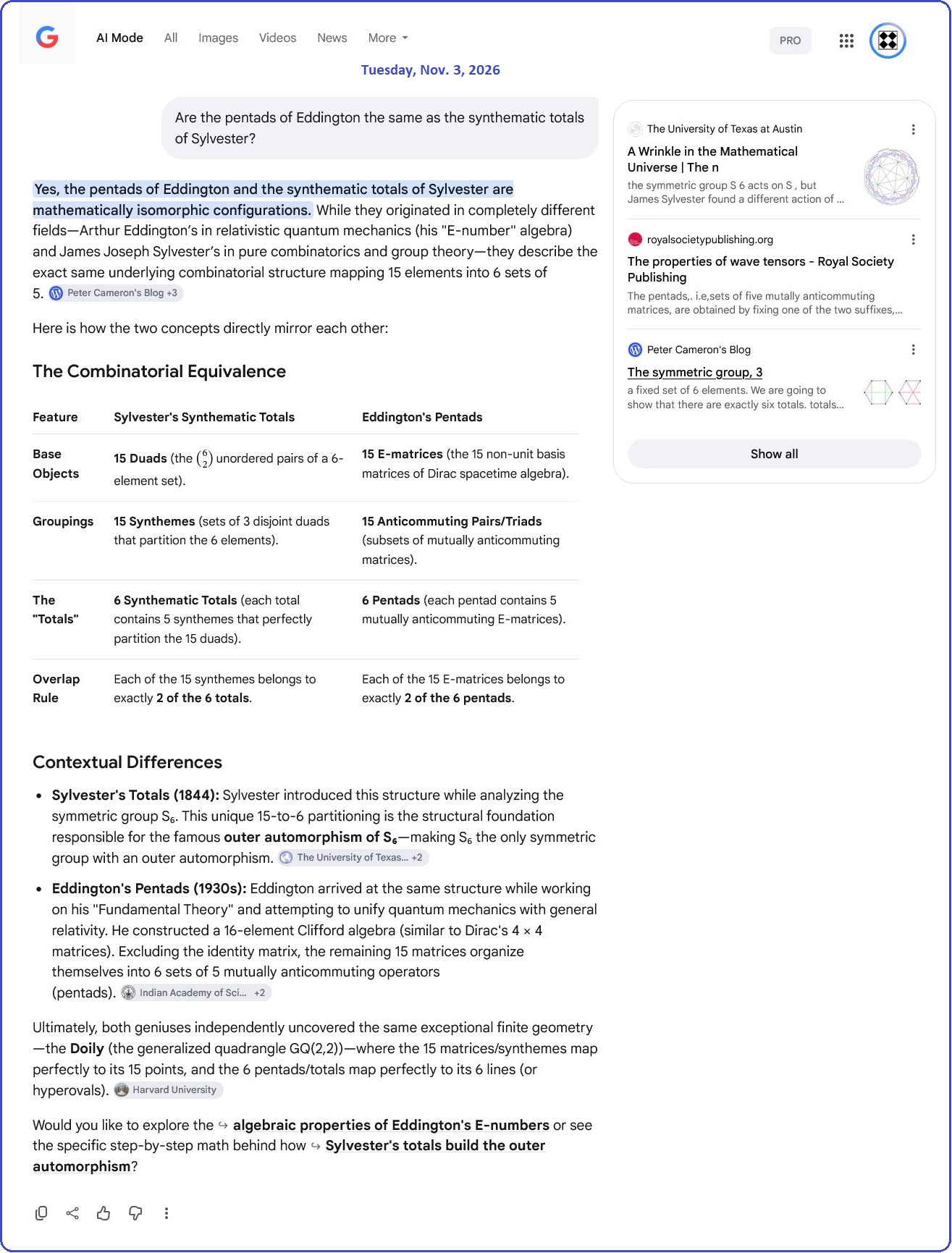
The view according to fields . . . via Google AI Overview —
A Song for Banana Beach
From the previous post, "Six-Set Variations" —
Related prose . . .
Related History of Science . . .
Banana Beach:

Banana Beach is on the island of Príncipe. Wikipedia —
"Príncipe was the site where Einstein's theory of relativity
was experimentally corroborated by Arthur Stanley Eddington
and his team during the total solar eclipse of May 29, 1919.
A Song for Banana Beach . . .

Monday, November 2, 2026
Six-Set Variations
Hudson, 1905:

Later:


|
Google Search AI Mode, November 2, 2026 . . .
Search prompt:
"Synthematic totals" and the Cremona-Richmond configuration
The relationship between synthematic totals and the Cremona–Richmond configuration lies in Sylvester's classical combinatorics of a 6-element set, which provides a geometric framework for understanding the outer automorphism of the symmetric group S₆. [1]
1. Defining the Combinatorial Objects
Starting with a basic set S of 6 elements (e.g., \(S = \{1, 2, 3, 4, 5, 6\}\)):
2. The Cremona–Richmond Configuration (15₃)
The Cremona–Richmond configuration is a geometric configuration consisting of 15 points and 15 lines, where 3 lines pass through every point and 3 points lie on every line. Crucially, it contains no triangles (three mutually intersecting lines). [1]
3. The Role of Synthematic Totals
Because there are exactly 6 synthematic totals, any permutation of the original 6-element set S acts on the 6 totals. This reveals an exceptional property of S₆: the outer automorphism. [1]
Geometrically, a synthematic total corresponds to a set of 5 mutually skew (completely non-intersecting) lines within the Cremona–Richmond configuration. These 5 lines collectively contain all 15 points of the configuration, forming a perfect matching or "spread" of lines. The 6 totals represent the 6 different ways to partition the configuration's lines into these parallel spreads. [1, 2]
If you would like to explore this configuration further, let me know if you want to look at:
How this system relates to the Tutte–Coxeter graph (the Levi graph of the configuration).
A explicit example of constructing a syntheme and a total using numbers 1–6.
How this geometry links to the bipartite double cover of the Petersen graph.
|
Sunday, November 1, 2026
Sigma Variations
"Consider as a single entity σ the seven sets of four pairs. . . ."
— Robert D. Carmichael in 1937 . . .
Vide 261101-Carmichael-1937-pp-440-441.jpg .
Later . . .
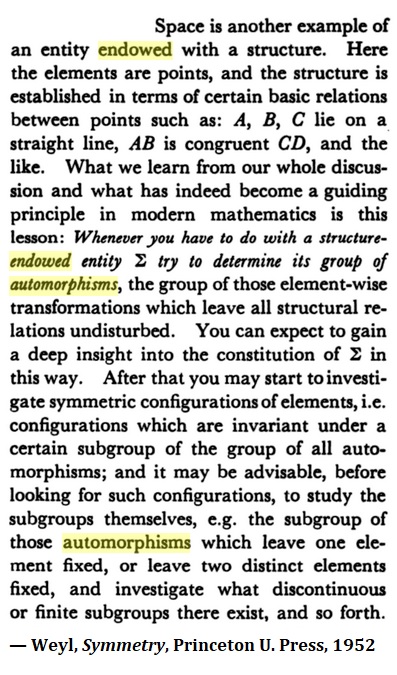
Veritas Revisited
"Among the crises that the arrival of A.I. has brought to mathematics,
'the most urgent one is, How are we going to train our graduate students?'
Tao said. It is a question that he has been asking for several years."
— Rivka Galchen in The New Yorker today
Training Google . . . and Jill Lepore . . .
|
Harvard's Jill Lepore on AI Do I use it? There are definitely times when I have used these tools. I would be silly to deny it. I actually really love NotebookLM. Have you ever used NotebookLM? Goldstein [interviewer]: I have not. Lepore: I had like 2,000 pages of an FBI file on someone. It was just a chaos of documents, and I knew I needed to sit and read it all. I mean, it’s 2,000 pages. It’s not gonna kill me, right? But I found it kind of baffling to find stuff in it. So I uploaded it all to NotebookLM, and I said, “I need a concordance. I need a chronological inventory. I need every document in these 2,000 pages accounted for chronologically, and then a one-line summary.” Just basically making me a concordance so that I could navigate my way through it.
[NotebookLM is now Gemini Notebook |
My own use of Gemini Notebook . . .
261101-Notebook.google.com-Diamond_Theory-wide-screenshot.jpg
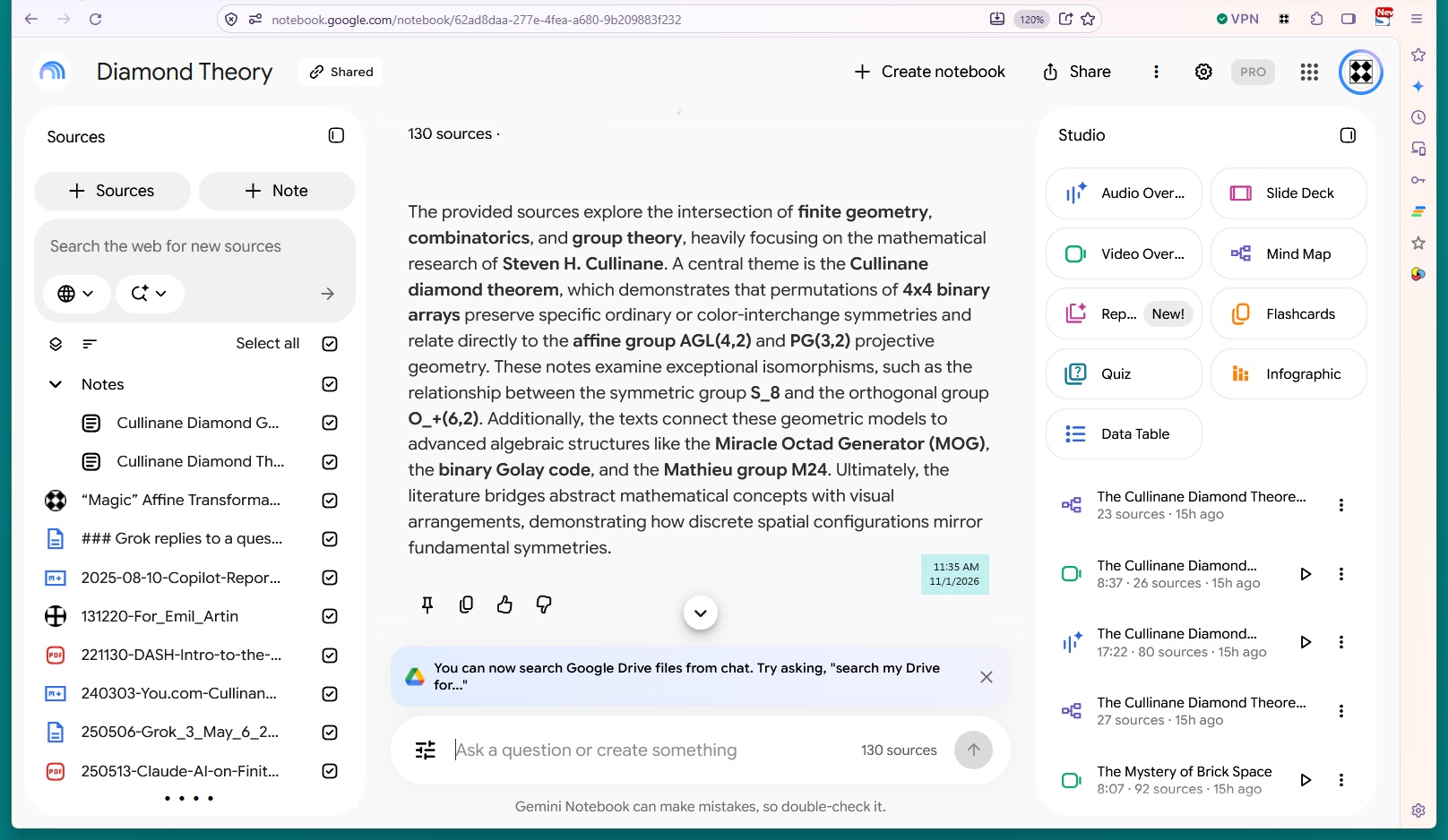
261101-AI_Overview-Google_notebook _diamond theory.jpg

“Human Understanding”
Terence Tao in a Sunday, November 1, 2026, New Yorker article by Rivka Galchen,
"The Year Math Changed Forever" —
| Human understanding needed to remain central. For example, with a proof written by a human, he noted, “you can talk to that person and say, ‘What was your experience? What was your inspiration?’ You have some insight into the process. They can give talks. And, years later, they’ll still be in the community, and they can pass on their expertise to their students. They contribute to the whole ecosystem of mathematics.” |
For Tao's community , from https://m759.net/wordpress/?s=Talman . . .
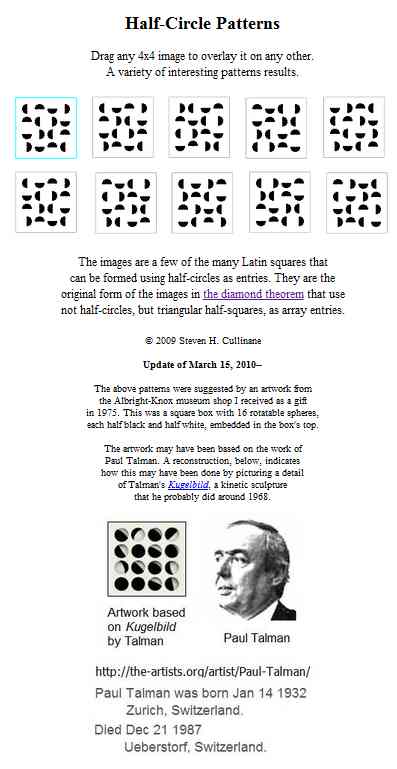
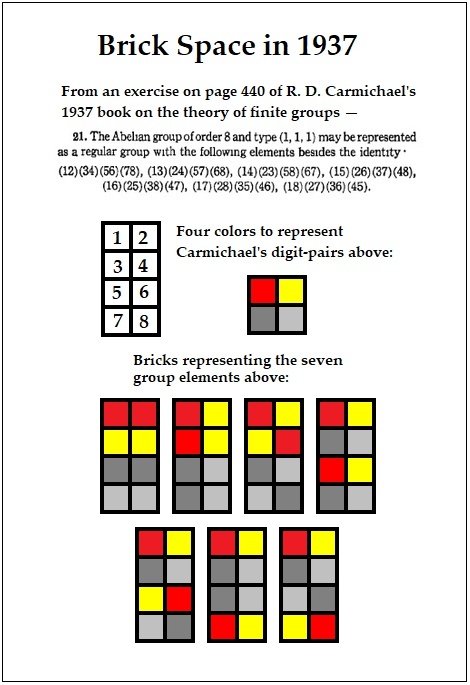
Brick Space 1937: The Entity
"Consider as a single entity σ the seven sets of four pairs. . . ."
261101-Carmichael-1937-pp-440-441.jpg
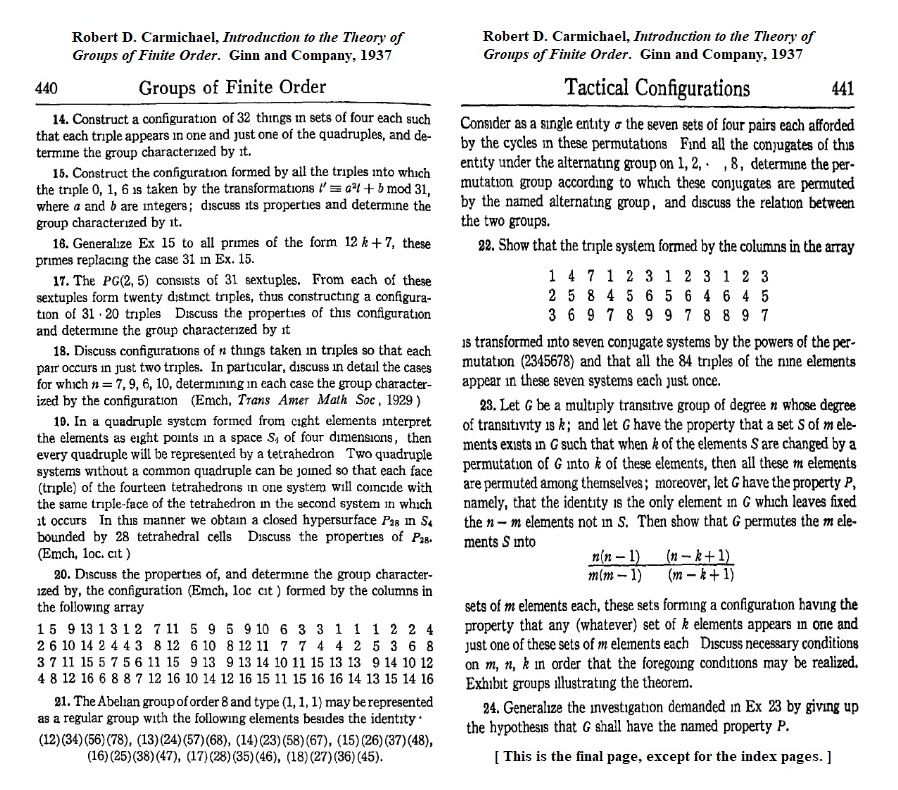
A companion to the webpage "Diamond Theory in 1937" —